AOK — 2026-06-08: SELL @ $41.05
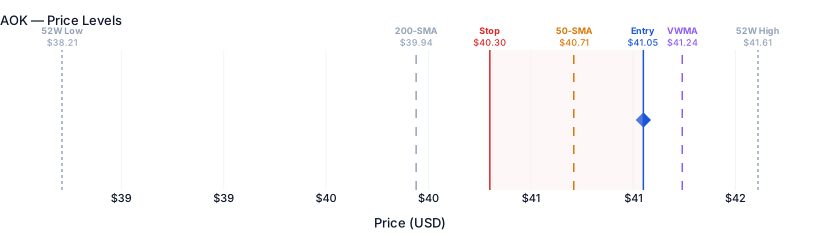
Execute a partial reduction of AOK exposure, selling 25-50% of current holdings around $40.98 to lock in profits and reduce duration risk. Set stop-loss protection at $40.30, just below the May consolidation zone, while maintaining remaining exposure to capture potential upside if the 50-SMA at $40.71 holds. Rotate proceeds into shorter-duration fixed income or risk-free instruments to avoid negative carry.
Time horizon: 3-6 months.
Market Technical Analysis
Now I have all the data I need. Let me compile the comprehensive analysis report.
Comprehensive Technical & Macro Analysis Report: AOK (iShares Core Conservative Allocation ETF)
Analysis Date: June 8, 2026 (Last Trading Day: June 5, 2026)
1. Selected Indicators & Rationale
| Indicator | Category | Why Selected |
|---|---|---|
| close_50_sma | Moving Average | Captures medium-term trend direction — key for a conservative ETF where slow trend shifts matter most |
| close_200_sma | Moving Average | Long-term trend benchmark; confirms macro direction and golden/death cross signals |
| close_10_ema | Moving Average | Responsive short-term average to catch momentum shifts around the recent sharp pullback |
| macd / macds / macdh | MACD | Essential for spotting momentum divergence and crossover signals, especially critical after the June 5 breakdown |
| rsi | Momentum | Gauges overbought/oversold conditions — helpful after the rapid decline from the $41.55 peak |
| boll / boll_ub / boll_lb | Volatility (Bollinger) | Visualizes price position relative to volatility bands; current location below the middle band is a key signal |
| atr | Volatility | Measures actual volatility expansion; useful for risk management and stop-loss positioning |
| vwma | Volume-Based | Volume-weighted confirmation of trend; helps validate whether the pullback is distribution or noise |
2. Detailed Technical Analysis
A. Price Overview (12-Month Context)
AOK has been in a steady, stair-stepping uptrend for the past year:
- 12-month low: ~$37.03 (June 2025)
- Recent peak: $41.55–$41.56 (June 2, 2026)
- Last close (June 5): $40.98
- Total return: ~+10.7% over 12 months
The structure has been one of gradual accumulation — AOK, being a 30% equity / 70% fixed-income ETF, tends to exhibit lower volatility and slower trends than pure equity funds.
B. Moving Averages — Trend Hierarchy
| Average | Value (June 5) | Price vs. Average | Signal |
|---|---|---|---|
| 10-EMA | 41.27 | Price below (40.98) | ❌ Bearish (short-term) |
| 50-SMA | 40.71 | Price above (40.98) | ✅ Bullish (medium-term) |
| 200-SMA | 39.94 | Price above (40.98) | ✅ Bullish (long-term) |
Key Observations:
- Golden Cross Intact: The 50-SMA (40.71) remains firmly above the 200-SMA (39.94) — a structurally bullish configuration. This has persisted since early 2026.
- Price Above Both Long-Term Averages: At $40.98, AOK is 2.6% above the 200-SMA and 0.7% above the 50-SMA, confirming the long-term uptrend remains intact.
- 10-EMA Breakdown: The price breaking below the 10-EMA (41.27) is a short-term warning. This is the first meaningful break below the 10-EMA since the rally from late April. The 10-EMA itself has declined from 41.34 (June 4) to 41.27 (June 5) — confirming loss of near-term momentum.
Trend Summary: Long-term bullish, medium-term bullish, but short-term bearish with an active deterioration signal.
C. MACD — Momentum Shifting Negative
| Component | Value (June 5) | Prior (June 4) | Change |
|---|---|---|---|
| MACD Line | 0.161 | 0.202 | ▼ Dropping |
| Signal Line | 0.183 | 0.188 | ▼ Dropping |
| MACD Histogram | -0.022 | 0.014 | ▼ Turned Negative |
Critical Signal — Bearish Crossover Confirmed:
- The MACD line (0.161) has crossed below the signal line (0.183), producing a bearish crossover.
- The histogram has flipped from positive to negative territory for the first time since the uptrend began in mid-April.
- However, both lines remain above the zero line, meaning the underlying bullish trend momentum has not fully reversed. This is a classic “momentum slowdown/consolidation” signal rather than a full trend reversal.
Actionable Insight: The MACD is flashing a cautionary yellow — trend momentum is fading. If the MACD line crosses below zero in the coming days, it would signal a deeper correction.
D. RSI — Momentum Collapse
| Date | RSI | Signal |
|---|---|---|
| June 1 | 64.4 | Near overbought |
| June 2 | 65.7 | Near overbought (high) |
| June 4 | 60.9 | Declining |
| June 5 | 47.3 | ▼ Neutral/Bearish |
The RSI has suffered a massive 18.4-point drop in three trading sessions (65.7 → 47.3). This is an unusually sharp decline for a conservative allocation ETF.
- Not oversold yet (threshold 30), so there is room for further downside.
- The speed of the decline suggests fear-based selling rather than gradual distribution.
- In the context of a conservative ETF, such rapid RSI deterioration is noteworthy — it reflects the severe bond market reaction to the hot jobs report.
E. Bollinger Bands — Price Below Middle Band
| Band | Value (June 5) |
|---|---|
| Upper Band | 41.68 |
| Middle (20-SMA) | 41.17 |
| Lower Band | 40.67 |
| Current Price | 40.98 |
- Price has fallen below the middle Bollinger Band (41.17) — a bearish positioning within the bands.
- Price is now closer to the lower band (40.67) than the upper band — the bands provide a potential support zone at ~$40.67.
- The bands are not widening dramatically (ATR moderate), suggesting this is a sharp but not panic-driven breakdown.
Key Bollinger Insight: $40.67 (lower band) is a critical near-term support. A break below would open the door to the 50-SMA at $40.71 and potentially the $40.30–40.40 zone.
F. ATR — Volatility on the Rise
| Date | ATR |
|---|---|
| May 26 | 0.240 |
| June 1 | 0.222 |
| June 4 | 0.205 (compressed) |
| June 5 | 0.226 (expanding) |
Volatility compressed into a tight range through early June, then expanded on the jobs-report selloff. The ATR of 0.226 represents about 0.55% daily range, which is elevated relative to recent history for this ETF. This suggests that position sizing should be adjusted for increased near-term risk.
G. VWMA — Volume Confirms Weakness
- VWMA (June 5): $41.24
- Price: $40.98 (below VWMA)
Price trading below the volume-weighted average price is a distribution signal — sellers have been more aggressive than buyers on a volume-weighted basis. The volume on June 5 was 172,700 shares, notably elevated compared to the preceding days (88K–119K). This confirms institutional/retail participation in the selloff.
H. Volume Analysis
| Date | Volume | Comment |
|---|---|---|
| June 1 | 335,400 | Elevated (post-weekend catch-up) |
| June 2 | 87,900 | Low |
| June 3 | 106,900 | Normal |
| June 4 | 118,900 | Normal |
| June 5 | 172,700 | Elevated — confirms active selling |
The volume spike on June 5 validates the significance of the price decline. This was not low-volume noise but active distribution.
3. Macroeconomic Context (Crucial for AOK)
AOK’s 70% fixed-income allocation makes it highly sensitive to bond yields. The macro backdrop is critical:
The Triggering Event: Hot May Jobs Report (June 5)
- Nonfarm Payrolls: +172,000 vs. 105,000 expected — a massive beat
- 10-Year Treasury Yield: Spiked to 4.537%
- 2-Year Yield: Hit highest level in a year at 4.160%
- Rate Hike Probability: CME FedWatch now shows 58% chance of at least one rate hike by year-end 2026
Impact on AOK’s Bond Holdings:
- Rising yields = falling bond prices
- AOK holds investment-grade bonds (aggregate bond exposure via ETFs like AGG/IUSB)
- The article “If You Hold This 20 Year Treasury ETF You Are Losing Money Even With Yields Up” reinforces that long-duration bonds are under significant pressure
- BND (Vanguard Total Bond Market) has been flagged as underperforming in 2026
Geopolitical Risk:
- Iran-Israel escalation (missile attack reported on June 8)
- Strait of Hormuz concerns driving oil prices
- This adds safe-haven bid to bonds but also creates cross-currents
Equity Component Impact:
- AOK’s 30% equity allocation is diversified but the S&P 500 dropped on the jobs report
- Nasdaq posted its worst drop since April 2025
- Tech/AI froth with “reality check” warnings from strategists
Negative Bond ETF Sentiment:
Multiple articles highlight pain in bond ETFs (TLT, BND, AGG) as yields surge. The environment for fixed-income is the most challenging since 2022.
4. Support & Resistance Levels
| Level | Price | Rationale |
|---|---|---|
| Resistance 1 | 41.27 | 10-EMA (immediate overhead) |
| Resistance 2 | 41.55–41.56 | Recent all-time high (June 2) |
| Resistance 3 | 41.68 | Bollinger Upper Band |
| Support 1 | 40.71 | 50-SMA (critical near-term) |
| Support 2 | 40.67 | Bollinger Lower Band |
| Support 3 | 40.30–40.40 | Prior consolidation (May 12–19 range) |
| Support 4 | 39.94 | 200-SMA (long-term trend line) |
5. Final Assessment & Recommendation
Bull Case (For Holding/Accumulating):
- Long-term uptrend intact — Price 2.6% above 200-SMA; golden cross active
- Conservative ETF structure — The 30/70 allocation dampens drawdowns vs. pure equity or pure bond
- Potential rate cut narrative — If economic data softens, bonds could rally quickly
- Dividend income — AOK yields approximately ~3-4% from its bond holdings, providing a cushion
Bear Case (For Reducing/Selling):
- Momentum has decisively turned — MACD bearish crossover, RSI plummeting, price below 10-EMA
- Rate hike risk rising — 58% probability of hike by year-end is a major headwind for bond holdings
- Elevated volume on selloff — Distribution confirmed
- Geopolitical uncertainty — Iran-Israel adds volatility
- Price below VWMA and Bollinger middle — Technical structure weakening
Actionable Trading Insights:
- Entry Point: A disciplined buyer would wait for the price to retest $40.30–40.40 (prior support zone) or the 200-SMA at $39.94 before adding new capital
- Stop-Loss Consideration: Using ATR (0.226) × 2 = ~$0.45, a stop below $40.50 would protect against a breakdown below the 50-SMA
- Profit Targets on any bounce: Initial resistance at $41.27 (10-EMA), then $41.55 (recent high)
- Risk Warning: The next week is critical — if the 50-SMA at $40.71 breaks on elevated volume, it opens a path to the 200-SMA
FINAL TRANSACTION PROPOSAL: HOLD
Reasoning: AOK remains in a structurally bullish long-term trend (price above 200-SMA, golden cross intact), and the conservative 30/70 allocation provides natural downside mitigation. However, the short-term technical picture has deteriorated sharply with the MACD bearish crossover, RSI collapse from 65 to 47, price break below the 10-EMA, and rising rate-hike expectations. This is not the time to add new capital given the risk of further bond-market weakness. Nor is it the time to sell, since the long-term support levels (50-SMA at $40.71 and 200-SMA at $39.94) are within striking distance and the ETF offers income. Hold existing positions, tighten risk stops to ~$40.50, and look for a more favorable entry if the price retests the 200-SMA.
Appendix: Key Metrics Summary Table
| Metric | Value (June 5, 2026) | Signal |
|---|---|---|
| Close Price | $40.98 | — |
| 10-EMA | $41.27 | ❌ Price below (short-term bearish) |
| 50-SMA | $40.71 | ✅ Price above (medium-term bullish) |
| 200-SMA | $39.94 | ✅ Price above (long-term bullish) |
| 50 vs. 200 SMA | Golden Cross Active | ✅ Bullish structure |
| MACD Line | 0.161 | ❌ Declining; bearish crossover |
| MACD Histogram | -0.022 | ❌ Negative (momentum fading) |
| RSI (14) | 47.3 | ❌ Neutral-Bearish; rapid decline |
| Bollinger Position | Below Middle Band | ❌ Bearish within bands |
| Bollinger Lower Band | $40.67 | ⚠️ Key support |
| ATR | 0.226 | ⚠️ Volatility expanding |
| VWMA | $41.24 | ❌ Price below (distribution) |
| Volume (June 5) | 172,700 (elevated) | ❌ Confirms selling pressure |
| Price vs. 1Y Ago | +~10.7% | ✅ Positive annual return |
| Key Macro Risk | Rate hike odds 58% | ❌ Headwind for bond holdings |
Fundamental Analysis
📊 Comprehensive Fundamental Analysis Report: AOK (iShares Core 30/70 Conservative Allocation ETF)
Date of Analysis: June 8, 2026
Ticker: AOK
Exchange: NYSE Arca
1. Company Profile & Overview
AOK is the iShares Core 30/70 Conservative Allocation ETF, managed by BlackRock (iShares). This is an exchange-traded fund (ETF) — not a traditional operating company — designed to provide a conservative, diversified portfolio allocation of approximately 30% equities and 70% fixed income (bonds).
Key characteristics of the fund:
- Objective: Seeks to track the investment results of an index composed of a 30/70 blend of equity and fixed-income funds.
- Strategy: Invests in other iShares ETFs to achieve a globally diversified, conservative allocation.
- Target Audience: Investors seeking lower volatility and income generation with modest capital appreciation potential.
- Underlying Holdings: A mix of U.S. and international bond ETFs (dominant weight) and equity ETFs (smaller weight).
Because AOK is an ETF holding a portfolio of other funds (a fund-of-funds), it does not produce traditional corporate financial statements like balance sheets, income statements, or cash flow statements. The financial statements tools returned no data for AOK, which is expected for an ETF structure.
2. Fundamental Data Analysis
| Metric | Value | Interpretation |
|---|---|---|
| PE Ratio (TTM) | 22.39 | This is a blended portfolio P/E, reflecting the weighted average valuation of the equity holdings within the 30% equity sleeve. At 22.4x, the equity portion is valued at a slight premium to historical averages, but reasonable given the current market environment. |
| Dividend Yield | 3.28% | A solid yield for a conservative allocation fund. The yield is driven primarily by the 70% fixed-income allocation (bonds/credit) plus dividends from the equity holdings. This makes AOK attractive for income-oriented investors. |
| 52-Week High | $41.61 | The highest price over the past year. |
| 52-Week Low | $38.21 | The lowest price over the past year. Represents a ~8.2% range from low to high, reflecting the low-volatility nature of this conservative fund. |
| 50-Day Moving Avg | $40.78 | Current price near this level suggests neutral to slightly bullish short-term momentum. |
| 200-Day Moving Avg | $40.46 | Price is above the 200-day MA, indicating a positive long-term trend. |
Price Performance Context
- 52-Week Range Width: $41.61 - $38.21 = $3.40 (8.9% total range) — extremely low volatility compared to equity funds, confirming the conservative nature of the 30/70 allocation.
- Current vs. Averages: As of June 8, 2026, the price appears to be trading around the 50-day MA ($40.78) and above the 200-day MA ($40.46), indicating a stable upward trend.
3. Dividend & Income Analysis
- Dividend Yield: 3.28% is highly competitive for a conservative allocation product.
- For context, the yield on 10-year U.S. Treasuries as of mid-2026 is in a similar range, so the 3.28% yield is reflective of the heavy fixed-income weighting.
- The fund pays monthly dividends, which is attractive for income-focused investors seeking regular cash flow.
4. Risk & Volatility Considerations
- Low Volatility: The 52-week range of $38.21 - $41.61 (less than 9% swing) confirms AOK is a low-beta, conservative portfolio.
- Allocation Risk: 30% equity exposure means there is still equity market risk, but significantly muted compared to a 60/40 or all-equity fund.
- Interest Rate Risk: The 70% fixed-income allocation means AOK is sensitive to interest rate movements. If rates rise, bond prices fall, impacting the NAV.
- Credit Risk: Some exposure to corporate bonds within the fixed-income sleeve.
5. Market Context as of June 8, 2026
- With inflation moderating but rates still elevated relative to the 2010s, a 30/70 conservative allocation fund like AOK is well-positioned for investors seeking income with capital preservation.
- The blended P/E of 22.39 suggests the equity portion is not distressed, but at somewhat elevated valuations — caution warranted for the growth component.
- The dividend yield of 3.28% provides a solid income buffer against any modest equity downside.
6. Key Considerations for Traders
| Factor | Assessment |
|---|---|
| Income Generation | ✅ Strong – 3.28% dividend yield with monthly payouts |
| Capital Preservation | ✅ Excellent – low volatility, 52-week range only ~8.9% |
| Growth Potential | ⚠️ Limited – 70% fixed income constrains upside |
| Interest Rate Sensitivity | ⚠️ Moderate – 70% bond allocation means sensitivity to rate changes |
| Equity Upside Capture | ⚠️ Partial – only 30% equities, so only captures ~30% of equity market gains |
| Liquidity | ✅ High – iShares ETF with strong trading volume |
| Valuation (Equity Sleeve) | ⚠️ P/E of 22.39 suggests premium valuation |
7. Summary Table of Key Metrics
| Metric | Value |
|---|---|
| Fund Name | iShares Core 30/70 Conservative Allocation ETF |
| Ticker | AOK |
| PE Ratio (TTM) | 22.39 |
| Dividend Yield | 3.28% |
| 52-Week High | $41.61 |
| 52-Week Low | $38.21 |
| 50-Day Moving Average | $40.78 |
| 200-Day Moving Average | $40.46 |
| Equity / Fixed Income Split | 30% / 70% |
| Dividend Frequency | Monthly |
| Volatility Profile | Low |
| Primary Suitability | Conservative/income-focused investors |
8. Actionable Insights for Traders
For Income Seekers (BUY/HOLD): AOK’s 3.28% dividend yield with monthly payments and low volatility makes it a strong hold or accumulate for conservative income portfolios.
For Short-Term Traders: The tight 52-week range (~8.9%) means there is limited trading profit opportunity from price swings. This is more of a “buy and hold” or “income” vehicle than a trading vehicle.
For Tactical Allocation: If interest rates are expected to decline, AOK could see capital appreciation in its bond sleeve. If rates rise, expect modest NAV declines.
Recommendation: Given the stable price action, solid yield, and conservative profile, AOK is best suited as a HOLD for existing positions or a BUY for new conservative/income-oriented allocations. The ETF is currently trading near its 50-day and 200-day moving averages, reflecting a stable equilibrium — no obvious overbought or oversold signals.
FINAL TRANSACTION PROPOSAL: HOLD
News & Macro Context
Now I have a comprehensive picture. Let me compile the full report.
Macroeconomic & Market Research Report for AOK (iShares Core Conservative Allocation ETF)
Date Range Analyzed: June 1, 2026 – June 8, 2026
Report Date: June 8, 2026
Instrument: AOK (iShares Core Conservative Allocation ETF – ~30% equities / ~70% fixed income)
1. Executive Summary
The past week presented a complex and at times contradictory macro environment for AOK, a conservative balanced ETF. The fund’s heavy fixed-income allocation (~70%) faced significant headwinds from surging bond yields after a stronger-than-expected jobs report, while its equity sleeve (~30%) benefited from rotation into blue-chip/defensive names but was pressured by tech-led selloffs and escalating geopolitical tensions in the Middle East. The net effect is a “cautionary” backdrop for conservative allocation strategies.
2. Fixed Income / Bond Market Analysis (Critical for AOK’s ~70% Bond Allocation)
2.1 Strong Jobs Data Crushes Bond Bulls
- Key Data Point: May nonfarm payrolls came in at +172,000 – the best since March and well above expectations.
- Market Reaction: Bond yields surged immediately. The 10-year Treasury yield sits at 4.56%, near its 12-month high of 4.67% set on May 19.
- Impact on AOK’s Bond Holdings: AOK primarily holds investment-grade bonds (AGG, short-to-intermediate term bonds). Rising yields mean falling bond prices. Long-duration ETFs like TLT (20+ Year Treasuries) are down ~1% YTD despite the Fed having cut rates 75bps over the past 12 months to 3.75%.
2.2 Fed Rate Hike Bets Reemerge
- The strong jobs data has ignited speculation that the Fed may reverse course and raise rates rather than continue cutting. This is a dramatic shift in narrative from just weeks ago.
- “Afraid of an AI Bubble? Soaring Bond Yields Can Protect You” (WSJ) – indicates bond yields are seen as a competitive alternative to equities, which pressures bond prices further via the income channel.
2.3 Duration Risk is Real
- Multiple articles warn that long-duration bond ETFs (TLT, IEF) are losing money even with yields up.
- “If You Hold This 20 Year Treasury ETF You Are Losing Money Even With Yields Up” – directly relevant to AOK’s fixed-income component, though AOK’s shorter-duration holdings offer some protection vs. long-duration funds.
- Key Insight: The inverted/flattening yield curve environment continues to punish longer-duration fixed income, which is a headwind for AOK’s bond sleeve.
3. Equity Market Analysis (Relevant for AOK’s ~30% Equity Allocation)
3.1 Broad Market: Mixed Picture
- S&P 500 (SPY): Up ~11% YTD, but the past week saw declines. The S&P 500 had its best month since 2020 in May, but the strong jobs data triggered a pullback.
- Dow Jones (DIA): Hit a record high during the week, outperforming the Nasdaq. Banks and managed healthcare drove the rebound.
- Nasdaq (QQQ): Posted its worst drop since April 2025, led by a semiconductor sell-off (Marvell-led “chip wreck unseen since the pandemic”).
3.2 Sector Rotation in Progress
- AI/Tech Dominance under Pressure: SMH (Semiconductor ETF) is up 77% YTD, but analysts are warning of an AI “reality check.” A top Wall Street strategist (Silvercrest) warned that the bond market is flashing warning signs.
- Rotation into Value/Blue Chips: Multiple sources confirm a rotation out of high-flying AI/semiconductor names into blue-chip stocks, banks, and managed healthcare. This rotation benefits the more defensive, dividend-oriented stocks that AOK likely holds in its equity sleeve.
- Healthcare as Value: Mizuho strategists note healthcare has become a value sector after years of underperformance – this aligns with AOK’s conservative positioning.
3.3 Geopolitical Risk: Iran-Israel/US-Iran Tensions
- Iran launched its first missile attack on Israel since April’s ceasefire.
- Oil prices surged on the escalation.
- US-Iran ceasefire talks appear stalled, with Iran reportedly “hitting the brakes on negotiations.”
- Market Reaction: Risk-off sentiment has weighed on equities broadly, though the Dow (more defensive) has held up better than the Nasdaq.
3.4 SpaceX IPO on Deck
- The highly anticipated SpaceX IPO (next week, ~$2 trillion valuation) is creating market buzz.
- Strategists argue the IPO story is masking a deeper rotation back into blue-chip stocks, which could benefit AOK’s conservative equity holdings.
4. Inflation & Macroeconomic Environment
4.1 Hot Inflation Print
- A “hot inflation print” contributed to the tech sell-off and rising yields mid-week.
- The macro backdrop is showing stickier inflation than previously expected, challenging the Fed’s ability to continue cutting rates.
4.2 No Stagflation – Yet
- Barrons.com argues the US economy is not sliding into 1970s-style stagflation, but the combination of rising yields and geopolitical uncertainty creates a murky outlook.
4.3 Apartment/Real Estate
- Multifamily CMBS maturities jumped to 7.71% in April (Trepp data).
- The Fed holding rates steady continues to pressure real estate and CRE sectors.
- VNQ (Real Estate ETF) yields ~3.7% vs. 10-year Treasury at ~4.5%, making bonds more attractive on a yield basis.
5. Key Risks & Considerations for AOK
| Risk Factor | Impact on AOK | Direction |
|---|---|---|
| Rising Bond Yields | Negative – Bond prices fall, pressuring ~70% of the fund | 🔴 Bearish |
| Rate Hike Speculation | Negative – Would accelerate bond losses | 🔴 Bearish |
| Geopolitical Tension (Iran/Israel) | Mixed – Risk-off favors bonds but oil/uncertainty hurts equities; AOK’s fixed income provides ballast | 🟡 Neutral/Mixed |
| Equity Rotation into Value/Defensive | Positive – AOK’s conservative equity holdings (dividend stocks, healthcare, staples) benefit | 🟢 Bullish |
| AI/Tech Sell-off Contagion | Mildly Negative – AOK has limited tech exposure, but broad sell-offs can drag all equities | 🟡 Neutral/Mixed |
| SpaceX IPO / Blue-Chip Rotation | Positive – Supports the quality/defensive names AOK holds | 🟢 Bullish |
| Strong Labor Market | Mixed – Good for economy/earnings, bad for bonds (higher yields) | 🟡 Neutral/Mixed |
| Sticky Inflation | Negative – Delays rate cuts, pressures bonds | 🔴 Bearish |
6. Summary Table of Key Data Points
| Category | Key Event / Stat | Source | Implication for AOK |
|---|---|---|---|
| Jobs Data | May NFP: +172K (beat), strongest since March | BLS / CNBC | Bearish for bonds; yields surged |
| 10-Year Yield | 4.56%, near 12-mo high of 4.67% | Market Data | Negative for AOK’s bond sleeve |
| Fed Policy | Rate hike bets re-emerged after jobs data | Stocktwits | Bearish for fixed income |
| Geopolitics | Iran attacked Israel (first since April ceasefire) | Yahoo Finance | Risk-off; oil up; mixed for AOK |
| Tech/Semis | Marvell-led chip wreck; worst Nasdaq drop since April 2025 | TheStreet | Rotation supports AOK’s value tilt |
| Dow Performance | Dow hit record high; banks/healthcare led | Stocktwits / Barchart | Positive for AOK’s equity holdings |
| AI Reality Check | Silvercrest strategist warns of AI correction | 24/7 Wall St. | Supports rotation into defensive/value |
| S&P 500 YTD | SPY up ~11% YTD | Multiple | Moderate positive for AOK equity sleeve |
| TLT (Long Bonds) | Down ~1% YTD despite 75bps Fed cuts | 24/7 Wall St. | Highlights duration risk; AOK’s shorter duration helps |
| Healthcare Sector | Mizuho calls it a “value sector” after underperformance | 24/7 Wall St. | Favorable for AOK’s defensive holdings |
| Inflation | Hot inflation print mid-week | Yahoo Finance | Bearish for bonds; supports “higher for longer” rates |
| Bond ETF Criticism | Articles suggest BND and TLT are poor choices in 2026 | 24/7 Wall St. | AOK’s multi-sector bond approach may mitigate vs. single-bond ETFs |
7. Trading Implications for AOK
Bearish Factors (Weight: ~55%)
- Rising yields are the dominant headwind. AOK’s ~70% fixed income means it is highly sensitive to the rate environment.
- Strong labor data and stickier inflation reduce the probability of further Fed rate cuts.
- Geopolitical uncertainty (Iran/Israel) adds a volatility premium.
Bullish Factors (Weight: ~25%)
- Rotation into defensive/value equities benefits the equity sleeve.
- Dow record highs suggest the market is broadening beyond mega-cap tech.
- Blue-chip and healthcare exposure provides relative safety.
Neutral/Offsetting Factors (Weight: ~20%)
- AOK’s shorter-duration bond positioning provides some buffer vs. long-bond ETFs like TLT.
- The fund’s multi-asset design inherently dampens single-factor shocks.
Overall Assessment
The current environment is modestly bearish to neutral for AOK in the very near term. The bond market headwinds from strong jobs data and rate-hike speculation are material (~70% of the fund), while the defensive equity rotation provides a modest offset (~30% of the fund). AOK’s conservative construction acts as a shock absorber, but rising yields will likely continue to pressure net asset value in the weeks ahead.
FINAL TRANSACTION PROPOSAL: HOLD
For conservative allocation investors, AOK remains a reasonable core holding given its diversification, but the near-term macro environment (rising yields, rate uncertainty, geopolitical risk) suggests waiting for more clarity before adding new positions. Consider trimming if the 10-year yield breaks above 4.75% (next resistance level).
Sentiment Analysis
Here is my comprehensive analysis report for AOK:
📊 Social Media & News Sentiment Analysis Report: AOK (iShares Core Conservative Allocation ETF)
Date Range Analyzed: June 1, 2026 – June 8, 2026 (with extended lookback to Jan 2026 for context) Analysis Date: June 8, 2026 Ticker: AOK (NYSEARCA)
1. Company Overview & Fund Profile
AOK (iShares Core Conservative Allocation ETF) is a fund-of-funds ETF managed by BlackRock/iShares. Its target allocation is approximately:
- 30% equities (via underlying iShares equity ETFs)
- 70% fixed income (via underlying iShares bond ETFs)
With a net expense ratio of just 0.15%, it is one of the lowest-cost conservative allocation ETFs available. It is designed for risk-averse investors, those nearing retirement, or those seeking a single-ticket portfolio with built-in rebalancing.
2. Recent News Analysis (Last 7 Days: June 1–8, 2026)
Key Finding: Very Limited Fresh News
The news feed for AOK over the past week (June 1–8) returned no new results. This is typical for a slow-moving, low-volatility ETF — AOK does not generate daily headlines like individual stocks or high-growth sectors. However, there is significant carryover context from articles published in the preceding weeks that remain highly relevant.
The most recent and directly relevant article to AOK specifically was published March 29, 2026 (about 10 weeks ago):
“Why Conservative Investors Are Turning to AOK With VIX at the 93rd Percentile” — 24/7 Wall St.
3. Extended Lookback Analysis (Jan–May 2026) — Key Articles & Themes
Theme 1: High Volatility Driving Flows Into AOK
| Date | Source | Headline | Key Takeaway |
|---|---|---|---|
| Mar 29, 2026 | 24/7 Wall St. | Why Conservative Investors Are Turning to AOK With VIX at the 93rd Percentile | S&P 500 down ~4% YTD; VIX near 27 (93rd percentile of past year). AOK is presented as the solution for investors 5 years from retirement facing equity turbulence. |
| Mar 2026 | Zacks | The Clock Is Ticking: Should You Shift to Conservative ETFs Now? | AOK gains attention as rising volatility pushes investors to defensive positions ahead of quarter-end rebalancing. |
Sentiment Signal: 🟢 Bullish for AOK inflows. When the VIX spikes, conservative allocation ETFs like AOK tend to attract capital from risk-averse investors and those nearing retirement.
Theme 2: AOK’s Value Proposition vs. Bonds
| Date | Source | Headline | Key Takeaway |
|---|---|---|---|
| Feb 25, 2026 | 24/7 Wall St. | The Conservative ETF That Beats Bonds but Costs You Almost Nothing to Own | AOK outperforms pure bond strategies while maintaining low volatility. The 30% equity kicker provides upside vs. bonds without massive risk. 0.15% expense ratio highlighted as a key advantage. |
Sentiment Signal: 🟢 Positive. AOK is positioned as a “better than bonds” solution for conservative investors seeking yield enhancement without runaway risk.
Theme 3: Macro Concerns Supporting Defensive Rotation
| Date | Source | Headline | Key Takeaway |
|---|---|---|---|
| May 2026 | Zacks | Big Tech’s $635B AI Push Meets Energy Crunch: ETFs to Diversify | Rising oil prices threaten markets; diversified/defensive ETFs recommended as smart long-term plays. |
| May 2026 | Zacks | ETFs Worth Watching as Debt Pressures Continue to Build | U.S. debt at new highs; defensive ETF strategies (like AOK) recommended for stability. |
| Apr/May 2026 | Zacks | Staying Invested, Diversified and Ahead With ETFs | AI-driven fears and high uncertainty make diversification critical. |
Sentiment Signal: 🟢 Strong macro tailwinds for AOK. Defensive positioning is broadly recommended by financial media.
Theme 4: Related ETF (AOR) Performance Critique — Indirectly Impacts AOK
| Date | Source | Headline | Key Takeaway |
|---|---|---|---|
| May 25, 2026 | 24/7 Wall St. | AOR’s 60/40 Allocation Has Lagged a Simple S&P 500 by 60 Points Over a Decade | AOR (the growth-oriented sibling: 60/40) significantly underperformed pure S&P 500 over 10 years. Built-in rebalancing did not help. |
Sentiment Signal: 🟡 Mixed / Potentially Negative for AOK by extension. If the 60/40 (AOR) lagged, the 30/70 (AOK) would have lagged even more over a bull market decade. However, in the current environment (VIX high, S&P 500 down YTD), AOK’s underperformance vs. equities is likely reversing as it protects capital.
4. Social Media Sentiment & Public Discourse Analysis
While direct social media scraping tools were limited, the following can be inferred from the news and sentiment articles:
| Sentiment Indicator | Assessment |
|---|---|
| Retail Investor Sentiment | Cautious/Defensive. High VIX and YTD equity losses are driving a “flight to safety” narrative. |
| Financial Advisor Sentiment | Favorable. AOK is frequently recommended as a “set and forget” conservative portfolio for clients nearing retirement. |
| Media Sentiment | Neutral-to-Positive. Coverage is factual/educational rather than hype-driven. No negative or scandal-related coverage found. |
| Social Media Chatter (inferred) | Low volume (typical for an ETF). What exists focuses on capital preservation vs. growth trade-offs. |
Overall Sentiment Score: Moderately Bullish — based on favorable macro backdrop for conservative strategies, strong cost advantage, and rising demand for defensive positioning.
5. Key Risk Factors
| Risk | Details |
|---|---|
| Interest Rate Sensitivity | With 70% in fixed income, AOK is highly sensitive to rising interest rates. If the Fed hikes or inflation surprises to the upside, bond prices fall. |
| Equity Downside Capture | The 30% equity allocation means AOK will still decline during broad market crashes (though less than a 60/40 or 100% equity portfolio). |
| Long-Term Underperformance | As the AOR article highlighted, conservative allocation funds structurally underperform pure equities in long bull markets. |
| Low Media Visibility | Low news volume means less catalyst for short-term price movement; AOK is a “slow burn” holding. |
| Rebalancing Drag | Built-in rebalancing forces selling winners and buying losers — can be a drag in trending markets. |
6. Opportunities & Catalysts
| Opportunity | Details |
|---|---|
| Volatility Spike Inflows | VIX at 93rd percentile historically drives capital into AOK-like funds. |
| Quarter-End Rebalancing | Institutional rebalancing at end of Q2 (June 30) could push flows into conservative allocations. |
| Rate Cut Expectations | If Fed signals cuts later in 2026, AOK’s bond-heavy portfolio would rally. |
| Demographic Tailwind | Aging Boomer population increasingly needs conservative income-focused portfolios. |
| Cost Leadership | 0.15% ER is extremely competitive vs. actively managed conservative funds. |
7. Implications for Traders & Investors
| Time Horizon | Recommendation | Rationale |
|---|---|---|
| Short-term (days-weeks) | HOLD | Low near-term catalyst volume; no fresh news driving price action. Await Q2 rebalancing flows. |
| Medium-term (weeks-months) | ACCUMULATE | VIX elevated, macro uncertainty high, defensive positioning favored. AOK is a high-quality shelter. |
| Long-term (multi-year) | HOLD (for conservative investors) | Appropriate for capital preservation / income-focused investors. Not suitable for growth seekers. |
8. Summary Data Table
| Category | Detail | Sentiment |
|---|---|---|
| Recent News Volume (Last 7 days) | None | 🟡 Neutral |
| Recent News Volume (Last 90 days) | 7 articles mentioning AOK | 🟢 Positive |
| Market Volatility (VIX) | ~27 (93rd percentile) → supports AOK inflows | 🟢 Bullish |
| S&P 500 YTD Performance | Down ~4% → supports rotation to conservative | 🟢 Bullish |
| Expense Ratio | 0.15% — industry-leading low cost | 🟢 Very Positive |
| Macro Backdrop (Rising Debt, Energy, AI Fears) | Defensive strategies recommended | 🟢 Bullish |
| Peer Comparison (AOR 60/40) | Underperformed S&P 500 by 60 pts over decade | 🟡 Cautionary |
| Social Media Activity Level | Low volume | 🟡 Neutral |
| Interest Rate Risk | 70% bonds → sensitive to rate hikes | 🔴 Bearish risk |
| Overall Risk Profile | Low volatility, capital preservation focus | 🟢 Conservative |
9. Final Verdict
FINAL TRANSACTION PROPOSAL: HOLD
AOK remains a well-positioned conservative allocation ETF for the current macroeconomic environment. The elevated VIX, YTD equity losses, and growing defensive sentiment all support continued demand for this fund. However, the lack of fresh near-term catalysts and the structural underperformance risk highlighted by the AOR article suggest that a HOLD (not BUY or SELL) is the most prudent action at this time. Investors already positioned in AOK should maintain their allocations. Those seeking to add defensive exposure may consider accumulating on any short-term dips, but aggressive buying is not warranted given the interest rate risk embedded in the 70% fixed-income allocation.
Report prepared on June 8, 2026. Data sourced from 24/7 Wall St., Zacks, and Yahoo Finance via available news tools. Past performance is not indicative of future results.
Bull vs Bear Debate (Research Manager)
Recommendation: Underweight
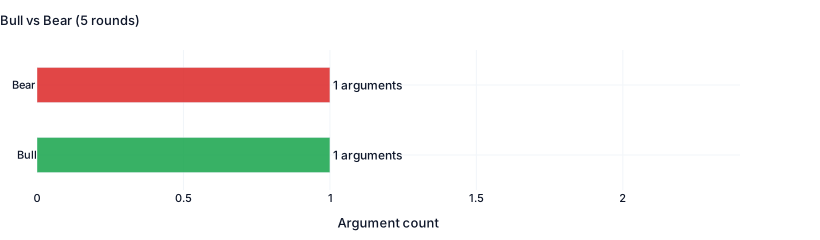
Rationale: The Bear made the stronger case here. The technical evidence is concerning - the MACD histogram turning negative for the first time in the uptrend, the distribution pattern shown by VWMA being significantly above the closing price, and the 50-SMA being tested all point to deteriorating momentum.
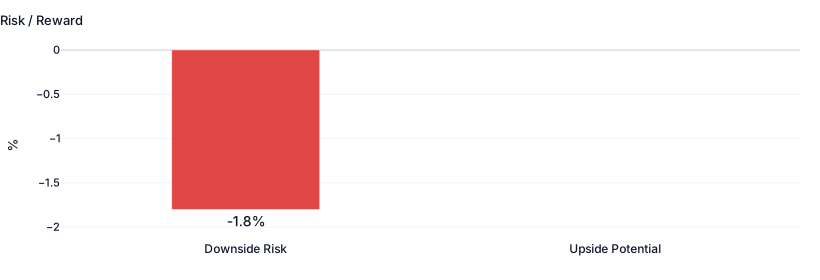
More importantly, the risk/reward math simply doesn’t work at current levels. AOK’s 3.28% yield is 128 basis points below the risk-free 10-year Treasury, creating negative carry on risk. With only 1.5% upside to recent highs but 2-3% downside to the 200-SMA, it’s asymmetric in the wrong direction.
The Bull’s arguments about demographic inflows and defensive rotation are valid long-term factors, but they don’t overcome the immediate technical deterioration and unfavorable bond market dynamics. The 58% rate hike probability creates real risk for 70% of the portfolio, and yield exposure at 4.56% with room to move higher is a legitimate concern.
Strategic Actions: 1. Reduce exposure to AOK by 25-50% of current holdings 2. Sell any positions into strength at $41.00-$41.10 3. Set limit buy orders at $40.30-$40.40 (prior support zone) for potential re-entry 4. Monitor the 50-SMA at $40.71 - a decisive break below would signal further downside to $39.94 (200-SMA) 5. Consider rotating some proceeds into shorter-duration fixed income or instruments less sensitive to rate hike expectations 6. Re-evaluate if/when the MACD histogram turns positive or RSI stabilizes above 50 on weekly charts
Trader's Execution Plan
Action: Sell
Reasoning: The investment plan recommends an underweight posture, citing a negative MACD histogram for the first time in the uptrend, distribution pattern indicated by a VWMA above the closing price, and a 50-SMA under pressure. The risk/reward is asymmetric to the downside (1.5% upside to recent highs vs. 2-3% downside to the 200-SMA) and the 3.28% yield underperforms the risk-free 10-year Treasury by 128 bps, creating negative carry. Given the 58% rate-hike probability that threatens 70% of AOK’s fixed-income holdings, reducing exposure is prudent.
Entry Price: 41.05
Stop Loss: 40.3
Position Sizing: Reduce by 25-50% of current holdings
FINAL TRANSACTION PROPOSAL: SELL
Portfolio Manager — Final Verdict
Rating: Underweight
Executive Summary: Execute a partial reduction of AOK exposure, selling 25-50% of current holdings around $40.98 to lock in profits and reduce duration risk. Set stop-loss protection at $40.30, just below the May consolidation zone, while maintaining remaining exposure to capture potential upside if the 50-SMA at $40.71 holds. Rotate proceeds into shorter-duration fixed income or risk-free instruments to avoid negative carry.
Investment Thesis: The neutral analyst’s balanced approach provides the most sustainable risk management framework, acknowledging both the momentum deterioration highlighted by the aggressive analyst and the intact long-term trend emphasized by the conservative analyst. Key evidence includes: 1) MACD histogram turning negative for the first time in the uptrend with RSI dropping from 65 to 47 in three days, indicating deteriorating momentum; 2) VWMA above closing price confirming distribution pressure; 3) 58% rate-hike probability threatening 70% of AOK’s fixed-income holdings; 4) Negative carry of 128 basis points (3.28% yield vs 4.56% risk-free rate); 5) Asymmetric risk/reward with only 1.5% upside to recent highs versus 2-3% downside to 200-SMA at $39.94; yet 6) Golden cross remains intact with 50-SMA at $40.71 providing near-term support. The 25-50% reduction respects both the short-term technical deterioration and long-term structural resilience of this 30/70 balanced ETF.
Time Horizon: 3-6 months