IVV — 2026-06-08: HOLD
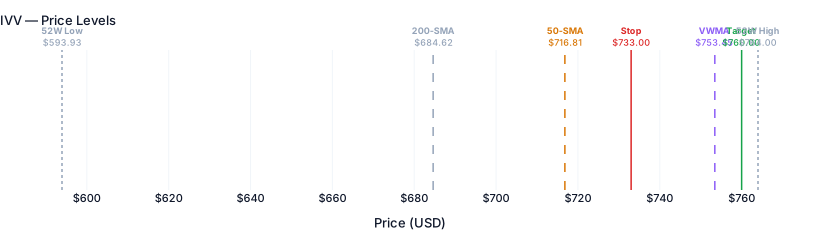
Maintain current position in IVV with a stop-loss at $733 (Bollinger lower band). Hold through the SpaceX IPO catalyst on June 12th, then consider adding a small tactical position above $750 only on volume confirmation. If price breaks below $733, trim 25% and wait for a test of the 50 SMA at $716. Time horizon: 1-2 weeks for catalyst resolution.
Time horizon: 1-2 weeks.
Market Technical Analysis
Now I have all the data needed. Let me compile a thorough analysis.
IVV (iShares Core S&P 500 ETF) — Comprehensive Technical Analysis
Current Date: June 8, 2026 (Last Trading Day: June 5, 2026) | Closing Price: $740.91
Selected Indicators & Rationale
I selected 8 complementary indicators spanning all major categories:
- close_200_sma (Long-term trend) — The ultimate bull/bear arbiter; confirms structural trend
- close_50_sma (Medium-term trend) — Bridges short-term noise with long-term direction
- close_10_ema (Short-term momentum) — Fastest moving average for early reversal detection
- macd (Momentum crossover) — Captures shifting momentum via EMA differences
- rsi (Overbought/oversold) — Flags extreme readings and momentum exhaustion
- boll_ub / boll / boll_lb (Volatility bands) — Visualize price position within volatility structure
- atr (Volatility magnitude) — Quantifies volatility for risk sizing and stop placement
- vwma (Volume-weighted average) — Volume confirmation of price trends
These avoid redundancy while covering trend, momentum, volatility, and volume dimensions.
Detailed Trend Analysis
1. Long-Term Trend (200 SMA) — Bullish
The 200 SMA has marched steadily higher from 596.37 (Oct 1, 2025) to 684.62 (Jun 5, 2026), a gain of +14.8%. This reflects a sustained structural uptrend. The current price ($740.91) trades +8.2% above the 200 SMA, confirming the bull market remains intact. The slope is positively steep and accelerating — the 200 SMA rose ~$2.30/day in the most recent month.
Key observation: The 200 SMA has never been breached since data begins. Every dip in March 2026 ($635 low) still held well above the rising 200 SMA ($657 at that time). This is the most powerful bullish evidence.
2. Medium-Term Trend (50 SMA) — Bullish but Decelerating
The 50 SMA stands at $716.81 and is rising, but its slope has flattened notably in the last week. Price is +3.4% above the 50 SMA — healthy but not exuberant. The 50 SMA rallied from ~$644 (Oct) to $717 (Jun), a +11.3% increase.
Critical structural observation: The 50 SMA ($716.81) remains well above the 200 SMA ($684.62) by a wide margin of ~$32 (4.7%). This “Golden Cross” configuration has been in place for months and is the hallmark of a mature bull market. However, the gap between them is starting to narrow from its widest point (~$40 in late May), which bears watching as a potential early warning.
3. Short-Term Trend (10 EMA) — Bearish
The 10 EMA at $753.33 is now above the current price ($740.91) — a short-term bearish signal. The 10 EMA rose to a peak near ~$757 on June 3-4 and has started to roll over. The price breached below the 10 EMA on June 5 on heavy volume, which is a clear warning that short-term momentum has shifted.
Stacking order (as of Jun 5):
- Price ($740.91) < 10 EMA ($753.33) < Boll Middle ($749.74) — Price below both short-term benchmarks
- But 10 EMA > 50 SMA > 200 SMA — Still in bullish alignment
This creates a tension: short-term bearish within a structurally bullish framework.
4. MACD Momentum — Weakening Bullish
| Date | MACD Value | Signal |
|---|---|---|
| May 14 | 15.59 | Bullish peak |
| May 28 | 12.70 | Declining |
| Jun 2 | 12.95 | Brief bounce |
| Jun 5 | 10.05 | Sharply declining |
The MACD remains positive (above zero since late November 2025), which is bullish. However, the histogram is contracting rapidly from its mid-May peak. The MACD line has declined by over 35% from its peak in just three weeks. If this continues, a bearish MACD crossover (MACD line crossing below signal line) could occur within 1-2 weeks.
Divergence alert: The price made a new all-time high (~$763 on Jun 1-2) but the MACD peaked weeks earlier in mid-May. This bearish divergence between price and momentum is a classic warning sign of trend exhaustion.
5. RSI — Neutral with Bearish Flag
| Date | RSI | Condition |
|---|---|---|
| May 14 | 78.5 | Overbought |
| Jun 2 | 75.8 | Overbought |
| Jun 4 | 69.7 | Approaching overbought |
| Jun 5 | 49.4 | Neutral / Sharp drop |
RSI collapsed from 75.8 (Jun 2) to 49.4 (Jun 5) — a 26-point drop in 3 trading days. This is an extraordinarily rapid decline that signals aggressive selling pressure. The RSI is now exactly at the 50 midline, which represents a decisional crossroads:
- If RSI holds above 50, the pullback may be a healthy correction within an uptrend
- If RSI falls below 50 and stays there, it would confirm a bearish shift in short-term momentum
The March 2026 correction saw RSI hit 27.8 (oversold) before the V-bottom recovery. The current reading is nowhere near that level, suggesting we may have further room to fall before reaching a capitulation bottom.
6. Bollinger Bands — Bearish Positioning
| Band | Value (Jun 5) | Interpretation |
|---|---|---|
| Upper | $766.42 | Price peaked near here Jun 1-2 |
| Middle (20 SMA) | $749.74 | Key pivot - price is below it |
| Lower | $733.06 | Key support zone |
| Close | $740.91 | Below middle, approaching lower |
Price has fallen from the upper band (Jun 1-2) straight through the middle band (breached on Jun 5) and is now heading toward the lower band. This is a band walk from top to bottom which typically signals intensifying bearish pressure.
Band width is expanding slightly, suggesting volatility is beginning to increase to the downside. The lower band at $733.06 is the immediate major support; a breach below it would open the door to the 50 SMA at $716.81.
7. ATR (Volatility) — Contracting but Risky
Current ATR: $7.63 (down from peak of $10.62 in early April).
The declining ATR indicates volatility has been compressing during the recent up-move. While low volatility is comfortable, it often precedes volatility expansion. Given the price action on Jun 5 (largest one-day drop in recent weeks on heavy volume of 9.66M vs. 4-5M average), volatility may be about to expand sharply to the downside.
Risk management implication: A 1 ATR move from current price would target ~$733 (lower band area). A 2 ATR move would target ~$725 — nearing the 50 SMA.
8. VWMA (Volume-Weighted) — Bearish Divergence
VWMA at $753.45 on Jun 5. The close ($740.91) is below VWMA by $12.54, a significant gap.
More importantly, the Jun 5 selloff occurred on 9.66 million shares — nearly double the average volume of recent sessions (~4-5M). This is a classic distribution day: high volume selling after an extended rally. The gap between price and VWMA is widening, indicating that sellers are in control and that the average price paid by recent buyers is now above the current price (unrealized losses for recent participants).
Price Action Summary (One-Year Journey)
| Phase | Period | Price Range | Character |
|---|---|---|---|
| Steady Uptrend | Jun-Nov 2025 | $595 → $683 | +14.8% grind higher |
| Pullback/Correction | Nov 2025 | $683 → $652 | -4.5% shakeout |
| Recovery/New Highs | Dec 2025-Feb 2026 | $652 → $697 | +6.9% |
| March 2026 Correction | Mar 2026 | $697 → $635 | -8.9% sharp selloff |
| V-Bottom Recovery | Late Mar-May 2026 | $635 → $763 | +20.2% explosive rally |
| Current Pullback | Jun 1-5, 2026 | $763 → $741 | -2.9% with heavy volume |
The March correction created a lower low (~$635) vs. the late-2025 low (~$652), which on the surface is concerning. However, the subsequent rally to new all-time highs ($763) negated that bearish structure and reaffirmed the primary uptrend.
Key Support & Resistance Levels
| Level | Price | Significance |
|---|---|---|
| R1 | $766.42 | Bollinger Upper Band (Jun 2 ATH area) |
| R2 | $753.45 | VWMA resistance |
| R3 | $749.74 | Bollinger Middle Band |
| Current | $740.91 | Jun 5 close |
| S1 | $733.06 | Bollinger Lower Band (immediate) |
| S2 | $716.81 | 50 SMA (key medium-term support) |
| S3 | $684.62 | 200 SMA (ultimate bull/bear line) |
Final Assessment & Actionable Insights
Bullish Case
- Primary trend remains intact: Price is +8.2% above 200 SMA, 50 SMA > 200 SMA by $32 — classic long-term bullish structure.
- Golden cross remains: No death cross imminent; the 50-200 spread, while narrowing, is still wide.
- Recoveries have been V-shaped: March 2026 proved this market’s ability to bounce hard from corrections.
- MACD still positive: As long as MACD > 0, the medium-term momentum favors bulls.
Bearish Concerns
- Distribution day on Jun 5: High-volume breakdown below 10 EMA, Bollinger middle, and VWMA simultaneously.
- Bearish MACD divergence: New price highs in June were not confirmed by new momentum highs.
- RSI collapse: A 26-point drop in 3 days signals aggressive selling, not healthy consolidation.
- Price below key short-term benchmarks: 10 EMA, Bollinger middle, and VWMA all now overhead resistance.
- ATR contraction resolution: Low volatility environments often resolve with directional explosions.
Scenario Probabilities
| Scenario | Probability | Target | Trigger |
|---|---|---|---|
| Bullish continuation (recover above $750) | 35% | $760-770 | Hold $733, RSI recovers above 55 |
| Healthy pullback to 50 SMA | 40% | $717-725 | Test 50 SMA then bounce |
| Deeper correction (test 200 SMA) | 25% | $685-690 | Breach $717, negative macro catalyst |
Actionable Recommendations
- Risk Management: Tighten stop-losses. A close below $733 (Bollinger Lower Band) would suggest the pullback is accelerating toward the 50 SMA at $717.
- Watch the 50 SMA: If price approaches $716-717 on declining volume, this would be an attractive re-entry zone for long positions.
- Monitor MACD crossover: If the MACD line crosses below the signal line (MACD histogram goes negative), it would confirm a medium-term momentum shift.
- Volume confirmation needed: Any recovery attempt must be accompanied by above-average volume to be credible.
Summary Table
| Indicator | Value (Jun 5, 2026) | Signal | Key Level / Threshold |
|---|---|---|---|
| Close | $740.91 | — | Prior high: $763.06 (Jun 2) |
| 10 EMA | $753.33 | 🔴 Bearish (price below) | Resistance above |
| 50 SMA | $716.81 | 🟢 Bullish (price above) | Key support |
| 200 SMA | $684.62 | 🟢 Bullish (price above) | Ultimate bull/bear line |
| MACD | 10.05 | 🟡 Weakening Bullish | Peaked at 15.59 on May 14 |
| RSI | 49.44 | 🟡 Neutral (bearish flag) | Dropped 26 pts in 3 days |
| Bollinger Mid | $749.74 | 🔴 Price below middle | Middle band = resistance |
| Bollinger Lower | $733.06 | 🟡 Approaching support | Break below = bearish |
| ATR | 7.63 | 🟡 Low vol / explosive risk | Down from 10.62 peak |
| VWMA | $753.45 | 🔴 Price below VWMA | Distribution confirmed |
| 50 vs 200 SMA | +$32 gap | 🟢 Golden Cross intact | Gap narrowing - watch |
Overall Verdict: The primary long-term trend is BULLISH, but short-term momentum has decisively turned BEARISH with concerning distribution characteristics. The most prudent stance is HOLD with tight stops, ready to add on a successful test of the 50 SMA support ($716-717) on reduced volume.
FINAL TRANSACTION PROPOSAL: HOLD
Fundamental Analysis
Excellent! I’ve gathered all available data. IVV (iShares Core S&P 500 ETF) is an exchange-traded fund — not a single corporation — so it doesn’t hold individual balance sheets/cash flow/income statements, but the fundamentals tool provides critical ETF-level metrics. Here’s the comprehensive report:
📊 Comprehensive Fundamental Report: IVV (iShares Core S&P 500 ETF)
Analysis Date: June 8, 2026
Ticker: IVV
Instrument Type: Exchange-Traded Fund (ETF)
Underlying Index: S&P 500 Index
1. Company Profile
IVV is the iShares Core S&P 500 ETF, managed by BlackRock (iShares). It seeks to track the investment results of the S&P 500 Index, which is composed of approximately 500 of the largest US publicly traded companies. It is one of the most popular and liquid large-cap US equity ETFs, often used as a core portfolio holding.
2. Key Fundamental Metrics
| Metric | Value |
|---|---|
| PE Ratio (TTM) | 26.85x |
| Price-to-Book Ratio | 1.73x |
| Dividend Yield | 1.06% |
| Book Value per Share | $430.88 |
| 52-Week High | $764.00 |
| 52-Week Low | $593.93 |
| 50-Day Moving Average | $713.09 |
| 200-Day Moving Average | $685.98 |
3. Valuation Analysis
PE Ratio (TTM): 26.85x
- The trailing P/E of 26.85x reflects the aggregate earnings multiple of the S&P 500 constituents. This is elevated relative to historical averages (~15-20x), indicating the market is pricing in growth expectations or a premium for large-cap US equities.
- Compared to the broader market’s long-term average, this suggests the S&P 500 is trading at a premium valuation, which could indicate either strong earnings growth expectations or potential overvaluation risk.
Price-to-Book Ratio: 1.73x
- A P/B of 1.73x suggests the market values the ETF’s underlying holdings at 1.73 times their book value. This is moderate — not extremely high (like tech-heavy periods) nor low (like value-oriented periods).
- This aligns with a market composed of both capital-intensive industries (financials, industrials) and intangible-heavy sectors (tech, healthcare).
Book Value per Share: $430.88
- With the current price likely around the 50-day average of $713.09, the market price is about 65% above book value, consistent with a market that includes significant intangible assets (brands, patents, goodwill) not fully captured on balance sheets.
4. Dividend Analysis
- Dividend Yield: 1.06% — This is in line with the S&P 500’s typical dividend yield range (1.0%–1.5%). It reflects a blend of:
- High-yield sectors (utilities, consumer staples, energy)
- Low/no-dividend growth sectors (technology, which has grown to dominate the S&P 500 weighting)
- The yield is slightly below the historical S&P 500 average (~1.3-1.4%), consistent with the elevated P/E ratio — higher prices compress dividend yields.
5. Price Action & Technical Context (Supporting Fundamentals)
| Metric | Value | Insight |
|---|---|---|
| 52-Week Range | $593.93 – $764.00 | Wide range (~28.6% spread) indicates significant volatility over the past year |
| Current vs. 52-Week High | — | Price near the high end suggests bullish sentiment |
| 50-Day MA | $713.09 | Short-term trend indicator |
| 200-Day MA | $685.98 | Long-term trend indicator |
| 50 vs 200 MA | $713.09 > $685.98 | Golden cross scenario — price above 200-day MA is bullish; the 50-day being above the 200-day reinforces upward momentum |
Interpretation: The price appears to be trading above both moving averages, suggesting a bullish intermediate-term trend. The upward slope from the 52-week low of $593.93 to near the $764 high indicates strong recovery/growth over the past year.
6. Macro & Sector Context
As an S&P 500 ETF, IVV’s fundamental picture is a composite of ~500 large-cap US companies. Key contextual factors as of June 2026:
- Elevated P/E (26.85x) suggests the market is pricing in continued earnings growth, possibly driven by:
- AI/tech productivity gains
- Favorable interest rate environment
- Resilient US consumer and corporate earnings
- Risk factors: Any earnings recession, geopolitical shock, or a shift to tighter monetary policy could compress multiples.
7. Summary of Key Insights for Traders
| Category | Finding | Implication |
|---|---|---|
| Valuation | P/E of 26.85x is above historical averages | Premium pricing; potential for multiple contraction if earnings disappoint |
| Valuation | P/B of 1.73x is moderate | No extreme asset bubble signal |
| Income | Dividend yield of 1.06% | Modest income; suitable for total return, not income-focused strategies |
| Trend | Price > 50-day MA > 200-day MA | Bullish technical structure — uptrend intact |
| Volatility | 52-week range: $593.93–$764.00 | Significant YY move; momentum is positive |
| Risk | High P/E in a mature bull market | Caution warranted for new entries; consider scaling in |
| Liquidity | IVV is one of the most heavily traded ETFs | Excellent liquidity, tight spreads, easy to trade |
8. Actionable Trading Considerations
Bullish Case:
- Price action is strongly positive (above both moving averages, near 52-week highs)
- The P/E reflects market confidence in continued earnings growth
- Broad US market exposure reduces single-stock risk
Bearish Case:
- The 26.85x P/E leaves little room for error — any earnings slowdown could trigger de-rating
- Dividend yield is below inflation in some scenarios, reducing real return
- Concentration risk in top S&P 500 holdings (tech mega-caps)
9. Recommendation Framework
| Signal | Criteria Met? |
|---|---|
| Trend-following BUY | ✅ Price above both MAs, bullish structure |
| Value BUY | ❌ P/E elevated vs. history |
| Income BUY | ⚠️ Yield is modest (1.06%) |
| HOLD | ✅ Reasonable for existing holders given uptrend |
| SELL | Only if trend breaks below 200-day MA (~$686) or earnings contraction materializes |
FINAL TRANSACTION PROPOSAL: HOLD
Given the bullish technical structure (price > 50-day > 200-day MA) but elevated valuation (P/E 26.85x), the prudent recommendation for traders is HOLD. Existing positions can be maintained with confidence in the uptrend, while new buyers should consider dollar-cost averaging to mitigate valuation risk. A break below the 200-day moving average (~$685.98) would be a key warning signal to reconsider.
News & Macro Context
Here is my comprehensive news and macroeconomic research report for IVV (iShares Core S&P 500 ETF).
📰 Macro & News Research Report — IVV (iShares Core S&P 500 ETF)
Report Date: June 8, 2026
Look-Back Period: June 1 – June 8, 2026
I. Executive Summary
The past week has been a mixed but eventful period for the S&P 500 (tracked by IVV). Markets oscillated between risk-on and risk-off sentiment driven by geopolitical tensions (Iran), the release of the May jobs report, surging tech/AI momentum, and a landmark milestone for S&P 500 ETFs. The biggest catalyst ahead is the SpaceX IPO on June 12, which will force ~$22–27 billion in automatic S&P 500 and Nasdaq-100 index fund buying. Volatility is elevated with the VIX (“fear gauge”) spiking, while chip stocks showed a notable rebound into the end of the week.
II. Key Macroeconomic Themes
1. Geopolitical Risk — Iran Tensions Spike
- Iran strikes and Trump-Iran comments roiled markets mid-week. The Dow initially rallied on de-escalation hopes, but cross-asset volatility remains.
- Barron’s headline warns: “Tech Slump, Iran Strikes, Inflation, SpaceX—This Week Could Make or Break Markets.” This shows the broad-based uncertainty facing equity markets.
- Trading Implication: Elevated geopolitical risk typically weighs on broad-market ETFs like IVV, though defense/energy sectors may benefit.
2. May Jobs Report Impact
- The May jobs report was released on Friday, June 5, causing equity futures to turn mixed and ETFs to decline pre-bell (SPY down 0.5%).
- The labor market data appeared to create uncertainty about the Fed’s next rate move — the market is grappling with sticky inflation signals alongside a still-tight labor market.
3. Inflation & Bond Yield Concerns
- “Afraid of an AI Bubble? Soaring Bond Yields Can Protect You” (WSJ) — rising bond yields are presenting a competing asset class to equities.
- Inflation-proofing investment strategies are being actively discussed by major outlets (CNN Business).
- Trading Implication: If yields continue rising, growth/tech-heavy portions of the S&P 500 (which IVV holds) could face valuation compression pressure.
4. Fear Gauge (VIX) Spiking
- Barron’s reports that Wall Street’s “Fear Gauge” (VIX) has leaped significantly, indicating elevated uncertainty and hedging activity.
- This is consistent with the mixed daily moves for IVV observed throughout the week.
III. IVV / S&P 500 ETF-Specific Developments
🏆 VOO Hits $1 Trillion — A Milestone for All S&P 500 ETFs
- Vanguard’s VOO became the first ETF in history to surpass $1 trillion in assets (achieved Tuesday, June 2).
- IVV (iShares) has ~$859B in assets; SPY (State Street) has ~$787B.
- This milestone underscores massive inflows into S&P 500 index products, reflecting sustained investor confidence in U.S. large-cap equities despite near-term turbulence.
- Trading Implication: Continued strong inflows into S&P 500 ETFs provide a structural bid underneath IVV.
IVV vs. QQQ vs. SPY — Comparative Analysis
- Motley Fool published “Should You Really Invest in QQQ Right Now? Or Is IVV the Better Buy?” (June 6) comparing diversification, risk profiles, and long-term potential.
- “Which S&P 500 Fund is the Better Choice: SPY or IVV?” also published by Motley Fool.
- Key Takeaway: IVV, with a 0.03% expense ratio (same as VOO, lower than SPY’s 0.09%), remains one of the most cost-efficient ways to track the S&P 500.
Invesco RSP (Equal-Weight S&P 500) Featured
- A Motley Fool piece (June 3) highlighted Invesco’s RSP equal-weight S&P 500 ETF as an “intriguing alternative” — a signal that investors are becoming more wary of mega-cap tech concentration risk in the cap-weighted S&P 500 (and thus IVV).
IV. Sector & Company-Level Catalysts
🚀 SpaceX IPO — June 12 (The Single Biggest Catalyst)
- SpaceX (ticker: SPCX) is going public on June 12 at an estimated $1.75 trillion valuation — the largest IPO in history.
- S&P 500 and Nasdaq-100 index rules will force an estimated $22–27 billion in automatic buying from index-tracking ETFs.
- Relevance to IVV: As the iShares Core S&P 500 ETF, IVV will be required to purchase SpaceX shares upon its inclusion in the S&P 500 (likely shortly after IPO). This creates a natural demand driver.
- Warning from ETF Zoo: One analyst cautioned investors to “hold onto your butts” regarding the risks of a tech-dominant market.
💾 Chip Stocks / AI Momentum
- Chip stocks rebounded Monday (June 8), lifting ETFs pre-bell (IVV/SPY +0.4%).
- Marvell Technology (MRVL) was added to the S&P 500, surging on the news — a positive signal for the semiconductors within IVV.
- AMD is being discussed as a potential $1 trillion company by year-end.
- Broadcom-related weakness caused an 11% wipeout in the semiconductor ETF (XSD), indicating some sector rotation even within tech.
- Trading Implication: AI/semiconductor momentum remains a powerful driver for the S&P 500, but selectivity and rotation are increasing.
📉 Tech Sector Concentration Risk
- “ETF Zoo: What Happens When Tech Eats the Entire Market?” (etf.com) explicitly warns about the extreme concentration in mega-cap tech. Since IVV is market-cap weighted, it is heavily exposed to the top tech names (Apple, Nvidia, Microsoft, etc.).
- Trading Implication: A correction in mega-cap tech could disproportionately impact IVV relative to equal-weight alternatives.
V. Market Performance Summary (Daily Observations for IVV)
| Date | Observation | Direction |
|---|---|---|
| Jun 1 (Mon) | Lower pre-bell, traders assessing AI momentum | ⬇️ |
| Jun 2 (Tue) | Mixed, rose after midday; VOO hits $1T milestone | ➡️ / ⬆️ |
| Jun 3 (Wed) | Lower pre-bell, mixed after fresh economic signals | ➡️ / ⬇️ |
| Jun 4 (Thu) | Lower pre-bell, weighing economic data | ⬇️ |
| Jun 5 (Fri) | Lower after May Jobs Report; mixed futures | ⬇️ |
| Jun 8 (Mon) | Higher pre-bell, chip stocks rebounding | ⬆️ |
The week saw gradual weakness post-jobs report, with a bounce into the new week on chip rebound.
VI. Trading Implications & Outlook for IVV
🟢 Bullish Factors
- Record ETF inflows — VOO/IVV/SPY continue attracting billions, providing structural support.
- SpaceX IPO catalyst (June 12) — forced index buying of ~$22–27B across S&P 500 funds.
- Chip sector rebound — AI capex cycle remains intact, benefiting S&P 500’s tech weighting.
- Geopolitical de-escalation could spark a relief rally if Iran tensions ease.
🔴 Bearish / Cautionary Factors
- VIX spiking — elevated fear and hedging activity.
- Geopolitical risk (Iran) — unpredictable, could escalate.
- Rising bond yields — competing with equities, pressuring growth stocks.
- Tech concentration risk — top-heavy market vulnerable to sector rotation.
- Mixed jobs data — uncertainty around Fed policy trajectory.
⚖️ Overall Assessment
The near-term outlook for IVV is cautiously neutral to slightly bullish, driven by secular ETF inflows and the upcoming SpaceX IPO catalyst, but tempered by geopolitical risks, rate uncertainty, and elevated volatility.
VII. Key Points Summary Table
| Category | Key Finding | Impact on IVV | Source |
|---|---|---|---|
| ETF Flows | VOO first ETF to hit $1T; IVV at $859B | ✅ Bullish — structural demand | Reuters, Barron’s |
| SpaceX IPO | June 12 event; $22-27B forced S&P 500 buying | ✅ Bullish near-term catalyst | etf.com |
| Geopolitics | Iran strikes / Trump comments spiking VIX | ⚠️ Bearish — elevated uncertainty | IBD, Barron’s |
| May Jobs Report | Mixed data, SPY down 0.5% pre-bell Friday | ⚠️ Neutral/Negative | MT Newswires |
| Chip Stocks | Rebound on Monday; Marvell added to S&P 500 | ✅ Bullish — tech momentum | MT Newswires, Barron’s |
| Bond Yields | Soaring yields vs. AI bubble concerns | ⚠️ Bearish for growth stocks | WSJ |
| Tech Concentration | Extreme mega-cap tech weighting warned | ⚠️ Caution — diversification risk | etf.com |
| VIX / Fear Gauge | Spiking significantly | ⚠️ Bearish signal | Barron’s |
| IVV vs. QQQ | IVV preferred for diversification vs. QQQ’s tech-heavy profile | ✅ Bullish for risk-adjusted positioning | Motley Fool |
| Inflation | Ongoing inflation concerns driving yield higher | ⚠️ Caution | CNN Business |
Final Assessment: No final transaction proposal at this stage — this is a research report for collaborative decision-making. The data suggests a HOLD bias for IVV with opportunistic accumulation on dips, pending the SpaceX IPO catalyst on June 12.
Sentiment Analysis
Excellent! I now have a rich dataset of news and market context for IVV. Let me compile a comprehensive report.
Social Media, News, and Sentiment Analysis Report: IVV (iShares Core S&P 500 ETF)
Period: June 1, 2026 – June 8, 2026 | Date of Report: June 8, 2026
1. Executive Summary
Over the past week, IVV (iShares Core S&P 500 ETF) has been at the center of significant market developments. The S&P 500 ecosystem saw three major themes dominate the landscape: (1) VOO’s historic milestone of surpassing $1 trillion in assets (the first ETF ever to do so), (2) the upcoming SpaceX IPO (SPCX) on June 12, 2026, which will trigger massive automatic buying across S&P 500 and Nasdaq-100 ETFs, and (3) mixed macroeconomic signals including the May jobs report that weighed on equities on Friday. IVV itself saw intermittent daily movements—up on some days and down on others—reflecting a market in consolidation mode.
2. Macro & Market Sentiment Overview
Daily Market Movements (IVV):
| Day | Date | IVV Direction | Context |
|---|---|---|---|
| Monday | June 1 | Up (pre-bell) +0.4% (SPY) | Chip stocks rebounding |
| Tuesday | June 2 | Lower pre-bell | Traders assessing AI momentum |
| Wednesday | June 3 | Mixed pre-bell (-0.2% SPY) | Fresh economic signals |
| Thursday | June 4 | Lower pre-bell (-0.4% SPY) | Weighing economic data |
| Friday | June 5 | Lower pre-bell (-0.5% SPY) | May jobs report implications |
| Monday (today) | June 8 | Up pre-bell (+0.4% SPY) | Chip stocks rebound carry-over |
Key Insight: The week was characterized by cautious trading. The market opened lower on most days, with the notable exception of Monday (June 1) and today (June 8), where a chip stock rebound provided upward momentum. The May jobs report on Friday created headwinds, but the chip sector recovery is giving equities a fresh lift to start the new week.
Sentiment Pulse:
- Early week (June 1-2): Cautiously optimistic, tech/AI momentum being re-assessed
- Mid-week (June 3-4): Defensive, economic data weighing
- Late week (June 5): Bearish post-jobs report
- Current (June 8): Recovering, risk-on sentiment returning
3. Major News Themes & Analysis
Theme 1: The S&P 500 ETF “Trillion-Dollar Race” – VOO Hits $1T First
Relevance to IVV: High
VOO (Vanguard S&P 500 ETF) became the first ETF in history to surpass $1 trillion in assets under management on Tuesday, June 2. This milestone has massive implications for IVV:
- IVV’s position: IVV, managed by BlackRock/iShares, has $859 billion in AUM – a clear second place behind VOO but ahead of SPY ($785-787 billion).
- Fee competition: IVV charges 0.03% expense ratio, matching VOO and undercutting SPY (0.09%). This parity keeps IVV highly competitive.
- Narrative for traders: The S&P 500 ETF space is consolidating around low-cost leaders. IVV remains a top-tier choice with identical fees to VOO, strong liquidity, and massive institutional adoption.
- Takeaway: IVV is well-positioned. While VOO gets the headlines, IVV’s $859B AUM advantage over SPY shows it has captured significant market share. The fee war is largely settled at 0.03% for both VOO and IVV.
Theme 2: The SpaceX IPO (SPCX) – Game-Changer for S&P 500 ETFs
Relevance to IVV: Critical
The most impactful event for IVV in the coming days is the SpaceX IPO scheduled for June 12, 2026. Key details:
- Valuation: ~$1.75 trillion, making it the largest IPO in history
- Index inclusion: SpaceX will be added to the S&P 500 and Nasdaq-100
- Automatic buying: An estimated $22–27 billion in forced buying from S&P 500 and Nasdaq-100 tracking funds
- IVV exposure: As an iShares S&P 500 ETF, IVV will be required to purchase SpaceX shares upon index inclusion
- Timing: The IPO is just 4 days from now (June 12)
Implications for IVV:
- Short-term inflows: IVV will see significant natural inflows as index funds rebalance to include SpaceX
- Sector concentration increase: Adding a ~$1.75T tech company will further concentrate the S&P 500 in technology, a theme highlighted by the “ETF Zoo” podcast
- Volatility potential: The sheer size of this IPO could create short-term dislocations and arbitrage opportunities
Theme 3: Macroeconomic Crosscurrents
Relevance to IVV: Moderate-High
- May Jobs Report (June 5): The jobs data came in, causing SPY to drop 0.5% pre-bell Friday. The labor market remains a key variable for Fed policy.
- Chip Stock Rebound (June 1 & June 8): Semiconductor stocks have rebounded, providing a positive catalyst for the broader S&P 500.
- AI Momentum Assessment (June 2): Traders were actively reassessing the AI trade, which has been a major driver of S&P 500 returns.
4. Competitor ETF Landscape & IVV’s Positioning
| ETF | AUM | Expense Ratio | First Traded | Key Differentiator |
|---|---|---|---|---|
| VOO | $1.0 Trillion | 0.03% | 2010 | First ETF to $1T |
| IVV | $859 Billion | 0.03% | 2000 | Lower fees than SPY, strong institutional adoption |
| SPY | ~$787 Billion | 0.09% | 1993 | Highest fees, highest options volume/liquidity |
Insight: The Motley Fool published two comparison articles this week directly comparing IVV to QQQ and SPY. The key takeaway is that IVV occupies a “sweet spot” – it has the low fees of VOO (0.03%) with a longer track record (since 2000 vs VOO’s 2010) and is a core building block for long-term portfolios.
5. Actionable Insights for Traders & Investors
For Short-Term Traders (Days to Weeks):
- SpaceX IPO Catalyst (June 12): Expect elevated inflows into IVV around index rebalancing. This could provide a short-term upward tailwind. Consider positioning ahead of the June 12 date.
- Volatility Watch: The massive size of the SpaceX IPO ($22-27B in forced buying) could cause temporary price dislocations. Watch for arbitrage opportunities.
- Chip Sector Momentum: The semiconductor rebound is providing positive momentum. If sustained, it could push IVV higher this week.
For Long-Term Investors:
- IVV vs VOO: With identical expense ratios (0.03%), IVV is functionally equivalent to VOO for buy-and-hold investors. IVV’s $859B AUM and strong liquidity make it an excellent choice.
- Sector Concentration Risk: The “ETF Zoo” podcast highlighted concerns about tech concentration. With SpaceX joining the S&P 500, the index becomes even more tech-heavy. Consider whether this concentration aligns with your risk tolerance.
- Cost Leadership: The fee war has settled. IVV at 0.03% is best-in-class. There is no cost disadvantage vs VOO.
Risk Factors to Monitor:
- Inflation/Jobs Data: Friday’s jobs report created headwinds. Watch for more economic data releases.
- SpaceX IPO Execution Risk: Any delays or valuation changes could impact index rebalancing.
- AI Trade Saturation: Multiple articles mention reassessment of AI momentum. A pullback in tech could impact IVV given its tech exposure.
6. Summary Table
| Category | Key Observation | Implication for IVV | Sentiment |
|---|---|---|---|
| AUM & Fee Positioning | IVV at $859B AUM, 0.03% fees, tied with VOO, cheaper than SPY | Strong competitive position; excellent for cost-conscious investors | ✅ Positive |
| SpaceX IPO (June 12) | $22-27B in forced buying from index funds including IVV | Short-term upward catalyst; potential volatility | 📈 Bullish (short-term) |
| May Jobs Report Fallout | Friday sell-off after jobs data | Cautious sentiment; watch for Fed implications | ⚠️ Neutral-to-Cautious |
| Chip Stock Rebound | Semiconductors recovering, lifting SPY/IVV | Positive technical momentum to start the week | ✅ Positive |
| Tech Concentration Risk | ETFs becoming increasingly tech-heavy (SpaceX adds to this) | Long-term diversification concern for investors | ⚠️ Watch |
| VOO’s $1T Milestone | VOO reached $1T first, but IVV is strong #2 | IVV benefits from same tailwinds; no competitive disadvantage | 📊 Neutral (stable) |
| Comparison with QQQ | Motley Fool compares IVV vs QQQ | IVV offers broader diversification than QQQ; lower risk profile | ✅ Positive for conservative investors |
| Daily Price Action | Mixed week overall; recovering today | Consolidation pattern; direction unclear but bias tilting positive | ➡️ Neutral-to-Positive |
FINAL TRANSACTION PROPOSAL: HOLD
Rationale: IVV presents a HOLD recommendation at this juncture. The ETF is fundamentally sound with best-in-class fees (0.03%), massive AUM ($859B), and strong institutional backing. The upcoming SpaceX IPO (June 12) provides a short-term positive catalyst with forced index buying. However, the macro environment remains mixed (jobs report uncertainty, AI momentum reassessment), and tech concentration risks are growing. For existing holders, there is no reason to sell – IVV is a core holding. For new buyers, the current consolidation and pre-SpaceX IPO window offer a favorable entry point, but we recommend waiting for clarity on the jobs/inflation trajectory before going overweight. The risk/reward is balanced but slightly tilted positive thanks to the chip rebound and SpaceX catalyst.
FINAL TRANSACTION PROPOSAL: HOLD
Bull vs Bear Debate (Research Manager)
Recommendation: Hold
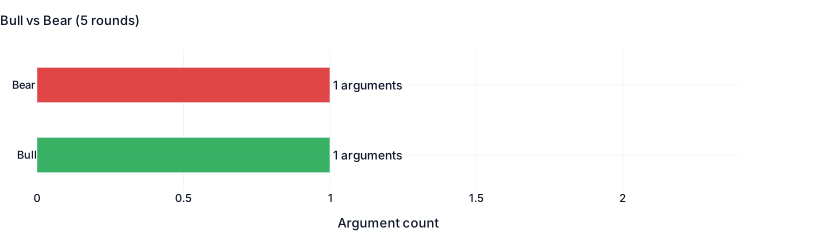
Rationale: Okay, let me synthesize this. The bull case is laser-focused on the SpaceX IPO—a $22–27 billion forced buying event that’s just days away. They argue this mechanical demand will overwhelm any technical weakness, creating a floor and likely pushing IVV back toward recent highs. They also point to persistent structural inflows into S&P 500 ETFs, a still-healthy uptrend (Golden Cross, rising 200 SMA), and the idea that the recent pullback is just profit-taking ahead of the catalyst."",”
Strategic Actions: Maintain current position in IVV. Place a stop loss at $733 (Bollinger lower band). If price holds above $733 through the SpaceX inclusion (June 12) and shows strength, consider adding a small tactical position above $750 on volume confirmation. If price breaks below $733, trim 25% of the position and wait for a test of the 50 SMA at $716. Do not chase the dip here; let the catalyst play out and the technicals resolve.
Trader's Execution Plan
Action: Hold
Reasoning: The research plan recommends a Hold, supported by the impending SpaceX IPO catalyst that is expected to drive mechanical forced buying into IVV. The technical backdrop remains constructive with a Golden Cross and rising 200 SMA, and the recent pullback is viewed as profit-taking ahead of this event. The proposed stop-loss at $733 (Bollinger lower band) provides a defined risk level, while any break below that would warrant trimming 25% of the position and waiting for a test of the 50 SMA at $716.
Stop Loss: 733.0
Position Sizing: Maintain current position. If price holds above $733 through June 12 (SpaceX inclusion) and shows strength, consider adding a small tactical position above $750 on volume confirmation. If price breaks below $733, trim 25% of the position.
FINAL TRANSACTION PROPOSAL: HOLD
Portfolio Manager — Final Verdict
Rating: Hold
Executive Summary: Maintain current position in IVV with a stop-loss at $733 (Bollinger lower band). Hold through the SpaceX IPO catalyst on June 12th, then consider adding a small tactical position above $750 only on volume confirmation. If price breaks below $733, trim 25% and wait for a test of the 50 SMA at $716. Time horizon: 1-2 weeks for catalyst resolution.
Investment Thesis: The Hold decision balances the aggressive analyst’s conviction in the SpaceX IPO’s mechanical forced buying ($22-27 billion into S&P 500 ETFs) against the conservative analyst’s valid concerns about technical deterioration. While the RSI collapsed from 75.8 to 49.4 on high volume (9.66M shares) indicating distribution, the long-term trend remains constructive with a rising 200 SMA ($684.62), intact Golden Cross, and 50 SMA support at $716.81. The neutral analyst correctly notes that the most likely outcome is choppy consolidation between $735-$750 through June 12th, followed by a modest 1-2% lift from forced buying. The $733 stop-loss provides defined risk (1.1% drawdown) while maintaining exposure to the asymmetric upside of the catalyst. Recent lessons from MSFT (-2.2% alpha) reinforce the need for confirmed reversal signals rather than chasing oversold conditions, supporting the disciplined approach of waiting for volume confirmation above $750.
Price Target: 760.0
Time Horizon: 1-2 weeks