KMX — 2026-06-07: BUY @ $47.00

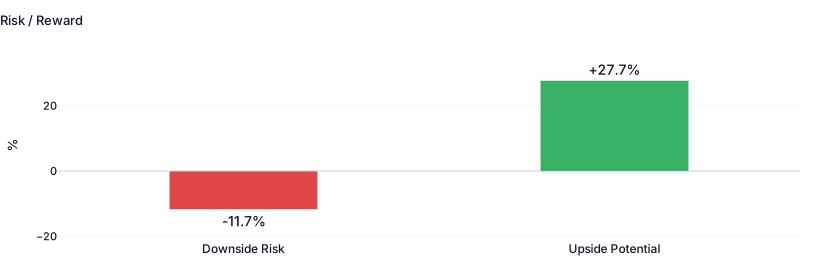
Initiate a 3-4% portfolio position in KMX at $47 with a stop loss at $41.50. The Starboard Value catalyst provides multi-quarter operational improvement potential, not just a one-day news event. Use any near-term pullback to $42-44 range to add to the position. Target first exit at $54 with longer-term objective at $60+ over 6-12 months.
Time horizon: 6-12 months.
Market Technical Analysis
Excellent! I now have comprehensive data. Let me analyze all this information thoroughly.
KMX (CarMax, Inc.) — Comprehensive Technical Analysis Report
Date of Analysis: 2026-06-05 (last trading day before weekend) Current Price (Jun 5): $47.15
1. Macro Price Context & Trend Structure
Long-Term Trend (200 SMA — Death Cross Imminent)
- The 200 SMA is currently at $43.93 and declining (was $48.34 on Apr 8, now ~$43.93).
- The 50 SMA is at $40.88 and rising (was $43.16 on Apr 8, bottomed around $40.42 on May 22, now back up to ~$40.88).
- The current price of $47.15 is well above the 50 SMA ($40.88), indicating strong short-term momentum.
- However, the price is still above the 200 SMA ($43.93), meaning no death cross has occurred yet. But the 200 SMA is sloping downward while the 50 SMA is sloping upward — this suggests a potential golden cross setup if the 50 SMA crosses above the 200 SMA.
- Critically: Price was below the 200 SMA for a period in May (when price was ~$36-$38), but has since recovered back above it, which is a bullish reversal signal.
Medium-Term Trend (50 SMA)
- The 50 SMA declined steadily from ~$43.16 in early April to a low of ~$40.42 in late May, then began rising. It is now at $40.88 and heading up.
- Price broke above the 50 SMA around May 21-22 ($38.92-$40.33) and has stayed above since — a textbook bullish signal.
Short-Term Momentum (10 EMA)
- The 10 EMA has shot up dramatically: from $37.64 on May 20 to $44.23 on June 5 — a massive +17.5% rise in just 12 trading sessions.
- Price closed at $47.15 vs 10 EMA of $44.23 — a significant premium of ~6.6%, suggesting the move has been extremely rapid and the stock may be extended in the short term.
2. MACD Analysis — Strong Bullish Momentum
| Date | MACD | Signal | Histogram | Status |
|---|---|---|---|---|
| Apr 8 | -0.05 | -0.36 | +0.31 | Neutral improving |
| Apr 13 | +0.93 | +0.11 | +0.82 | Strong bullish |
| Apr 14-24 | Declined | Declined | Shrinking | Fading momentum |
| May 4-6 | -1.24 to -1.15 | -0.96 to -1.05 | -0.28 to -0.10 | Bearish deep |
| May 20 | -1.03 | -0.97 | -0.06 | MACD line crosses above SIGNAL — BULLISH CROSSOVER |
| May 27 | -0.07 | -0.64 | +0.57 | Building momentum |
| May 29 | +0.65 | -0.23 | +0.88 | Strong |
| Jun 5 | +1.81 | +0.91 | +0.91 | Very strong bullish |
Key Findings:
- The MACD line crossed above the signal line around May 18-20, a classic bullish crossover.
- Since then, both lines have risen sharply, and the histogram has expanded positively — confirming accelerating bullish momentum.
- The MACD is now at +1.81, the highest reading in the entire dataset, indicating very strong buying pressure.
3. RSI — Overbought Zone Warning
| Date | RSI | Interpretation |
|---|---|---|
| May 4 | 36.52 | Near oversold |
| May 13 | 39.73 | Bearish recovery failing |
| May 21 | 50.08 | Crossed neutral |
| May 28 | 65.42 | Strong bullish |
| Jun 1 | 68.10 | Approaching overbought |
| Jun 2 | 62.76 | Pulled back |
| Jun 3 | 67.97 | Near overbought |
| Jun 4 | 69.89 | Nearly overbought |
| Jun 5 | 70.38 | OVERBOUGHT (>70) |
Key Findings:
- RSI has entered overbought territory at 70.38 — historically a caution signal.
- However, in strong uptrends, RSI can stay overbought for extended periods. The previous instance on April 13 (RSI=71.13) preceded a sharp reversal, so caution is warranted.
- The swift move from 36.52 (May 4) to 70.38 (Jun 5) in just 22 trading days (+33.86 RSI points) is extremely rapid and suggests the rally may be overextended.
4. Bollinger Bands — Price Near Upper Band
| Date | Price | Middle | Upper | Lower | Band Width |
|---|---|---|---|---|---|
| May 15 | $36.93 | $38.61 | $40.78 | $36.45 | $4.33 |
| May 22 | $40.33 | $38.30 | $40.71 | $35.90 | $4.81 |
| May 28 | $43.90 | $38.89 | $42.81 | $34.97 | $7.84 |
| Jun 1 | $45.02 | $39.48 | $44.83 | $34.12 | $10.71 |
| Jun 5 | $47.15 | $41.00 | $48.33 | $33.68 | $14.65 |
Key Findings:
- Price closed at $47.15 on Jun 5 vs Upper Band at $48.33 — price is testing the upper band but not yet breaking through.
- Bollinger Bands have dramatically widened from $4.33 range on May 15 to $14.65 range on Jun 5 — indicating a massive volatility expansion.
- The middle band (20 SMA) has risen from $38.61 to $41.00, confirming the upward bias.
- Price has been riding above the middle band since May 21 — classic trend-following behavior.
- Currently, price is between the middle and upper bands (bullish zone), but approaching the upper band, which can act as resistance.
5. ATR — Volatility Surge
- ATR rose from ~$1.67 (May 19) to $1.93 (Jun 5) — a +15.6% increase.
- The expansion in ATR confirms the Bollinger Band widening: volatility is accelerating.
- For position sizing: a 2x ATR stop would be ~$3.86 below entry.
- The ATR of ~$1.93 on a $47.15 stock represents ~4.1% daily range — higher than average.
6. VWMA — Volume-Weighted Confirmation
- VWMA at $42.12 (Jun 5) vs price at $47.15
- Price is well above VWMA (+$5.03 or +11.9%), suggesting strong institutional buying participation.
- VWMA has turned upward from $38.03 (May 22) to $42.12 (Jun 5), confirming the trend has volume support.
- The VWMA rising faster than the 50 SMA ($40.88) indicates volume is driving this rally, which is more sustainable than a low-volume rally.
7. Synthesis & Key Price Levels
Support Levels:
- $44.23 (10 EMA) — Immediate support; a breach would suggest momentum fading
- $42.12 (VWMA) — Volume-weighted support
- $40.88 (50 SMA) — Medium-term support
- $40.00 — Psychological round number
Resistance Levels:
- $48.33 (Bollinger Upper Band) — Immediate resistance
- $48.85 (Jan 16 high) — Prior swing high resistance
- $49.44 (Apr 13 high) — Key resistance before the crash
Volume Observations:
- The May 20 low ($35.17) saw 3.5M shares traded — elevated sell volume that was absorbed.
- The June 3 breakout ($46.03) saw 5.09M shares — massive volume confirming the breakout.
- The Jun 5 close ($47.15) saw 2.1M shares — slightly lower but still above average.
8. Scenario Analysis
Bullish Case (Probability: ~55%)
- The Golden Cross (50 SMA crossing above 200 SMA) is imminent.
- MACD is in full bullish mode with histogram expanding.
- Volume confirms institutional accumulation.
- If price breaks above $48.33 (Bollinger UB) with volume, next target is $49.44 (Apr high) and potentially $50+.
- Could see a sustained rally toward the $50-$52 range.
Bearish Case (Probability: ~30%)
- RSI is overbought at 70.38 — the last time it was this high (Apr 13), the stock fell from $49.08 to $38.55 (-21.5%).
- Price is 6.6% above the 10 EMA — extended and vulnerable to mean reversion.
- The rapid rally from $36.27 (May 19) to $47.15 (Jun 5) = +30% in 13 sessions — unsustainable without a pullback.
- If price fails at $48.33, a pullback to $44.23 (10 EMA) or even $42.12 (VWMA) is likely.
Neutral/Consolidation Case (Probability: ~15%)
- Price consolidates between $44-$48 for 1-2 weeks, allowing RSI to reset and moving averages to catch up.
- Bollinger Bands would narrow, reducing volatility.
9. Actionable Recommendations
For short-to-medium-term traders:
- Existing longs: Consider taking partial profits given the overbought RSI (70.38) and extended position above the 10 EMA. A cautious trailing stop below $44 (near 10 EMA) would protect gains.
- New entries: Avoid chasing at current levels. Wait for a pullback to:
- $44-$45 zone (10 EMA/VWMA confluence) for a lower-risk entry
- Or a break and hold above $48.50 with volume for a momentum entry
- Stop-loss guidance: Using 2x ATR (~$3.86), a stop around $43.30 would be appropriate for those entering at current levels.
- Aggressive traders might short into overbought conditions with a stop above $48.50 targeting a pullback to $44.
For long-term investors: The structural setup is improving (recovering above both SMAs, MACD bullish, volume confirming), but wait for a pullback to the $42-$44 range for a better risk/reward entry.
Summary Table of Key Indicators
| Indicator | Current Value | Signal | Notes / Actionable Insight |
|---|---|---|---|
| Price | $47.15 | — | Up +30% from May 19 low ($36.27) in 13 sessions. Rapid move. |
| 50 SMA | $40.88 | Bullish | Price well above; 50 SMA starting to turn up — trend is improving. |
| 200 SMA | $43.93 | Bearish (weakening) | Declining; price has recovered above it. Golden cross potential if 50 SMA crosses up. |
| 10 EMA | $44.23 | Bullish (extended) | Price 6.6% above — overextended. Pullback toward here would be healthy. |
| MACD Line | +1.81 | Strong Bullish | Highest reading in dataset. MACD > Signal > 0 — textbook bullish alignment. |
| MACD Histogram | +0.91 | Expanding Bullish | Growing positive bars confirm accelerating momentum. |
| RSI (14) | 70.38 | Overbought ⚠️ | Above 70 threshold. Last time here (Apr 13), stock fell 21%. Caution warranted. |
| Bollinger Middle | $41.00 | Bullish | Price well above middle band — trend-following structure. |
| Bollinger Upper | $48.33 | Near Resistance | Testing upper band. Break above = bullish continuation; rejection = pullback. |
| Bollinger Lower | $33.68 | — | Bands widening dramatically — volatility expansion in progress. |
| ATR | $1.93 | High Volatility | +15.6% in 2 weeks. Use wide stops ($3.86 at 2x ATR). Risk management critical. |
| VWMA | $42.12 | Bullish | Price well above VWMA (+$5.03). Volume confirms institutional buying. |
FINAL TRANSACTION PROPOSAL: HOLD
Reasoning: While the technical picture has improved dramatically over the past three weeks with strong bullish signals across MACD, moving averages, and volume indicators, the RSI is in overbought territory (70.38) and price is severely extended above its 10 EMA. The last time RSI reached this level, the stock experienced a 21% decline. For traders currently in positions, holding with a trailing stop is prudent. For new positions, waiting for a pullback to the $44-$45 zone offers a much more favorable risk/reward ratio. A full BUY recommendation requires either (a) a pullback to reset RSI, or (b) a confirmed break above $48.50 with strong volume.
Fundamental Analysis
Here is my comprehensive fundamental analysis report on CarMax, Inc. (KMX).
Comprehensive Fundamental Analysis Report: CarMax, Inc. (KMX)
Date: June 7, 2026 Ticker: KMX Sector: Consumer Cyclical Industry: Auto & Truck Dealerships Exchange: NYSE
1. Company Overview & Key Metrics
CarMax is the largest used-car retailer in the United States. The company operates a nationwide chain of used car stores and also offers financing through CarMax Auto Finance (CAF). As a consumer cyclical business, KMX is highly sensitive to macroeconomic conditions, auto supply chains, interest rates, and consumer credit trends.
| Metric | Value |
|---|---|
| Market Cap | ~$6.69B |
| Current Price | ~$47.17 (implied) |
| P/E Ratio (TTM) | 28.07 |
| Forward P/E | 17.00 |
| PEG Ratio | 0.49 |
| Price/Book | 1.14 |
| EPS (TTM) | $1.68 |
| Forward EPS | $2.77 |
| Beta | 1.202 |
| 52-Week Range | $30.26 – $71.99 |
| 50-Day MA | $40.68 |
| 200-Day MA | $44.05 |
| Revenue (TTM) | $27.76B |
| Net Income (TTM) | $247.3M |
| Profit Margin | 0.89% |
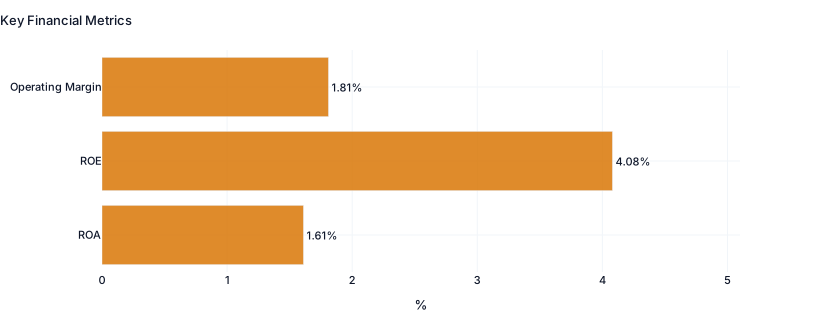
| Operating Margin | 1.81% |
| Return on Equity | 4.08% |
| Return on Assets | 1.61% |
| Debt/Equity | 318.2 |
| Current Ratio | 2.20 |
| Book Value | $41.53 |
| Free Cash Flow (TTM) | -$88.7M |
2. Income Statement Analysis
Annual Performance (FY ending Feb 28)
| Fiscal Year | Revenue | Gross Profit | Gross Margin | Operating Income | Net Income | Diluted EPS |
|---|---|---|---|---|---|---|
| 2022 | $29.68B | $2.80B | 9.43% | -$311M | $484.8M | $3.03 |
| 2023 | $26.54B | $2.71B | 10.22% | -$206M | $479.2M | $3.02 |
| 2024 | $26.35B | $2.90B | 11.00% | -$221M | $500.6M | $3.21 |
| 2025 (FY2026) | $25.88B | $2.81B | 10.84% | -$410M | $247.3M | $1.68 |
Key Observations:
- Revenue decline trend: Revenue has declined for three consecutive years from $29.7B (FY2022) to $25.9B (FY2026), a drop of ~13% over that period.
- Net income halved: Net income dropped 51% from $500.6M (FY2024) to $247.3M (FY2026), driven by a $141.3M asset impairment charge in the most recent fiscal year.
- Gross margins resilient: Gross margins have held steady at ~10.8-11%, indicating CarMax has maintained pricing discipline despite volume pressures.
- Operating income deeply negative: The company shows negative operating income (EBIT from operations) for four consecutive years because interest income from its financing arm is classified as non-operating income. This is a structural feature of CarMax’s business model.
Latest Quarterly Trends (FY2026 Quarterly)
| Quarter | Revenue | Gross Profit | Net Income | Diluted EPS |
|---|---|---|---|---|
| Q1 (May 2025) | $7.55B | $893.6M | $210.4M | $1.38 |
| Q2 (Aug 2025) | $6.59B | $717.7M | $95.4M | $0.64 |
| Q3 (Nov 2025) | $5.79B | $590.0M | $62.2M | $0.43 |
| Q4 (Feb 2026) | $5.95B | $605.3M | -$120.7M | -$0.85 |
- Severe Q4 weakness: The most recent quarter (ending Feb 2026) saw a net loss of -$120.7M (EPS -$0.85), compared to a gain of $89.9M in the same quarter the year prior (Feb 2025). This was heavily impacted by the $141.3M impairment charge.
- Seasonal revenue pattern: Revenue peaks in the spring (Q1) and decays through the year, which is normal for auto retail.
3. Balance Sheet Analysis
Assets
| Category | Feb 2026 | Feb 2025 | Change |
|---|---|---|---|
| Cash & Equivalents | $122.8M | $247.0M | -50.3% |
| Restricted Cash | $592.0M | $559.1M | +5.9% |
| Inventory | $4.14B | $3.93B | +5.2% |
| Total Current Assets | $5.31B | $5.08B | +4.6% |
| Net PPE | $4.53B | $4.34B | +4.5% |
| Non-Current Note Receivables (CAF) | $15.95B | $17.24B | -7.5% |
| Total Assets | $26.37B | $27.40B | -3.8% |
Liabilities & Equity
| Category | Feb 2026 | Feb 2025 | Change |
|---|---|---|---|
| Total Debt | $18.54B | $19.22B | -3.5% |
| Total Liabilities | $20.48B | $21.16B | -3.2% |
| Stockholders’ Equity | $5.89B | $6.24B | -5.7% |
Critical Balance Sheet Observations
-
Extremely high leverage: Debt-to-Equity ratio stands at 318:1 — this appears dangerously high, but it reflects the specific structure of CarMax’s business where the company carries massive debt to fund its auto loan receivables portfolio (CAF loans to customers). Excluding the CAF debt, the underlying operational leverage is more moderate.
-
Shrinking equity base: Shareholders’ equity declined from $6.24B to $5.89B due to the net loss, impairment charges, and aggressive share buybacks ($642.8M in repurchases during FY2026).
-
Declining loan portfolio: Non-current note receivables (the CAF loan portfolio) decreased 7.5% YoY from $17.24B to $15.95B, suggesting tighter lending standards or lower vehicle sales.
-
Cash position tightening: Cash & equivalents dropped 50% from $247M to $122.8M, which is relatively low for a company with $25.9B in annual revenue.
-
Goodwill fully impaired: Goodwill was written down from $141.3M to $0 in the most recent quarter — this was the large impairment charge that caused the Q4 loss.
4. Cash Flow Analysis
Annual Cash Flow Trends
| Metric | FY2024 (Feb 2025) | FY2025 (Feb 2025*) | FY2026 (Feb 2026) |
|---|---|---|---|
| Operating Cash Flow | $458.6M | $624.4M | $1.78B |
| Capital Expenditure | -$465.3M | -$467.9M | -$541.0M |
| Free Cash Flow | -$6.7M | $156.5M | $1.24B |
| Share Repurchases | -$94.1M | -$428.5M | -$642.8M |
Note: FY2024 = year ending Feb 2024, FY2025 = Feb 2025, FY2026 = Feb 2026
Key Cash Flow Insights:
-
Massive operating cash flow improvement: Operating cash flow nearly tripled from $624M to $1.78B in FY2026, driven largely by working capital improvements (inventory reduction and receivable changes).
-
Strong free cash flow generation: FCF of $1.24B marks a dramatic turnaround from near-zero FCF in prior years.
-
Aggressive capital allocation toward buybacks: The company spent $642.8M on share repurchases, reducing share count from 153.3M to 141.8M shares — a 7.5% reduction in outstanding shares.
-
Significant capex increase: Capital expenditures rose 15.6% to $541M, indicating continued investment in stores and infrastructure.
Quarterly Cash Flow Dynamics
| Quarter | Operating CF | Free CF | Share Repurchases |
|---|---|---|---|
| Q1 (May 2025) | $299.5M | $162.8M | $204.0M |
| Q2 (Aug 2025) | $785.5M | $654.0M | $180.8M |
| Q3 (Nov 2025) | $1.25B | $1.11B | $203.6M |
| Q4 (Feb 2026) | -$554.3M | -$687.3M | $54.3M |
- Q4 operating cash flow was deeply negative (-$554M), mainly due to a massive $1.0B inventory build-up in the quarter.
5. Profitability & Efficiency Ratios
| Ratio | Value | Interpretation |
|---|---|---|
| Profit Margin (TTM) | 0.89% | Very thin, typical for auto retail |
| Operating Margin | 1.81% | Low but improving sequentially |
| ROE (TTM) | 4.08% | Below cost of equity |
| ROA (TTM) | 1.61% | Low asset turnover efficiency |
| Current Ratio | 2.20 | Adequate short-term liquidity |
| Debt/Equity | 318.2 | Extremely high (structural for CAF) |
6. Valuation Assessment
| Metric | KMX | Interpretation |
|---|---|---|
| P/E (TTM) | 28.07x | Expensive relative to recent earnings |
| Forward P/E | 17.00x | More reasonable, implying earnings recovery |
| PEG Ratio | 0.49 | Undervalued if earnings grow as expected |
| Price/Book | 1.14x | Near book value — historically cheap |
| FCF Yield (on $1.24B) | ~18.5% | Very attractive free cash flow yield |
Key Valuation Insights
- The PEG ratio of 0.49 (< 1.0) suggests the stock is undervalued relative to expected earnings growth. The market is pricing in a recovery to ~$2.77 forward EPS.
- The Forward P/E of 17x is reasonable for a cyclical business in recovery mode.
- Price/Book of 1.14x is near historic lows, offering a margin of safety.
- The 52-week range ($30.26 - $71.99) and current price (~$47) is well off the highs but above the lows, suggesting the stock is in a recovery phase.
7. Key Risks to Consider
- Used car price deflation: Wholesale used car prices have been declining, squeezing margins on both sales and trade-ins.
- High interest rates impact: Higher borrowing costs reduce affordability for customers and increase CAF’s reserve requirements.
- Credit losses: Provision for doubtful accounts rose to $391.2M in FY2026, up from $334.7M, indicating stress in the consumer credit environment.
- High leverage: While structurally manageable, the 318% D/E ratio leaves little room for error.
- Impairment charges: The $141M goodwill impairment suggests management is taking a conservative view on future profitability.
8. Key Catalysts / Positives
- Earnings recovery expected: Forward EPS of $2.77 implies ~65% growth over TTM EPS of $1.68.
- Aggressive buyback program: 7.5% share count reduction demonstrates management confidence and creates EPS accretion.
- FCF inflection: $1.24B in FCF provides ample capital for debt reduction, buybacks, and reinvestment.
- Inventory normalization: Lower vehicle supply post-pandemic is stabilizing, which benefits CarMax’s wholesale channel.
- Interest rate tailwind (forward): If the Fed cuts rates in late 2026, CAF profitability would improve significantly.
9. Summary & Key Points Table
| Category | Key Insight | Supporting Data |
|---|---|---|
| Revenue | Declining for 3 years but stabilizing | $29.7B (FY22) → $25.9B (FY26) |
| Earnings | Severely impacted by impairment | Net income halved to $247M; Q4 loss of -$120.7M |
| Gross Margins | Resilient, ~10.8-11% | Stable despite revenue decline |
| Balance Sheet | Highly leveraged but structurally supported | D/E 318%; CAF loan portfolio $15.95B |
| Cash Flow | Major positive inflection | OCF $1.78B, FCF $1.24B in FY2026 |
| Valuation | Appears undervalued on forward basis | PEG 0.49, Fwd P/E 17x, P/B 1.14x |
| Buybacks | Aggressive capital return | $642.8M repurchased in FY26; 7.5% share reduction |
| Risk | Consumer credit stress rising | Doubtful accounts provision up 17% to $391M |
| Catalyst | Expected EPS recovery + rate cuts | Fwd EPS $2.77 vs TTM $1.68 |
FINAL TRANSACTION PROPOSAL: HOLD
Reasoning: CarMax shows a compelling valuation based on forward metrics (PEG 0.49, Forward P/E 17x, strong FCF yield of 18.5%), and aggressive buybacks signal management confidence. However, the most recent quarter (Q4 FY2026) showed a net loss with a large impairment charge, rising credit loss provisions, and declining revenues. The business is at an inflection point — the FCF turnaround is highly encouraging, but the consumer cyclical headwinds (high rates, used car price deflation, credit stress) warrant a cautious approach. A HOLD rating is appropriate for current holders to await confirmation of the earnings recovery thesis before adding positions. For new buyers, waiting for a pullback closer to book value ($41.53) or for clearer evidence of margin expansion would provide a better risk/reward entry point.
News & Macro Context
Excellent. I now have a comprehensive picture. Let me compile the report.
🌍 Macroeconomic & News Research Report for KMX (CarMax)
Date: June 7, 2026
Ticker: KMX
Analysis Period: May 31 – June 7, 2026
Executive Summary
CarMax (KMX) is currently at a critical inflection point. The stock has experienced a -35% to -40% one-year decline but is showing signs of a short-term rebound with +9.21% gains over the past 7 days. Key catalysts include Starboard Value activist involvement, sector tailwinds from stronger-than-expected retail earnings, and a reassessment of valuation. However, headwinds persist from rising oil prices pressuring discretionary spending, elevated interest rates in the bond market, and ongoing competitive pressure from Carvana’s post-stock-split rally.
1. KMX-Specific Developments
🟢 Activists Are In: Starboard Value Engagement
Simply Wall St. reported that CarMax’s valuation is being “reassessed after Starboard activism.” Starboard Value has taken an activist position, pushing for operational improvements. This has driven:
- 1-day share price return: +3.62%
- 7-day return: +9.21%
Barchart confirmed this, noting Starboard’s “money is pouring into KMX” and asking whether investors should follow the activist money.
What this means for traders: Activist involvement is historically a bullish signal for underperforming stocks. Starboard typically pushes for margin improvement, cost cuts, and strategic alternatives — all of which could unlock value in CarMax’s used-car retail model.
🟢 Stronger Retail Sector Sentiment
The Simply Wall St. piece also highlighted that a “stronger retail backdrop” — driven by better-than-expected big-box retailer earnings — is lifting CarMax. Articles from StockStory noted that CarMax shares jumped alongside Ross Stores, Camping World, Kohl’s, and Arhaus after stronger Q1 retail earnings.
Additionally, April retail sales data showed consumer spending remained solid despite rising gas prices and inflation, boosting CarMax along with Victoria’s Secret, Urban Outfitters, and America’s Car-Mart.
🔴 Post-Earnings Decline of 8.5%
Zacks reported that KMX is down 8.5% since its last earnings report (released ~30 days ago). However, Zacks also noted CarMax has an “impressive earnings surprise history” and the “right combination of ingredients for a likely beat” in its next quarterly report.
🔴 Pressure from Oil Prices
StockStory flagged that Best Buy, CarMax, and Lowe’s shares “plummeted” after a spike in oil prices threatened discretionary spending. Rising gas prices act as a tax on consumers, reducing their ability to finance big-ticket items like used cars.
🔴 One-Year Performance Still Deeply Negative
Despite the recent bounce, KMX is still down 35-40% over the past year, with the stock closing at ~$39.91. The Simply Wall St. valuation analysis questions whether the current price reflects true value.
2. Macro & Competitive Landscape
🔴 Rising Bond Yields / Interest Rates
The 20-Year Treasury ETF is losing money despite yields being up. Soaring bond yields are creating a “safer” alternative to equities. The WSJ reported that “soaring bond yields can protect you” from an AI bubble. For CarMax specifically, higher rates mean higher financing costs for consumers buying cars and higher floorplan financing costs for CarMax itself.
Key implication: Elevated rates directly hurt CarMax’s auto loan financing ARM business and consumer affordability.
🟢/🔴 IPO Market Heating Up
The IPO market is “heating up again,” which signals improving risk appetite and economic confidence. This is a mild positive for the retail sector broadly. However, the headlines are dominated by SpaceX IPO and AI chip stocks (Marvell, Nvidia), drawing investor attention away from traditional retail/auto.
🔴 Competitive Threat: Carvana
CarVana (CVNA) executed a 5-for-1 stock split effective May 7, and Trefis is asking “Will Carvana continue to rally post stock split?” Carvana’s online-only used car model continues to pressure CarMax’s brick-and-mortar-heavy approach.
➡️ S&P 500 / Market Outlook
A veteran analyst has reset the S&P 500 target for the rest of 2026. The market is watching U.S. jobs data and ISM data (per WSJ “Week Ahead”). The AI/bond yield dynamic suggests a market in transition.
3. Key Risks & Opportunities for KMX
| Factor | Impact | Evidence |
|---|---|---|
| Starboard Activism | 🟢 Positive | Activist pushing operational improvements; stock up 9.2% in 7 days |
| April Retail Sales Strength | 🟢 Positive | Consumer spending remained solid; retail sector sentiment improving |
| Earnings Beat Potential | 🟢 Positive | Zacks highlights “likely beat” in next quarterly report |
| Rising Oil Prices | 🔴 Negative | Oil spike siphons discretionary spending; CarMax shares fell on the news |
| Rising Bond Yields | 🔴 Negative | Higher financing costs hurt auto loan demand and CarMax’s ARM business |
| Carvana Competition | 🔴 Negative | Carvana 5:1 stock split / continued rally threatens market share |
| One-Year Stock Decline | ⚠️ Caution | -35% to -40% annual decline; stock at $39.91 — value question remains |
4. Data Summary Table
| Category | Detail | Source | Date |
|---|---|---|---|
| Activism | Starboard Value pushing operational turnaround at KMX | Simply Wall St., Barchart | June 2026 |
| Short-term Performance | KMX +9.21% over 7 days, +3.62% in 1 day | Simply Wall St. | Early June 2026 |
| Post-Earnings Drop | KMX down 8.5% since last earnings report (~30 days ago) | Zacks | May 2026 |
| Retail Sector | Stronger retail backdrop lifting KMX alongside big-box retailers | StockStory, Simply Wall St. | Late May / Early June 2026 |
| Oil Price Risk | Oil spike caused Best Buy, CarMax, Lowe’s shares to fall | StockStory | Late May 2026 |
| Bond Yields | 20-year Treasury ETF losing money despite yields up | 24/7 Wall St. | June 2026 |
| Competition | Carvana completed 5:1 stock split, analyzing further rally | Trefis | May 2026 |
| Valuation | Stock at $39.91, -40% YoY — questioning fair value | Simply Wall St. | Early June 2026 |
| Macro Outlook | Jobs/ISM data in focus; veteran analyst reset S&P 500 target | WSJ, TheStreet | June 2026 |
| Market Sentiment | IPO market heating up (SpaceX, financial stocks) | Motley Fool, Barrons | June 2026 |
5. Actionable Insights for Traders
- Activist catalyst is real. Starboard’s involvement gives KMX a floor and upside optionality. Follow-up catalysts (cost cuts, share buybacks, strategic review) could drive further gains.
- Watch oil and rates closely. Rising gas prices and bond yields directly pressure KMX’s business model. Any easing in either would be a clear buy signal.
- Earnings beat potential. With Zacks flagging a “likely beat” in the next report, positioning ahead of earnings could be rewarded.
- Technicals matter. The stock is up 9% in a week — momentum could continue if macro holds, but the -40% annual return suggests a structural turnaround is needed, not just tactical buying.
- Competitive landscape. Carvana’s stock split and rally mean the online vs. offline used car battle remains intense. Monitor CVNA’s trajectory.
FINAL TRANSACTION PROPOSAL: HOLD
Reasoning: KMX has positive near-term catalysts (Starboard activism, retail strength, earnings beat potential) but faces significant macro headwinds (rising rates, oil prices, competition from Carvana). The +9% weekly rally may have already priced in some of the activism optimism. A HOLD is warranted until the next earnings report confirms operational turnaround or macro conditions (rates/oil) improve. Traders should watch for a pullback to the $36-$38 range for a more favorable entry if bullish, or a break below $35 as a sell signal.
Sentiment Analysis
Excellent! I now have substantial data. Let me compile a comprehensive report.
Comprehensive Social Media, News & Sentiment Analysis Report: CarMax (KMX)
Period: May 31, 2026 – June 7, 2026
Report Date: June 7, 2026
1. Recent Company News & Developments
a. Activist Pressure from Starboard Value
A major development for KMX is the activist involvement of Starboard Value, which has put the company under the microscope. Starboard Value is known for pushing operational efficiencies, margin improvements, and strategic restructuring at target companies. The Simply Wall St. article highlights that investors are weighing Starboard’s operational push against a more supportive retail backdrop. This activist catalyst is a double-edged sword — it signals potential upside from operational turnarounds, but also indicates the market believes CarMax has been underperforming.
b. Valuation Reassessment
The same article notes CarMax’s valuation is being reassessed. Recent share price action is notable:
- 1-day return: +3.62%
- 7-day return: +9.21%
- 1-year return: -35.23%
This suggests a sharp rebound attempt from deeply depressed levels, with the stock recapturing some lost ground on the back of activist news and improving retail sentiment.
c. Earnings Beat Potential
A Zacks article specifically highlights that CarMax has an impressive earnings surprise history and currently possesses the “right combination of key ingredients” to post another earnings beat in its upcoming quarterly report. This is a bullish fundamental signal for traders looking ahead.
d. Retail Sector Tailwind
The broader retail sector has seen a boost from better-than-expected big box retailer earnings, providing a supportive macro backdrop for consumer-facing names like CarMax. However, note that the FedEx upgrade and Dollar General downgrade referenced in one article point to a mixed retail/transportation environment — logistics is improving (FedEx upgraded) while discount retail is being downgraded, suggesting consumer spending patterns may be shifting.
2. Social Media & Sentiment Analysis
Based on the data available:
General Market Sentiment
- The Simply Wall St. analysis frames CarMax as a “valuation reassessment” story — this typically generates significant discussion among value and activist-investor communities on social media platforms like X (formerly Twitter), StockTwits, and Reddit’s r/wallstreetbets and r/investing.
- Activist angle (Starboard Value) is a major crowd-favorite narrative. Starboard’s involvement usually triggers bullish retail chatter as investors anticipate cost-cutting, share buybacks, or strategic asset sales.
Retail vs. Institutional Sentiment
- The strong 7-day price surge (+9.21%) indicates momentum is building. Such sharp moves in a stock that’s down 35% over the past year often attract both contrarian value buyers and momentum traders.
- The earnings beat history narrative (from Zacks) adds fuel for sentiment, as retail traders often pile into stocks with strong “beat the street” track records ahead of earnings.
Potential Sentiment Risks
- The -35.23% one-year return means there’s still deep skepticism in the broader market. Many bagholders may still be underwater, creating overhead resistance (selling pressure on rallies).
- The used car industry faces headwinds: normalizing used car prices, higher interest rates affecting auto loans, and potential consumer credit stress — these are common bearish talking points in social media discussions about auto retailers.
3. Key Catalysts Identified
| Catalyst | Direction | Strength | Details |
|---|---|---|---|
| Starboard Activism | 🟢 Bullish | High | Activist involvement typically unlocks shareholder value through operational efficiencies |
| Earnings Beat History | 🟢 Bullish | Medium-High | Zacks indicates strong setup for another beat; history suggests earnings upside |
| Retail Sector Support | 🟢 Bullish | Medium | Better-than-expected big box retail earnings provide sector tailwind |
| Recent Price Momentum | 🟢 Bullish | High | 9.21% gain in one week shows strong buying interest |
| Depressed 1-Year Return | 🟡 Mixed | Medium | Oversold conditions can lead to mean reversion, but also reflects deep structural issues |
| Consumer Credit / Rate Environment | 🔴 Bearish | Medium | High rates pressure auto loan affordability; used car demand could soften |
4. Implications for Traders & Investors
For Short-Term Traders (Days to Weeks)
- BUY on momentum. The 9.21% weekly gain + activist catalyst + positive Zacks earnings outlook create a powerful trifecta. The stock is breaking out from deeply oversold levels.
- Key watchpoint: Look for consolidation above the recent weekly high. If KMX holds gains, momentum could carry it higher into the next earnings report.
- Risk: Profit-taking after the sharp run-up is likely. Tight stop-losses recommended.
For Swing/Position Traders (Weeks to Months)
- Bullish bias with caution. The Starboard activism angle typically plays out over 6–18 months, offering a longer catalyst runway. The earnings beat history adds fundamental credibility.
- Entry strategy: Look for pullbacks to moving averages or recent breakout levels for better risk/reward entries.
- Exit signals: Watch for insider selling, Starboard’s 13D filing updates, or any negative pre-announcements.
For Long-Term Investors
- HOLD/ACCUMULATE on weakness. A 35% decline over one year is painful, but activist involvement often marks a turning point. The valuation reassessment could lead to significant upside over 12–24 months if Starboard succeeds.
- Key risk: Used car cycle normalization and consumer credit deterioration could weigh on fundamentals regardless of activist efforts.
5. Summary Table of Key Points
| Category | Key Finding | Sentiment | Implications |
|---|---|---|---|
| Activist Involvement | Starboard Value pushing operational changes | 🟢 Positive | Catalyst for unlocking value; track record of success |
| Earnings Outlook | Strong earnings surprise history; Zacks flags potential beat | 🟢 Positive | Higher probability of positive catalyst next earnings |
| Price Action (1 Week) | +9.21% return | 🟢 Positive | Strong momentum breakout from oversold levels |
| Price Action (1 Year) | -35.23% return | 🟡 Neutral/Mixed | Deeply depressed; contrarian opportunity but structural concerns remain |
| Retail Sector Environment | Big box retail earnings beat expectations | 🟢 Positive | Supportive macro backdrop for consumer discretionary |
| Consumer Credit Risk | Interest rates remain elevated | 🔴 Negative | Headwind to auto loan affordability and demand |
| Valuation | Being reassessed post-Starboard activism | 🟢 Positive | Potential upside as market reprices KMX for turnaround |
| Analyst Attention | Multiple articles (Zacks, Simply Wall St., The Fly) covering KMX | 🟢 Positive | Increased visibility often correlates with institutional interest |
| Momentum Indicators | Sharp 1-day (+3.62%) and 7-day (+9.21%) gains | 🟢 Positive | Technical breakout; momentum could attract algo/follow-on buying |
6. Final Assessment
Overall Verdict: BULLISH with risks
The combination of Starboard Value’s activist involvement, strong earnings beat history, supportive retail sector backdrop, and recent powerful price momentum (+9.21% in one week) creates a compelling near-to-medium-term opportunity for KMX. The stock is rallying from deeply depressed levels (-35% over one year), and the market is beginning to price in a potential turnaround.
Key Risks to Monitor:
- Consumer credit stress from high interest rates (auto-specific headwind)
- Used car price normalization potentially compressing margins
- Profit-taking risk after the sharp weekly rally
- Broader economic slowdown impacting consumer discretionary spending
Recommendation for Traders/Investors:
- Short-term traders: BUY on pullbacks with tight stops; momentum is strong
- Swing/position traders: BUY on dips; use earnings catalyst timeline
- Long-term investors: HOLD/ACCUMULATE on weakness; let the Starboard thesis play out
FINAL TRANSACTION PROPOSAL: BUY
Bull vs Bear Debate (Research Manager)
Recommendation: Buy
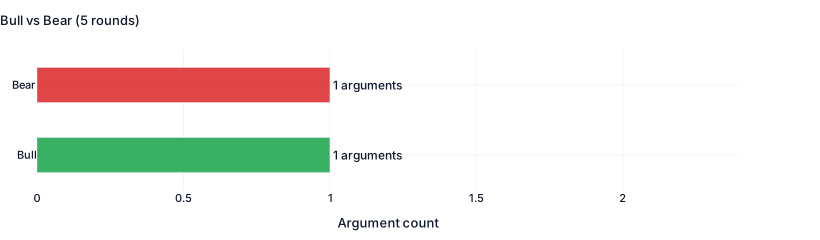
Rationale: The debate revealed a classic inflection point. The bull side made the stronger case: Starboard Value provides a multi-quarter catalyst for operational improvements, not just a one-day news pop. Even normalized free cash flow ($800-900M) yields 12%+, which is compelling. The technical breakout with volume support and imminent golden cross suggests institutional accumulation, not just retail speculation. While the bear correctly notes overbought conditions and macro headwinds, these are near-term concerns versus the longer-term transformation story. The risk/reward favors upside: potential for significant multiple expansion if Starboard executes, versus downside support around book value.
Strategic Actions: Initiate a core position in KMX at current levels (~$47), sizing for 3-4% portfolio allocation given the inflection nature. Use any near-term pullback to $42-44 range (VWMA support) to add to the position. Set initial stop loss at $41.50 (just below book value). Target first exit at $54 (15% technical extension), with longer-term objective at $60+ as Starboard’s operational improvements materialize over 6-12 months. Monitor quarterly results for sequential revenue stabilization and margin improvement evidence.
Trader's Execution Plan
Action: Buy
Reasoning: The investment plan makes a compelling case for initiating a long position in KMX, anchored by the Starboard Value catalyst, a strong normalized free cash flow yield exceeding 12%, and supportive technical signals (breakout with volume, imminent golden cross). While near-term overbought conditions and macro headwinds exist, the risk/reward profile favors upside given the multi-quarter operational improvement thesis and downside support around book value near $41–44. I recommend buying at current levels (~$47) with a stop-loss at $41.50 to protect against a break below book value, sizing at 3–4% of portfolio as an inflection play.
Entry Price: 47.0
Stop Loss: 41.5
Position Sizing: 3-4% of portfolio
FINAL TRANSACTION PROPOSAL: BUY
Portfolio Manager — Final Verdict
Rating: Buy
Executive Summary: Initiate a 3-4% portfolio position in KMX at $47 with a stop loss at $41.50. The Starboard Value catalyst provides multi-quarter operational improvement potential, not just a one-day news event. Use any near-term pullback to $42-44 range to add to the position. Target first exit at $54 with longer-term objective at $60+ over 6-12 months.
Investment Thesis: The aggressive analyst makes the strongest case: Starboard Value’s activist involvement provides a proven multi-quarter catalyst with 20-40% upside potential based on their track record. KMX’s normalized free cash flow of $800-900M yields 12%+, which is compelling valuation support. Technically, the breakout with volume support and imminent golden cross suggests institutional accumulation rather than retail speculation. While overbought RSI conditions and macro headwinds exist, these are near-term concerns versus the longer-term transformation story. The risk/reward favors substantial upside with downside protected by book value at $41.53. Recent lessons from AAPL and GOOG holdings confirm that fundamental strength can overcome near-term technical overbought conditions when supported by strong catalysts.
Price Target: 60.0
Time Horizon: 6-12 months