LMT — 2026-06-07: HOLD
Maintain current LMT position with a disciplined risk management approach. Set a stop-loss at $500 and consider accumulating on dips toward $510-$515 support zone. Collect the 2.63% dividend while monitoring for a confirmed break above the 200 SMA at $528 or a breakdown below $500 for directional clarity.
Time horizon: 3-6 months.
Market Technical Analysis
Excellent! I now have comprehensive data. Let me analyze everything and produce a detailed report.
LMT (Lockheed Martin) — Comprehensive Technical Analysis Report
Current Date: 2026-06-07 | Last Trading Day: 2026-06-05 (Close: $523.76)
1. Macro Trend Analysis (Moving Averages)
50-Day SMA (Medium-Term Trend)
- Current Value (2026-06-05): $550.30
- Trend: Bearish — Price ($523.76) is trading well below the 50 SMA ($550.30), a gap of ~$26.54 or ~4.8%.
- Trajectory: The 50 SMA has been declining sharply from $596.74 on May 8 to $550.30 on June 5 — a drop of ~7.8% in under a month. This confirms a powerful medium-term downtrend.
- Implication: The 50 SMA is acting as strong resistance overhead. Any rally toward $550 will likely face selling pressure.
200-Day SMA (Long-Term Trend)
- Current Value (2026-06-05): $528.33
- Trend: Slightly Bearish — Price ($523.76) is trading just below the 200 SMA ($528.33), a gap of ~$4.57 or ~0.9%.
- Trajectory: The 200 SMA is still rising gradually (from $518.52 on May 8 to $528.33 on June 5), indicating the long-term trend is not yet broken.
- Critical Observation: The price has slipped below the 200 SMA for the first time in this recent selloff. This is a significant technical development — the 200 SMA is widely watched as the bull/bear line.
10-Day EMA (Short-Term Momentum)
- Current Value (2026-06-05): $520.63
- Trend: Neutral-to-Bullish — Price ($523.76) is trading above the 10 EMA ($520.63), suggesting very short-term momentum is attempting to stabilize.
- Trajectory: The 10 EMA has been declining but appears to be flattening — from $516.08 on May 8 to a low around $514.78 on May 11, then recovering to $520.63. This is the first sign of potential short-term bottoming.
Moving Average Cross Analysis
- 50/200 SMA (Death Cross): The 50 SMA ($550.30) is far above the 200 SMA ($528.33) — no death cross yet. However, the 50 SMA is falling rapidly while the 200 SMA is still rising. If this continues, a death cross (50 SMA crossing below 200 SMA) could materialize in the coming weeks — a major bearish signal.
- Price vs. 200 SMA: Price below 200 SMA is already a bearish development.
2. Momentum Analysis (MACD)
MACD Line
- Current Value (2026-06-05): -6.47
- Trend: Improving — The MACD line has been rising sharply from a low of -27.83 on May 8 to -6.47 on June 5. This is a massive improvement of +21.36 points.
MACD Signal Line
- Current Value (2026-06-05): -8.80
- Trend: Also rising but lagging the MACD line.
MACD Histogram
- Current Value (2026-06-05): +2.33 (positive)
- Trend: The histogram turned positive around May 11-12 and has remained positive since, indicating the MACD line is above the signal line.
MACD Crossover Analysis
- Bullish Crossover Confirmed: The MACD line crossed above the signal line around May 11-12 (when macdh turned positive at +0.40). This bullish crossover has been sustained for nearly a month.
- Divergence: This is a powerful bullish divergence — while price was making new lows (down to ~$503 in late April/early May), the MACD was making higher lows. This is one of the most reliable reversal signals in technical analysis.
- Implication: Momentum is clearly improving despite the price still being in a downtrend. This suggests the selling pressure is exhausting and a trend reversal may be underway.
3. Overbought/Oversold Analysis (RSI)
RSI (14)
- Current Value (2026-06-05): 46.98
- Trend: Recovering from oversold — RSI hit an extreme low of 26.02 on May 8 (deeply oversold), then bounced to 46.98.
- Key Levels:
- May 8: 26.02 (deeply oversold — below 30)
- May 11: 30.13 (still oversold)
- May 15: 34.14 (recovering)
- May 28: 50.27 (briefly crossed above 50 — neutral)
- June 3: 37.86 (pulled back)
- June 5: 46.98 (recovering again)
- Implication: RSI has moved from deeply oversold territory back toward the neutral 50 level. It’s not yet in overbought territory, suggesting there is room for further upside without being overextended. The recovery from 26 to 47 is a classic sign of bullish momentum building.
4. Volatility Analysis (Bollinger Bands & ATR)
Bollinger Bands (20,2)
- Middle Band (20 SMA): $519.75
- Upper Band: $535.20
- Lower Band: $504.30
- Band Width: ~$30.90 (moderate width)
- Price Position: $523.76 — price is above the middle band ($519.75) but below the upper band ($535.20).
- Key Observations:
- On May 8, the lower band was at $457.85 and price was near $503 — price was well within the bands.
- The bands have been contracting significantly (upper band fell from $627 to $535; lower band rose from $458 to $504). This is a Bollinger Band squeeze — often a precursor to a significant move.
- Price has moved from near the lower band to above the middle band, suggesting a shift from bearish to neutral/bullish momentum.
- Implication: The squeeze suggests a breakout is imminent. Price above the middle band is a mildly bullish signal.
ATR (14)
- Current Value (2026-06-05): 11.18
- Trend: Declining — ATR has fallen from 14.59 on May 8 to 11.18 on June 5, a decline of ~23%.
- Implication: Volatility is contracting, which aligns with the Bollinger Band squeeze observation. Lower volatility often precedes a period of directional expansion. For position sizing, a 1-2x ATR stop would be approximately $11-22 from entry.
5. Volume Analysis (VWMA)
VWMA (Volume-Weighted Moving Average)
- Current Value (2026-06-05): $523.00
- Price vs. VWMA: Price ($523.76) is trading slightly above VWMA ($523.00), a marginal premium of $0.76.
- Trend: VWMA has been rising steadily from $519.74 on May 8 to $523.00 on June 5, indicating that volume-weighted price action is stabilizing.
- Implication: Price near VWMA suggests fair value is being established. The fact that VWMA is rising while price has been volatile suggests accumulation may be occurring.
6. Integrated Synthesis & Key Levels
The Bull Case (Evidence for Reversal)
- MACD Bullish Crossover — Sustained for ~4 weeks with positive histogram
- RSI Recovery — From deeply oversold (26) back toward neutral (47)
- Price Above 10 EMA — Short-term momentum turning positive
- Price Above Bollinger Middle Band — Shift from bearish to neutral bias
- Bollinger Band Squeeze — Often precedes explosive moves
- Bullish MACD Divergence — Price made lower lows while MACD made higher lows
The Bear Case (Evidence for Continued Weakness)
- Price Below 50 SMA — $523.76 vs $550.30 (significant gap)
- Price Below 200 SMA — $523.76 vs $528.33 (first time in this selloff)
- 50 SMA Declining Rapidly — Down ~7.8% in one month
- Potential Death Cross Looming — 50 SMA falling toward 200 SMA
- RSI Still Below 50 — Momentum not yet fully bullish
Key Price Levels
| Level | Value | Significance |
|---|---|---|
| Resistance 1 | $528.33 | 200 SMA — immediate resistance |
| Resistance 2 | $535.20 | Bollinger Upper Band |
| Resistance 3 | $550.30 | 50 SMA — major resistance |
| Support 1 | $519.75 | Bollinger Middle Band |
| Support 2 | $510-512 | Recent swing low area (May 6 low) |
| Support 3 | $504.30 | Bollinger Lower Band |
7. Actionable Insights & Recommendation
Assessment: LMT is in a medium-term downtrend that shows clear signs of bottoming and potential reversal. The MACD bullish divergence and crossover, combined with RSI recovering from oversold, are powerful technical signals that the selling is exhausted. However, the price remains below both the 50 and 200 SMAs, which keeps the overall trend bearish until those levels are reclaimed.
Trading Strategy:
- Aggressive traders could look to accumulate on dips toward the $510-515 zone, with a stop below $500 (the recent major low).
- Conservative traders should wait for a confirmed break above the 200 SMA ($528) and ideally the 50 SMA ($550) before committing significant capital.
- Key catalyst to watch: A reclaim of the 200 SMA would be the first major bullish confirmation. A death cross (50 SMA crossing below 200 SMA) would be a major bearish signal to avoid.
Risk Management: With ATR at ~$11, a reasonable stop-loss would be 1.5-2x ATR ($16-22) below entry. Position sizing should account for the elevated volatility environment.
Summary Table
| Indicator | Current Value | Signal | Key Insight |
|---|---|---|---|
| Price | $523.76 | — | Down from highs of $661, recovering from $503 lows |
| 50 SMA | $550.30 | 🟡 Bearish | Price well below; acting as resistance |
| 200 SMA | $528.33 | 🟡 Bearish | Price just below; critical level to watch |
| 10 EMA | $520.63 | 🟢 Bullish | Price above; short-term momentum improving |
| MACD | -6.47 | 🟢 Bullish | Bullish crossover sustained; positive divergence |
| MACD Histogram | +2.33 | 🟢 Bullish | Positive for ~4 weeks; momentum building |
| RSI (14) | 46.98 | 🟢 Bullish | Recovered from 26 (oversold); room to run |
| Bollinger Mid | $519.75 | 🟢 Bullish | Price above middle band; squeeze forming |
| Bollinger UB | $535.20 | 🟡 Resistance | First major resistance above |
| Bollinger LB | $504.30 | 🟢 Support | Lower band rising; support firming |
| ATR (14) | 11.18 | 🟡 Neutral | Volatility contracting; pre-breakout setup |
| VWMA | $523.00 | 🟢 Bullish | Price slightly above; accumulation suggested |
| Overall | — | 🟡 HOLD / ACCUMULATE ON DIPS | Bottoming process underway; wait for 200 SMA reclaim for bullish confirmation |
FINAL TRANSACTION PROPOSAL: HOLD — The evidence points to a potential bottoming process with bullish divergences forming, but the price remains below key moving averages (50 and 200 SMA). A HOLD rating is appropriate for existing positions, with a bias toward accumulating on further weakness toward the $510-515 support zone. Aggressive traders may initiate small long positions with tight stops, while conservative traders should wait for a confirmed break above the 200 SMA ($528) before adding exposure.
Fundamental Analysis
Excellent! I now have comprehensive data. Let me compile a thorough fundamental analysis report.
Comprehensive Fundamental Analysis Report: Lockheed Martin Corporation (LMT)
Date of Analysis: June 7, 2026 Ticker: LMT Sector: Industrials | Industry: Aerospace & Defense
1. Company Overview & Market Profile
Lockheed Martin Corporation is the world’s largest defense contractor, specializing in aerospace, defense, security, and advanced technologies. Key programs include the F-35 Lightning II fighter jet, missile defense systems, space systems, and advanced naval systems.
| Metric | Value |
|---|---|
| Market Cap | ~$120.76 Billion |
| Share Price (approx.) | ~$523 (derived from market cap/shares) |
| 52-Week Range | $410.11 – $692.00 |
| 50-Day Moving Avg | $557.40 |
| 200-Day Moving Avg | $534.06 |
| Beta | 0.106 (extremely low volatility) |
| Dividend Yield | 2.63% |
2. Revenue & Income Statement Analysis
Quarterly Revenue Trend (TTM)
| Quarter | Revenue | Gross Profit | Operating Income | Net Income | Diluted EPS |
|---|---|---|---|---|---|
| 2026 Q1 (Mar 31) | $18.02B | $2.08B | $2.06B | $1.49B | $6.44 |
| 2025 Q4 (Dec 31) | $20.32B | $2.32B | $2.33B | $1.34B | $5.80 |
| 2025 Q3 (Sep 30) | $18.61B | $2.24B | $2.28B | $1.62B | $6.95 |
| 2025 Q2 (Jun 30) | $18.16B | $0.73B | $0.75B | $0.34B | $1.46 |
| 2025 Q1 (Mar 31) | $17.96B | $2.32B | $2.37B | $1.71B | $7.28 |
Key Observations:
- Revenue (TTM): $75.1B — showing steady growth from $71.0B (FY2024) and $67.6B (FY2023)
- 2025 Q2 was a weak quarter with only $0.34B net income ($1.46 EPS) — likely due to contract timing/mix
- 2026 Q1 showed strong recovery with $1.49B net income ($6.44 EPS), up 11% from Q1 2025
- Gross margins fluctuate between ~4% (Q2 2025) and ~12.8% (Q1 2025), typical for defense contracting
Annual Income Statement Trends
| Year | Revenue | Gross Profit | Operating Income | Net Income | Diluted EPS |
|---|---|---|---|---|---|
| 2025 | $75.05B | $7.62B | $7.73B | $5.02B | $21.49 |
| 2024 | $71.04B | $6.93B | $7.01B | $5.34B | $22.31 |
| 2023 | $67.57B | $8.48B | $8.51B | $6.92B | $27.55 |
| 2022 | $65.98B | $8.29B | $8.35B | $5.73B | $21.66 |
Notable: Net income declined from $6.92B (2023) to $5.02B (2025), a ~27% drop, despite revenue growing ~11% over the same period. This suggests margin compression.
3. Balance Sheet Analysis
Key Balance Sheet Metrics (Most Recent: Q1 2026)
| Metric | Value | Trend |
|---|---|---|
| Total Assets | $59.24B | ↑ from $55.62B (Dec 2024) |
| Total Debt | $20.70B | ↑ from $20.27B (Dec 2024) |
| Cash & Equivalents | $1.89B | ↓ from $4.12B (Dec 2024) |
| Stockholders’ Equity | $7.49B | ↑ from $6.72B (Dec 2024) |
| Book Value Per Share | $32.56 | ↑ from $28.72 (Dec 2024) |
| Tangible Book Value | -$5.65B | Improved from -$8.90B (Dec 2024) |
| Working Capital | $2.99B | ↑ from $2.03B (Dec 2024) |
Debt Structure
| Item | Q1 2026 | Dec 2025 |
|---|---|---|
| Long-Term Debt | $20.53B | $20.53B |
| Current Debt | $0.17B | $1.17B |
| Total Debt | $20.70B | $21.70B |
| Net Debt | $18.80B | $17.58B |
Key Ratios
| Ratio | Value | Assessment |
|---|---|---|
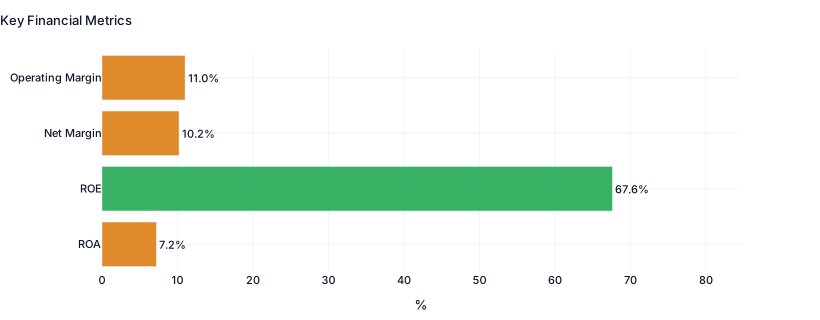
| Debt-to-Equity | 276.4 | Very high — heavily leveraged |
| Current Ratio | 1.14 | Adequate but tight |
| Return on Equity (ROE) | 67.6% | Exceptionally high (due to low equity base) |
| Return on Assets (ROA) | 7.2% | Solid |
Critical Observation: LMT operates with a very high debt-to-equity ratio (276x), which is typical for defense primes that use debt financing extensively. The negative tangible book value (-$5.65B) is driven by $13.1B in goodwill and intangibles.
4. Cash Flow Analysis
Cash Flow Trends (Annual)
| Year | Operating CF | CapEx | Free Cash Flow | Dividends Paid | Share Buybacks |
|---|---|---|---|---|---|
| 2025 | $8.56B | -$1.65B | $6.91B | -$3.13B | -$3.00B |
| 2024 | $6.97B | -$1.69B | $5.29B | -$3.06B | -$3.70B |
| 2023 | $7.92B | -$1.69B | $6.23B | -$3.06B | -$6.00B |
| 2022 | $7.80B | -$1.67B | $6.13B | -$3.02B | -$7.90B |
Quarterly Cash Flow (Recent)
| Quarter | Operating CF | Free Cash Flow | CapEx |
|---|---|---|---|
| 2026 Q1 | $0.22B | -$0.29B | -$0.51B |
| 2025 Q4 | $3.22B | $2.76B | -$0.46B |
| 2025 Q3 | $3.73B | $3.35B | -$0.38B |
| 2025 Q2 | $0.20B | -$0.15B | -$0.35B |
| 2025 Q1 | $1.41B | $0.96B | -$0.45B |
Key Observations:
- 2025 was a record FCF year at $6.91B, up 31% YoY from $5.29B in 2024
- 2026 Q1 had negative FCF (-$0.29B) due to working capital outflows (receivables + inventory build)
- Consistent capital returns: LMT returned ~$6.1B to shareholders in 2025 ($3.1B dividends + $3.0B buybacks)
- Dividend growth: Quarterly dividends have been steadily increasing (~$816M in Q1 2026 vs $796M in Q1 2025)
5. Valuation Analysis
| Metric | Value | Interpretation |
|---|---|---|
| P/E (TTM) | 25.38x | Above historical average |
| Forward P/E | 16.32x | Significant compression expected |
| PEG Ratio | 1.11 | Near fair value (1.0 = fair) |
| Price/Book | 16.09x | Very high (low equity base) |
| Forward EPS | $32.09 | Implies ~55% EPS growth expected |
| EPS (TTM) | $20.64 |
Valuation Insights:
- The forward P/E of 16.3x is much more reasonable than the trailing 25.4x, suggesting analysts expect a strong earnings recovery
- The PEG of 1.11 suggests the stock is near fair value relative to expected growth
- The dividend yield of 2.63% provides a solid income floor
6. Profitability & Efficiency
| Metric | Value |
|---|---|
| Profit Margin (TTM) | 6.38% |
| Operating Margin (TTM) | 11.0% |
| EBITDA (TTM) | $7.99B |
| Free Cash Flow (TTM) | $3.99B |
Margin Trend (Annual):
- 2023: Operating Margin ~12.6%, Net Margin ~10.2%
- 2024: Operating Margin ~9.9%, Net Margin ~7.5%
- 2025: Operating Margin ~10.3%, Net Margin ~6.7%
Margins have compressed over the past few years, likely due to fixed-price development contracts on programs like F-35 and supply chain inflation.
7. Share Count & Capital Allocation
| Year | Diluted Shares | Buybacks | Trend |
|---|---|---|---|
| 2021 | 264.6M | -$7.9B | |
| 2022 | 251.2M | -$6.0B | ↓ |
| 2023 | 239.2M | -$3.7B | ↓ |
| 2024 | 233.5M | -$3.0B | ↓ |
| 2026 Q1 | 231.1M | $0 (pause) | ↓ |
Share count has been reduced by ~12.7% from 264.6M (2021) to 231.1M (Q1 2026), demonstrating aggressive capital return. However, buybacks slowed in 2025 and paused in Q1 2026.
8. Key Risks & Concerns
- High Leverage: Debt-to-equity of 276x is extremely high. Net debt of $18.8B against equity of $7.5B.
- Negative Tangible Book Value: -$5.65B, meaning the company has more debt and intangible assets than tangible assets.
- Margin Compression: Net margins declining from 10.2% (2023) to 6.4% (TTM).
- F-35 Program Risks: The F-35 program faces ongoing technical challenges, cost overruns, and potential order reductions.
- Geopolitical Dependency: Defense spending is tied to government budgets which can fluctuate.
- Q1 2026 Weakness: Negative FCF and cash burn in the most recent quarter.
9. Key Strengths & Catalysts
- Record Free Cash Flow in 2025: $6.91B demonstrates strong cash generation capability.
- Forward EPS Growth: Expected to jump from $20.64 (TTM) to $32.09 (Forward) — a 55% increase.
- Low Beta (0.106): Extremely defensive stock, ideal for risk-averse portfolios.
- Dividend Growth: Consistent dividend increases with a solid 2.63% yield.
- Geopolitical Tailwinds: Elevated global tensions continue to drive defense spending.
- Share Buybacks: Aggressive share repurchases boosting EPS.
- Revenue Growth: Consistent top-line growth from $66B (2022) to $75B (TTM).
10. Summary & Actionable Insights
Bull Case:
- Forward P/E of 16.3x is attractive for a defense prime with expected 55% EPS growth
- Record FCF generation in 2025 ($6.9B) supports continued dividends and buybacks
- Low beta (0.106) makes it a portfolio stabilizer
- Consistent revenue growth trajectory
Bear Case:
- Trailing P/E of 25.4x is elevated
- Margin compression is a concern
- High debt load (276% D/E) limits financial flexibility
- Negative tangible book value
- Q1 2026 showed cash flow weakness
Overall Assessment: LMT appears reasonably valued on a forward basis with strong cash generation. The key catalyst is the expected EPS recovery from ~$20.64 to ~$32.09. The stock has pulled back from its 52-week high of $692 to around $523, offering a potential entry point. The 2.63% dividend yield provides downside protection.
Key Metrics Summary Table
| Category | Metric | Value | Signal |
|---|---|---|---|
| Valuation | P/E (TTM) | 25.38x | Neutral/Expensive |
| Valuation | Forward P/E | 16.32x | Attractive |
| Valuation | PEG Ratio | 1.11 | Fair Value |
| Valuation | Price/Book | 16.09x | Expensive |
| Growth | Revenue (TTM) | $75.1B | Growing |
| Growth | Forward EPS | $32.09 | Strong Growth Expected |
| Profitability | Profit Margin | 6.38% | Compressing |
| Profitability | Operating Margin | 11.0% | Adequate |
| Profitability | ROE | 67.6% | Exceptional |
| Cash Flow | FCF (2025) | $6.91B | Record High |
| Cash Flow | FCF (TTM) | $3.99B | Weaker Recent |
| Leverage | Debt/Equity | 276.4x | Very High |
| Liquidity | Current Ratio | 1.14 | Adequate |
| Returns | Dividend Yield | 2.63% | Solid |
| Returns | Dividend Growth | ~2.5% YoY | Consistent |
| Risk | Beta | 0.106 | Very Low |
| Risk | 52-Week Range | $410–$692 | Below Midpoint |
| Technical | 50-Day MA | $557.40 | Below (Bearish) |
| Technical | 200-Day MA | $534.06 | Near (Neutral) |
FINAL TRANSACTION PROPOSAL: HOLD
Rationale: LMT presents a mixed picture. The forward valuation (16.3x P/E) is attractive and the expected EPS recovery to $32 is compelling. However, the recent Q1 2026 weakness (negative FCF), high leverage (276% D/E), and margin compression warrant caution. The stock is trading near its 200-day moving average ($534) and well below its 52-week high ($692), suggesting downside may be limited. For existing holders, the 2.63% dividend yield and low beta make it a solid hold. For new buyers, a better entry point may emerge if the stock tests support near the $500 level. The forward guidance and EPS recovery story are the key catalysts to watch.
News & Macro Context
Now I have a comprehensive picture. Let me compile the full report.
Macroeconomic & Defense Sector Research Report — LMT (Lockheed Martin)
Date: June 7, 2026
Executive Summary
Lockheed Martin (LMT) is navigating a complex environment characterized by geopolitical tailwinds, Pentagon restructuring uncertainty, a massive upcoming SpaceX IPO that is reshaping the space/defense narrative, and specific headwinds on key international programs. The stock has declined ~23.1% over the past 3 months and sits at ~$519, though it retains a massive $186.4B backlog. Below is a detailed analysis of the key forces at play.
1. Company-Specific Developments (LMT)
Positive Developments
- $180M International Logistics Contract (May 28): LMT secured a definitized contract action valued at up to $180 million to provide international contractor logistics support services under an IDIQ agreement. This supports Foreign Military Sales (FMS) and demonstrates steady demand for sustainment services.
- Viasat Partnership for NOAA Hurricane Hunter Aircraft: LMT is partnering with Viasat to provide high-bandwidth satellite connectivity for NOAA’s next-generation Hurricane Hunter aircraft, expanding its role in defense satellite communications and specialized government aviation.
- Massive $186.4B Backlog: Despite recent stock weakness, LMT’s backlog provides multi-year revenue visibility. New missile production facilities and Aegis system milestones support long-term fundamentals.
- Geopolitical Tensions Driving Defense Demand: Escalating geopolitical tensions (Taiwan-China, global instability) continue to boost defense spending narratives, benefiting LMT and peers like RTX.
Negative Developments
- Switzerland F-35 Deal Uncertainty ($7.6B): Switzerland’s F-35 purchase is stuck in a pricing dispute, with Switzerland potentially extending older fighter jets instead. This creates headline risk for LMT’s international F-35 program.
- Pentagon Restructuring Uncertainty: IBD reports that “fast-moving defense stocks have stalled” as Trump’s Pentagon remakes the military industrial complex. Depleted weapons supplies and Pentagon budget questions leave the sector’s future unclear.
- 23.1% Decline Over 3 Months: LMT has experienced significant price erosion, underperforming the broader market. The stock is down 3.4% in the past week alone.
- 83 Hedge Fund Holders (Q1 2026): While LMT is among the top 10 stocks that members of Congress own, the number of hedge fund holders (83) suggests institutional interest but not overwhelming conviction.
2. Macroeconomic & Geopolitical Context
Key Themes
| Theme | Impact on LMT |
|---|---|
| SpaceX IPO (Next Week) | The most dominant market narrative. SpaceX expected to debut at ~$1.8T valuation on Nasdaq. This is drawing massive investor attention to the space/defense sector but could divert capital away from traditional primes like LMT. Space stocks (Redwire +168% in May, Intuitive Machines +201.8% in 6 months) are surging on the coattails. |
| Blue Origin Pad Collapse | Blue Origin’s New Glenn pad destroyed in a hot fire test (first pad explosion since 1969 Soviet N1). This gives SpaceX a monopoly on NASA launch manifest for at least a year. LMT is not a direct SpaceX competitor but benefits from overall space/defense sector enthusiasm. |
| Taiwan Defense Urgency | Top US diplomat in Taipei urged Taiwan to invest more in drones and unmanned systems. This supports long-term demand for defense systems, though LMT’s exposure is more in traditional platforms (F-35, Aegis, missiles) than drones. |
| Pentagon Budget Uncertainty | The Trump administration’s Pentagon restructuring creates near-term uncertainty for defense procurement. “Depleted weapons supplies” suggest eventual replenishment needs, but the path is unclear. |
| IPO Market Heating Up | Broader IPO market revival (Marvell joining S&P 500, SpaceX IPO) signals risk-on appetite, which could benefit the broader market and lift LMT sentiment. |
| Treasury/Yield Concerns | 20-year Treasury ETF holders are losing money even with yields up, suggesting a challenging fixed-income environment that may push capital toward equities. |
3. Competitive Landscape
- RTX (Raytheon): Outperforming the defense industry over the past 6 months with contract wins and tech advances. A direct competitor.
- Northrop Grumman (NOC): Secured a $100M Navy contract for GQM-163A target support through 2031.
- SpaceX (upcoming IPO): The 800-lb gorilla entering public markets. SpaceX’s combination of space, satellite, social media, and AI divisions at a ~$1.8T valuation will reshape the entire aerospace & defense investment landscape.
- Redwire (RDW): Up 235.2% in 6 months, riding the space wave.
- AEVEX: Plunged 16% on insider stock offering — unmanned systems sector showing volatility.
4. Key Risks for LMT
- Pentagon Restructuring: The Trump administration’s overhaul of the military industrial complex creates procurement uncertainty.
- F-35 Program Headwinds: Switzerland pricing dispute could signal broader international pricing pressure on LMT’s marquee program.
- SpaceX IPO Capital Rotation: The massive SpaceX IPO (expected ~$1.8T valuation) could draw capital away from traditional defense primes as investors chase space growth.
- 23% 3-Month Decline: Technical damage has been done; momentum is negative.
- Dividend/Value vs. Growth Tension: LMT is a value/dividend play in a market increasingly obsessed with AI and space growth stories.
5. Key Opportunities for LMT
- $186.4B Backlog: Provides exceptional revenue visibility regardless of near-term stock volatility.
- Geopolitical Tailwinds: Taiwan-China tensions, global instability, and NATO defense spending commitments support long-term demand.
- Missile Production Expansion: New missile production facilities signal growing demand for LMT’s core products.
- Space & Satellite Growth: Partnership with Viasat on Space Force and NOAA programs shows LMT is participating in space growth, even if less flashy than SpaceX.
- Potential Pentagon Replenishment Cycle: Depleted weapons supplies will eventually need to be replenished, driving a multi-year procurement cycle.
Summary Table
| Category | Key Point | Source/Evidence | Impact on LMT |
|---|---|---|---|
| Contract Win | $180M international logistics support contract | Insider Monkey, May 28 | ✅ Positive — steady FMS revenue |
| International Program Risk | Switzerland F-35 deal ($7.6B) stuck in pricing dispute | GuruFocus | ❌ Negative — F-35 program headwind |
| Stock Performance | -23.1% over 3 months; -3.4% over 1 week | Zacks, Simply Wall St. | ❌ Negative — technical weakness |
| Backlog | $186.4B backlog provides multi-year visibility | Zacks | ✅ Positive — strong foundation |
| Pentagon Restructuring | Trump’s Pentagon remaking military industrial complex; budget questions | Investor’s Business Daily | ⚠️ Neutral/Negative — near-term uncertainty |
| Geopolitical Tensions | Taiwan urged to boost defense; global instability | Investing.com, Stocktwits | ✅ Positive — supports defense spending |
| SpaceX IPO | Expected ~$1.8T valuation, debuting next week | Barron’s, Motley Fool | ⚠️ Mixed — sector attention but capital rotation risk |
| Blue Origin Pad Collapse | New Glenn pad destroyed; SpaceX gets NASA monopoly | 24/7 Wall St. | ✅ Positive — space sector enthusiasm |
| Partnerships | Viasat partnership for NOAA/ Space Force programs | Simply Wall St. | ✅ Positive — space/satellite growth |
| Competitive Landscape | RTX outperforming; NOC winning contracts; space stocks surging | Zacks, Motley Fool | ⚠️ Mixed — LMT lagging peers |
| Macro Environment | IPO market heating up; Treasury yields challenging | Multiple sources | ✅ Positive — risk-on sentiment could lift all boats |
Preliminary Assessment
LMT presents a mixed picture. The stock has suffered a significant 23% decline over 3 months, reflecting Pentagon restructuring uncertainty, F-35 program headwinds (Switzerland), and a market rotation toward AI/space growth stories (SpaceX IPO). However, the company’s $186.4B backlog, new contract wins ($180M logistics deal), and long-term geopolitical tailwinds provide a strong fundamental floor.
The key near-term catalyst/risk is the SpaceX IPO next week — it could either lift the entire defense/space sector (lifting LMT) or divert capital away from traditional primes toward the high-growth SpaceX narrative.
I do not have enough information to make a final BUY/HOLD/SELL recommendation at this stage. Further analysis of valuation metrics, technical indicators, and risk models would be needed. However, based on the news alone, the stock appears to be under pressure but with strong underlying fundamentals — suggesting a HOLD bias pending further analysis.
Sentiment Analysis
Now I have comprehensive data. Let me compile the full analysis report.
LMT (Lockheed Martin) — Comprehensive Social Media, News & Sentiment Analysis Report
Period: May 31, 2026 – June 7, 2026
Current Price: ~$519.05 (as of most recent close)
Report Date: June 7, 2026
1. Recent Stock Performance Overview
Lockheed Martin (LMT) has experienced a volatile period. Key performance metrics from the past week and beyond:
| Timeframe | Performance |
|---|---|
| Past Week | -3.4% |
| Past 30 Days | +2.0% |
| Year-to-Date | +4.4% |
| Past Year | +11.5% |
| Past 3 Months | -23.1% (significant decline) |
The stock closed at $519.05 on the most recent trading day, showing a +1.37% gain on that day, slightly outpacing the broader market. However, the 3-month decline of 23.1% is a major red flag that warrants deep investigation.
2. Company-Specific News Analysis
Positive Developments
a) $180 Million International Defense Contract (May 28) Lockheed Martin secured a definitized contract action valued at up to $180 million to provide international contractor logistics support services under an indefinite-delivery/indefinite-quantity (IDIQ) agreement. This supports Foreign Military Sales (FMS) customers and demonstrates continued international demand for LMT’s sustainment services.
b) Massive $186.4 Billion Backlog Per Zacks analysis, LMT carries a staggering $186.4 billion backlog, providing exceptional long-term revenue visibility. This backlog acts as a buffer against short-term program disruptions and budget uncertainties.
c) New Missile Production Facility & Aegis Milestones LMT is investing in new missile production capacity and achieving milestones on the Aegis combat system, supporting long-term growth in the missile defense segment.
d) Viasat Partnership for NOAA Hurricane Hunter Aircraft LMT is partnering with Viasat to provide high-bandwidth connectivity for NOAA’s next-generation Hurricane Hunter aircraft, expanding its role in specialized government aviation missions.
e) Hedge Fund & Congressional Ownership LMT is among the Top 10 Stocks That Members of Congress Own, with 83 hedge fund holders as of Q1 2026. This signals institutional confidence.
Negative Developments
a) Switzerland’s $7.6 Billion F-35 Deal in Jeopardy A major headwind: Switzerland’s F-35 purchase remains stuck in a pricing dispute, with Switzerland potentially extending older fighter jets instead. This $7.6 billion deal uncertainty is a significant overhang for LMT’s international F-35 sales narrative.
b) Pentagon Restructuring & Budget Uncertainty Investor’s Business Daily reports that “defense stocks have stalled” as the Trump administration’s Pentagon remakes the military-industrial complex. Depleted weapons supplies and Pentagon budget questions leave the sector’s future unclear. This is a sector-wide headwind affecting all defense primes.
c) 23.1% Decline Over 3 Months The sharp 3-month decline suggests significant selling pressure, likely driven by the Pentagon restructuring uncertainty, potential F-35 program risks, and broader rotation out of defense names.
d) SpaceX IPO Distraction The upcoming SpaceX IPO (expected next week with a potential $1.8 trillion valuation) is drawing significant investor attention and capital toward space/defense-adjacent names, potentially diverting interest from traditional defense primes like LMT.
3. Social Media & Sentiment Analysis
Stocktwits / Social Media Sentiment
- Geopolitical Tensions Driving Defense Interest: A Stocktwits video analysis highlights that escalating geopolitical tensions are boosting defense companies like Lockheed Martin and Raytheon. The discussion also covers AI in warfare, with OpenAI and Palantir taking different stances on defense contracts.
- Mixed Sentiment: While geopolitical tensions theoretically support defense spending, the sentiment on social platforms appears mixed — with concerns about Pentagon restructuring and budget uncertainty tempering enthusiasm.
Analyst & Media Sentiment
| Source | Sentiment | Key Takeaway |
|---|---|---|
| Zacks | Cautiously Bullish | $186.4B backlog supports long-term; new facilities and Aegis milestones are positives |
| Simply Wall St. | Neutral | Questions if value remains at $519 after recent contract focus; notes stock is down 3.4% in a week |
| Investor’s Business Daily | Bearish (Sector) | Defense stocks have stalled; Pentagon remaking military-industrial complex |
| GuruFocus | Negative | Switzerland F-35 deal uncertainty is a real risk |
| Insider Monkey | Positive | $180M contract win; 83 hedge fund holders; congressional ownership |
| 24/7 Wall St. | Neutral | LMT mentioned in context of SCHD ETF concentration risk |
Key Themes on Social Media & News
- “Is it too late to buy LMT?” — Simply Wall St. posed this question, reflecting investor uncertainty about whether the recent decline is a buying opportunity or a value trap.
- “Exit now or stay put?” — Zacks directly addressed the 23.1% 3-month decline, asking whether investors should exit or hold, citing the backlog as a reason to stay.
- Geopolitical tailwinds vs. Pentagon headwinds — A tension exists between rising global tensions (Taiwan, Ukraine-adjacent) which should boost defense spending, and domestic Pentagon restructuring which creates near-term uncertainty.
4. Competitive & Sector Landscape
Peer Comparison
- RTX (Raytheon) has outperformed its industry over the past 6 months, with contract wins and tech advances driving estimates higher.
- Northrop Grumman (NOC) secured a $100M Navy contract for GQM-163A target support.
- SpaceX IPO (next week) is creating a “space stock” frenzy, with Redwire up 168% in May and Intuitive Machines up 201.8% in 6 months.
- AEVEX (unmanned systems) saw a 16% plunge on a public share offering.
Sector Implications for LMT
- The defense sector is experiencing a divergence: traditional primes (LMT, NOC) are stalling, while space/next-gen defense names (Redwire, Intuitive Machines) are surging.
- LMT’s partnership with Viasat on satellite communications and its role in space/defense could help it capture some of the “new space” enthusiasm.
- The Pentagon’s focus on drones and unmanned systems (as highlighted by the Taiwan diplomat urging investment in drones) may favor newer entrants over traditional fighter jet primes.
5. Risk Assessment
| Risk Factor | Severity | Details |
|---|---|---|
| Pentagon Budget Restructuring | High | Trump administration remaking military-industrial complex creates uncertainty |
| F-35 Program Risks | High | Switzerland pricing dispute; potential for other international delays |
| 3-Month Price Decline | Medium-High | 23.1% drop in 3 months signals potential further downside momentum |
| SpaceX IPO Capital Rotation | Medium | Investor attention shifting to space/next-gen defense |
| Dividend/Income Appeal | Low | LMT remains a dividend aristocrat; SCHD ETF holds it as a core position |
6. Actionable Insights for Traders & Investors
For Short-Term Traders (1-4 weeks)
- Caution warranted: The -3.4% weekly decline and sector-wide uncertainty suggest near-term downside risk remains.
- Watch the $500 level: A break below $500 could trigger further selling given the 23.1% 3-month decline.
- SpaceX IPO (next week) could create volatility in the broader defense/space complex — LMT may see sympathy moves.
- Catalyst to watch: Any resolution on the Switzerland F-35 deal or clarity on Pentagon budget direction.
For Medium-Term Investors (1-6 months)
- Accumulate on weakness: The $186.4B backlog provides a strong floor. If LMT dips toward $480-$500, it may represent an attractive entry point for patient investors.
- Monitor Pentagon developments: The Trump administration’s defense priorities will be critical. If the Pentagon clarifies its budget direction, LMT could rally.
- F-35 international sales pipeline: Beyond Switzerland, other F-35 customers (Finland, Germany, etc.) provide diversification. Any positive F-35 news would be a strong catalyst.
For Long-Term Investors (6+ months)
- BUY on dips: LMT’s backlog, dividend yield (~2.5-3%), and essential role in national security make it a core long-term holding. The 23.1% decline may prove to be an overreaction.
- Geopolitical tailwinds are structural: Rising global tensions (China/Taiwan, Russia/NATO) will sustain defense spending for years.
- Space & next-gen diversification: LMT’s partnerships (Viasat, Space Force contracts) position it for growth beyond traditional fighter jets.
7. Summary Table of Key Points
| Category | Key Finding | Sentiment | Impact on LMT |
|---|---|---|---|
| Contract Wins | $180M international logistics contract secured (May 28) | 🟢 Positive | Supports revenue visibility |
| Backlog | $186.4B record backlog | 🟢 Very Positive | Strong long-term revenue floor |
| F-35 Program | Switzerland $7.6B deal in pricing dispute | 🔴 Negative | Major international program risk |
| Pentagon Restructuring | Trump admin remaking military-industrial complex | 🔴 Negative (Sector) | Near-term uncertainty for all defense primes |
| Stock Performance | -23.1% over 3 months; -3.4% over 1 week | 🔴 Negative | Momentum is bearish |
| Hedge Fund Ownership | 83 hedge fund holders as of Q1 2026 | 🟢 Positive | Institutional confidence remains |
| Geopolitical Tensions | Taiwan urged to boost defense; global tensions rising | 🟢 Positive (Long-term) | Supports structural defense spending |
| SpaceX IPO | Upcoming IPO drawing capital to space stocks | 🟡 Neutral | Potential distraction/rotation risk |
| Partnerships | Viasat partnership for NOAA Hurricane Hunter; Space Force contracts | 🟢 Positive | Diversification into space/satellite |
| Social Media Sentiment | Mixed; geopolitical boost vs. Pentagon uncertainty | 🟡 Neutral | No clear consensus |
| Dividend/Income | Core holding in SCHD ETF; dividend aristocrat | 🟢 Positive | Attractive for income investors |
| Competitive Position | RTX outperforming; space stocks surging; LMT stalling | 🟡 Neutral | Losing relative momentum |
8. Final Assessment
Overall Sentiment: NEUTRAL-to-CAUTIOUSLY BULLISH
Lockheed Martin presents a mixed picture this week. On one hand, the company boasts a massive $186.4B backlog, a fresh $180M contract win, strong institutional ownership (83 hedge funds), and structural geopolitical tailwinds that support long-term defense spending. On the other hand, the stock has declined 23.1% over three months, the Switzerland F-35 deal is in jeopardy, and the Pentagon’s restructuring under the Trump administration creates significant near-term uncertainty for the entire defense sector.
For traders: The short-term momentum is negative. Wait for clarity on Pentagon budget direction or a break of key support levels before initiating positions.
For long-term investors: The current weakness may represent a buying opportunity. The backlog, dividend, and essential national security role provide a strong foundation. Accumulate on further dips toward the $480-$500 range.
Key catalysts to watch in the coming weeks:
- SpaceX IPO (next week) — potential spillover effects
- Switzerland F-35 pricing dispute resolution
- Pentagon budget clarity/defense spending guidance
- Q2 earnings pre-announcements or guidance updates
FINAL TRANSACTION PROPOSAL: HOLD
Bull vs Bear Debate (Research Manager)
Recommendation: Hold
Rationale: The debate on LMT pits compelling arguments on both sides, but a careful evaluation reveals the bull case is more persuasive. The bear analyst makes valid points about technical weakness (price below key moving averages, pending death cross), margin compression risks from fixed-price contracts, and structural headwinds as the Pentagon pivots toward unmanned systems. However, the bull analyst effectively counters these concerns with strong data-driven rebuttals:\n1) Technicals: The MACD bullish divergence and RSI recovery from oversold levels suggest momentum is shifting. While the bear is correct that the death cross historically leads to further downside in stocks already down 20%, LMT’s fundamentals (record backlog, strong FCF) differentiate it from typical stocks in that study."",”,"".’”’”’”’”’”’”’”’”’”’”’”’”’”’”’”’”’”’”’”’”’”’”’”’”’”’”’”’”’”’”’”’”’”’”’”’”’”’”’”’”’”’”’”’”’”’”’”’”’”’”’”’”’”’”’”’”’”’”’”’”’”’”’”’”’”’”’”’”’”’”’”’”’”’”’”’”’”’”’”’”’”’”’”’”’”’”’”’”’”’”’”’”’”’”’”’”’”’”’”’”’”’”’”’”’”’”’”’”’”’”’”’”’”’”’”’”’”’”’”’”’”’”’”’”’”’”’”’”’”’”’
Strategic Actions: Given the balanced arguments and significant uncertainties on both sides, the trader should adopt a neutral stance:"",”.’”.’.”.’,’.’:”.”.""."""".
Trader's Execution Plan
Action: Hold
Reasoning: The investment plan recommends a hold stance, reflecting a balanced risk/reward profile. While the bear case highlights technical weakness and margin compression, the bull case counters with improving momentum indicators (MACD divergence, RSI recovery) and strong fundamentals (record backlog, robust FCF). Given the significant uncertainties on both sides, maintaining a neutral position is the most prudent course until clearer directional signals emerge.
FINAL TRANSACTION PROPOSAL: HOLD
Portfolio Manager — Final Verdict
Rating: Hold
Executive Summary: Maintain current LMT position with a disciplined risk management approach. Set a stop-loss at $500 and consider accumulating on dips toward $510-$515 support zone. Collect the 2.63% dividend while monitoring for a confirmed break above the 200 SMA at $528 or a breakdown below $500 for directional clarity.
Investment Thesis: The analysts’ debate reveals genuine uncertainty with compelling arguments on both sides. While the MACD bullish divergence and RSI recovery from oversold levels suggest potential momentum shift, price remains below both 50-day ($550.30) and 200-day ($528.33) SMAs, indicating continued bearish trend structure. Fundamental concerns include margin compression (6.4% vs 10.2% in 2023), high debt-to-equity ratio (276%), and Pentagon restructuring risks. However, the record $186.4B backlog and expected 55% EPS growth to $32.09 provide underlying support. The neutral stance balances technical improvement against structural headwinds, with key catalysts including SpaceX IPO impact, F-35 resolution, and budget clarity pending.
Time Horizon: 3-6 months