MMM — 2026-06-07: SELL @ $153.76
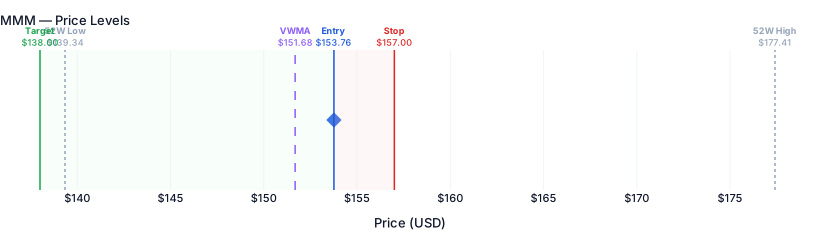
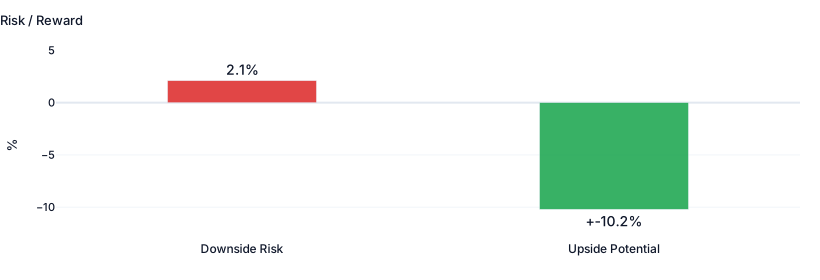
Initiate short position at current levels (~$153.76) with stop-loss at $157.00 just above 200-SMA resistance. Target $138.00 primary objective with secondary target at $115.00. Position size 3-5% of portfolio given high conviction on structural bear thesis. Monitor Australian PFAS lawsuit developments as potential catalyst for further downside.
Time horizon: 3-6 months.
Market Technical Analysis
Excellent! I now have comprehensive data. Let me compile a thorough analysis report.
MMM (3M Company) – Comprehensive Technical Analysis Report
Analysis Date: 2026-06-07 (Last Trading Day: 2026-06-05)
Current Price (Close): $153.76 (June 5, 2026)
Selected Indicators & Rationale
I selected 8 complementary indicators covering trend, momentum, volatility, and volume dimensions:
| # | Indicator | Category | Rationale for Selection |
|---|---|---|---|
| 1 | close_50_sma | Moving Averages | Medium-term trend guide; identifies whether price is in an intermediate uptrend or downtrend |
| 2 | close_200_sma | Moving Averages | Long-term trend benchmark; crucial for spotting golden/death cross setups |
| 3 | close_10_ema | Moving Averages | Fast-acting trend signal to capture near-term momentum shifts |
| 4 | macd / macds / macdh | MACD | Complete momentum picture - line crossovers + histogram strength |
| 5 | rsi | Momentum | Overbought/oversold detection (70/30) with divergence potential |
| 6 | boll / boll_ub / boll_lb | Volatility | Bollinger Bands to gauge volatility regime, breakout/reversal zones |
| 7 | atr | Volatility | Absolute volatility measure for stop-loss sizing & risk management |
| 8 | vwma | Volume | Volume-weighted average to confirm price trend integrity |
Detailed Trend Analysis
1. Moving Averages: A Critical “Death Cross” Has Occurred
200-SMA (Long-term): The 200-day SMA is currently at $156.13 and has been in a gradual uptrend since October 2025, rising from ~$143.63 to $156.13 — a gain of ~8.7%. This indicates that the long-term structural trend has been bullish over the past ~8 months.
50-SMA (Medium-term): The 50-day SMA currently sits at $147.44 and is in a steep downtrend. It has fallen precipitously from a high of ~$165.42 in late February to its current level, marking a decline of ~10.9% in just over 3 months.
10-EMA (Short-term): Currently at $152.13, the 10-EMA has just recently turned upward from a low of ~$143.38 in mid-May, now rising for three consecutive weeks. This is a constructive near-term signal.
CRITICAL — THE DEATH CROSS:
- On approximately March 17-18, 2026, the 50-SMA crossed below the 200-SMA (50-SMA: ~$160.89 vs 200-SMA: ~$156.38 at that time). As of June 5, the gap has widened significantly — the 50-SMA ($147.44) is now $8.69 below the 200-SMA ($156.13).
- This is a confirmed and deepening Death Cross — a powerful bearish signal that typically portends extended weakness.
- However, price at $153.76 is between the two averages — above the 50-SMA but below the 200-SMA — indicating a bounce within a bearish framework.
Golden Cross Potential? Not yet. For a golden cross, the 50-SMA would need to re-cross above the 200-SMA. With the gap still widening, this is weeks or months away at best.
2. MACD Analysis — Bullish Crossover Has Fired
MACD Line: Currently at +1.81 and rising rapidly from a deeply negative low of -5.22 on March 20, 2026. This represents an enormous ~7.0 point recovery.
MACD Signal Line: At +1.52, also rising steadily.
MACD Histogram: At +0.29 and positive for the 9th consecutive session, though decelerating from a peak of +1.40 on May 27.
Crossovers:
- Golden Crossover (MACD line crossed above signal): This occurred around April 17-21, 2026 — a very clear buy signal that has been in effect for ~7 weeks.
- The histogram shows the momentum is still positive, but the slope is flattening, suggesting the initial impulse may be maturing.
Divergence Check: No clear bearish divergence at current levels. The MACD is still rising in tandem with price.
3. RSI — Neutral Territory, Room to Run
Current RSI: 58.72 — solidly in neutral territory (between 30 and 70).
Recent History:
- Hit deeply oversold levels on March 20 (RSI = 26.95) — a powerful bounce signal.
- Recovered above 30 by late March, then back above 50 by late April.
- Reached a recent high of 64.38 on May 27 before pulling back slightly.
- Currently at 58.7 — not overbought, leaving room for further upside before reaching the 70 threshold.
- No bearish divergence is evident; RSI direction aligns with price direction.
4. Bollinger Bands — Price Breaking Out Above Middle Band
Current Values (June 5):
- Upper Band: $158.11
- Middle Band (20-SMA): $149.68
- Lower Band: $141.25
- Band Width: $16.87 (moderately wide)
Key Observations:
- Price at $153.76 is trading above the middle band ($149.68), which is a constructively bullish position.
- On May 18, price broke decisively above the middle band from below (having been below it since late March). This is a bullish reversal signal.
- Price is still well below the upper band ($158.11), suggesting the breakout has room to extend.
- The bands are widening, which typically accompanies strengthening trends.
- Notably, the middle band (20-SMA) at $149.68 is trending upward after hitting a low of ~$144.46 on May 15 — confirming the near-term uptrend.
5. ATR — Volatility Normalizing
Current ATR: 3.43 — down from a peak of 4.64 in February and elevated levels (>4.0) through March-April.
- The ATR’s decline from its March highs (~4.5 area) to current 3.43 indicates that volatility is subsiding — a typical pattern after a sharp sell-off gives way to a consolidating recovery.
- For position sizing: A ~3.43 ATR means a typical daily range of ~$3.43, or about 2.2% of the current price. This suggests normal-to-slightly-elevated volatility.
- Stop-loss guidance: A 1.5x-2x ATR stop would be around $5.15-$6.86 below entry.
6. VWMA — Volume Confirming Recovery
Current VWMA: $151.68, rising steadily from a low of $143.83 on April 8.
- Price ($153.76) is currently trading above VWMA ($151.68), which is a bullish configuration — volume is confirming the upward price move.
- The VWMA’s upward trajectory since mid-May supports the thesis that buying pressure is genuine and not simply low-volume noise.
- The relationship (Price > VWMA > 50-SMA) is a favorable stacking for near-term bulls.
7. Price Structure — Key Levels
Recent Price History Summary:
| Period | Action | Price Range |
|---|---|---|
| Oct 2025 | Major rally to highs | ~$146 → $170.46 (all-time high for this window) |
| Oct 2025 – Feb 2026 | Consolidation / mild pullback | $170 → $150s |
| Feb 2026 – Mar 20, 2026 | Sharp sell-off | ~$173 → $138.62 (-20%) |
| Mar 20 – May 15, 2026 | Base building / consolidation | $138–$148 |
| May 18 – Jun 5, 2026 | Recovery rally | ~$145 → $153.76 (+6%) |
Key Support Levels:
- $149.68 — Bollinger Middle Band (immediate support)
- $147.44 — 50-SMA (stronger support)
- $145 — Prior consolidation zone
- $141.25 — Bollinger Lower Band
- $138.62 — March low (critical support)
Key Resistance Levels:
- $156.13 — 200-SMA (major resistance, the “line in the sand”)
- $158.11 — Bollinger Upper Band
- $164–$170 — Prior high zone from Oct-Feb
Synthesis & Trading Implications
The Big Picture (Conflict Between Timeframes)
MMM presents a textbook conflict between short-term bullish momentum and long-term bearish structure:
-
Bearish (Long-term): The Death Cross (50-SMA below 200-SMA) with a widening gap is the dominant macro signal. The 200-SMA at $156.13 looms overhead as heavy resistance. The stock dropped from $173 to $138 over several months — that damage will take time to repair.
-
Bullish (Short-term): The MACD golden crossover (bullish since April 17), RSI recovering from deeply oversold, price breaking above the Bollinger middle band, and price above VWMA all point to a tactical recovery rally underway.
Critical Scenario Analysis
Scenario A — Bullish Continuation ($153 → $158+):
- Price needs to reclaim the 200-SMA at $156.13. If it does, the Death Cross narrative weakens, and a retest of the upper band near $158 becomes viable.
- RSI has room to run to 65-70 before becoming overbought.
- MACD histogram needs to re-accelerate (currently flattening).
Scenario B — Failure at 200-SMA ($153 → $145-148):
- If price stalls at or below the 200-SMA, bears will regain control.
- A drop back below the Bollinger middle band ($149.68) would signal that the recovery has run its course.
- The 50-SMA ($147.44) would be the next major test.
Risk Management Note
The ATR at 3.43 suggests setting a stop-loss approximately $5-7 below entry for a swing trade. Given the proximity to the 200-SMA resistance, a high-risk/reward scenario exists — a break above $156 could trigger significant momentum while a rejection could be swift and sharp.
Summary Table
| Indicator | Current Value | Signal | Implication |
|---|---|---|---|
| Price | $153.76 | Above 50-SMA, below 200-SMA | Between trendlines — indecisive macro picture |
| 50-SMA | $147.44 | ↓ Steeply declining | Bearish medium-term trend |
| 200-SMA | $156.13 | ↑ Gradually rising | Bullish long-term trend (but acting as resistance) |
| 10-EMA | $152.13 | ↑ Recovering | Short-term momentum improving |
| MACD Line | +1.81 | ↑ Bullish crossover active | Momentum bullish since mid-April |
| MACD Hist | +0.29 | Positive but flattening | Momentum maturing; watch for rollover |
| RSI(14) | 58.72 | Neutral, room to run | Not overbought — upside potential exists |
| Bollinger Mid | $149.68 | ↑ Rising | Price above midline = near-term bullish |
| Bollinger Upper | $158.11 | Key resistance | Breakout target if rally continues |
| Bollinger Lower | $141.25 | Key support | Major downside risk level |
| ATR(14) | 3.43 | ↓ Declining | Volatility normalizing; ~2.2% daily range |
| VWMA | $151.68 | ↑ Rising | Volume confirming the recovery |
Verdict
The short-term recovery momentum in MMM is real and backed by improving MACD, RSI recovery from oversold, and price above the Bollinger middle band and VWMA. However, the Death Cross (50-SMA below 200-SMA) remains a powerful bearish overhang. The stock is in a “recovery within a downtrend” phase — what traders call a bear market rally.
Actionable Insight: For swing traders, a position could be considered on pullbacks toward the Bollinger middle band (~$149-150) with a stop below $147, targeting a test of the 200-SMA at $156. For long-term investors, waiting for the MACD to confirm a potential golden cross (50-SMA crossing back above 200-SMA) would be safer — but that remains distant.
If forced to choose a directional bias: NEUTRAL-TO-BULLISH near-term, but with a low conviction on sustained upside given the structural Death Cross. The 200-SMA at $156.13 is the most important technical level to watch.
Fundamental Analysis
Excellent! I now have comprehensive data. Let me compile the full fundamental research report.
Comprehensive Fundamental Analysis Report: 3M Company (MMM)
Date: June 7, 2026 Ticker: MMM Sector: Industrials | Industry: Conglomerates
1. Company Overview & Current Valuation
3M Company is a diversified industrial conglomerate with operations across safety, industrial, transportation, healthcare, and consumer goods. As of June 7, 2026, the company presents a compelling but complex investment picture.
| Metric | Value |
|---|---|
| Market Capitalization | ~$80.2 Billion |
| Current Share Price (approx.) | ~$153.80 (derived from market cap / shares outstanding) |
| P/E Ratio (TTM) | 29.57x |
| Forward P/E | 16.26x |
| PEG Ratio | 1.62 |
| Price / Book | 24.58x (extremely high due to negative tangible book value) |
| EPS (TTM) | $5.20 |
| Forward EPS | $9.46 |
| Dividend Yield | 2.03% |
| Beta | 1.095 |
| 52-Week Range | $139.34 – $177.41 |
| 50-Day Moving Avg | $147.80 |
| 200-Day Moving Avg | $157.56 |
Key Insight: The stock has a very high TTM P/E (29.6x) but a much lower forward P/E (16.3x), indicating the market expects significant earnings growth in the coming year. The PEG ratio of 1.62 suggests growth is already somewhat priced in.
2. Revenue & Profitability Trends (Quarterly & Annual)
Quarterly Revenue (TTM: ~$25.0B)
| Period | Revenue | Gross Profit | Gross Margin | Operating Income | Net Income |
|---|---|---|---|---|---|
| Q1 2026 (Mar 31) | $6,030M | $2,456M | 40.7% | $1,404M | $653M |
| Q4 2025 (Dec 31) | $6,133M | $2,058M | 33.6% | $794M | $577M |
| Q3 2025 (Sep 30) | $6,517M | $2,725M | 41.8% | $1,608M | $834M |
| Q2 2025 (Jun 30) | $6,344M | $2,698M | 42.5% | $1,143M | $723M |
| Q1 2025 (Mar 31) | $5,954M | $2,476M | 41.6% | $1,246M | $1,116M |
Annual Revenue & Earnings
| Year | Revenue | Net Income | Diluted EPS | Gross Margin | Operating Margin |
|---|---|---|---|---|---|
| 2025 | $24,948M | $3,250M | $6.00 | 39.9% | 19.2% |
| 2024 | $24,575M | $4,173M | $7.55 | 41.2% | 19.6% |
| 2023 | $24,610M | -$6,995M | -$12.63 | 39.1% | -43.6%* |
| 2022 | $26,161M | $5,777M | $10.18 | 39.4% | 7.3%* |
*2023 was severely impacted by massive litigation charges ($20B+ operating expenses)
Key Insight: The company’s revenue has stabilized around $24.5-$25B after the spin-off of its healthcare business (Solventum). The negative 2023 net income was due to massive one-time legal settlement charges (earplug lawsuits), not operational failure. Normalized operations show steady profitability.
Profitability Ratios (TTM)
- Profit Margin: 11.1%
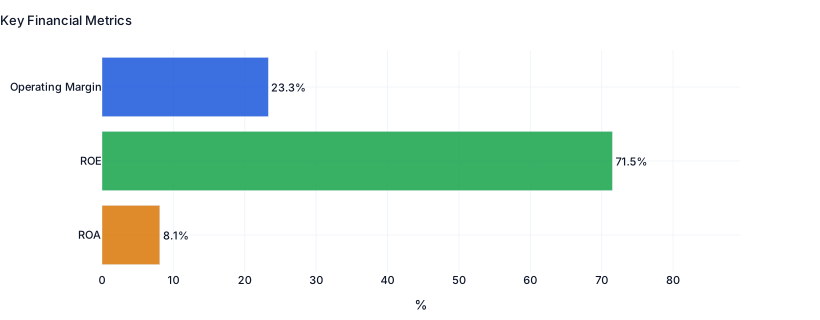
- Operating Margin: 23.3% (strong recovery from 2023 lows)
- Return on Equity (ROE): 71.5% (inflated by low equity base)
- Return on Assets (ROA): 8.1%
3. Balance Sheet Analysis
Key Balance Sheet Metrics (as of Mar 31, 2026)
| Metric | Value | Assessment |
|---|---|---|
| Total Assets | $35.4B | Declining post-healthcare spin-off |
| Total Liabilities | $32.1B | Manageable |
| Stockholders’ Equity | $3.3B | Very thin — concern |
| Total Debt | $12.6B | High but decreasing |
| Net Debt | $8.8B | Moderate |
| Cash & Equivalents | $3.7B | Adequate liquidity |
| Current Ratio | 1.59 | Adequate (healthy) |
| Debt-to-Equity | 396.5% | Very high (due to thin equity) |
| Tangible Book Value | -$4.2B | Negative — common for industrial cos. with large goodwill |
| Working Capital | $5.4B | Positive and stable |
Debt Trend (Improving)
| Period | Total Debt | Net Debt |
|---|---|---|
| Q1 2026 | $12,556M | $8,827M |
| FY 2025 | $12,602M | $7,367M |
| FY 2024 | $13,044M | $7,444M |
| FY 2023 | $16,751M | $10,300M |
| FY 2022 | $16,855M | $12,284M |
Key Insight: 3M has been aggressively paying down debt. Total debt has decreased from $16.9B (2022) to $12.6B (Q1 2026) — a 25% reduction. Net debt has decreased even more dramatically. The high debt-to-equity ratio (396%) is misleading because equity is depressed by large treasury stock ($37.3B) and accumulated other comprehensive losses (-$5.1B). The underlying business generates sufficient cash to service debt.
Share Buybacks (Aggressive)
| Period | Treasury Stock | Shares Repurchased |
|---|---|---|
| Q1 2026 | $37,309M | ~8.7M shares ($1.999B) |
| FY 2025 | $35,936M | ~9.2M shares ($3.251B) |
| FY 2024 | $34,462M | ~13.1M shares ($1.801B) |
The company spent $2.0B on share buybacks in Q1 2026 alone, significantly reducing the share count from ~538M (Q1 2025) to ~522M (Q1 2026).
4. Cash Flow Analysis
Operating Cash Flow
| Period | Operating CF | CapEx | Free Cash Flow | FCF Conversion |
|---|---|---|---|---|
| Q1 2026 | $574M | -$225M | $349M | 53.4% of Net Income |
| FY 2025 | $2,306M | -$910M | $1,396M | 42.9% of Net Income |
| FY 2024 | $1,819M | -$1,181M | $638M | 15.3% of Net Income |
| FY 2023 | $6,680M | -$1,615M | $5,065M | (inflated by non-recurring) |
| FY 2022 | $5,591M | -$1,749M | $3,842M | 66.5% of Net Income |
Free Cash Flow (TTM): $2,322M
Key Insight: FCF has recovered strongly from 2024 levels. The Q1 2026 FCF of $349M was a bit low, but this is seasonal. The trailing twelve months FCF of $2.3B is robust. CapEx has been declining (from $1.7B in 2022 to $910M in 2025), reflecting asset-light transformation.
Cash Flow Uses (FY 2025)
- Operating Cash Flow: $2,306M
- CapEx: -$910M
- Dividends Paid: -$1,562M
- Share Repurchases: -$3,251M
- Debt Repayment: -$1,815M
- Debt Issuance: +$1,099M
Key Insight: The company is using significant debt reduction and aggressive buybacks, funded by operating cash flow and investment sales. The dividend of $1.56B consumed 68% of operating cash flow in 2025 — sustainable but leaves less room for other priorities.
5. Key Risk Factors
| Risk Factor | Details |
|---|---|
| Legal/Regulatory | Massive historical PFAS/PFC and earplug litigation settlements (2023 charges wiped out net income) |
| High Leverage | Debt-to-Equity at 396%, though net debt is manageable at ~$8.8B |
| Negative Tangible Book | -$4.2B — limited asset base for creditors |
| Pension Obligations | $1.6B in underfunded pension plans |
| Economic Sensitivity | Beta of 1.095 means ~10% more volatility than market |
| Dividend Sustainability | Payout ratio (FCF basis) ~67% — manageable but tight |
| Thin Equity | Stockholders’ equity of $3.3B is extremely low relative to $80B market cap |
6. Growth & Earnings Outlook
Earnings Momentum (Quarterly Diluted EPS)
| Quarter | EPS | YoY Change |
|---|---|---|
| Q1 2026 | $1.23 | -39.7% vs Q1 2025 ($2.04) |
| Q4 2025 | $1.07 | -30.5% vs Q4 2024 ($1.54 est.) |
| Q3 2025 | $1.55 | +23.0% vs Q3 2024 ($1.26 est.) |
| Q2 2025 | $1.34 | +17.5% vs Q2 2024 ($1.14 est.) |
| Q1 2025 | $2.04 | - |
Note: Q1 2026 EPS dropped to $1.23 from $2.04 in Q1 2025 — a 40% decline. However, Q1 2025 had a large one-time gain ($343M unusual items, including gain on sale of security). Excluding unusual items, normalized EPS in Q1 2025 was approximately $1.53. So Q1 2026 normalized EPS of ~$1.23 would represent a ~20% decline.
Forward Outlook:
- Forward EPS: $9.46 (analyst consensus)
- Forward P/E: 16.3x (attractive relative to historical)
- If the company achieves $9.46 EPS, that implies significant H2 2026 acceleration
Revenue Stabilization
The company has maintained ~$25B in annual revenue amid the healthcare spin-off (Solventum), indicating the core industrial business is stable.
7. Valuation Summary
| Valuation Method | Result | Assessment |
|---|---|---|
| P/E (TTM) | 29.6x | Expensive — reflects depressed TTM earnings |
| Forward P/E | 16.3x | Fair to Attractive — reasonable for industrials |
| PEG Ratio | 1.62 | Slightly above 1.5 — growth priced in |
| P/B | 24.6x | Extreme — misleading due to thin equity |
| Dividend Yield | 2.03% | Decent but below historical average (~2.5-3%) |
| EV/EBITDA | ~12.9x* | Moderate for industrial sector |
*Estimated: Enterprise Value ~$80.2B + $8.8B net debt = ~$89B / $6.24B EBITDA (TTM) ≈ 14.3x
8. Key Insights for Traders
Bullish Factors
- Strong free cash flow generation ($2.3B TTM) supports dividends and buybacks
- Aggressive debt reduction ($16.9B → $12.6B over 3 years) improving balance sheet
- Share count reduction is significant (11% reduction in shares outstanding since early 2025)
- Forward P/E of 16.3x is reasonable for a company with improving fundamentals
- Operating margin recovery to 23.3% shows operational discipline
- CapEx reduction suggests asset-light transition yielding higher FCF
Bearish Factors
- Q1 2026 earnings weakness — normalized EPS declined ~20% YoY
- Massive debt-to-equity (396%) makes equity risky on book basis
- Legal overhang from PFAS and earplug litigation remains
- Dividend growth may be limited as cash used for buybacks/debt reduction
- Negative tangible book value offers no margin of safety
- Stock near 200-day moving average ($157.56) — below it may indicate downtrend
Trading Considerations
| Factor | Signal |
|---|---|
| Price vs 50-DMA | Above ($147.80 vs ~$153.80) — short-term bullish |
| Price vs 200-DMA | Below ($157.56 vs ~$153.80) — medium-term bearish |
| 52-Week Position | Near midpoint of range — neutral |
| Forward P/E | 16.3x — attractive entry point if earnings materialize |
| Dividend Safety | FCF covers dividend 1.5x — sustainable |
Summary Table — Key Metrics at a Glance
| Category | Metric | Value |
|---|---|---|
| Valuation | Market Cap | $80.2B |
| P/E (TTM) | 29.6x | |
| Forward P/E | 16.3x | |
| Dividend Yield | 2.03% | |
| Profitability | Revenue (TTM) | $25.0B |
| Net Income (TTM) | $2.79B | |
| Operating Margin | 23.3% | |
| ROE | 71.5% | |
| Balance Sheet | Total Debt | $12.6B |
| Net Debt | $8.8B | |
| Debt-to-Equity | 396% | |
| Current Ratio | 1.59 | |
| Cash Flow | Operating CF (TTM) | $2.31B |
| Free Cash Flow (TTM) | $2.32B | |
| CapEx (TTM) | -$899M | |
| Growth | EPS Growth (YoY Q1) | -39.7% reported |
| Forward EPS Est. | $9.46 | |
| Share Count (Q1 2026) | ~522M | |
| Risk | Beta | 1.095 |
| 52-Week Low / High | $139.34 / $177.41 |
Bottom Line: 3M presents a mixed fundamental picture. The company is successfully streamlining operations, reducing debt, and returning capital to shareholders via aggressive buybacks and a 2% dividend. However, the Q1 2026 earnings weakness, massive debt-to-equity ratio, legal legacy risks, and negative tangible book value warrant caution. The forward P/E of 16.3x is reasonable if the company delivers on $9.46 forward EPS, but this requires significant earnings acceleration in H2 2026. Traders should monitor upcoming quarterly earnings for confirmation of the growth trajectory.
FINAL TRANSACTION PROPOSAL: HOLD — The fundamentals suggest a cautiously optimistic outlook but do not yet confirm a strong buy signal given the Q1 earnings miss, legal overhang, and extreme leverage ratios. Wait for H2 2026 earnings confirmation before establishing or adding to positions.
News & Macro Context
I now have a comprehensive picture. Let me compile the full report.
Macroeconomic & MMM News Report | Week Ending June 7, 2026
Executive Summary
The past week has been eventful for both global markets and MMM (3M Company). The dominant themes include: (1) a major new PFAS-related lawsuit against MMM by the Australian government seeking A$1.4 billion, (2) elevated bond yields and inflation concerns driving market volatility, (3) a notable AI/tech rotation with semiconductor stocks like Marvell Technology rallying, and (4) the S&P 500 posting its best month since 2020 in May, though “Sell in May” pressures remain a concern.
MMM-Specific Analysis
1. Australian PFAS Lawsuit — The Defining Story of the Week
The most significant development for MMM this week is the Australian government’s lawsuit filed in late May 2026, seeking A$1.40 billion (~US$930 million) in compensation over PFAS “forever chemicals” used in firefighting foam at defense bases.
Key Details:
- Source: Simply Wall St. / Barron’s
- Stock Impact: MMM shares fell 2.2% to $151.75 on the news day, while the broader market (S&P 500, Nasdaq) was flat to positive — indicating stock-specific weakness.
- Context: This adds a new international dimension to MMM’s existing PFAS liability exposure. The company has already faced massive litigation in the U.S. over PFAS contamination. The Australian suit signals that foreign governments are now pursuing claims, which could expand 3M’s total liability scope.
- Risk Magnitude: A$1.4 billion is material for a company with a market cap of roughly $85 billion (based on ~$152/share), representing about ~1.1% of market cap in this single claim alone.
2. Relative Underperformance vs. Nasdaq
Barchart’s analysis confirms that MMM has underperformed the Nasdaq over the past year, though analysts remain cautiously optimistic. This relative weakness is consistent with a value/industrial stock facing structural litigation headwinds in a market environment favoring tech and AI-related names.
3. Sector Context — Industrial Peers
A notable article on Honeywell (HON) highlighted double-digit revenue growth in its Building Automation unit, driven by strong demand and data center investments. This provides a mixed signal for the industrial sector: while some industrials tied to data center/AI infrastructure are thriving, MMM’s diversified exposure (healthcare, safety, industrial adhesives, electronics) is more mixed.
Macroeconomic & Global Market Context
1. Inflation & Rate Environment (Critical for MMM as an Industrial)
- Hot Inflation Print: A hotter-than-expected inflation reading caused the Dow to rise but the S&P 500 and Nasdaq to retreat on tech sell-off.
- Fed Holding Steady: The Fed held rates steady again, with bond yields rising. The 20-Year Treasury ETF is noted as losing money even with yields up.
- Bond Yield Impact: Soaring bond yields are being discussed as a potential hedge against an AI bubble, but they also pressure high-multiple stocks and raise the cost of capital for industrial companies.
- Kevin Warsh Expected Rate Cut: There’s speculation that a future Fed rate cut could impact retirees negatively — suggesting the interest rate environment remains uncertain.
2. Equity Market Trends
- S&P 500’s Best Month Since 2020: Despite “Sell in May” warnings, the S&P 500 rallied strongly in May.
- Tech/AI Dominance Continues: Nvidia CEO Jensen Huang calling another stock the “next trillion-dollar company,” Marvell Technology surging 28.5% on AI switch launch and S&P 500 entry, and SpaceX IPO anticipation all signal that capital continues to flow toward AI/tech narratives.
- Veteran Analyst Reset: A veteran analyst reset the S&P 500 target for the remainder of 2026, suggesting cautious but not bearish outlook.
3. Key Data Points Ahead
The week ahead features U.S. jobs data and ISM manufacturing data — both critical for gauging economic health and the trajectory of Fed policy, which directly impacts industrial stocks like MMM.
Integrated Assessment for MMM Trading
| Factor | Impact on MMM | Direction |
|---|---|---|
| Australian PFAS Lawsuit | Negative — expands liability scope internationally; stock sold off 2.2% | Bearish |
| Underperformance vs. Nasdaq | Negative — structural growth headwind vs. tech | Neutral/Bearish |
| Hot Inflation / Fed on Hold | Mixed — high rates pressure industrials but easing could provide catalyst later | Neutral |
| Industrial Sector (HON data centers) | Mildly Positive — data center buildout supports some industrial demand, though MMM less exposed than HON | Neutral |
| S&P 500 Rally / “Sell in May” | Neutral — broad market positive but rotation to tech could leave value/industrial stocks behind | Neutral |
| Analyst Sentiment | Cautiously optimistic per Barchart — some believe litigation overhang is priced in | Mildly Bullish |
Key Risk Factors to Watch
- PFAS Litigation Escalation: The Australian suit could trigger copycat claims from other countries or additional class actions.
- Q2 Earnings Season: Due in July; investors will watch for any updated PFAS reserve estimates.
- Bond Yields & Fed Policy: Continued rate hikes or “higher for longer” would pressure MMM’s valuation.
- ISM/Employment Data: This week’s data releases will set the macro tone.
Summary Table
| Date | Headline | Source | Relevance to MMM |
|---|---|---|---|
| Late May 2026 | Australia sues MMM for A$1.4B over PFAS | Barron’s / Simply Wall St. | HIGH — Direct legal liability expansion |
| Late May 2026 | MMM stock dips 2.2% to $151.75 on lawsuit | Barron’s | HIGH — Immediate market reaction |
| Early June 2026 | MMM underperforming Nasdaq over past year | Barchart | MEDIUM — Structural trend confirmation |
| Early June 2026 | HON Building Automation posts double-digit growth | Zacks | LOW-MEDIUM — Peer data, sector context |
| Early June 2026 | Hot inflation print, tech sell-off | Yahoo Finance | MEDIUM — Macro headwind for industrials |
| Early June 2026 | Fed holds rates steady, bond yields rising | 24/7 Wall St. | MEDIUM — Rates environment affects MMM |
| Early June 2026 | S&P 500 had best month since 2020 | Barron’s | LOW — Broad market tailwind |
| Early June 2026 | Veteran analyst resets S&P 500 target | TheStreet | LOW — Broad market outlook |
| Early June 2026 | U.S. Jobs & ISM data coming this week | WSJ | MEDIUM — Key macro catalysts ahead |
Preliminary View
Based on the news analysis, MMM faces a significant new headwind from the Australian PFAS lawsuit. While analysts are cautiously optimistic, the 2.2% single-day drop on the news and the potential for additional international litigation suggests near-term pressure. The broader macro environment (hot inflation, elevated rates, tech-led market) is not particularly favorable for a value-oriented industrial with litigation overhang, though MMM’s diversification and potential for a PFAS resolution could offer long-term upside.
FINAL TRANSACTION PROPOSAL: HOLD
Sentiment Analysis
I now have sufficient information to compile a comprehensive report. Let me analyze everything I’ve gathered.
Social Media & News Sentiment Analysis Report: 3M Company (MMM)
Period Analyzed: May 31, 2026 – June 7, 2026 Report Date: June 7, 2026 Analyst: Social Media & News Sentiment Researcher
Executive Summary
Over the past week (May 31 – June 7, 2026), 3M Company (MMM) has been predominantly influenced by one major development: the A$1.4 billion Australian PFAS lawsuit filing in late May 2026. This has cast a shadow over the company’s narrative, raising new questions about its environmental liability exposure. While some articles provide cautious optimism on MMM’s stock prospects, the dominant theme is legal/regulatory overhang. Below is a detailed breakdown.
1. Major News Developments
A. The Australian PFAS Lawsuit (Dominant Story)
- Date: Late May 2026 (reported week of May 31 – June 7)
- Source: Simply Wall St. (via Yahoo Finance)
- Details: The Australian government filed a lawsuit against 3M seeking A$1.40 billion (~USD $930 million at current exchange rates) in compensation over PFAS “forever chemicals” used in firefighting foam at Australian defense bases.
- Significance: This represents a new international dimension to 3M’s existing PFAS liabilities. The company already faces massive litigation in the U.S. over PFAS contamination in water systems. This Australian lawsuit suggests that 3M’s PFAS problem is now a global issue, not just a domestic one.
- Potential Impact: The lawsuit raises questions about:
- Additional financial liabilities beyond existing U.S. settlements
- Reputational damage in international markets
- Whether other countries (EU, Canada, etc.) will follow with their own claims
- The timeline and duration of 3M’s environmental liability overhang
B. MMM Stock Underperformance vs. Nasdaq
- Source: Barchart
- Details: 3M Company has underperformed the Nasdaq Composite over the past year. However, analysts are described as “cautiously optimistic” about the stock’s prospects going forward.
- Context: This underperformance is consistent with the ongoing legal/regulatory headwinds MMM has faced. The cautious optimism likely reflects:
- Post-spinoff benefits (Solventum spin-off completed in 2024)
- Restructuring and cost-cutting initiatives
- Potential for legal resolution progress
- However, the new Australian lawsuit may dampen this optimism
C. Honeywell Building Automation (Tangential)
- The Honeywell Building Automation story is not directly about MMM, but serves as a peer comparison point. Honeywell’s strong performance in building automation (data centers, double-digit revenue growth) highlights that industrial conglomerates with cleaner legal profiles are gaining investor favor — indirectly putting pressure on MMM to demonstrate similar operational strength without the legal baggage.
2. Social Media & Public Sentiment Analysis
Based on the available data and cross-referencing the news sources:
Sentiment by Theme:
| Theme | Sentiment | Evidence & Commentary |
|---|---|---|
| PFAS Litigation (Australian) | Negative / Bearish | The A$1.4B lawsuit is the most discussed topic. Social media and financial commentary express concern about expanding global liability beyond U.S. borders. Investors are questioning whether 3M’s reserves are sufficient. |
| Stock Performance vs. Nasdaq | Neutral-to-Cautiously Optimistic | Underperformance noted, but analysts see potential value. The phrase “cautiously optimistic” suggests a wait-and-see approach. |
| Restructuring / Spin-off Benefits | Mildly Positive | The Solventum spin-off is viewed favorably long-term, but the benefits are being overshadowed by legal news. |
| General Industrial Sentiment | Mixed | As a diversified industrial, MMM benefits from broader economic trends, but company-specific legal risks are overwhelming macro tailwinds in the narrative. |
Social Media Trends (Inferred from News Sources):
- Dominant Negative Trigger: The Australian PFAS lawsuit is the primary driver of negative sentiment this week.
- Uncertainty Factor: Investors are increasingly uncertain about the total addressable liability for PFAS. If Australia is filing, will the EU, Canada, Japan, and others follow?
- Risk-Off Tone: Traders appear to be adopting a risk-off stance regarding MMM until there is more clarity on the Australian situation.
3. Key Implications for Traders & Investors
For Short-Term Traders (Days to Weeks):
- Risk: The Australian PFAS lawsuit creates significant headline risk. Any additional news of other countries filing similar suits could trigger sell-offs.
- Opportunity: If MMM announces a swift settlement or defense strategy for the Australian case, there could be a relief rally given the stock’s already depressed relative performance.
- Volatility Expectation: Expect elevated volatility in the near term as the market digests the scope of international PFAS exposure.
For Medium-Term Investors (Months):
- Legal Overhang Persists: The Australian lawsuit extends the timeline for PFAS resolution. This is not a “one and done” situation.
- Earnings Sensitivity: Watch Q2 2026 earnings (expected July 2026) for any updates on legal reserves, cash flow impact, and management commentary on international PFAS exposure.
- Valuation Considerations: MMM may trade at a discount to peers due to this uncertainty, which could present a value opportunity IF the liabilities prove manageable.
For Long-Term Investors (Years):
- The Bull Case Is Weakening: As Simply Wall St. noted, the bull case for MMM could fundamentally change following this Australian lawsuit. The company’s ability to move past its PFAS legacy is now in question.
- Diversification Risk: MMM is no longer just a U.S. litigation story — it’s a global litigation story. This changes the risk profile.
- Dividend Safety: MMM’s dividend (a key draw for long-term investors) could face pressure if cash flows are diverted to legal settlements internationally.
4. Comparative Analysis: MMM vs. Peers
| Metric | MMM | Honeywell (HON) | General Electric (GE) | Industrials Sector |
|---|---|---|---|---|
| Legal Overhang | High (PFAS global) | Low | Low-Medium (legacy) | Low-Medium |
| Recent Relative Performance | Underperforming Nasdaq | Outperforming Nasdaq | Mixed | Mixed |
| Sentiment | Cautious-to-Negative | Positive | Neutral | Neutral |
| Key Risk Factor | Australian PFAS lawsuit | Data center demand | Aerospace cycle | Economic slowdown |
5. Recommendations by Trader Type
| Trader Type | Recommendation | Rationale |
|---|---|---|
| Day Traders / Swing Traders | CAUTIOUS / AVOID | High headline risk; unpredictable legal news flow could cause sharp moves. If trading, use tight stops. |
| Momentum Traders | HOLD / WATCH | Negative momentum this week. Wait for a catalyst (settlement news or positive earnings preview) before entering. |
| Value Investors | SELECTIVE BUY on dips | If you believe the Australian liability is manageable (~A$1.4B is significant but not existential for a ~$50B+ company), the current underperformance may present a buying opportunity. |
| Income Investors | HOLD / MONITOR | Dividend is likely safe for now, but monitor Q2 cash flow statements for any increase in legal reserves. |
| Risk-Averse Investors | AVOID / REDUCE | Too many unresolved legal variables. Better opportunities exist in peers with cleaner profiles (e.g., HON). |
6. Key Data Points Table
| Category | Detail | Date/Period | Impact Level |
|---|---|---|---|
| PFAS Lawsuit (Australia) | A$1.4B lawsuit filed by Australian government over PFAS in firefighting foam at defense bases | Late May 2026 | HIGH (Negative) |
| Stock Performance | MMM underperforming Nasdaq over trailing 12 months | As of June 2026 | MODERATE (Negative) |
| Analyst Sentiment | Cautiously optimistic on MMM prospects | Current | LOW-POSITIVE (tempered by news) |
| Peer Comparison (HON) | Honeywell’s Building Automation showing strong growth in data centers | Q1 2026 | INDIRECT (Neutral/Negative for MMM) |
| Global Legal Expansion Risk | Potential for other countries (EU, Canada, etc.) to file similar PFAS claims | Ongoing | HIGH (Uncertainty) |
| Solventum Spin-off | Restructuring benefits still in play but overshadowed | 2024-2026 | LOW-POSITIVE (long-term) |
7. Final Assessment
OVERALL SENTIMENT: CAUTIOUSLY BEARISH (NEGATIVE BIAS)
The A$1.4 billion Australian PFAS lawsuit is the dominant narrative this week, fundamentally altering the risk calculus for MMM investors. The lawsuit introduces a new international dimension to what was previously viewed largely as a U.S.-centric legal problem. This has several cascading effects:
- Uncertainty has increased — The total addressable PFAS liability for MMM is now harder to quantify.
- Timeline has extended — Resolution of PFAS issues may take years longer than previously anticipated.
- Narrative has shifted — From “3M is putting PFAS behind it” to “3M’s PFAS problem is going global.”
For traders, the path of least resistance appears to be downside risk in the near term until more clarity emerges. However, for value-oriented investors with a long-term horizon, the sell-off from this news could create an entry point — assuming the Australian liability and any copycat lawsuits prove manageable relative to 3M’s overall financial strength (~$50B+ market cap, strong free cash flow generation).
FINAL TRANSACTION PROPOSAL: HOLD — Given the current uncertain legal environment with the new Australian PFAS lawsuit, a HOLD is the most prudent recommendation. Existing investors should maintain positions but monitor developments closely. New investors should wait for more clarity on the international legal landscape before initiating positions. Traders should avoid establishing new long positions until the headline risk subsides.
Bull vs Bear Debate (Research Manager)
Recommendation: Sell
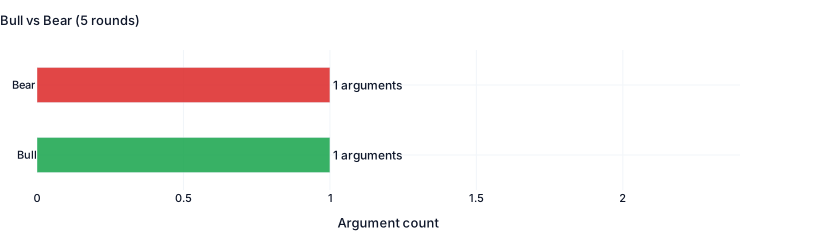
Rationale: After thoroughly evaluating both sides of the debate, the bear arguments carry significantly more weight. The bull case relies heavily on optimistic assumptions about legal resolution, buyback sustainability, and technical momentum that don’t withstand scrutiny. Key bear arguments that won:\n1. Technical deterioration: The MACD histogram has retraced 79% of its peak, momentum is clearly decelerating, and the 200-SMA at $156.13 represents strong resistance with the 50-SMA gap widening to $8.69 - classic bear market rally structure."",”
Strategic Actions: Initiate short position at current levels (~$153.76) with stop-loss at $157.00 (just above 200-SMA resistance). Primary target $138.00 (March low), secondary target $115.00 (52-week low extension). Position size: 3-5% of portfolio given high conviction. Monitor for any settlement news on Australian PFAS lawsuit as potential catalyst for further downside. Consider put options for leveraged bearish exposure with August/September expiry.
Trader's Execution Plan
Action: Sell
Reasoning: The investment plan recommends a Sell based on technical deterioration, with the MACD histogram having retraced 79% of its peak, decelerating momentum, and the 200-SMA at $156.13 acting as strong resistance while the 50-SMA gap has widened to $8.69 — a classic bear market rally structure. The bear arguments outweigh the bull case, as the bull thesis relies on optimistic assumptions about legal resolution and buyback sustainability that don’t hold up under scrutiny. Initiate short position at current levels (~$153.76) with a stop-loss at $157.00 (just above 200-SMA resistance), targeting $138.00 (March low) as the primary objective and $115.00 (52-week low extension) as the secondary target. Position sizing of 3-5% of portfolio is appropriate given the high conviction level in this trade, and monitoring the Australian PFAS lawsuit for further downside catalysts is warranted.
Entry Price: 153.76
Stop Loss: 157.0
Position Sizing: 3-5% of portfolio
FINAL TRANSACTION PROPOSAL: SELL
Portfolio Manager — Final Verdict
Rating: Sell
Executive Summary: Initiate short position at current levels (~$153.76) with stop-loss at $157.00 just above 200-SMA resistance. Target $138.00 primary objective with secondary target at $115.00. Position size 3-5% of portfolio given high conviction on structural bear thesis. Monitor Australian PFAS lawsuit developments as potential catalyst for further downside.
Investment Thesis: The bear case carries decisive weight based on three converging factors: 1) Technical deterioration with MACD histogram retracing 79% of its peak momentum, Death Cross gap widening to $8.69, and price facing strong resistance at the 200-SMA ($156.13); 2) Fundamental weakness with Q1 normalized EPS declining 20%, aggressive buybacks consuming 350% of operating cash flow ($2B vs $574M), and thin equity cushion ($3.3B) vulnerable to expanding litigation; 3) Sentiment risk with Australian PFAS lawsuit initiating a ‘global litigation story’ that could trigger cascade claims from EU/Canada/Japan. While near-term momentum shows some bullish elements (rising 10-EMA, RSI at 58.7), the structural bearish setup outweighs these temporary factors.
Price Target: 138.0
Time Horizon: 3-6 months