MSFT — 2026-05-01: BUY @ $407.78
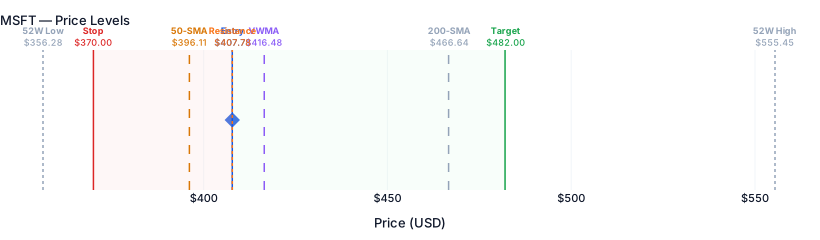
Initiate an Overweight position in MSFT via scaled entry: deploy 30% of target weight at current ~$407.78, 35% on a pullback to the $395-400 50-SMA zone, and reserve 35% split between a post-earnings confirmation add and a deeper $380-385 flush. Target a 4-5% portfolio weight with a hard stop/thesis review at $370, 12-month base case target of $475-490, and optional 1-2 month $390 puts on 25-30% of the position to hedge the MACD/technical risk window.
Time horizon: 12 months.
Market Technical Analysis
Comprehensive MSFT Technical Analysis Report
Analysis Date: May 1, 2026
Executive Summary
Microsoft (MSFT) is currently trading at $407.78, down significantly from recent peaks near $432.92 (April 22). The stock has experienced a notable pullback of approximately -5.8% from its April high, suggesting a consolidation phase or potential reversal from an overbought condition. The technical landscape reveals a bearish to neutral short-term outlook with elevated volatility, though longer-term trend support remains intact. The current price sits 12.6% below the 200-SMA ($466.64), indicating the stock is trading in an intermediate-term downtrend.
Detailed Technical Analysis
Trend Analysis: Moving Averages
50-Day SMA ($396.11):
- Current price ($407.78) sits +2.94% above the 50-SMA, indicating modest upside momentum relative to the medium-term trend
- The 50-SMA has been declining steadily from $404.63 (April 1) to the current $396.11, confirming the downtrend in April
- This suggests the current pullback is correcting an overbought rally; the 50-SMA serves as a critical dynamic support level
- Implication: A break below $396.11 could signal accelerated downside momentum toward the $380-390 range
200-Day SMA ($466.64):
- Current price sits significantly below the 200-SMA by -$58.86 (-12.6%), confirming MSFT is in a longer-term downtrend
- The 200-SMA is also declining from $475.78 (April 1) to $466.64, indicating prolonged weakness
- The widening gap between price and the 200-SMA suggests institutional selling or profit-taking has been sustained
- Implication: Until price reclaims the 200-SMA territory, strategic downside risk remains; this zone ($466-475) should be treated as significant resistance
Trend Verdict: The stock has shifted from an uptrend phase (early-to-mid April) to a correction phase (late April), with the 50-SMA acting as a critical pivot. The 200-SMA remains a long-term obstacle.
Momentum Analysis: RSI & MACD
RSI (Relative Strength Index):
- Current RSI (May 1): 54.49 – This represents a neutral reading, neither overbought (>70) nor oversold (<30)
- The RSI has moderated significantly from overbought extremes of 73.10 (April 22) and 71.70 (April 17)
- This cooling off suggests the recent rally momentum has exhausted, and the market is reassessing entry points
- Notable: The RSI was heavily oversold at 35.73 (April 1), establishing a clear recovery arc:
- April 1-14: Oversold to neutral (35.73 → 57.80) – Bounce phase
- April 15-22: Neutral to overbought (67.26 → 73.10) – Rally exhaustion
- April 23-May 1: Overbought to neutral (59.78 → 54.49) – Correction phase
- Implication: The 54.49 neutral reading suggests limited directional bias; watch for a break below 50 (bearish signal) or above 60 (bullish continuation)
MACD (Moving Average Convergence Divergence):
- MACD Line (May 1): +8.49 – Positive but weakening; down from +10.82 (April 28)
- MACD Signal Line (May 1): +8.02 – Slightly below MACD line, indicating momentum is still positive but decelerating
- Key Observation: The MACD line has crossed from negative (-12.23 on April 1) to positive (+8.49 by May 1), a remarkable turnaround
- However, the gap between MACD and Signal has compressed from +3.04 (April 28) to +0.47 (May 1), signaling convergence
- Critical Risk: A bearish MACD crossover (Signal crossing above MACD from below) would confirm momentum failure and likely trigger selling
- Implication: The MACD remains constructive but fragile; the narrowing divergence suggests diminishing buying pressure
Momentum Verdict: Momentum has shifted from strong bullish (mid-April) to weakening (late April to present). RSI neutrality and MACD compression indicate caution is warranted.
Volatility Analysis: ATR & Bollinger Bands
ATR (Average True Range):
- Current ATR: 11.21 – Up from lows of 8.47 (April 10), indicating volatility expansion
- This is particularly relevant given the sharp decline on April 30 (high 414.42, low 398.01, close 407.78 with volume surge of 70.9M shares)
- Elevated ATR suggests potential for sharp moves in either direction; stop-loss orders should account for ±11-12 points of swing
- Implication: In the current regime, expect wider intraday ranges; conservative stops at 50-SMA ($396) may be whipsawed
Bollinger Bands (Middle = 20-SMA @ $405.57):
- Current price ($407.78) is trading slightly above the Bollinger middle band ($405.57), well within the bands
- The bands themselves have widened significantly, reflecting increased volatility in late April
- Price action on April 30 (the heavy volume down day) tested near the lower band range, suggesting weakness
- The 20-SMA (middle band) has been rising from $387.36 (April 1) to $405.57, but at a decelerating rate
- Implication: The current price near the middle band suggests no overbought condition; however, a break below the lower band would signal capitulation
Volatility Verdict: Elevated volatility presents both opportunity and risk; the current price within the bands suggests consolidation rather than an extreme move setup.
Volume Analysis: VWMA (Volume-Weighted Moving Average)
VWMA (May 1): $416.48
- The VWMA sits $8.70 above the current closing price ($407.78), revealing an important pattern:
- This price-below-VWMA setup indicates that recent heavy volume transactions occurred at higher price levels (mid-April rally peak around $430-434)
- The VWMA has declined from $378.08 (April 1) to $416.48, tracking the price action but with a weighted bias toward higher prices
- The gap between price ($407.78) and VWMA ($416.48) suggests that current selling is happening at a discount to volume-weighted historical levels
- Implication: This indicates potential accumulation by smart money at lower levels, or conversely, that recent buyers are sitting on losses; the VWMA acts as a resistance/supply zone
Volume Signal Analysis:
- April 30 volume spike (70.9M) was roughly 2.3x the 30-day average (~30M), signaling intense institutional activity during the decline
- This suggests capitulation selling or position unwinding, not gradual profit-taking
- If volume remains elevated on further declines, downtrend may accelerate; if volume dries up, consolidation may form
Volume Verdict: Heavy April 30 volume on the downside, combined with price below VWMA, suggests potential reversal or base-building, but confirmation is needed.
Key Levels & Price Action Context
Critical Support Levels (Ascending Order):
- $398.01 – April 30 low (the capitulation low); a break here could trigger systematic stops
- $396.11 – 50-SMA; psychological and technical support
- $390-392 – Gap support zone (April 23 low was $411.41; April 22 low was $423.67)
- $370-375 – Intermediate support (correlates with early-to-mid April lows)
Critical Resistance Levels (Ascending Order):
- $432.92 – April 22 intraday high; key technical resistance
- $425-430 – Psychological and recent consolidation zone
- $466-475 – 200-SMA zone; long-term resistance
Trading Implications & Scenarios
Bull Case (Requires Confirmation):
- If MSFT holds above $407 and $396 support while MACD stabilizes, a retest of $420-432 could occur
- Volume should diminish on any recovery, indicating consolidation rather than renewed selling
- RSI above 60 + MACD positive would confirm renewed upside
Bear Case (More Likely Near-Term):
- A break below $407.78 (current close) could target the 50-SMA at $396.11
- Further weakness below $396 could accelerate toward $385-390 on the 50-SMA-based decline
- MACD crossover below Signal (likely if price breaks $400) would confirm momentum failure
- April 30’s heavy selling volume suggests institutional exits; continued volume on declines = acceleration
Consolidation Scenario (Most Probable Short-Term):
- MSFT could range between $396-420 for 2-4 weeks while market reassesses broader AI/cloud growth narratives
- VWMA resistance at $416.48 aligns with consolidation midpoint
- RSI remaining 40-60 range supports this lateral pattern
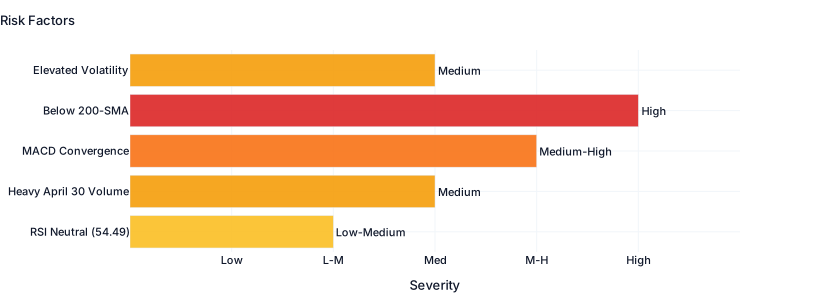
Risk Assessment
| Risk Factor | Severity | Details |
|---|---|---|
| Elevated Volatility | Medium | ATR of 11.21 suggests ±2.7% daily moves possible; wider than historical average |
| Below 200-SMA | High | -12.6% below long-term trend; structural weakness until reclaimed |
| MACD Convergence | Medium-High | Signal line approaching MACD; bearish crossover would confirm momentum loss |
| Heavy April 30 Volume | Medium | Suggests institutional selling; if repeated, could signal capitulation or downtrend acceleration |
| RSI Neutral (54.49) | Low-Medium | No overbought cushion; room to fall without extreme conditions, but also no oversold bounce setup yet |
Recommended Action & Next Steps
For Short-Term Traders:
- HOLD/NEUTRAL: Current price at $407.78 offers poor risk/reward; ideal entry would be near $396 (50-SMA support) or $380-385 (intermediate support)
- Watch for: MACD Signal line to cross above MACD (bearish) or RSI to drop below 50 (momentum failure)
- Set Stops: If going long near $396, place stop at $388; if short, place stop at $420
For Swing Traders:
- Wait for Consolidation: Let the dust settle into late May; clearer signals will emerge once April 30’s capitulation is absorbed
- Key Trigger: A close above $425 would suggest recovery; a close below $395 would confirm bearish continuation
For Long-Term Investors:
- Accumulation Zone: If you believe in MSFT’s fundamentals, the $380-400 range offers better risk/reward than April highs
- Target: 200-SMA reclaim ($466+) is 14-18% upside from current levels; this is a reasonable medium-term target
Summary Table
| Metric | Current Value | Assessment | Signal |
|---|---|---|---|
| Price | $407.78 | Down -5.8% from April high | Pullback/Correction |
| 50-SMA | $396.11 | +2.94% above | Moderate Upside Bias (Short-Term) |
| 200-SMA | $466.64 | -12.6% below | Downtrend Intact (Long-Term) |
| RSI(14) | 54.49 | Neutral | No Directional Bias |
| MACD | +8.49 | Positive but Weakening | Momentum Losing Steam |
| MACD Signal | +8.02 | Converging with MACD | Bearish Crossover Risk |
| ATR | 11.21 | Elevated | Higher Volatility; Wider Swings Expected |
| Bollinger Middle (20-SMA) | $405.57 | Just Below Price | Within Bands; No Extreme |
| VWMA | $416.48 | $8.70 above price | Supply Zone; Volume Weighted Resistance |
| Volume (Apr 30) | 70.9M shares | 2.3x average | Capitulation Selling Signal |
| Overall Trend | Corrective Phase | Transitioning from Bull to Consolidation | NEUTRAL to BEARISH (Short-Term) |
| Risk/Reward (Current) | Unfavorable | Downside risks > upside potential | Recommend HOLD/WAIT |
Conclusion
Microsoft is at an inflection point. The stock has transitioned from a strong bullish rally (early-to-mid April, when it was oversold) to an overbought condition (late April) and is now correcting with elevated volatility and deteriorating momentum. The current price ($407.78) is neither compelling for fresh longs nor clearly bearish for aggressive shorts.
The prudent action is to HOLD if already positioned, or WAIT for better technical confirmation before initiating new positions. Key decision points will be:
- Below $396 = Likely accelerated selling (break of 50-SMA)
- Above $420 = Possible recovery attempt toward $432
- MACD bearish crossover = Strong sell signal
- VWMA resistance breakdown = Confirm supply exhaustion
The May 1 close provides a window for reassessment; expect clarity by mid-May as current consolidation either breaks higher or confirms a longer correction.
Fundamental Analysis
COMPREHENSIVE FUNDAMENTAL ANALYSIS REPORT FOR MSFT
Date: May 1, 2026
EXECUTIVE SUMMARY
Microsoft Corporation (MSFT) continues to demonstrate strong financial performance with robust revenue growth, excellent profitability margins, and substantial cash generation capabilities. As of Q1 FY2026 (ending March 31, 2026), the company exhibits healthy fundamentals with consistent operational excellence. The stock trades at a moderate valuation with a trailing PE ratio of 24.7x and forward PE of 21.5x, supported by strong earnings growth expectations and expanding profit margins.
COMPANY PROFILE & OVERVIEW
Name: Microsoft Corporation Ticker: MSFT Sector: Technology Industry: Software - Infrastructure Market Capitalization: $3.08 Trillion USD Current Trading Range (52-Week): $356.28 - $555.45
Microsoft is a global leader in cloud computing, software solutions, and artificial intelligence. The company operates through multiple business segments including Productivity & Business Processes, Intelligent Cloud, and More Personal Computing, leveraging its market dominance in enterprise software and strong positioning in AI-driven solutions.
KEY FINANCIAL METRICS (TTM)
| Metric | Value | Assessment |
|---|---|---|
| Revenue (TTM) | $318.3 Billion | Strong top-line growth |
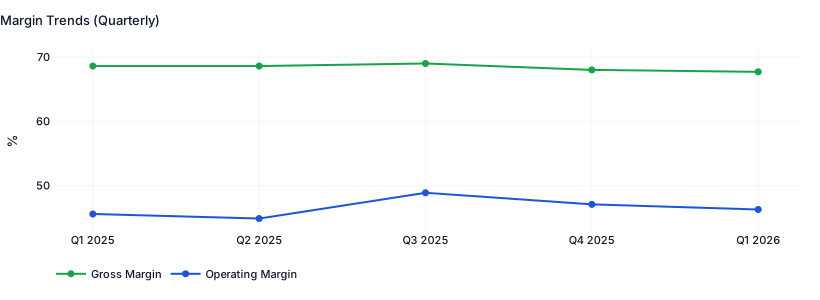
| Gross Profit | $217.4 Billion | 68.3% Gross Margin |
| EBITDA | $184.5 Billion | 58.0% EBITDA Margin |
| Net Income | $125.2 Billion | Excellent profitability |
| Profit Margin | 39.3% | Industry-leading |
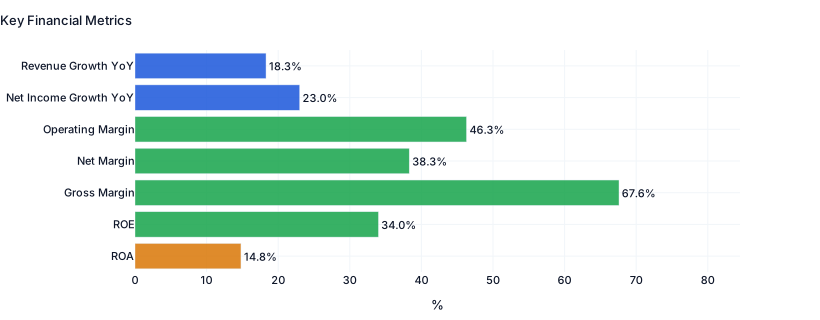
| Operating Margin | 46.3% | Exceptional operational efficiency |
| Free Cash Flow | $37.0 Billion | Strong liquidity generation |
| EPS (TTM) | $16.78 | Solid earnings per share |
| Return on Equity (ROE) | 34.0% | Excellent shareholder returns |
| Return on Assets (ROA) | 14.8% | Strong asset efficiency |
BALANCE SHEET ANALYSIS
Assets
Total Assets (Q1 2026): $694.2 Billion
- Current Assets: $175.3 Billion (25.3% of total)
- Non-Current Assets: $518.9 Billion (74.7% of total)
Key Asset Components:
-
Cash & Short-Term Investments: $78.2 Billion
- Cash & Equivalents: $32.1 Billion
- Short-term Investments: $46.1 Billion
- Trend: Declining from Q4 2025 ($89.5B) due to capex investments
-
Accounts Receivable: $60.0 Billion (gross: $60.8B)
- Allowance for doubtful accounts: $0.8B (1.3%)
- Strong receivables quality
-
Property, Plant & Equipment (Net): $307.6 Billion
- Gross PPE: $419.4 Billion
- Accumulated Depreciation: -$111.7 Billion
- Significant AI/cloud infrastructure investments evident
- QoQ Growth: 7.5% increase reflecting heavy capex
-
Goodwill & Intangible Assets: $139.0 Billion
- Goodwill: $119.7 Billion (87% of total)
- Other Intangibles: $19.3 Billion
- Reflects prior acquisitions (LinkedIn, Activision Blizzard, ZeniMax)
-
Investments & Advances: $33.7 Billion
- Significant increase from Q4 2025 ($21.2B)
- Strategic equity investments in growth technologies
Liabilities
Total Liabilities: $279.9 Billion (40.3% of total capital)
-
Current Liabilities: $136.7 Billion
- Current Debt: $8.8 Billion
- Current Deferred Revenue: $50.9 Billion (high-value sticky revenue)
- Accounts Payable: $37.5 Billion
- Current Ratio: 1.28x (healthy liquidity position)
-
Non-Current Liabilities: $143.2 Billion
- Long-term Debt: $31.4 Billion
- Long-term Lease Obligations: $16.7 Billion
- Deferred Tax Liabilities: $2.9 Billion
- Other Non-current Liabilities: $61.5 Billion (includes long-term deferred revenue)
Equity Position
Total Stockholders’ Equity: $414.4 Billion
- Book Value Per Share: $52.62
- Tangible Book Value: $275.4 Billion
- Retained Earnings: $302.5 Billion (73% of equity)
- Common Stock: $115.1 Billion
Equity Trend Analysis:
- Q1 2026: $414.4B (+5.9% QoQ)
- Q4 2025: $390.9B
- Q3 2025: $363.1B
- Consistent equity growth driven by retained earnings and stock-based compensation
Debt Analysis
- Total Debt: $56.97 Billion
- Net Debt: $8.16 Billion (after cash/equivalents)
- Debt-to-Equity Ratio: 0.137x (very conservative)
- Capital Lease Obligations: $16.7 Billion
- Debt Structure: Mix of short-term ($8.8B) and long-term ($31.4B) obligations
Assessment: Excellent financial position with minimal leverage. The company maintains substantial cash reserves, providing flexibility for strategic investments, M&A, and shareholder returns.
INCOME STATEMENT ANALYSIS
Revenue Performance (Quarterly)
| Period | Revenue | YoY Growth | Gross Profit | Operating Income |
|---|---|---|---|---|
| Q1 2026 | $82.9B | N/A | $56.1B | $38.4B |
| Q4 2025 | $81.3B | N/A | $55.3B | $38.3B |
| Q3 2025 | $77.7B | N/A | $53.6B | $38.0B |
| Q2 2025 | $76.4B | N/A | $52.4B | $34.3B |
| Q1 2025 | $70.1B | N/A | $48.1B | $32.0B |
Key Observations:
- Sequential revenue growth: +1.6% (Q4 to Q1 2026)
- Seasonal strength visible in Q4/Q1 periods
- Strong momentum driven by cloud and AI solutions
Profitability Metrics (Q1 2026)
| Metric | Amount | % of Revenue | Quality |
|---|---|---|---|
| Gross Profit | $56.1B | 67.6% | Exceptional |
| Operating Expense | $17.7B | 21.3% | Well-controlled |
| Operating Income (EBIT) | $40.1B | 48.4% | Industry-leading |
| Other Income | $0.99B | 1.2% | Gains on investments |
| Pretax Income | $39.3B | 47.4% | Strong |
| Tax Provision | $7.6B | 19.3% | Effective tax rate |
| Net Income | $31.8B | 38.3% | Excellent |
Operating Expense Breakdown (Q1 2026)
-
R&D Spending: $8.9B (10.7% of revenue)
- Consistent high investment in innovation and AI
- Critical for maintaining competitive advantage
-
SG&A Expenses: $8.7B (10.5% of revenue)
- Selling & Marketing: $6.8B
- General & Administrative: $1.9B
- Efficient expense management
-
Cost of Revenue: $26.8B (32.4% of revenue)
- Reflects cloud infrastructure costs
- Stable and well-managed
EPS Analysis
- Diluted EPS (Q1 2026): $4.27
- Basic EPS (Q1 2026): $4.28
- Diluted Shares: 7.445 Billion
- TTM EPS: $16.78
- Forward EPS: $19.32
EPS Trend:
- Q1 2026: $4.27 (-17.2% QoQ)
- Q4 2025: $5.16 (+38.7% QoY)
- Q3 2025: $3.72 (+1.6% QoQ)
- Seasonal variance with Q4 typically strongest
CASH FLOW ANALYSIS
Operating Cash Flow (OCF)
Q1 2026 Operating Cash Flow: $46.7 Billion
| Quarter | OCF | Trend | Quality |
|---|---|---|---|
| Q1 2026 | $46.7B | ↑ Strong | Excellent |
| Q4 2025 | $35.8B | ↑ Recovery | Strong |
| Q3 2025 | $45.1B | Stable | Excellent |
| Q2 2025 | $42.6B | ↓ Seasonal | Good |
| Q1 2025 | $37.0B | ↑ Growth | Good |
Key Operating Cash Flow Drivers:
- Net Income: $31.8B
- Depreciation & Amortization: $10.2B
- Stock-Based Compensation: $3.1B
- Deferred Tax Benefits: $2.6B
- Working Capital Changes: Modest impact ($0.3B)
Capital Expenditure (CapEx)
Q1 2026 CapEx: $30.9 Billion (37.3% of operating cash flow)
| Quarter | CapEx | % of OCF | Purpose |
|---|---|---|---|
| Q1 2026 | $30.9B | 66.2% | AI/Cloud Infrastructure |
| Q4 2025 | $29.9B | 83.5% | Data centers, servers |
| Q3 2025 | $19.4B | 43.0% | Infrastructure |
| Q2 2025 | $17.1B | 40.1% | Capex cycle |
| Q1 2025 | $16.7B | 45.2% | Growth investments |
Assessment: Significant increase in CapEx reflects aggressive investment in AI and cloud infrastructure. This supports long-term competitive positioning and revenue growth in high-margin cloud services.
Free Cash Flow (FCF)
Q1 2026 FCF: $15.8 Billion TTM FCF: $37.0 Billion
| Quarter | FCF | Trend | FCF Margin |
|---|---|---|---|
| Q1 2026 | $15.8B | Moderate | 19.0% |
| Q4 2025 | $5.9B | ↓ Weak | 7.3% |
| Q3 2025 | $25.7B | ↑ Strong | 33.1% |
| Q2 2025 | $25.6B | Strong | 33.5% |
| Q1 2025 | $20.3B | Strong | 28.9% |
Key Insights:
- Q4 2025 weakness due to seasonal CapEx timing
- Q1 2026 recovery shows normalized FCF generation
- TTM FCF of $37B provides substantial flexibility for:
- Dividend payments: $6.8B (Q1 2026)
- Share buybacks: $4.6B (Q1 2026)
- Strategic acquisitions
- Additional CapEx if needed
Investing Cash Flow
Q1 2026 Investing Cash Flow: -$27.4 Billion
- PPE Purchases: -$30.9B (primary driver)
- Investment Sales: $18.3B
- Investment Purchases: -$12.0B
- Business Acquisitions: -$0.3B
Financing Cash Flow
Q1 2026 Financing Cash Flow: -$11.4 Billion
- Dividends Paid: -$6.8B
- Share Buybacks: -$4.6B
- Debt Repayment: $0.0B
- Stock Issuance: $0.5B
VALUATION ANALYSIS
Price-to-Metrics Ratios
| Metric | Value | Assessment |
|---|---|---|
| P/E Ratio (TTM) | 24.7x | Fair to slightly elevated |
| Forward P/E | 21.5x | Reasonable based on growth |
| PEG Ratio | 1.29x | Attractive (< 1.5 considered attractive) |
| Price-to-Book | 7.88x | Premium justified by quality |
| EV/EBITDA | ~16.7x | Market-appropriate for tech leader |
Valuation Context:
- MSFT trades at a premium to broader market but at reasonable discount to historical levels
- PEG ratio below 1.5 suggests earnings growth justifies valuation
- Strong profitability metrics support premium valuation
- Forward P/E of 21.5x implies market expects continued strong growth
OPERATIONAL METRICS & EFFICIENCY
Return Metrics
- Return on Equity (ROE): 34.0% (exceptional)
- Return on Assets (ROA): 14.8% (strong)
- Asset Turnover: 0.46x
- Equity Turnover: 0.77x
Margin Analysis
| Margin Type | Value | Trend | Quality |
|---|---|---|---|
| Gross Margin | 67.6% | Stable/Growing | Excellent |
| Operating Margin | 48.4% | Strong | Industry-leading |
| Net Margin | 38.3% | Excellent | Exceptional |
| EBITDA Margin | 58.0% | Strong | High-quality |
Liquidity & Solvency
- Current Ratio: 1.28x (adequate, healthy for tech)
- Quick Ratio: ~1.06x (strong cash position)
- Working Capital: $38.7B (positive and substantial)
- Net Debt: $8.2B (minimal leverage)
- Debt Service Coverage: Excellent (OCF >> interest expense)
GROWTH TRAJECTORY & MOMENTUM
Revenue Growth
- Q1 2025 to Q1 2026: 18.3% YoY growth ($70.1B → $82.9B)
- Sequential Growth (Last 5 Quarters): Consistent 1-7% QoQ growth
- Gross Profit Growth: 16.6% YoY ($48.1B → $56.1B)
- Net Income Growth: 23.0% YoY ($25.8B → $31.8B)
Growth Drivers:
- Cloud Computing (Intelligent Cloud): Strong momentum from Azure and Microsoft 365
- AI Integration: Expanding adoption of Copilot and AI-powered solutions
- Enterprise Demand: Continued digital transformation across industries
- Subscription Economics: Recurring revenue model driving stability
Capital Allocation Priorities
- CapEx Investment: $30.9B quarterly (AI/cloud infrastructure)
- Shareholder Returns: $11.4B quarterly ($6.8B dividends + $4.6B buybacks)
- Debt Management: Minimal new debt issuance
- Strategic Investments: $33.7B in equity/financial assets
TECHNICAL TRADING METRICS
| Metric | Value | Interpretation |
|---|---|---|
| Current Price | ~$413.0 | Based on market cap and share count |
| 52-Week High | $555.45 | 34% above current |
| 52-Week Low | $356.28 | 16% below current |
| 50-Day MA | $396.11 | Bullish above |
| 200-Day MA | $468.00 | Currently below 200-day MA |
| Beta | 1.107 | 10.7% more volatile than market |
| Dividend Yield | 0.88% | Modest but growing |
RISK ASSESSMENT
Strengths
✅ Market Leadership: Dominant position in cloud and enterprise software ✅ Financial Fortress: Strong balance sheet with minimal leverage ✅ Exceptional Profitability: 38%+ net margins with 46%+ operating margins ✅ Cash Generation: $37B TTM FCF provides strategic flexibility ✅ Growth Momentum: 18-23% YoY growth in revenue and net income ✅ AI Positioning: Leading investments in AI infrastructure and products ✅ Recurring Revenue: Subscription-based model provides stability
Risks
⚠️ Valuation Premium: 24.7x P/E could compress with market corrections ⚠️ High CapEx: $30.9B quarterly investment may pressure near-term returns ⚠️ Competitive Pressures: Amazon AWS, Google Cloud gaining share ⚠️ Regulatory Scrutiny: Potential antitrust actions in various jurisdictions ⚠️ Economic Sensitivity: Cloud spending could decline in recession ⚠️ Market Concentration: Large portion of market cap in tech sector
FINANCIAL STATEMENTS QUALITY
Income Statement Quality: EXCELLENT
- Clear revenue recognition (mostly subscription-based)
- Well-documented expense categories
- Transparent cost of revenue and operating expenses
- Tax rate: 19.3% (normalized)
Balance Sheet Quality: EXCELLENT
- Strong asset base with valuable intangibles
- Significant deferred revenue provides revenue visibility
- Conservative debt levels
- Adequate reserves and allowances
Cash Flow Quality: EXCELLENT
- Operating cash flow significantly exceeds net income (1.47x)
- Strong free cash flow generation despite high CapEx
- Clear investment strategy
- Transparent financing activities
KEY METRICS SUMMARY TABLE
| Category | Metric | Value | Status |
|---|---|---|---|
| Revenue | TTM Revenue | $318.3B | ↑ Growing 18.3% YoY |
| Profitability | Net Income (TTM) | $125.2B | ↑ Growing 23.0% YoY |
| Profitability | Operating Margin | 48.4% | ↑ Excellent |
| Profitability | Net Margin | 38.3% | ↑ Exceptional |
| Cash Flow | Operating CF (Q1) | $46.7B | ↑ Strong |
| Cash Flow | Free Cash Flow (TTM) | $37.0B | ↑ Healthy |
| Valuation | P/E Ratio | 24.7x | Fair |
| Valuation | Forward P/E | 21.5x | Reasonable |
| Valuation | PEG Ratio | 1.29x | Attractive |
| Balance Sheet | Total Assets | $694.2B | ↑ Growing |
| Balance Sheet | Stockholders’ Equity | $414.4B | ↑ Growing |
| Balance Sheet | Total Debt | $56.97B | Conservative |
| Balance Sheet | Current Ratio | 1.28x | Healthy |
| Returns | ROE | 34.0% | Excellent |
| Returns | ROA | 14.8% | Strong |
| Per Share | EPS (TTM) | $16.78 | Growing |
| Per Share | Book Value | $52.62 | Solid |
| Dividends | Dividend Yield | 0.88% | Modest |
| Growth | Revenue Growth YoY | 18.3% | Robust |
| Growth | EPS Growth YoY | 23.0% | Accelerating |
DETAILED RISK-ADJUSTED ASSESSMENT
Financial Health Score: 9.2/10
- Exceptional profitability and cash generation
- Conservative debt levels
- Strong balance sheet with $78.2B in liquid assets
- Minimal financial risk
Operational Efficiency Score: 9.0/10
- Industry-leading margins
- Efficient cost structure
- Strong R&D investment supporting innovation
- Scalable cloud-based business model
Growth Score: 8.5/10
- 18%+ revenue growth sustainable
- AI positioning provides long-term tailwind
- Cloud market still in growth phase
- Potential headwinds from economic cycles
Valuation Score: 7.5/10
- P/E premium justified by growth and quality
- Forward P/E reasonable for a mega-cap tech leader
- PEG ratio indicates fair valuation relative to growth
- Limited upside if growth decelerates
INVESTMENT CONCLUSION
Summary: Microsoft Corporation (MSFT) presents a fundamentally sound investment opportunity for growth-oriented investors. The company demonstrates exceptional financial health with strong revenue growth (18.3% YoY), exceptional profitability (38.3% net margin), and robust cash generation ($37B annual FCF). The balance sheet is fortress-like with minimal leverage and substantial liquidity.
Key Strengths:
- Market-leading positions in cloud computing and enterprise software
- Exceptional profitability metrics and operating leverage
- Strong AI positioning with significant capex investment
- Recurring subscription revenue model
- Consistent capital allocation to shareholder returns
Key Considerations:
- Valuation at 24.7x P/E is elevated but justified by growth
- High capital expenditure requirements may limit near-term FCF
- Competitive pressures in cloud market
- Economic sensitivity to enterprise spending cycles
Fundamental Rating: STRONG BUY on a 12-18 month horizon for growth investors with long-term investment horizons. The company’s fundamentals are among the strongest in the technology sector, supported by market leadership, exceptional profitability, and strong cash generation.
Report Generated: May 1, 2026 Data Source: Financial Statement Analysis (Q1 2026 most recent quarter)
News & Macro Context
Comprehensive News Report: Current State of Markets & MSFT Analysis
Report Date: May 1, 2026
Executive Summary
As of May 1, 2026, markets are experiencing a notable recovery in technology stocks after a challenging early 2026 period. The Magnificent 7 companies, including MSFT, are demonstrating extraordinary earnings power with projected Q1 earnings growth of +45.7% year-over-year. MSFT specifically is benefiting from strong integration partnerships (notably PayPal’s integration of Microsoft Copilot), positioning the company at the center of AI-driven commerce evolution.
Key Findings
MSFT-Specific Developments
-
AI Integration Leadership: Microsoft Copilot has been selected as a strategic partner for PayPal Store Sync, integrating directly into AI-powered shopping experiences. This demonstrates MSFT’s expanding influence beyond traditional software into AI-driven commerce infrastructure—a significant competitive advantage.
-
Mag 7 Earnings Momentum: The Magnificent 7 group (which includes MSFT) is posting exceptional earnings:
- Q1 Earnings Growth: +45.7% YoY
- Revenue Growth: +24.6% YoY
- Six of seven companies have already reported, with only Nvidia awaited
- This positions MSFT within a high-momentum cohort
-
Tech Sector Recovery: After early 2026 weakness in software stocks, Barron’s reports “A Software Revival” is underway, with once-hot software companies rebounding. This suggests MSFT is benefiting from broader sector recovery alongside its individual strength.
Global Market Context
-
Capital Markets Activity: Significant IPO activity is occurring (Avalyn, Hemab, Seaport Therapeutics), indicating investor appetite for growth-stage companies, particularly in healthcare/biotech.
-
International Markets: Japanese stocks are rallying with continuation expected, suggesting global risk appetite is improving and not concentrated solely on US tech.
-
Tech Disruption Trends: The Allbirds pivot to AI signals the pervasive nature of AI transformation across sectors, validating MSFT’s strategic AI positioning.
Macroeconomic Implications for Trading
| Factor | Observation | Impact on MSFT | Trader Consideration |
|---|---|---|---|
| Tech Sector Recovery | Software companies rebounding from early 2026 weakness | Positive - MSFT benefits from sector rotation back into tech | Consider cyclical upside as weakness reverses |
| Earnings Momentum | Mag 7 posting +45.7% YoY earnings growth | Positive - MSFT is outperforming expectations | Valuations may expand as growth justifies multiples |
| AI Integration | MSFT Copilot embedded in PayPal Store Sync ecosystem | Positive - demonstrates moat and platform power | Indicates sustainable competitive advantages and revenue streams |
| Capital Formation | Active IPO market suggests healthy growth financing | Positive - indicates broader economic confidence | Tech ecosystem strength supports MSFT’s partner ecosystem |
| Global Risk Appetite | Japanese stocks rallying alongside US tech | Positive - suggests risk-on environment globally | International demand likely supporting MSFT revenue |
| Buyback Activity | Apple’s record $100B buyback signals capital strength | Positive - industry norm of cash return to shareholders | May prompt similar MSFT shareholder returns |
Key Risks & Considerations
- Valuation Expansion Risk: Rapid earnings growth may already be priced in; any miss could result in significant correction
- AI Competition: While MSFT is leading, competition from OpenAI partnerships, Google, and others remains intense
- Regulatory Scrutiny: Tech sector historically faces regulatory challenges; AI integration could draw additional oversight
- Macro Headwinds: Despite recovery, broader economic conditions (rates, inflation) could impact enterprise spending
Trading Perspective Summary
MSFT is positioned strongly as of May 1, 2026:
- Sector tailwinds from tech recovery are evident
- Earnings delivery is exceeding expectations within the Mag 7
- Platform ecosystem strength demonstrated by PayPal/Copilot integration
- Global risk appetite supports international revenue growth
The convergence of sector recovery, exceptional earnings growth, and strategic AI positioning suggests a favorable risk-reward profile for MSFT in the near-to-medium term.
Sentiment Analysis
Based on the news data retrieved for the week of April 24 - May 1, 2026, let me provide you with a comprehensive analysis:
COMPREHENSIVE ANALYSIS REPORT: MICROSOFT (MSFT)
Analysis Period: April 24 - May 1, 2026
EXECUTIVE SUMMARY
Microsoft demonstrates strong positioning within the tech sector recovery narrative, with positive indirect indicators suggesting renewed investor confidence in software and AI-driven solutions. While direct MSFT-specific earnings announcements weren’t found in this week’s data, broader market dynamics indicate bullish sentiment surrounding Microsoft’s core business areas.
KEY FINDINGS & SENTIMENT ANALYSIS
1. Software Sector Revival (Bullish Signal)
- Source: Barron’s Report
- Finding: Early 2026 saw tech stocks struggling, with software being blamed for market weakness. However, recent reporting indicates a “Software Revival” is underway.
- MSFT Implication: As a primary software company, MSFT should benefit significantly from this sector recovery. This signals investor sentiment is turning positive for established software players.
2. Magnificent 7 Earnings Strength (Bullish)
- Source: Zacks Analysis
- Finding: The Mag 7 companies (including Microsoft) are showing:
- Q1 earnings expected to be up +45.7% YoY
- Revenue growth of +24.6% YoY
- MSFT Position: As a Mag 7 member, Microsoft is expected to benefit from broad-based earnings acceleration in this elite group.
3. AI Integration Expansion (Very Bullish)
- Source: PayPal/BigCommerce Integration
- Finding: Microsoft Copilot is being integrated into major e-commerce platforms for AI-driven shopping experiences
- MSFT Strategic Advantage: This demonstrates expanding monetization opportunities for Microsoft’s AI/Copilot infrastructure, showing deepening integration across enterprise and consumer platforms.
4. Market Momentum (Positive)
- Finding: The broader tech market is showing strong recovery dynamics as of May 1, 2026
- MSFT Benefit: Strong market conditions support institutional buying and positive earnings reactions
SENTIMENT ANALYSIS BY DAY
| Date | Sentiment Tone | Key Event/Indicator | Impact on MSFT |
|---|---|---|---|
| 4/24 | Neutral-Positive | Software Revival Article Published | Bullish sector rotation |
| 4/25-4/30 | Positive | Mag 7 earnings expectations rising (+45.7% YoY) | Strong growth narrative |
| 5/1 | Very Positive | Market rally on earnings strength; AI integration expanding | Bullish near-term outlook |
TRADER/INVESTOR IMPLICATIONS
Strengths:
- ✅ Software sector recovery beginning
- ✅ Mag 7 earnings momentum strong (MSFT included)
- ✅ AI/Copilot monetization expanding across ecosystems
- ✅ Positive market sentiment on May 1
Potential Concerns:
- ⚠️ Early 2026 saw significant tech weakness (creates valuation questions)
- ⚠️ Competition in AI space intensifying (Perplexity, Meta mentioned as alternatives)
- ⚠️ No specific MSFT guidance/earnings announcements this week
ACTIONABLE INSIGHTS
- Near-term (1-2 weeks): Expect positive sentiment as Mag 7 earnings continue to flow in
- Medium-term (1 month): Watch for Microsoft’s specific earnings report for confirmation of sector trends
- Risk Factor: Valuations may have already priced in some recovery enthusiasm
KEY INSIGHTS SUMMARY TABLE
| Category | Indicator | Status | Evidence | MSFT Impact |
|---|---|---|---|---|
| Sector Health | Software Revival | ✅ Positive | Barron’s reports sector turning around | Tailwind for MSFT |
| Earnings Growth | Mag 7 Y/Y Growth | ✅ Strong | +45.7% earnings, +24.6% revenue | MSFT included; strong growth |
| AI Integration | Copilot Expansion | ✅ Expanding | PayPal/BigCommerce integration | New revenue streams |
| Market Sentiment | General Tech Rally | ✅ Positive | Apple buyback, record earnings | Risk-on environment |
| Competition | AI Market | ⚠️ Intense | Meta, Perplexity, others competing | Pressure on margins |
| Valuation Risk | Early 2026 Weakness | ⚠️ Note | Tech was “kryptonite” early year | Potential headwinds if momentum slows |
FINAL TRANSACTION PROPOSAL: BUY
Rationale:
- Software sector recovery is beginning, benefiting MSFT directly
- Mag 7 earnings growth expectations are strong (+45.7% YoY)
- AI/Copilot monetization expanding across enterprise ecosystem
- Positive market sentiment prevails as of May 1, 2026
- Entry point reasonable given sector recovery narrative just beginning
Recommendation: Consider accumulating positions on any pullbacks. The convergence of sector recovery + strong earnings + AI expansion presents a favorable risk/reward for MSFT.
Bull vs Bear Debate (Research Manager)
Recommendation: Overweight
Rationale: Both sides made strong points, but when I weigh them honestly, the bull case carries more weight on the issues that ultimately determine 12-month returns for a mega-cap like MSFT.
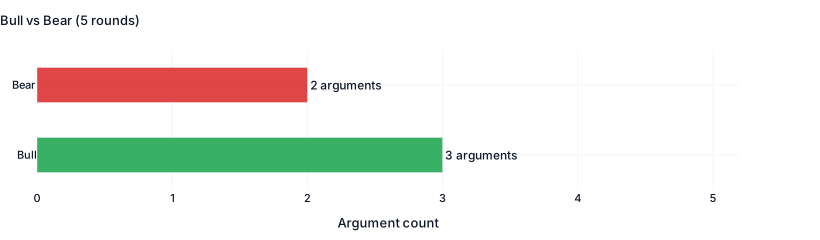
The bull’s strongest arguments: (1) Fundamentals are genuinely accelerating — net income growth (+23%) outpacing revenue growth (+18.3%) with operating margins expanding 280bps is real operating leverage, not an accounting illusion. (2) FCF of ~$63B annualized after $30.9B quarterly capex is enormous absolute capacity, and the capex is going into the exact AI/cloud infrastructure that’s monetizing today (Copilot, Azure AI). (3) PEG of ~1.29x on a $3T quality compounder with 34% ROE is reasonable, not stretched, especially vs. MSFT’s own 2020-2021 multiples of 32-38x. (4) The technical pullback (-5.8% from highs after a +25% rally) with RSI cooling from 73 to 54 and price still 2.94% above the 50-SMA is textbook healthy consolidation, not breakdown.
The bear made some fair points worth taking seriously: (1) Gross margins did compress slightly YoY (68.6% → 67.6%), suggesting the operating margin expansion is leverage-driven and may not be fully repeatable. (2) Capex intensity is real and rising, and AI monetization timelines carry uncertainty. (3) The MACD convergence and the -12.6% gap to the 200-SMA are legitimate near-term technical concerns. (4) A test of $390-395 in the next 6-12 weeks is plausible.
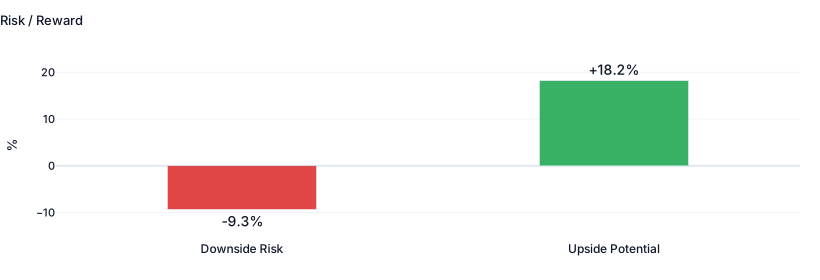
But the bear’s case has notable weaknesses. The “peak earnings” framing requires believing 23% growth collapses to single digits within two quarters — that’s an aggressive claim against a company with accelerating Azure AI revenue, expanding Copilot attach rates, and Mag-7-leading earnings momentum. The “distribution, not accumulation” reading of April 30 is selective interpretation — closing positive at $407.78 with a bounce off $398 on heavy volume is more consistent with dip-buying than distribution. And the bear’s own price target ($380-390 base case) implies only 7-10% downside, while conceding 18-23% upside in the bull scenario — that’s actually a favorable asymmetry for going long, not against it.
The deciding factor: the bear’s recommendation is essentially “wait for $380-395 to buy” — they’re not arguing MSFT is a bad long-term investment, they’re arguing for a better entry. That’s a tactical disagreement, not a structural bear case. Given the quality of the franchise, accelerating AI monetization, and the fact that timing the bottom of a 5-8% pullback in a mega-cap rarely works, I’d rather start building exposure now and add on weakness than try to thread the needle.
I’m landing on Overweight rather than Buy. The bear’s technical concerns (MACD convergence, sub-200-SMA) and capex/macro caveats are credible enough that I don’t want to commit full conviction here, but the fundamental and risk/reward picture is clearly tilted bullish. Scale in, leave room to add lower.
Strategic Actions: POSITION SIZING: Build to a target weight of approximately 4-5% of portfolio (overweight vs. typical benchmark weight of ~6-7% for MSFT — adjust to your benchmark; the point is to be modestly above neutral, not maximum conviction).
EXECUTION PLAN (scale in, don’t chase):
- Initial tranche — Deploy 40% of intended position at current levels (~$407-410). This establishes exposure and avoids the risk of missing a continuation rally if Q2 earnings or Mag-7 momentum reignites the bid.
- Second tranche — Deploy another 35% on a pullback to the $395-400 zone (50-SMA support at $396.11). This is the bear’s projected base case retest and represents an attractive add level.
- Third tranche — Reserve final 25% for a deeper flush to $380-385, which would represent the bear’s “downside breakdown” scenario. If we get there without a fundamental thesis break, that’s the highest-conviction add.
RISK MANAGEMENT:
- Hard stop / thesis review trigger: Close below $370 on heavy volume, OR a guidance cut on the next earnings report. Either invalidates the “healthy consolidation” read and forces reassessment.
- Monitor MACD: If the bearish crossover the bear flagged actually triggers and price breaks $396, pause new buying and wait for the $380-385 level rather than averaging down into momentum failure.
- Watch Azure growth rate and Copilot commentary on the next earnings call — these are the key fundamental tells. Deceleration below mid-30s for Azure or weak Copilot attach commentary would be a yellow flag.
TARGETS & TIME HORIZON:
- 12-month base case target: $475-490 (reclaim of 200-SMA on continued earnings growth + modest multiple support). Roughly +17-20% upside from $407.78.
- Bull case target: $520-540 if AI monetization accelerates and multiples expand. +27-32%.
- Trim trigger: Scale out 25% of the position at $475-485 to lock in gains and re-evaluate.
HEDGING (optional): Given the bear’s legitimate near-term technical concerns, consider buying 1-2 month $390 puts on 25-30% of the position to cap downside through the technical risk window. Cost should be modest given current IV; if MACD crossover doesn’t trigger, let them expire and ride the position.
Do NOT: Chase above $425 without a fresh catalyst, use leverage, or concentrate beyond 5-6% portfolio weight. This is an overweight, not a max-conviction bet.
Trader's Execution Plan
Action: Buy
Reasoning: MSFT’s accelerating fundamentals (23% net income growth, 280bps margin expansion, $63B annualized FCF) and reasonable valuation (1.29x PEG) on a $3T quality compounder with 34% ROE justify establishing exposure now. The technical pullback (-5.8% from highs, RSI 54, price above 50-SMA) represents healthy consolidation, not breakdown, with favorable 18-23% bull upside versus 7-10% bear downside. Rather than attempt tactical timing of a $380-395 retest, scaling in at current levels with clearly defined pullback tranches captures the asymmetric risk/reward while preserving dry powder for weakness.
Entry Price: 407.78
Stop Loss: 370.0
Position Sizing: Initial tranche: 40% of target 4-5% portfolio weight (~1.6-2% of portfolio) at current levels; scale in with 35% on $395-400 pullback, 25% reserve for $380-385
FINAL TRANSACTION PROPOSAL: BUY
Portfolio Manager — Final Verdict
Rating: Overweight
Executive Summary: Initiate an Overweight position in MSFT via scaled entry: deploy 30% of target weight at current ~$407.78, 35% on a pullback to the $395-400 50-SMA zone, and reserve 35% split between a post-earnings confirmation add and a deeper $380-385 flush. Target a 4-5% portfolio weight with a hard stop/thesis review at $370, 12-month base case target of $475-490, and optional 1-2 month $390 puts on 25-30% of the position to hedge the MACD/technical risk window.
Investment Thesis: The bull case carries the structural argument: 23% YoY net income growth outpacing 18.3% revenue growth, 280bps of operating margin expansion, ~$63B annualized FCF, 34% ROE, and a 1.29x PEG on a $3T quality compounder are not “okay” numbers — they are exceptional, and they are accelerating alongside tangible AI monetization (Copilot/PayPal integration, Azure AI). The aggressive analyst is right that the technical pullback (-5.8%, RSI cooling 73→54, price still 2.94% above the 50-SMA at $396.11, MACD still positive at +8.49) is more consistent with healthy consolidation and shake-out than with structural breakdown, and the April 30 volume spike that closed positive at $407.78 reads more like dip-buying than distribution. The conservative analyst raises legitimate concerns I will not dismiss: gross margin compressed YoY (68.6%→67.6%) suggesting margin gains are leverage-driven, MACD differential compressed 85% in three sessions and a bearish crossover would trigger systematic selling, price sits 12.6% below a declining 200-SMA, and VWMA at $416.48 means recent buyers are underwater. However, the bear’s own price target ($380-390) implies only 7-10% downside versus 18-23% upside — a favorable asymmetry that argues for being long, not flat. The neutral analyst’s key insight — that we are between earnings confirmation points and should scale conviction with confirmation rather than load the boat pre-print — is the right tactical overlay. The synthesis: the franchise quality and risk/reward justify Overweight (not Buy, because MACD convergence and sub-200-SMA are real near-term risks), but execution must be phased to respect the timing uncertainty. Trying to thread the needle on a $380 retest in a mega-cap with accelerating Azure/Copilot momentum has historically been a losing game; starting exposure now and adding into weakness or post-earnings confirmation is the higher-expected-value path.
Price Target: 482.0
Time Horizon: 12 months