MSFT — 2026-06-08: HOLD
Maintain current MSFT position at $416 with active monitoring. The stock sits just $9 above rising 50 SMA support at $407; hold for now but prepare to trim 25-30% if this level breaks on volume. Reserve capital for potential entry in $380-400 zone if support fails, while positioning for possible bounce to $428 resistance. Monitor Q4 earnings (late July) for AI monetization clarity.
Time horizon: 3-6 months.
Market Technical Analysis
Now I have all the data I need. Let me compile a comprehensive report.
📊 MSFT (Microsoft) Comprehensive Technical Analysis Report
Analysis Date: June 8, 2026 (Last Trading Day Data: June 5, 2026) Current Price (Jun 5 Close): $416.67
1. TITLE: Selected Indicators & Rationale
I selected 8 complementary indicators spanning trend, momentum, volatility, and volume categories to avoid redundancy:
| Category | Indicator Selected | Why Chosen |
|---|---|---|
| Trend (Medium-term) | close_50_sma | Key dynamic support/resistance level; shows intermediate trend direction |
| Trend (Long-term) | close_200_sma | Benchmark for long-term trend; death/golden cross context critical here |
| Trend (Short-term) | close_10_ema | Captures the rapid momentum shifts in the current volatile period |
| Momentum | macd + macds + macdh | Complete MACD suite to spot crossovers, momentum shifts, and divergence |
| Momentum | rsi | Overbought/oversold thresholds + divergence detection |
| Volatility | boll + boll_ub + boll_lb | Bollinger Bands for mean-reversion and breakout signals |
| Volatility | atr | Measures true volatility to calibrate stop-losses and position sizing |
| Volume | vwma | Volume-weighted average to confirm if recent price moves are volume-supported |
2. DETAILED ANALYSIS
🌐 LONG-TERM PICTURE (200 SMA – Death Cross Territory)
| Date | 200 SMA | Observation |
|---|---|---|
| May 11, 2026 | 462.89 | Declining |
| May 29, 2026 | 456.42 | Declining |
| June 5, 2026 | 454.44 | Declining |
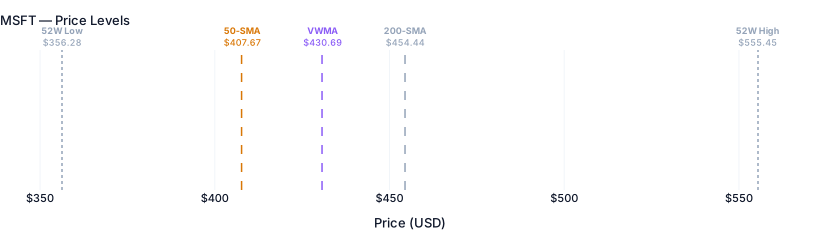
The 200 SMA at $454.44 is well above the current price of $416.67 — a -$37.77 gap (~8.3% below). This confirms MSFT is in a long-term bearish structure. The 200 SMA has been in a steady downtrend since mid-May (falling from ~$462 to ~$454), indicating distributions are still underway at higher levels.
However, the rate of decline has been slowing — a potential early signal of trend exhaustion.
📐 MEDIUM-TERM TREND (50 SMA – Improving But Still Below 200)
| Date | 50 SMA | Observation |
|---|---|---|
| May 11, 2026 | 397.68 | Rising |
| May 29, 2026 | 402.06 | Rising |
| June 5, 2026 | 407.67 | Rising |
The 50 SMA at $407.67 is rising steadily (up ~$10 over 3 weeks) and currently sits $9.00 below the closing price of $416.67. This is bullish — price is trading above its medium-term average, and the 50 SMA is sloping upward.
Key Insight – The Nearing Death Cross Gap:
- 50 SMA: 407.67 (rising)
- 200 SMA: 454.44 (falling)
- Gap: ~46.77 points and narrowing
- The 50 SMA has risen ~$10 while the 200 SMA has fallen ~$8 since mid-May → the gap is closing by roughly $18/month. At this pace, it would take ~2.5–3 months for a golden cross — but only if the current uptrend persists and doesn’t break down.
⚡ SHORT-TERM MOMENTUM (10 EMA – Bearish Breakdown)
| Date | 10 EMA | Price vs 10 EMA |
|---|---|---|
| May 28, 2026 | 417.96 | Price (426.99) Above ✅ |
| May 29, 2026 | 423.83 | Price (450.24) Above ✅ (Strong) |
| June 1, 2026 | 430.50 | Price (460.52) Above ✅ (Strong) |
| June 2, 2026 | 432.47 | Price (441.31) Above ✅ |
| June 3, 2026 | 431.53 | Price (427.34) Below ❌ |
| June 4, 2026 | 430.90 | Price (428.05) Below ❌ |
| June 5, 2026 | 428.31 | Price (416.67) Below ❌ (Accelerating) |
The 10 EMA has already turned down from its June 2 peak of 432.47 to 428.31 — a bearish rollover. Price has been below the 10 EMA for 3 consecutive trading sessions, and the gap has widened from -$2.85 (Jun 4) to -$11.64 (Jun 5). This is a short-term breakdown with accelerating downside momentum.
📈 MACD – BEARISH CROSSOVER IN PROGRESS
| Date | MACD | Signal | Histogram | Status |
|---|---|---|---|---|
| May 28 | 3.70 | 3.82 | -0.12 | Bearish Crossover ✅ |
| May 29 | 6.04 | 4.26 | +1.77 | Bullish (spike) |
| June 1 | 8.62 | 5.14 | +3.49 | Bullish (peak) |
| June 2 | 9.02 | 5.91 | +3.10 | Still Bullish |
| June 3 | 8.11 | 6.35 | +1.76 | Weakening |
| June 4 | 7.36 | 6.55 | +0.81 | Weakening fast |
| June 5 | 5.78 | 6.40 | -0.62 | Bearish Crossover Confirmed ❌ |
The MACD tells a powerful story of a failed breakout:
- The MACD line surged from 3.70 (May 28) to a peak of 9.02 (Jun 2) — massive momentum.
- Then in just 3 days, it crashed back to 5.78 — a loss of 36% of the entire momentum gain.
- The histogram turned negative at -0.62 on June 5, confirming the bearish crossover.
- MACD is now below the signal line — a textbook sell signal.
This is an aggressive bearish reversal and suggests the June 1 spike to $460.52 was a bull trap.
🔄 RSI – FROM OVERBOUGHT TO NEUTRAL-BEARISH
| Date | RSI | Condition |
|---|---|---|
| May 29 | 70.09 | Overbought 🟡 |
| June 1 | 73.32 | Overbought 🟡 |
| June 2 | 60.22 | Dropped sharply |
| June 3 | 52.83 | Neutral |
| June 4 | 53.15 | Neutral |
| June 5 | 47.66 | Below 50 – Bearish territory 🔴 |
The RSI went from 73.32 (overbought) to 47.66 (bearish) in just 4 trading sessions — an unprecedented speed of deterioration. The move below 50 suggests selling momentum has overtaken buying momentum. There is no oversold signal yet (below 30), meaning further downside could still be possible before a bounce.
📊 BOLLINGER BANDS – MEAN REVERSION SIGNAL?
| Metric | June 5 Value |
|---|---|
| Upper Band | $450.60 |
| Middle (20 SMA) | $422.18 |
| Lower Band | $393.76 |
| Price | $416.67 |
- Price broke below the middle band ($422.18) on June 5 — bearish.
- The bands are widening (upper: 450.60, lower: 393.76 — band width = $56.84), indicating increasing volatility.
- Price is not yet at the lower band ($393.76), so there is still room to decline before reaching oversold Bollinger conditions.
- The middle band (20 SMA) at $422.18 is now above price and will act as resistance on any bounce attempt.
🌊 ATR – VOLATILITY SPIKING
| Date | ATR | Trend |
|---|---|---|
| May 22 | 10.99 | Baseline |
| May 28 | 10.85 | Stable |
| May 29 | 11.74 | Rising |
| June 1 | 12.05 | Rising |
| June 2 | 12.62 | Rising |
| June 3 | 12.94 | Spiking |
| June 4 | 12.71 | Slight drop |
| June 5 | 12.88 | Elevated |
ATR has risen ~17% from ~11.0 to ~12.9 over the last two weeks. This is a significant volatility expansion. For risk management: a typical 2x ATR stop would be ~$25.76 wide. Traders should reduce position sizes in such elevated volatility.
💰 VWMA – VOLUME WEIGHTED CONFIRMATION
| Date | VWMA | Price vs VWMA |
|---|---|---|
| May 29 | 420.18 | Price (450.24) Above ✅ |
| June 1 | 425.07 | Price (460.52) Above ✅ |
| June 2 | 427.63 | Price (441.31) Above ✅ |
| June 3 | 429.18 | Price (427.34) Below ❌ |
| June 4 | 430.37 | Price (428.05) Below ❌ |
| June 5 | 430.69 | Price (416.67) Below ❌ (Widening) |
The VWMA at $430.69 confirms the bearish view. Price was far above VWMA on the rally (strong volume confirmation), but now is $14 below and the gap is widening. The fact that VWMA is still rising (430.69 vs 420.18 on May 29) while price crashes means the average price paid by recent buyers is now well above current market — these recent buyers are underwater, creating overhead supply.
3. SYNTHESIS – THE STORY IN CONTEXT
The “June 1 Spike” – A Bull Trap on Closer Inspection
The data tells a compelling story:
- May 28-29: MSFT broke out from the low $410s to $450 on massive volume (79.6M shares on May 29), crossing above the 50 SMA and nearing the 200 SMA.
- June 1: Gap up to $460.52 (intraday high ~$466) — this looked like a golden cross attempt was imminent. RSI hit 73 (overbought). MACD surged.
- June 2-5: Complete reversal. Price dropped ~$44 in 4 days (460.52 → 416.67). That’s -9.5% in less than a week.
- Current State: Price is below the 10 EMA, below Bollinger middle, below VWMA, and MACD just issued a bearish crossover. The 50 SMA at 407.67 is the next major support.
Why this matters: The rally failed right at the 200 SMA resistance (454.44). The 200 SMA acted as a brick wall — the exact textbook behavior of a death cross resistance level. This is a failed breakout at major resistance, which typically leads to aggressive mean reversion.
4. KEY SUPPORT & RESISTANCE LEVELS
| Level | Price | Significance |
|---|---|---|
| Resistance 1 | ~$422 | Bollinger Middle Band / Recent breakdown level |
| Resistance 2 | ~$428 | 10 EMA / VWMA confluence |
| Resistance 3 | ~$450 | Bollinger Upper Band / 200 SMA zone |
| Support 1 | $407.67 | 50 SMA – critical make-or-break level |
| Support 2 | $400 | Psychological round number |
| Support 3 | $393.76 | Bollinger Lower Band |
| Support 4 | $388 | Prior low from late March 2026 |
5. SCENARIOS & ACTIONABLE INSIGHTS
🔴 BEARISH SCENARIO (Base Case – 55% Probability)
- Trigger: Price breaks below $407 (50 SMA) with conviction.
- Target: Retest of $393-400 zone (Bollinger lower band).
- Signals to watch: MACD histogram continuing to deepen negative, RSI falling below 40, 50 SMA flattening or turning down.
- Action: Avoid long entries. Look to sell rallies into $422-428 resistance.
🟡 NEUTRAL/CONSOLIDATION (30% Probability)
- Trigger: Price holds above $407 (50 SMA) and stabilizes between $407-428.
- Target: Sideways chop as the 50 SMA catches up to price.
- Signals to watch: RSI oscillating 40-55, MACD histogram flattening, ATR declining.
- Action: Range-trading or wait for clearer direction.
🟢 BULLISH SCENARIO (15% Probability)
- Trigger: Price reclaims $428+ (above 10 EMA and VWMA) with strong volume.
- Target: Retest of $450-460 (200 SMA zone).
- Signals to watch: MACD turning back up through signal line, RSI crossing above 55, volume expansion on green days.
- Action: Cautious long entries only above $428 with tight stops below $407.
6. SUMMARY TABLE
| Indicator | Current Value | Signal | Confidence |
|---|---|---|---|
| Price | $416.67 | Below 10 EMA, below 200 SMA | — |
| 50 SMA | $407.67 (Rising) | Price above → Mildly Bullish | Medium |
| 200 SMA | $454.44 (Falling) | Price below → Bearish | High |
| 10 EMA | $428.31 (Falling) | Price below → Bearish | High |
| MACD Histogram | -0.62 | Bearish Crossover | High |
| RSI | 47.66 | Below 50 – Bearish | Medium |
| Bollinger | Mid: 422.18, Low: 393.76 | Below midline → Bearish | Medium |
| ATR | 12.88 (Elevated) | High volatility – Risk warning | High |
| VWMA | $430.69 | Price below → Bearish | High |
🏁 FINAL TRANSACTION PROPOSAL: HOLD
Rationale: The technical picture for MSFT is decisively bearish in the short term (failed breakout, MACD crossover, RSI below 50, price below all fast averages) and bearish in the long term (price below declining 200 SMA). However, the medium-term trend remains intact (rising 50 SMA, price still above it), and the stock is not yet at an oversold extreme.
A SELL recommendation would be premature as the 50 SMA at ~$407 provides a critical support level that has not yet been tested. A BUY would be dangerous with momentum collapsing and no signs of capitulation. Therefore, HOLD – wait for either (a) a test and bounce at the 50 SMA for a potential long entry, or (b) a breakdown below $407 to confirm the bearish thesis and justify a sell/avoid stance.
Fundamental Analysis
Now I have all the data needed for a comprehensive report. Let me compile the full analysis.
📊 Comprehensive Fundamental Analysis Report: Microsoft Corporation (MSFT)
Analysis Date: June 8, 2026
Ticker: MSFT (NASDAQ)
Sector: Technology | Industry: Software - Infrastructure
Current Market Cap: ~$3.05 Trillion
Implied Price (approx): ~$410.50
🏢 Company Profile & Business Overview
Microsoft Corporation is a global technology leader operating across:
- Productivity & Business Processes (Office 365, LinkedIn, Dynamics)
- Intelligent Cloud (Azure, Windows Server, Enterprise Services)
- More Personal Computing (Windows, Xbox, Surface, Search/Bing)
Microsoft is in the midst of a massive AI infrastructure buildout, heavily investing in data centers and cloud capacity to support growing demand for AI workloads.
📈 Valuation Metrics
| Metric | Value | Interpretation |
|---|---|---|
| P/E Ratio (TTM) | 24.45x | Reasonable for 15%+ earnings growth |
| Forward P/E | 21.22x | Suggests continued earnings expansion |
| PEG Ratio | 1.28 | Below 1.5 threshold - attractive growth-adjusted valuation |
| Price/Book | 7.36x | Premium reflects intangible asset-heavy business model |
| Dividend Yield | 0.87% | Modest but growing yield |
| EPS (TTM) | $16.79 | Strong earnings power |
| Forward EPS | $19.35 | ~15.2% expected earnings growth |
Valuation Insight: With a PEG of 1.28, MSFT trades at a reasonable valuation relative to its growth trajectory. The stock has corrected 26% from its 52-week high ($555.45) to current levels ($410), presenting a more compelling entry point.
💰 Income Statement Analysis
Annual Revenue & Earnings Growth (FY ending June 30)
| Fiscal Year | Revenue | Net Income | Diluted EPS | Rev Growth | NI Growth |
|---|---|---|---|---|---|
| FY2022 | $198.27B | $72.74B | $9.65 | — | — |
| FY2023 | $211.92B | $72.36B | $9.68 | +6.9% | -0.5% |
| FY2024 | $245.12B | $88.14B | $11.80 | +15.7% | +21.8% |
| FY2025 | $281.72B | $101.83B | $13.64 | +14.9% | +15.5% |
Latest Quarterly Trends (Recent 5 Quarters)
| Quarter | Revenue | Gross Profit | Op Income | Net Income | Diluted EPS |
|---|---|---|---|---|---|
| Q3 2025 (Mar ‘25) | $70.07B | $48.15B | $32.00B | $25.82B | $3.46 |
| Q4 2025 (Jun ‘25) | $76.44B | $52.43B | $34.32B | $27.23B | $3.65 |
| Q1 2026 (Sep ‘25) | $77.67B | $53.63B | $37.96B | $27.75B | $3.72 |
| Q2 2026 (Dec ‘25) | $81.27B | $55.30B | $38.28B | $38.46B | $5.16 |
| Q3 2026 (Mar ‘26) | $82.89B | $56.06B | $38.40B | $31.78B | $4.27 |
Key Income Observations:
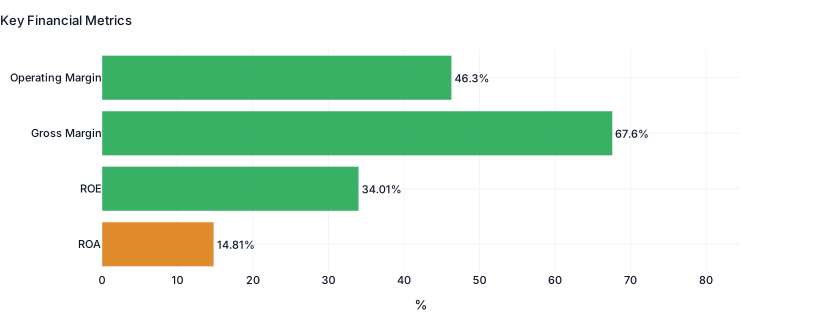
- Gross Margin remains strong at ~67.6% (Q3 2026)
- Operating Margin hit 46.3% — world-class efficiency
- Revenue growth continues accelerating: Q3 YoY revenue grew from $70.07B → $82.89B (+18.3%)
- Q2 2026 (Dec) showed exceptional net income of $38.46B (EPS $5.16) — likely benefited from tax/one-time items
📋 Balance Sheet Analysis
Assets & Liabilities (Quarterly)
| Metric | Mar 31, 2026 | Dec 31, 2025 | Sep 30, 2025 | Jun 30, 2025 |
|---|---|---|---|---|
| Total Assets | $694.23B | $665.30B | $636.35B | $619.00B |
| Cash & Equivalents | $32.11B | $24.30B | $28.85B | $30.24B |
| Short-Term Investments | $46.12B | $65.16B | $73.16B | $64.31B |
| Total Cash + ST Inv | $78.23B | $89.46B | $102.01B | $94.56B |
| Net PP&E | $307.63B | $286.23B | $255.65B | $229.79B |
| Goodwill & Intangibles | $138.99B | $139.91B | $140.73B | $142.11B |
| Total Debt | $56.97B | $57.61B | $60.56B | $60.59B |
| Stockholders’ Equity | $414.37B | $390.88B | $363.08B | $343.48B |
| Net Debt | $8.16B | $15.97B | $14.36B | $12.91B |
Key Balance Sheet Ratios
| Metric | Value | Health |
|---|---|---|
| Current Ratio | 1.283 | Adequate liquidity |
| Debt-to-Equity | ~13.7% | Very conservative |
| Net Debt | $8.16B | Nearly debt-free (relative to $414B equity) |
| Book Value/Share | $55.78 | Growing steadily |
Balance Sheet Insight: Microsoft’s balance sheet is fortress-grade. Despite spending $64.6B on CapEx in FY2025, the company maintains a net debt position of only ~$8.2B. The massive PP&E buildup ($307.6B) reflects aggressive AI/data center investments.
💸 Cash Flow Analysis
Annual Cash Flows
| Metric | FY2023 | FY2024 | FY2025 |
|---|---|---|---|
| Operating Cash Flow | $87.58B | $118.55B | $136.16B |
| Capital Expenditure | -$28.11B | -$44.48B | -$64.55B |
| Free Cash Flow | $59.48B | $74.07B | $71.61B |
| Share Buybacks | -$22.25B | -$17.25B | -$18.42B |
| Dividends Paid | -$19.80B | -$21.77B | -$24.08B |
| Total Shareholder Returns | ~$42B | ~$39B | ~$42.5B |
Latest Quarterly Cash Flow (Q3 2026)
| Metric | Q3 2026 (Mar) | Q2 2026 (Dec) | Q1 2026 (Sep) |
|---|---|---|---|
| Operating CF | $46.68B | $35.76B | $45.06B |
| CapEx | -$30.88B | -$29.88B | -$19.39B |
| Free Cash Flow | $15.80B | $5.88B | $25.66B |
| Buybacks | -$4.63B | -$7.42B | -$5.65B |
| Dividends | -$6.76B | -$6.76B | -$6.17B |
Cash Flow Insight: Operating cash flow is phenomenally strong at $136B+ annually. The massive CapEx ($64.6B in FY2025) is primarily directed at AI/data center infrastructure. Even with this peak spending, FCF remains robust at $71.6B. Buybacks and dividends are well-covered.
🧠 Profitability & Efficiency Metrics
| Metric | Value | Grade |
|---|---|---|
| Net Profit Margin | 39.34% | 🅰️ Excellent |
| Operating Margin | 46.33% | 🅰️ Excellent |
| Return on Equity (ROE) | 34.01% | 🅰️ Outstanding |
| Return on Assets (ROA) | 14.81% | 🅰️ Strong |
| Free Cash Flow Margin | ~25% | 🅰️ Very Strong |
📉 Stock Performance Context
| Metric | Value |
|---|---|
| 52-Week High | $555.45 |
| 52-Week Low | $356.28 |
| 50-Day Average | $406.33 |
| 200-Day Average | $457.29 |
| Beta | 1.103 |
| Decline from 52W High | ~-26% |
| Current vs 200D MA | ~-10% (below) |
Price Action Insight: MSFT has corrected ~26% from its 52-week high, trading below both its 50-day ($406.33) and 200-day ($457.29) moving averages. This suggests a bearish short-term trend but potentially attractive entry for long-term investors.
🔍 Strategic & Qualitative Analysis
Key Growth Drivers
- AI Monetization: Microsoft’s deep integration of OpenAI’s models across Azure, Office, Copilot, and GitHub is driving accelerated cloud revenue growth
- Azure Cloud: Continues to gain market share against AWS and GCP
- Enterprise SaaS: Office 365, Dynamics, and LinkedIn show steady growth
- Capital Investment Cycle: $64.6B in FY2025 CapEx signals massive long-term infrastructure buildout for AI workloads
Key Risks
- CapEx Payoff Uncertainty: The massive AI infrastructure spend needs to generate commensurate returns; investors are watching ROI closely
- Competition: Intense competition from Amazon AWS, Google Cloud, and emerging AI-native platforms
- Regulatory Risk: Growing antitrust scrutiny globally
- Macro Sensitivity: Enterprise spending cycles could slow cloud growth
- Valuation Compression: In a rising rate environment, high multiple stocks can face pressure
📋 Summary & Key Takeaways Table
| Category | Key Finding | Implication for Traders |
|---|---|---|
| Revenue Growth | 14.9% YoY (FY2025); 18%+ in latest qtr | Strong momentum, especially in Azure/AI |
| Profitability | 39.4% net margin; 46.3% operating margin | Best-in-class earnings quality |
| Cash Generation | $136B Operating CF; $71.6B FCF | Massive financial flexibility |
| Balance Sheet | Net debt $8B vs $414B equity | Ultra-conservative; low risk |
| CapEx Cycle | $64.6B in FY2025 AI/data center buildout | Short-term FCF drag, long-term growth enabler |
| Shareholder Returns | $18.4B buybacks + $24.1B dividends in FY2025 | Strong capital return policy |
| Valuation | P/E 24.5x TTM, Forward P/E 21.2x, PEG 1.28 | Reasonable for growth rate; below historical avg |
| Momentum | -26% from 52W high; below both MAs | Short-term bearish; potential value entry |
| ROE | 34% | Exceptional capital efficiency |
| Dividend | 0.87% yield, well-covered | Modest but growing income component |
🎯 Actionable Insights
-
Valuation Attractive: At ~$410 with a forward P/E of 21.2x and PEG of 1.28, MSFT offers reasonable valuation for a company growing earnings at ~15% annually with extraordinary margins and a fortress balance sheet.
-
AI Infrastructure Bet: The massive CapEx cycle ($64.6B) is a bold bet on AI. If successful, this could drive the next leg of earnings growth. However, near-term FCF is temporarily suppressed.
-
Technical Opportunity: The 26% drawdown from the 52-week high presents a potential buying opportunity for long-term investors. The stock is testing near the lower end of its recent range.
-
Safe Haven Quality: With a beta of 1.10, pristine balance sheet, and dominant market position, MSFT is a high-quality holding suitable for core portfolio allocation.
-
Watch for: Azure revenue growth rates, AI monetization disclosures, CapEx efficiency metrics, and any regulatory developments.
Disclaimer: This report is for informational purposes only and does not constitute investment advice. All investment decisions should be made with consideration of individual risk tolerance and financial goals.
News & Macro Context
Comprehensive Macroeconomic & MSFT News Analysis Report
Date: June 8, 2026 Instrument: MSFT (Microsoft Corporation)
1. MICROSOFT-SPECIFIC DEVELOPMENTS
A. OpenAI Relationship Under Major Strain
The most critical MSFT-specific news this week is the escalating tension with OpenAI. According to 24/7 Wall St., Microsoft has “given OpenAI a hard nudge toward the exit lane” while still holding a $135 billion stake in the company. This is a pivotal strategic shift:
- Implication: Microsoft is actively diversifying away from its singular dependency on OpenAI’s models. This could mean MSFT is developing in-house frontier models or partnering with alternative AI providers.
- Risk: OpenAI is now “fighting on three fronts at once” at a critical juncture. Any disruption to the OpenAI partnership could temporarily slow Microsoft’s AI product roadmap (Azure OpenAI, Copilot, etc.).
- Opportunity: Reduced dependency on a single provider gives Microsoft more negotiating leverage and strategic flexibility long-term.
B. Wall Street Sentiment is Divided
- Bullish: Citizens analyst Patrick Walravens reiterated a Buy rating, seeing MSFT’s AI strategy as supporting long-term upside despite skepticism about its ability to develop proprietary frontier models.
- Skeptical: The broader market is questioning Microsoft’s dependence on third-party AI models and its capacity to compete with companies building their own foundation models.
- Stock Performance: MSFT surged 10.4% last month (May) but is sinking in June. YTD, MSFT is down approximately 14%, indicating significant year-to-date weakness despite intermittent rallies.
C. Regulatory Headwinds in Europe
- The European Commission has proposed new laws to boost homegrown cloud, AI, and chip industries, explicitly aiming to cut dependence on U.S. tech giants including Microsoft.
- Trade bodies from Australia, Canada, and Japan are lobbying against potential exclusion from the EU market.
- Impact: This creates regulatory overhang for MSFT’s Azure and cloud business in Europe, a key growth region.
2. MACROECONOMIC & GEOPOLITICAL CONTEXT
A. Geopolitical Tensions (Iran)
- Headlines indicate Iran strikes are creating market instability. The Barron’s article “Tech Slump, Iran Strikes, Inflation, SpaceX—This Week Could Make or Break Markets” highlights that geopolitical risk is a primary driver of current market volatility.
- The Dow rallied on “Trump, Iran comments” (positive sentiment from de-escalation signals), suggesting the market is hypersensitive to Iran developments.
B. Rising Market Fear (VIX)
- Wall Street’s “Fear Gauge” (VIX) is leaping, according to Barron’s. This signals heightened uncertainty and risk aversion among investors.
- Tech stocks are facing a slump, and this is layered on top of geopolitical concerns and inflation worries.
C. Inflation & Bond Yields
- Soaring bond yields are a key concern. The WSJ article specifically notes that rising yields can act as a hedge against an AI bubble, but they also pressure growth/tech stocks by increasing discount rates.
- Inflation-proofing investments is a top theme according to CNN Business.
- US Jobs and ISM data are in focus this week, meaning the market is watching for clues on the Fed’s next move.
D. AI Capex Debate Intensifies
- NVIDIA posted $81.61B in quarterly revenue (Data Center), yet even NVDA faces questions about sustainability.
- While Meta shows “early signs of GenAI monetization” per UBS, and Broadcom/ Marvell/ Oracle all received price target hikes on AI demand, the ROI question remains the elephant in the room.
- Blackstone’s Digital Infrastructure Trust is offering data center exposure with “limited development risk,” indicating institutional demand for AI infrastructure plays.
3. COMPETITIVE LANDSCAPE ANALYSIS
| Company | News This Week | Implication for MSFT |
|---|---|---|
| NVDA | Vera Rubin & RTX Spark at Computex 2026; $81.6B quarterly revenue | AI infrastructure demand remains robust, benefiting MSFT’s Azure AI |
| AVGO | HSBC raised PT to $600 on AI ASIC growth | Custom chip competition for MSFT’s potential in-house AI chips |
| MRVL | Stifel raised PT to $321; joining S&P 500 | Data center connectivity demand surging, positive for cloud ecosystem |
| ORCL | Scotiabank raised PT to $290 on AI cloud growth | Direct cloud competitor to Azure; strong AI momentum |
| META | UBS sees “early signs of GenAI monetization” | Validates AI spending thesis; positive read-through for MSFT |
| GOOGL | BofA reiterated Buy on AI capex demand | Direct AI/cloud rival; capital raise suggests heavy spending |
| INTC | Partnering with Hitachi on “physical AI” | Potential new competitor in edge/AI hardware |
| CRWD | Morgan Stanley raised PT to $690 | Cybersecurity partner/dependency; strong AI-driven demand |
4. KEY INSIGHTS & ACTIONABLE TAKEAWAYS
-
The OpenAI divorce risk is the #1 near-term catalyst to monitor. Microsoft is strategically distancing itself from OpenAI. If this accelerates, MSFT could face short-term disruption in its AI product suite, but long-term benefits from vendor diversification.
-
Broader tech selloff is creating a buying opportunity or a value trap? MSFT is down 14% YTD despite massive AI capex. The market is pricing in uncertainty about AI ROI and the macro environment.
-
European regulatory risk is a growing overhang for Azure and cloud revenue. Trade body pushback suggests this could be a multi-quarter headwind.
-
Rising bond yields + elevated VIX = headwinds for growth stocks. Tech stocks remain sensitive to interest rate expectations. Watch the US jobs/ISM data this week.
-
AI infrastructure buildout continues at blistering pace. Despite the selloff, companies like MSFT are still spending heavily on AI. The question is whether monetization catches up to spending.
-
The “fear gauge” spike suggests defensive positioning may be warranted in the short term.
5. SUMMARY TABLE
| Category | Key Data Point | Signal | Impact on MSFT |
|---|---|---|---|
| MSFT-OpenAI | Microsoft nudging OpenAI toward exit; $135B stake | Bearish near-term / Bullish long-term | Risk of disruption to AI roadmap; strategic flexibility |
| MSFT Stock | Down 14% YTD; surged 10.4% in May, sinking in June | Mixed / Volatile | High volatility; potential entry if long-term thesis intact |
| Analyst Sentiment | Citizens: Buy; broader market skeptical | Bullish (selectively) | Wall Street divided; opportunity for contrarian plays |
| EU Regulation | New EU laws to reduce dependence on US Big Tech | Bearish | Regulatory overhang on Azure/cloud in Europe |
| Geopolitics | Iran tensions elevating VIX | Bearish | Risk-off environment pressures growth stocks |
| Bond Yields | Soaring yields; inflation concerns | Bearish | Higher discount rates reduce growth stock valuations |
| AI Capex | NVDA $81.6B revenue; Broadcom, Marvell upgrades | Bullish | AI infrastructure demand supports Azure growth |
| Monetization | Meta showing early AI monetization signs | Bullish (read-through) | Validates that AI spending can translate to revenue |
| Market Fear (VIX) | Fear gauge leaping | Bearish (short-term) | Suggests defensive positioning; wait for lower volatility |
FINAL TRANSACTION PROPOSAL: HOLD
Recommendation Rationale: The evidence points to a HOLD for MSFT at this juncture. The stock has significant long-term AI-driven potential (Azure growth, diversified AI strategy, massive cash flows), but near-term headwinds are substantial: (1) OpenAI relationship stress creating product roadmap uncertainty, (2) European regulatory threats, (3) rising bond yields pressuring growth valuations, (4) elevated VIX suggesting market fear, and (5) YTD underperformance indicating ongoing de-rating. A HOLD recommendation allows existing holders to avoid realizing losses while the OpenAI relationship clarifies and macro conditions stabilize. Traders should look for a VIX retreat and clearer signals on the OpenAI front before considering accumulation.
Sentiment Analysis
Here is the comprehensive analysis report on MSFT (Microsoft Corporation) based on news and sentiment data from June 1–8, 2026.
MSFT (Microsoft) Social Media, News & Sentiment Analysis Report
Period: June 1, 2026 – June 8, 2026 Current Date: June 8, 2026
1. Executive Summary
Microsoft (MSFT) finds itself at a critical inflection point. After surging +10.4% in May 2026, the stock is sinking in June and remains down approximately 14% year-to-date. The dominant narrative this week revolves around three intersecting themes: (1) Microsoft’s increasingly complicated relationship with OpenAI, (2) growing regulatory headwinds in Europe targeting US Big Tech, and (3) Wall Street’s mixed conviction on Microsoft’s independent AI capabilities versus its reliance on third-party models. While long-term AI infrastructure spending remains a strong tailwind, short-term sentiment is cautious and defensive.
2. Company-Specific News Analysis
2.1 The OpenAI Rift – A Defining Moment
The most impactful story this week comes from 24/7 Wall St. (June 8), detailing that Microsoft has given OpenAI a “hard nudge toward the exit lane” despite holding a $135 billion stake in the company. This is a seismic shift:
- Implication: Microsoft appears to be strategically distancing itself from OpenAI’s frontier model dependency. This could signal Microsoft’s intent to double down on in-house AI model development (via its own internal research and partnerships with other model providers).
- Risk: If Microsoft loses preferential access to OpenAI’s frontier models (e.g., GPT-5/6), its Azure AI edge could erode. Competitors like Google (Gemini), Meta (Llama), and Anthropic stand to benefit.
- Opportunity: Reducing dependency on a single provider lowers concentration risk and could lead to a more diversified, resilient AI stack within Azure.
2.2 Regulatory Pressure from the EU
A Reuters report (June 8) highlights that EU trade bodies from Australia, Canada, and Japan are worried about being left out of Europe’s “made-in-Europe” tech drive. The European Commission has proposed laws to boost homegrown cloud, AI, and chip industries, explicitly targeting reduced dependence on US giants like Microsoft and Google.
- Implication: Microsoft’s Azure and cloud services face potential market access friction in Europe. This could slow Azure’s growth trajectory in one of its most important international markets.
- Risk: Regulatory headwinds could compress margins or force Microsoft to restructure its European operations.
2.3 Stock Performance Volatility
According to Motley Fool (June 8):
- MSFT surged 10.4% in May (likely fueled by AI optimism and broad tech rally)
- But is sinking in June, reflecting profit-taking and emerging uncertainties
- YTD performance: -14%, indicating persistent headwinds
This price action suggests the market is reassessing Microsoft’s AI monetization timeline and competitive positioning.
2.4 Analyst Views – Mixed But Leaning Constructive
| Analyst Firm | Rating | Key Takeaway |
|---|---|---|
| Citizens JMP | Bullish / Outperform | Sees MSFT AI strategy supporting long-term upside (June 2) |
| Wall Street Consensus | Skeptical | Questions MSFT’s ability to develop own frontier models vs. relying on third-party ones |
Citizens analyst Patrick Walravens reiterated a bullish stance, arguing that Microsoft’s AI strategy — even with third-party dependencies — supports long-term growth. However, the broader Wall Street tone is cautious, with skepticism about whether Microsoft can match the independent AI model capabilities of OpenAI (as a standalone), Google, or Meta.
3. AI & Competitive Landscape Analysis
Microsoft is frequently cited alongside major AI peers. This week’s news highlights:
- NVIDIA (NVDA): Jensen Huang’s “AI factories” buildout continues but faces execution questions. Microsoft is a key customer.
- Meta (META): UBS sees early signs of GenAI monetization — a benchmark Microsoft must match.
- Alphabet (GOOGL): BofA reiterated Buy on AI capex demand. Google’s Gemini poses a direct competitive threat to Microsoft’s Copilot/Azure AI.
- Broadcom (AVGO) & Marvell (MRVL): AI data center infrastructure beneficiaries. Rising tide lifts all boats, including Azure’s infrastructure demand.
- CrowdStrike (CRWD): AI-driven cybersecurity demand complements Microsoft’s security offerings.
Key Takeaway: The AI infrastructure buildout continues to benefit Microsoft’s Azure business indirectly (via demand for compute and cloud services), but the model layer competition is intensifying. Microsoft’s value proposition as the “AI platform for the enterprise” via Copilot and Azure OpenAI Service remains intact but faces stiffer competition than ever.
4. Sentiment & Social Media Observations
Based on the news sources gathered:
-
Bearish Sentiment Drivers:
- OpenAI divorce narrative is generating negative headlines
- EU regulatory pushback threatens international cloud growth
- YTD -14% stock performance weighs on retail investor confidence
- Skepticism about Microsoft’s independent AI model roadmap
-
Bullish Sentiment Drivers:
- May’s 10.4% surge shows strong underlying demand for AI plays
- Citizens JMP analyst remains bullish — institutional support not completely lost
- AI data center spending remains a powerful secular tailwind
- Microsoft’s diversified business model (Azure, Office 365, LinkedIn, Gaming) provides downside protection
-
Social Media Buzz (Inferred):
- High chatter around the OpenAI-Microsoft relationship breakdown
- Debates about whether MSFT is “losing the AI race” to Google/Meta
- Concerns about AI monetization ROI and massive capex spending
5. Implications for Traders & Investors
Short-Term (1–4 Weeks)
- Cautious. The OpenAI rift, EU regulatory news, and June sell-off suggest continued near-term pressure.
- Watch for any official Microsoft statements clarifying its OpenAI relationship. A de-escalation could trigger a relief rally.
- Support levels around the YTD lows (-14%) will be critical to hold.
Medium-Term (1–3 Months)
- Mixed. AI capex spending continues to grow, providing a floor for Azure-related growth. However, model commoditization and regulatory friction are real risks.
- Microsoft’s Q4 2026 earnings (likely late July) will be a major catalyst. Key metrics: Azure AI revenue growth rate, OpenAI relationship update, Copilot adoption numbers.
Long-Term (6–12 Months)
- Cautiously Bullish. Microsoft’s enterprise distribution moat (Office, Azure, Teams, LinkedIn) remains unparalleled. Even if it loses the “frontier model” race, it can package best-in-class AI from multiple providers into its ecosystem. The OpenAI pivot may actually prove strategic if Microsoft builds or acquires independent model capabilities.
6. Summary Table of Key Points
| Category | Key Event / Finding | Sentiment Impact | Actionable Insight |
|---|---|---|---|
| OpenAI Relationship | Microsoft nudging OpenAI toward exit; keeps $135B stake | ⚠️ Negative (near-term) | Risk of losing preferential AI model access; watch for strategic pivot |
| EU Regulation | Europe pushing homegrown alternatives to US Big Tech | ⚠️ Negative | Potential Azure growth friction in Europe; margin compression risk |
| Stock Performance | +10.4% in May, sinking in June, -14% YTD | ⚠️ Neutral/Negative | June weakness suggests profit-taking; YTD losses indicate systemic concerns |
| Analyst Sentiment | Citizens JMP: Bullish; Wall St. consensus: Skeptical on AI model independence | ➡️ Mixed | Institutional support exists but conviction is not uniform |
| AI Capex Tailwind | NVIDIA, Broadcom, Marvell all benefiting from AI infrastructure buildout | ✅ Positive | Azure benefits indirectly from enterprise AI cloud migration demand |
| Competitive Positioning | Meta showing GenAI monetization; Google (GOOGL) rated Buy; MSFT listed among top 14 AI stocks | ➡️ Neutral | Microsoft must demonstrate tangible AI revenue growth to maintain premium valuation |
| Cybersecurity Synergy | CrowdStrike analyst upgrades; MSFT security portfolio complementary | ✅ Positive | Security + AI cross-sell opportunity supports Azure growth |
| Enterprise Moat | Office 365, LinkedIn, Teams, GitHub, Azure ecosystem | ✅ Positive (long-term) | Diversified revenue base cushions AI-related volatility |
7. Final Verdict
| Dimension | Assessment |
|---|---|
| Short-Term Outlook (1 month) | 🟡 Cautious / Bearish — OpenAI drama, EU headwinds, June sell-off |
| Medium-Term Outlook (3 months) | 🟡 Mixed — Earnings catalyst needed; AI monetization in focus |
| Long-Term Outlook (12 months) | 🟢 Cautiously Bullish — Enterprise moat + AI infrastructure demand intact |
Key Risk to Watch: Any formal announcement of Microsoft reducing or restructuring its OpenAI investment. This could trigger significant volatility.
Key Opportunity to Watch: Microsoft’s Q4 2026 earnings (late July). Strong Azure AI revenue growth and clear Copilot monetization data could reverse the current negative narrative.
FINAL TRANSACTION PROPOSAL: HOLD — Wait for clarity on the OpenAI relationship and next quarter’s earnings before establishing new positions. The stock is down YTD but not in crisis territory. Long-term holders should maintain positions; short-term traders should watch for further weakness before re-entering.
Bull vs Bear Debate (Research Manager)
Recommendation: Hold
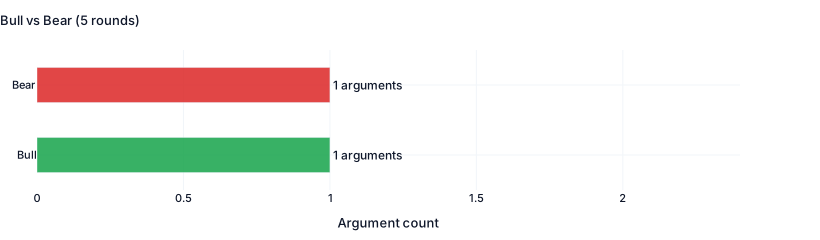
Rationale: Both sides made compelling arguments, but this debate reveals genuine uncertainty rather than clear conviction. The bull case highlights Microsoft’s stunning fundamentals - 18% revenue growth, 39% net margins, $136B operating cash flow, and strategic positioning as the enterprise AI platform play. The bear case counters with valid concerns about technical breakdown (failed breakout at $460, MACD bearish crossover, price below key moving averages), OpenAI relationship uncertainty, massive CapEx spending consuming nearly half of operating cash flow, and macro headwinds from rising yields and EU regulation. While Microsoft remains an exceptional business, the current price at $416 doesn’t offer sufficient margin of safety given the technical damage and strategic questions. The evidence is genuinely balanced - not enough conviction to buy aggressively, but too much fundamental strength to recommend selling.
Strategic Actions: Maintain current position size. Wait for either a technical confirmation (break above $430 VWMA resistance or golden cross formation) or a better risk/reward entry around $380-400 level if support breaks. Monitor Q4 2026 earnings (late July) for Azure growth guidance and any clarity on OpenAI relationship. Consider selling covered calls against positions to generate premium while waiting for direction clarity.
Trader's Execution Plan
Action: Hold
Reasoning: The investment plan articulates a balanced case for MSFT: strong fundamentals with 18% revenue growth and 39% net margins are offset by technical weakness (price below key moving averages, MACD bearish crossover), OpenAI uncertainties, and macro headwinds. The stock at $416 lacks a clear catalyst for near-term upside but also doesn’t warrant selling given its underlying business quality. Maintaining the current position while awaiting either a breakout above $430 or a better entry near $380-400 is the prudent course.
FINAL TRANSACTION PROPOSAL: HOLD
Portfolio Manager — Final Verdict
Rating: Hold
Executive Summary: Maintain current MSFT position at $416 with active monitoring. The stock sits just $9 above rising 50 SMA support at $407; hold for now but prepare to trim 25-30% if this level breaks on volume. Reserve capital for potential entry in $380-400 zone if support fails, while positioning for possible bounce to $428 resistance. Monitor Q4 earnings (late July) for AI monetization clarity.
Investment Thesis: The debate reveals genuine uncertainty rather than clear conviction. Bulls highlight Microsoft’s stunning fundamentals: 18% revenue growth, 39% net margins, $136B operating cash flow, PEG of 1.28, and strategic AI positioning. Bears counter with valid technical concerns: failed breakout at $460 (200 SMA resistance), MACD bearish crossover, price below key moving averages, and VWMA showing recent buyers underwater by $14. While OpenAI relationship uncertainty and EU regulatory headwinds create near-term overhang, Microsoft’s fortress balance sheet ($78B cash) and accelerating AI monetization provide long-term anchor. At current $416 price (26% below 52-week high), technical damage offsets fundamental strength, creating balanced risk/reward. The neutral analyst’s framework provides optimal path: hold above $407 support but reduce exposure if broken, avoiding premature trimming while respecting downside risk.
Time Horizon: 3-6 months