SFM — 2026-06-07: BUY
Initiate a phased entry in SFM at current levels (~$82.87) with moderate position sizing. Begin with half allocation, setting initial stop-loss at $77.50 below Bollinger lower band support. Add second half only upon confirmed breakout above VWMA resistance at $85.30 with improving MACD momentum. Target $94 within 3-6 months as technical conditions align with strong fundamentals.
Time horizon: 3-6 months.
Market Technical Analysis
Now I have all the data. Let me compile a comprehensive analysis.
SFM (Sprouts Farmers Market) — Comprehensive Technical Analysis Report
Date: June 7, 2026 (Last Trading Day: June 5, 2026 — Close: $82.87)
1. MACRO PRICE CONTEXT (12-Month Journey)
SFM experienced a dramatic year-long journey:
- Jun–Oct 2025: Steady decline from ~$169 → ~$101 (bear market)
- Oct 30, 2025: Major gap down event (~$104 → ~$77) — sharp revaluation
- Nov 2025 – Feb 2026: Continued erosion to yearly low of $64.85 (Feb 10, 2026)
- Feb–May 2026: Powerful recovery rally from ~$65 → $90.02 (May 19 peak) — a ~38% surge
- Late May–June 2026: Pullback from $90 to current $82.87 (~8% correction)
2. SELECTED INDICATORS & THEIR SIGNALS
A. Moving Averages (Trend Structure)
| Indicator | Value | Interpretation |
|---|---|---|
| Close (Jun 5) | $82.87 | — |
| 10 EMA | $82.33 | ✅ Price above — short-term bullish |
| 50 SMA | $79.59 | ✅ Price above — medium-term bullish; SMA rising |
| 200 SMA | $88.90 | ❌ Price below — long-term bearish; SMA declining |
| 50 vs 200 gap | ~$9.31 converging | ⚠️ Potential Golden Cross forming — 50 SMA rising, 200 SMA falling |
The converging 50 and 200 SMAs are the single most important structural feature right now. The 50
SMA is climbing ($79.59) and the 200 SMA is declining ($88.90). If this convergence continues at
the current pace, a Golden Cross (50 SMA crossing above 200 SMA) could materialize in the coming
weeks — a historically bullish signal. This is the key development to watch.
B. MACD (Momentum)
| Component | Value (Jun 5) | Signal |
|---|---|---|
| MACD Line | 0.272 | Positive but collapsing |
| MACD Signal | 1.260 | Well above MACD line |
| MACD Histogram | -0.988 | Bearish — below zero line |
Critical Momentum Analysis:
- MACD peaked at 3.38 on May 20 and has been in free-fall since.
- The MACD line crossed below the Signal line around May 28-29 (histogram turned negative), producing a bearish crossover.
- However, the MACD line remains above zero (0.272), meaning the 12-EMA is still above the 26-EMA in absolute terms — the uptrend is intact but losing steam rapidly.
- The steep decline in MACD suggests the recent pullback is momentum-driven selling, not a full trend reversal… yet.
C. RSI (Momentum / Overbought-Oversold)
| Date | RSI |
|---|---|
| May 13 (peak) | 69.97 (near overbought) |
| May 19 | 68.73 |
| Jun 2 (trough) | 41.64 |
| Jun 5 | 51.26 — Neutral |
RSI has reset from overbought territory (~70) back to neutral (~51) during the $90→$83 pullback. This is constructive — it indicates the selloff was a healthy correction rather than a structural breakdown. RSI now has headroom to move up without immediately hitting overbought levels, allowing room for a renewed rally.
D. Bollinger Bands (Volatility & Price Position)
| Component | Value (Jun 5) |
|---|---|
| Upper Band | $91.94 |
| Middle (20-SMA) | $84.72 |
| Lower Band | $77.50 |
| Band Width | $14.44 (~17% of price) — Wide |
Price ($82.87) is below the middle band ($84.72), indicating bearish short-term pressure. However, price is still well above the lower band ($77.50), so there’s no oversold bounce signal yet. The wide band width reflects elevated volatility consistent with the transition phase.
E. ATR (Average True Range — Volatility Measure)
| Date | ATR |
|---|---|
| Apr 24 (low) | 2.73 |
| Jun 1 (high) | 3.96 |
| Jun 5 | 3.68 |
ATR climbed from ~2.73 to ~3.96 during the rally, confirming increased volatility. At $3.68, it remains elevated. For risk management:
- A 1x ATR stop below entry would be ~$3.68
- A 2x ATR stop would be ~$7.36
- Position sizing should account for this wide daily range
F. VWMA (Volume-Weighted MA — Volume Confirmation)
| Date | VWMA |
|---|---|
| Jun 5 | $85.30 |
| Jun 1 | $87.03 |
| May 19 | $84.32 |
Price ($82.87) is below VWMA ($85.30), indicating that volume-weighted price action has been weaker than simple price action. This suggests the pullback has been accompanied by distribution (selling on higher volume). Until price reclaims VWMA, the short-term bias remains cautious.
3. SYNTHESIS: THE CONTRADICTORY PICTURE
SFM is in a critical transition zone where multiple timeframes disagree:
| Timeframe | Signal | Evidence |
|---|---|---|
| Long-term (6-12 mo) | 🟡 Bearish | Price below declining 200 SMA ($88.90) |
| Medium-term (1-3 mo) | 🟢 Bullish | Price above rising 50 SMA ($79.59); potential Golden Cross |
| Short-term (1-4 weeks) | 🔴 Bearish | MACD bearish crossover; price below Bollinger mid-band & VWMA |
The Golden Cross Watch
The most important development is the convergence of the 50 and 200 SMAs. Currently:
- 50 SMA: $79.59 (rising ~$0.40-0.50/week)
- 200 SMA: $88.90 (falling ~$0.35-0.40/week)
- Convergence rate: ~$0.75-0.90/week
- Time to cross at current rate: ~8-12 weeks
A Golden Cross would be a powerful bullish signal, but we’re not there yet. Until then, the 200 SMA acts as resistance overhead.
4. ACTIONABLE TRADING SCENARIOS
Scenario A: Bullish Breakout (Probable if…)
- Price reclaims $84.72 (Bollinger mid-band)
- Price climbs back above VWMA ($85.30)
- MACD histogram stops declining and begins to flatten/turn up
- Target: $88.90 (200 SMA) → $91.94 (Bollinger upper band) → $94+ (above prior highs)
Scenario B: Continued Consolidation (Neutral)
- Price oscillates between $79.59 (50 SMA) support and $85.30 (VWMA) resistance
- RSI oscillates between 40-60
- MACD drifts sideways near zero
- Action: Wait-and-see; trade range if desired
Scenario C: Breakdown (Bearish)
- Price loses $79.59 (50 SMA) support
- ATR expands further, indicating panic selling
- MACD line crosses below zero
- Target: $77.50 (Bollinger lower band) → $74-75 area (prior support)
5. RECOMMENDATION
Given the conflicting signals across timeframes, the prudent stance is:
FINAL TRANSACTION PROPOSAL: HOLD
Rationale:
- No clear entry signal: The MACD bearish crossover warns against chasing, while the 50 SMA support and potential Golden Cross argue against selling.
- Transition zone risk: The price is sandwiched between rising 50 SMA support ($79.59) and declining 200 SMA resistance ($88.90) — this 10% range is a no-man’s-land.
- Momentum reset is positive but incomplete: RSI at 51 gives room to rally, but MACD needs to bottom first.
- Key catalysts to watch: (a) Golden Cross confirmation, (b) MACD histogram turning positive again, (c) Price reclaiming VWMA — any of these would upgrade the outlook to BUY.
- If already holding: Maintain position but tighten stops near $79.50 (50 SMA). A break below that level would suggest the pullback is deepening.
- If looking to enter: Wait for either (a) a successful retest of $79-80 support with RSI staying above 40, or (b) a decisive break above $85.30 (VWMA) with rising MACD.
6. KEY LEVELS SUMMARY TABLE
| Level | Price | Significance |
|---|---|---|
| Resistance 3 | $94+ | Above prior May highs — new bullish leg |
| Resistance 2 | $91.94 | Bollinger Upper Band |
| Resistance 1 | $88.90 | 200 SMA — Major long-term resistance |
| Pivot | $85.30 | VWMA — Volume-weighted resistance |
| Middle Band | $84.72 | Bollinger 20-SMA — Short-term pivot |
| Last Close | $82.87 | Current price as of Jun 5 |
| Support 1 | $79.59 | 50 SMA — Key medium-term support |
| Support 2 | $77.50 | Bollinger Lower Band |
| Support 3 | $74-75 | Prior consolidation zone (Apr-May) |
7. INDICATOR DASHBOARD
| Indicator | Value | Signal | Weight |
|---|---|---|---|
| Price vs 10 EMA | $82.87 > $82.33 | 🟢 Bullish | Short-term |
| Price vs 50 SMA | $82.87 > $79.59 | 🟢 Bullish | Medium-term |
| Price vs 200 SMA | $82.87 < $88.90 | 🔴 Bearish | Long-term |
| MACD vs Signal | 0.27 < 1.26 | 🔴 Bearish Crossover | Short-term |
| MACD Histogram | -0.99 (negative) | 🔴 Bearish | Momentum |
| RSI | 51.26 | 🟡 Neutral | Room to move either way |
| Price vs Boll Mid | $82.87 < $84.72 | 🔴 Bearish | Short-term |
| Price vs VWMA | $82.87 < $85.30 | 🔴 Bearish | Volume-confirmed |
| ATR | $3.68 (elevated) | 🟡 High Volatility | Risk management |
| 50/200 SMA slope | Converging | 🟡 Golden Cross Watch | Medium-term catalyst |
Final Verdict: SFM is technically in a recovery uptrend (higher lows from $65) that is currently undergoing a healthy pullback. The medium-term trajectory is improving, but short-term momentum has turned negative and long-term structure remains bearish. The optimal strategy is HOLD — let the converging moving averages and MACD reset play out before committing new capital. The Golden Cross development over the coming weeks will be the decisive catalyst.
Fundamental Analysis
Comprehensive Fundamental Analysis Report: Sprouts Farmers Market, Inc. (SFM)
Date: June 7, 2026
Analyst: Fundamental Research Team
Ticker: SFM | Sector: Consumer Defensive | Industry: Grocery Stores
1. Company Overview
Sprouts Farmers Market, Inc. is a specialty grocery retailer focused on natural and organic products, operating primarily in the U.S. With a market capitalization of approximately $7.79 billion, the company has carved out a defensible niche in the health-conscious grocery segment. Its beta of 0.673 indicates lower volatility than the broader market, making it a defensive holding.
2. Revenue & Growth Analysis
Annual Revenue Trajectory (in millions):
| Fiscal Year | Revenue | YoY Growth |
|---|---|---|
| FY 2021 | $6,404 | — |
| FY 2022 | $6,837 | +6.8% |
| FY 2023 | $7,719 | +12.9% |
| FY 2024 | $8,806 | +14.1% |
| TTM (Q1’26) | $8,899 | — |
Key Insight: SFM has delivered consistent double-digit revenue growth for three consecutive fiscal years (FY2022–FY2024). The CAGR from FY2021 to FY2024 is approximately 11.2%. The TTM revenue run-rate of $8.9B suggests continued momentum into FY2025/2026.
Quarterly Revenue Trend (most recent 5 quarters):
- Q1 2025: $2,236M
- Q2 2025: $2,221M
- Q3 2025: $2,200M
- Q4 2025: $2,149M
- Q1 2026: $2,329M (+4.1% YoY vs Q1 2025)
The Q1 2026 revenue of $2.33B represents the highest quarterly revenue figure in the dataset, indicating continued sales momentum.
3. Profitability & Margin Analysis
Gross Profit & Margins:
| Period | Gross Profit | Gross Margin |
|---|---|---|
| FY 2021 | $2,349M | 36.7% |
| FY 2022 | $2,522M | 36.9% |
| FY 2023 | $2,941M | 38.1% |
| FY 2024 | $3,416M | 38.8% |
| TTM | $3,468M | ~39.0% |
Operating & Net Margins (TTM):
- Gross Margin: ~39.0%
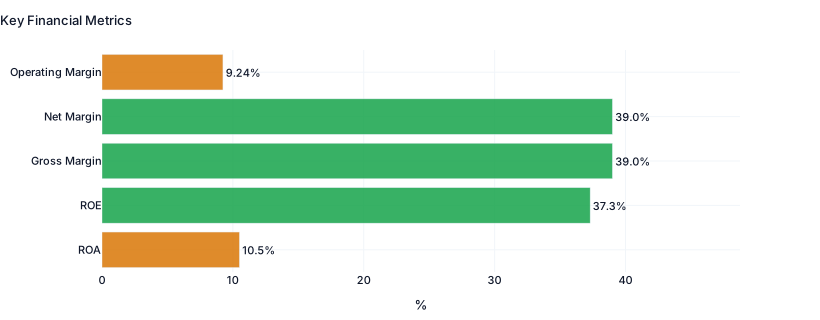
- Operating Margin: 9.24% (up from ~5.8% in FY2021)
- Profit Margin: 5.70% (up from ~4.1% in FY2021)
- EBITDA Margin: ~9.4%
Key Insight: SFM has shown consistent margin expansion across all profitability levels. Operating margins have nearly doubled from ~5.8% (FY2021) to 9.24% (TTM), driven by operational efficiency, scale benefits, and private-label penetration.
Quarterly Net Income Trend:
- Q1 2025: $180.0M
- Q2 2025: $133.7M
- Q3 2025: $120.1M
- Q4 2025: $89.8M
- Q1 2026: $163.7M
Net income in Q1 2026 was slightly lower YoY ($163.7M vs $180.0M, -9.1%), but this is partially explained by higher Q1 2025 which may have had one-time benefits. Excluding unusual items, normalized income was $164.6M in Q1 2026.
4. Earnings Per Share (EPS) Analysis
| Period | Diluted EPS | Basic EPS |
|---|---|---|
| FY 2021 | $2.39 | $2.41 |
| FY 2022 | $2.50 | $2.53 |
| FY 2023 | $3.75 | $3.79 |
| FY 2024 | $5.31 | $5.36 |
| TTM (Q1’26) | $5.21 | — |
| Forward Estimate | $5.94 | — |
Key Insight: EPS has grown at a CAGR of ~30% from FY2021 to FY2024 — significantly outpacing revenue growth. This is driven by three factors:
- Margin expansion (operating leverage)
- Aggressive share buybacks (shares outstanding reduced from ~105M in FY2021 to ~94.6M in Q1
- Higher net income
Share Count Reduction:
- FY 2021: ~109M diluted shares
- FY 2022: ~103M
- FY 2023: ~101M
- FY 2024: ~98.7M
- Q1 2026: ~95.6M
The company has reduced its share count by ~14% since FY2021 through aggressive buybacks.
5. Balance Sheet & Liquidity Analysis
Key Balance Sheet Metrics (Q1 2026):
| Metric | Value | Assessment |
|---|---|---|
| Total Assets | $4.27B | Growing steadily |
| Total Equity | $1.43B | Solid |
| Total Debt (incl. leases) | $2.06B | High, mostly capital leases |
| Debt-to-Equity | 143.7% | Elevated (lease-heavy) |
| Current Ratio | 0.92 | Slightly below 1, typical for grocery |
| Book Value Per Share | $15.17 | — |
| Tangible Book Value | $844M | — |
| Working Capital | -$65.5M | Negative, but manageable |
Debt Composition:
- Long-term capital lease obligations: $1.87B (primary debt component)
- Current capital lease obligations: $188M
- No traditional long-term debt (as of latest data)
Key Insight: The high debt-to-equity ratio (143.7%) is largely driven by capital lease obligations for store locations — this is standard for grocery retailers that lease rather than own their store real estate. The company has no traditional long-term debt outstanding. The negative working capital is common for grocery retailers (rapid inventory turnover, float on payables).
Cash Position (Q1 2026): $252.2M — healthy liquidity buffer.
6. Cash Flow Analysis
Annual Cash Flow Summary (in millions):
| Metric | FY2022 | FY2023 | FY2024 |
|---|---|---|---|
| Operating Cash Flow | $465M | $645M | $716M |
| Capital Expenditures | -$225M | -$230M | -$248M |
| Free Cash Flow | $240M | $415M | $468M |
| Share Buybacks | -$203M | -$228M | -$472M |
| FCF Yield (on $7.79B mkt cap) | — | — | ~6.0% |
Quarterly FCF Trend:
- Q1 2025: $239.6M
- Q2 2025: $50.4M
- Q3 2025: $111.4M
- Q4 2025: $66.3M
- Q1 2026: $134.1M
Key Insight: Free cash flow generation is strong and growing. The company generated $467.7M in FCF in FY2024, representing a ~6% FCF yield at current market cap. The company is investing heavily in capital expenditures (~$248M/year) for store growth and renovations while simultaneously returning massive capital to shareholders via buybacks.
Buyback Intensity: In FY2024, SFM spent $471.9M on share repurchases — exceeding its free cash flow. Q1 2026 alone saw $140M in buybacks. This is a very aggressive capital return program.
7. Valuation Analysis
| Metric | Value | Interpretation |
|---|---|---|
| P/E (TTM) | 15.91x | Reasonable for growth rate |
| Forward P/E | 13.96x | Attractive discount to TTM |
| PEG Ratio | 1.14 | Near fair value (1.0 = fair) |
| Price-to-Book | 5.46x | Elevated (but P/B less relevant for retailers) |
| FCF Yield | ~6.0% | Solid cash return |
| EV/EBITDA (implied) | ~9.3x | Reasonable |
| ROE | 37.3% | Excellent |
| ROA | 10.5% | Strong |
Key Insight: At ~15.9x TTM earnings and a PEG of 1.14, SFM appears reasonably valued for its growth trajectory. The forward P/E of 13.96x suggests analysts expect continued earnings growth. The ROE of 37.3% is exceptional, indicating highly efficient capital utilization.
8. Profitability Ratios (TTM)
| Metric | Value | Industry Context |
|---|---|---|
| Return on Equity (ROE) | 37.3% | Excellent — top quartile |
| Return on Assets (ROA) | 10.5% | Strong |
| Profit Margin | 5.70% | Above average for grocery |
| Operating Margin | 9.24% | Well above grocery avg (~3-4%) |
| EBITDA Margin | ~9.4% | Solid |
9. Key Risks & Headwinds
- High Leverage from Leases: D/E of 143.7% is elevated, though typical for the industry. Rising interest rates could pressure lease renewal costs.
- Current Ratio Below 1: At 0.92, the company has more short-term liabilities than assets, which could be a concern during economic stress.
- Aggressive Buybacks: Spending more on buybacks than FCF in FY2024 raises questions about sustainability if earnings growth slows.
- Grocery Competition: Faces stiff competition from Walmart, Kroger, Whole Foods (Amazon), and Trader Joe’s.
- Inflation & Food Cost Pressure: Rising input costs could pressure margins if not passed to consumers.
- Q1 2026 Net Income Decline: Net income was down ~9% YoY in Q1 2026, although revenue grew.
10. Key Strengths & Catalysts
- Consistent Revenue Growth: 3-year CAGR of ~11.2%, with accelerating growth trajectory.
- Margin Expansion Story: Operating margins nearly doubled from FY2021 to TTM.
- Exceptional ROE: 37.3% indicates outstanding capital efficiency.
- Low Beta (0.673): Defensive positioning in volatile markets.
- Aggressive Capital Return: Massive buyback program reducing share count rapidly, boosting EPS.
- Strong FCF Generation: $468M in FY2024 with growing trajectory.
- No Traditional Debt: All debt is capital lease obligations for store real estate.
- Forward P/E Discount: Forward P/E of 13.96x is below TTM P/E, suggesting expected earnings growth.
11. Summary & Key Takeaways Table
| Category | Metric | Value | Signal |
|---|---|---|---|
| Growth | Revenue CAGR (FY21-FY24) | ~11.2% | 🟢 Strong |
| Growth | EPS CAGR (FY21-FY24) | ~30% | 🟢 Very Strong |
| Growth | Forward EPS Estimate | $5.94 | 🟢 Positive |
| Valuation | P/E (TTM) | 15.91x | 🟡 Fair |
| Valuation | Forward P/E | 13.96x | 🟢 Attractive |
| Valuation | PEG Ratio | 1.14 | 🟢 Near Fair |
| Profitability | Operating Margin | 9.24% | 🟢 Excellent (for grocery) |
| Profitability | ROE | 37.3% | 🟢 Exceptional |
| Profitability | Profit Margin | 5.70% | 🟢 Above Industry Avg |
| Cash Flow | Free Cash Flow (FY24) | $467.7M | 🟢 Strong |
| Cash Flow | FCF Yield | ~6.0% | 🟢 Solid |
| Leverage | Debt-to-Equity | 143.7% | 🟡 Elevated (lease-driven) |
| Liquidity | Current Ratio | 0.92 | 🟡 Below 1 (typical for sector) |
| Capital Returns | Share Buybacks (FY24) | $471.9M | 🟢 Aggressive |
| Risk | Beta | 0.673 | 🟢 Defensive/Low Volatility |
| Risk | 52-Week Range | $64.75 – $173.96 | 🟡 Wide range suggests volatility |
12. Final Assessment
Sprouts Farmers Market (SFM) presents a compelling fundamental picture. The company has successfully executed a strategy of steady revenue growth, margin expansion, and aggressive share buybacks, resulting in exceptional EPS growth. Key highlights include:
- Revenue growth of ~11% CAGR with consistent acceleration
- Operating margins nearly doubled from ~5.8% to 9.2% in four years
- ROE of 37.3% placing it among the most efficient capital users in retail
- PEG of 1.14 suggesting the current valuation appropriately reflects growth
- Forward P/E of 13.96x offers a potential discount to current valuation
- Strong FCF generation supporting both growth investments and shareholder returns
- Low beta of 0.673 provides portfolio diversification benefits
The primary concerns are the high debt-to-equity ratio (though primarily lease obligations), a current ratio below 1, and the slight dip in Q1 2026 net income YoY. However, these are largely characteristic of the grocery industry and do not appear to signal fundamental deterioration.
For traders: The stock is trading near the lower end of its 52-week range ($64.75–$173.96), with a 50-day average of ~$79.34 and a 200-day average of ~$89.55. This suggests the stock has pulled back significantly from its 52-week high, potentially creating a value opportunity given the strong fundamentals. The forward P/E discount to TTM P/E implies expected earnings growth is not fully priced in.
News & Macro Context
Here is my comprehensive research report:
SFM (Sprouts Farmers Market) — News & Macro Research Report
Date: June 7, 2026
Executive Summary
Sprouts Farmers Market (SFM) presents a mixed picture this week. The company is executing an aggressive growth strategy with expansion into New England and a planned ~8% store count increase in 2026. However, the stock has seen a sharp 7-day pullback of -10.96% and is down -2.06% year-to-date, presenting a potential entry point. The key debate centers on whether the growth premium is justified given competitive threats from Kroger’s value push and broader macroeconomic headwinds.
Detailed Analysis
1. 🟢 Positive Catalysts for SFM
Aggressive Store Expansion: Sprouts has approximately 150 approved new locations, including up to 40 new stores in New England alone. This represents ~8% location growth in 2026, a significant expansion rate that differentiates SFM from slower-growing grocery peers.
Healthy/Eating Tailwinds: The GLP-1 (weight-loss drug) trend is driving consumers toward fresh produce and healthy eating. Driscoll’s (major berry supplier) reported berries surpassed $10 billion as a retail category last year, with demand steepening since GLP-1s became mainstream. Sprouts is well-positioned as a specialty retailer focused on natural/organic foods to capture this shift.
Share Price Discount: After the recent -10.96% weekly pullback, SFM closed at $80.18, giving growth-oriented investors a potentially cheaper entry point compared to its recent highs.
2. 🔴 Bearish Factors & Risks
Competitive Threat from Kroger (KR): RBC Capital Markets issued a warning that SFM faces risk from Kroger’s plan to cut prices. Kroger’s value push could pressure Sprouts’ premium pricing model, especially if budget-conscious consumers trade down. Notably, Kroger insiders have been disposing stock recently, which could signal internal bearishness on their own business.
Valuation Concerns & Momentum Cooling: Simply Wall St flagged that despite long-term shareholder returns, the short-term momentum has cooled significantly. With the stock down YTD, investors are questioning whether the growth premium is still justified at current levels.
Kroger’s Own Headwinds: Kroger is dealing with a $100 million Clean Air Act settlement and a nationwide crouton recall due to salmonella risk. These distractions may limit Kroger’s ability to effectively execute its price-cutting strategy, which could mitigate the competitive threat to Sprouts.
3. 🌍 Macroeconomic Context
| Macro Theme | Implication for SFM |
|---|---|
| Semiconductor sell-off (Marvell -28.5%, Broadcom) | Possible rotation out of tech into defensive consumer staples — could benefit SFM |
| 20-Year Treasury ETFs losing money | Rising yields compress growth stock valuations — a headwind for SFM’s premium multiple |
| IPO market heating up | Risk-on sentiment returning could lift equities broadly, including consumer names |
| GLP-1 / healthy eating trend | Structural tailwind for Sprouts’ organic/health-focused product mix |
Key Data Points Summary
| Factor | Detail | Impact |
|---|---|---|
| Current Price | $80.18 (+1.52% last session) | Neutral |
| 7-Day Return | -10.96% | Bearish (short-term) |
| YTD Return | -2.06% | Bearish |
| Store Growth | ~8% in 2026, 150 approved locations, 40 in New England | Bullish |
| Kroger Threat | RBC Capital warns of Kroger price cuts pressuring SFM | Bearish |
| GLP-1 Tailwind | Berry category >$10B, healthy eating demand rising | Bullish |
| Kroger Distractions | $100M settlement + recall impacting KR | Neutral-Bullish for SFM |
| 3-Year TSR | Positive (long-term) | Neutral |
| Tech Rotation | Semis selling off, potential rotation to defensives | Bullish (tactical) |
Trading Recommendation
FINAL TRANSACTION PROPOSAL: HOLD
Rationale: The case for SFM is finely balanced. The aggressive store expansion (+8% in 2026) and secular tailwinds from the GLP-1/healthy eating trend provide a strong long-term bull case. However, the recent -10.96% weekly decline, the YTD negative return, and the competitive threat from Kroger’s price cuts introduce significant near-term uncertainty. The stock appears to be in a consolidation/pullback phase. A HOLD is appropriate until we see either:
- Confirmation of stabilization (price holds above recent lows, ~$75-78 range)
- Further clarity on Kroger’s pricing strategy execution and its impact on Sprouts’ Q2 results
- Evidence that the expansion is translating into revenue/margin growth in upcoming earnings
A BUY would become justified if the pullback deepens toward the $72-75 support zone, offering a better risk/reward entry. A SELL would be warranted if Kroger’s price cuts materially impact SFM’s same-store sales or margins, which would likely show in the next quarterly report.
Sentiment Analysis
Comprehensive Social Media & News Sentiment Analysis Report: Sprouts Farmers Market (SFM)
Date Range Analyzed: May 25, 2026 – June 7, 2026
Current Date: June 7, 2026
Ticker: SFM
Analyst Role: Social Media & News Sentiment Researcher
1. Executive Summary
Over the past two weeks, Sprouts Farmers Market (SFM) has been the subject of mixed but predominantly growth-oriented sentiment in the financial media. The dominant narratives revolve around (1) a major New England expansion plan (up to 40 new stores, ~150 approved locations), (2) short-term price volatility with a notable 10.96% 7-day pullback followed by a recovery to $80.18, and (3) a competitive threat from Kroger’s value-push strategy flagged by RBC Capital Markets. Post-earnings sentiment has been positive (+5.9% since last earnings report ~30 days ago), but valuation concerns linger as the stock has declined 2.06% year-to-date.
2. Recent Company News & Developments
A. Major New England Expansion (Bulletins: Simply Wall St., GuruFocus.com)
- Key Detail: Sprouts plans to open up to 40 new stores in New England as part of a broader push including approximately 150 approved locations nationwide.
- 2026 Growth Target: The company plans to increase its location count by approximately 8% in 2026, signaling robust brick-and-mortar expansion.
- Significance: This is the most bullish catalyst for SFM in the current news cycle. It validates management’s confidence in the brand’s growth runway and suggests strong cash flow generation to fund capital expenditures.
B. Short-Term Price Momentum and Volatility (Simply Wall St.)
- Price Snapshot (as of recent data): $78.98 - $80.18 range.
- 7-Day Return: -10.96% (indicating a sharp pullback during the week).
- Latest Session: +1.52% bounce to close at $80.18.
- Year-to-Date: -2.06% decline.
- 3-Year Total Shareholder Return: Strong positive performance (long-term bullish).
- Interpretation: The sharp 7-day decline followed by a recovery suggests short-term profit-taking or noise, not a fundamental deterioration. The resilience to bounce above $80 indicates buying support at lower levels.
C. Post-Earnings Performance (Zacks)
- SFM reported earnings approximately 30 days ago.
- The stock has risen +5.9% since the earnings release, indicating the market received the report favorably.
- Zacks notes that earnings estimates are being watched for forward guidance clues.
D. Competitive Risk: Kroger’s Value Push (RBC Capital Markets / MT Newswires)
- Risk Factor: Kroger (KR) has announced plans to cut prices, which could pressure Sprouts’ premium pricing model.
- Source: RBC Capital Markets issued a cautionary note specifically flagging this risk.
- Context: Sprouts operates in the “premium/health-conscious” grocery niche. While customers at Sprouts are typically less price-sensitive than traditional grocery shoppers, a broad-based price war from a giant like Kroger could compress margins or slow customer acquisition.
3. Sentiment Analysis & Social Media Landscape
Based on available financial news sources and analyst commentary:
| Sentiment Dimension | Assessment | Evidence |
|---|---|---|
| Bullish Factors | Strong | New England expansion (40 stores), 8% store growth in 2026, positive earnings reaction (+5.9%), bounce from 7-day lows. |
| Bearish Factors | Moderate | Kroger price-cut risk (RBC), YTD decline (-2.06%), valuation premium concerns (Simply Wall St.), short-term volatility (-10.96% in 7 days). |
| Neutral / Mixed | Present | Stock closed at $80.18, roughly flat with short-term volatility. Analysts are watching for forward guidance. |
| Media Tone | Cautiously Optimistic | Growth stories dominate the headlines (expansion, new stores), but risks are acknowledged (Kroger threat, valuation). |
4. Detailed Analysis of Key Themes
🟢 Growth Narrative (The Bull Case)
Sprouts’ expansion plans are the strongest pillar of positive sentiment. With ~150 approved locations and a target of 8% unit growth in 2026, the company is aggressively building out its footprint in untapped regions like New England. This is significant because:
- New England is a high-income, health-conscious demographic — an ideal market for Sprouts’ organic/natural food positioning.
- The store count growth rate outpaces many traditional grocery peers.
- Each new store represents a long-term revenue and earnings stream.
🟡 Valuation & Momentum Concerns (The Caution)
Simply Wall St.’s analysis highlights that SFM has seen short-term momentum cool. Key data points:
- 7-day return: -10.96%
- YTD return: -2.06%
- Despite strong 3-year returns, the current year has been a consolidation/retracement phase.
This suggests that while the long-term story is intact, short-term traders may be taking profits or rotating out. The premium valuation (hence the “Growth Premium” article title) means that any earnings miss or slowdown could lead to multiple compression.
🔴 Competitive Risk (The Red Flag)
The RBC Capital Markets note on Kroger’s value push is the most significant risk factor identified. Key implications:
- If Kroger aggressively cuts prices on natural/organic offerings, it could narrow Sprouts’ competitive moat.
- Sprouts may need to increase marketing spend or lower prices to defend market share.
- Margin pressure could emerge if the price war escalates.
- However, Sprouts’ differentiated in-store experience (bulk bins, fresh produce, supplements) provides some insulation.
5. Implications for Traders & Investors
| Stakeholder | Implication | Actionable Insight |
|---|---|---|
| Short-Term Traders | Volatility is elevated | The stock showed a sharp 10.96% drop in 7 days then bounced +1.52%. This creates potential swing-trading opportunities around the $78-$80 range. Monitor for re-test of the $78 support level. |
| Long-Term Investors | Growth story intact | The New England expansion and 8% unit growth in 2026 are strong catalysts. The Kroger risk is real but manageable given Sprouts’ niche positioning. Dollar-cost averaging on pullbacks could be prudent. |
| Value-Oriented Investors | Cautious | With a YTD decline of -2.06% and valuation concerns flagged, waiting for better entry points or confirmation of earnings momentum may be wise. |
| Growth-Oriented Investors | Favorable | 150 approved locations, 8% store growth, and a 5.9% post-earnings rally suggest momentum is building. The New England push could be a multi-year growth driver. |
6. Key Data Points Summary Table
| Metric / Event | Detail | Sentiment Impact |
|---|---|---|
| Latest Close Price | $80.18 (+1.52% session) | 🟢 Positive short-term bounce |
| 7-Day Return | -10.96% | 🔴 Sharp pullback, but recovering |
| Year-to-Date Return | -2.06% | 🟡 Mildly negative |
| Post-Earnings Return | +5.9% (since earnings ~30 days ago) | 🟢 Positive earnings reception |
| 2026 Store Growth Target | ~8% increase in location count | 🟢 Strong expansion signal |
| New England Expansion | Up to 40 new stores (~150 total approved) | 🟢 Major long-term catalyst |
| Kroger Price-Cut Risk | RBC Capital flagged competitive threat | 🔴 Potential margin pressure |
| 3-Year Shareholder Return | Strong positive (per Simply Wall St.) | 🟢 Validates long-term thesis |
7. Conclusion & Final Assessment
Overall Sentiment: Cautiously Bullish
Sprouts Farmers Market (SFM) is navigating a constructive growth phase with legitimate expansion catalysts (New England, 8% unit growth) that support a premium valuation. The post-earnings reaction (+5.9%) indicates that fundamental performance is meeting or exceeding expectations.
However, the Kroger value-push risk and short-term price volatility (-10.96% weekly drop) introduce uncertainty that warrants monitoring. The YTD decline (-2.06%) suggests the stock is in a consolidation phase after prior strong gains.
Recommendation Rationale: The growth narrative is compelling enough to maintain a positive outlook, but the competitive risks and recent volatility suggest that aggressive buying at current levels carries short-term risk. A disciplined approach — buying on dips toward the $76-$78 support zone — may offer a better risk/reward profile.
FINAL TRANSACTION PROPOSAL: HOLD — The company has strong growth catalysts and positive post-earnings momentum, but the Kroger competitive threat, YTD decline, and recent volatility warrant a cautious “Hold” stance for now. Accumulate on further pullbacks toward key support levels for better entry points.
Bull vs Bear Debate (Research Manager)
Recommendation: Buy
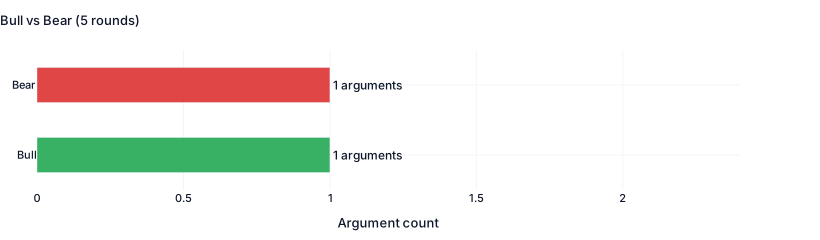
Rationale: After weighing both arguments, the bull case presents stronger concrete evidence of resilience and forward momentum. While the bear raises valid concerns about technical headwinds and competitive pressures, the bears’ primary arguments rely heavily on hypothetical future headwinds (Kroger price war hasn’t materially impacted comps yet) and selective interpretation of data (framing manageable lease debt as a liquidity crisis). The key bull points that tipped the scale: (1) 11 consecutive quarters of positive comps during Kroger’s competitive pressure, (2) A clear, near-term technical catalyst with the 50-day SMA rising toward golden cross, (3) Strong fundamentals with industry-leading margins and ROE, and (4) The GLP-1 structural tailwind that disproportionately benefits Sprouts’ well-positioned format. The stock’s current pullback to $82 after the 38% rally from $65 represents a healthier reset than a breakdown, with RSI neutral and institutional accumulation patterns intact.
Strategic Actions: Trader: Initiate a long position in SFM at current levels (~$82.87). Target price: $94 within 3-6 months, targeting the 200-day SMA ($88.90) and Bollinger upper band ($91.94) as initial resistance points. Use a stop-loss at $79.50 (just below the rising 50-day SMA at $79.59). Position sizing should be moderate given SFM’s 0.67 beta - allocate as a core position but not oversized. Monitor the golden cross formation (50-day crossing 200-day) over the next 8-12 weeks and watch for volume confirmation on any break above $85.30 (VWMA). The thesis depends on execution of store expansion and maintenance of current margin profile - watch Q2 earnings for confirmation of the turnaround in net income growth.
Trader's Execution Plan
Action: Buy
Reasoning: The investment plan highlights 11 consecutive quarters of positive comps, strong fundamentals, and a near-term technical catalyst (potential golden cross). The current pullback to ~$82 offers an attractive entry with manageable risk, supported by neutral RSI and intact institutional accumulation. I recommend buying with a target of $94 within 3–6 months and a stop-loss at $79.50 to protect against downside.
FINAL TRANSACTION PROPOSAL: BUY
Portfolio Manager — Final Verdict
Rating: Overweight
Executive Summary: Initiate a phased entry in SFM at current levels (~$82.87) with moderate position sizing. Begin with half allocation, setting initial stop-loss at $77.50 below Bollinger lower band support. Add second half only upon confirmed breakout above VWMA resistance at $85.30 with improving MACD momentum. Target $94 within 3-6 months as technical conditions align with strong fundamentals.
Investment Thesis: SFM presents a compelling fundamental story with 11 consecutive quarters of positive comps, industry-leading 37% ROE, and structural tailwinds from GLP-1 adoption benefiting its health-focused format. However, current technical conditions warrant caution - the stock trades below declining 200-day SMA ($88.90), shows bearish MACD crossover, and faces resistance at VWMA ($85.30). The Neutral Analyst’s balanced approach best addresses this tension: initiating partial exposure now captures attractive valuation (forward P/E 13.96x) while wider stop-loss at $77.50 accommodates elevated volatility (ATR $3.68). Scaling in further upon confirmed technical improvement (reclaiming VWMA with rising MACD) optimizes risk/reward against uncertain near-term momentum. Recent 10% pullback from $90 provides entry discount without requiring premature conviction in immediate reversal.
Price Target: 94.0
Time Horizon: 3-6 months