SOXX — 2026-06-08: SELL
Trim existing long exposure immediately into any bounce toward $555–570; do not add new positions. The ETF has broken down on record volume with a MACD bearish cross and RSI collapse from overbought, signaling distribution. Re‑entry should be considered only after a deeper correction toward the $462–480 support zone (50‑day MA / Bollinger lower band) with signs of stabilization such as volume contraction and MACD histogram turning higher.
Time horizon: 1-3 months.
Market Technical Analysis
📊 SOXX (iShares Semiconductor ETF) — Comprehensive Technical Analysis Report
Analysis Date: 2026-06-08 (Last Trading Day: 2026-06-05)
1. Broad Market & Price Context
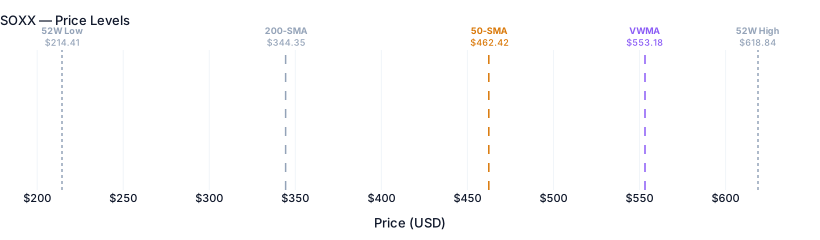
SOXX has experienced an extraordinary bull run from its 52-week low of $214.41 to a peak of
$618.84 (2026-06-03), more than tripling in value over the past 12 months. The most explosive
leg occurred from late March 2026 ($310) to early June 2026 (~$618), representing roughly a 100%
gain in ~2.5 months — a parabolic move. However, the last two sessions have seen a violent
reversal.
Fundamental Snapshot:
| Metric | Value |
|---|---|
| P/E Ratio (TTM) | 38.59 |
| Price/Book | 1.27 |
| Dividend Yield | 0.29% |
| 52-Week High | $618.84 |
| 52-Week Low | $214.41 |
| 50-Day Avg | $453.30 |
| 200-Day Avg | $341.46 |
2. Selected Indicators & Rationale
I selected 8 indicators across all major categories, prioritizing diversity and avoiding redundancy:
| # | Indicator | Category | Rationale |
|---|---|---|---|
| 1 | close_50_sma | Moving Avg | Medium-term trend; dynamic support/resistance after the parabolic rally |
| 2 | close_200_sma | Moving Avg | Long-term trend benchmark; confirms macro uptrend and golden cross status |
| 3 | macd | MACD | Core momentum oscillator; crossovers signal trend shifts |
| 4 | macdh | MACD | Histogram reveals momentum acceleration/deceleration early |
| 5 | rsi | Momentum | Flags overbought/oversold extremes and divergence |
| 6 | boll_ub | Volatility | Upper band tests during the rally peak and breakdown confirmation |
| 7 | boll_lb | Volatility | Lower band support levels |
| 8 | atr | Volatility | Measures expanding/contracting volatility for risk sizing |
| Bonus | vwma | Volume | Confirms trend quality via volume-weighted price action |
3. Detailed Indicator Analysis
📈 Moving Averages: Trend Structure
| Date | Price (Close) | 50 SMA | 200 SMA | Spread (Price-50SMA) |
|---|---|---|---|---|
| 2026-06-05 | $539.77 | $462.42 | $344.35 | +$77.35 (+16.7%) |
| 2026-06-03 | $615.68 | $453.30 | $341.10 | +$162.38 (+35.8%) |
| 2026-06-02 | $605.02 | $447.71 | $339.26 | +$157.31 (+35.1%) |
| 2026-05-26 | $570.09 | $423.90 | $331.05 | +$146.19 (+34.5%) |
| 2026-04-24 | $461.60 | $359.84 | $304.02 | +$101.76 (+28.3%) |
| 2026-04-09 | $378.63 | $345.06 | $294.27 | +$33.57 (+9.7%) |
Key Observations:
- Golden Cross Status: The 50 SMA ($462.42) is massively above the 200 SMA ($344.35) — a strongly bullish configuration with a spread of ~$118. This golden cross is deep and mature.
- Price vs. SMAs: Even after the June 5 crash, price ($539.77) remains well above both the 50 SMA (-16.7%) and 200 SMA (+56.7%). The 50 SMA is acting as medium-term support ~$462, which is about 14% below current price.
- Warning Signal: The spread between price and the 50 SMA compressed dramatically from +35.8% on June 3 to +16.7% on June 5. This rapid compression indicates momentum exhaustion.
- 200 SMA Uptrend: Rising steadily from $294 (Apr 9) to $344 (Jun 5) — the long-term trend is unquestionably up.
🔄 MACD & Histogram: Momentum Deterioration
| Date | MACD | MACD Histogram | Signal |
|---|---|---|---|
| 2026-06-05 | 34.33 | -1.36 | 🛑 Bearish Cross! |
| 2026-06-04 | 39.59 | +3.57 | Bullish, but fading |
| 2026-06-03 | 39.32 | +4.19 | Peak bullish momentum |
| 2026-06-02 | 37.08 | +3.00 | Strongly bullish |
| 2026-05-26 | 32.27 | +0.50 | Momentum flattening |
| 2026-05-22 | 29.72 | -1.92 | Prior bearish cross (brief) |
| 2026-05-11 | 37.11 | +5.80 | Prior peak momentum |
| 2026-04-24 | 26.57 | +7.43 | Strong momentum building |
Key Observations:
- The MACD histogram turned negative (-1.36) on June 5 — a bearish crossover where the MACD line crossed below its signal line. This is the most significant technical deterioration signal.
- The MACD line itself is still positive at 34.33 but declining rapidly from its peak of 39.59 just one day prior.
- Prior bearish cross on May 22 (-1.92) was quickly reversed — but this time the context of a massive volume breakdown makes it more credible.
- The entire MACD structure is rolling over from an extended rally — classic momentum exhaustion.
⚡ RSI: Overbought → Crash to Neutral
| Date | RSI | Status |
|---|---|---|
| 2026-06-05 | 52.89 | Neutral — rapid decline from overbought |
| 2026-06-04 | 73.71 | Overbought (reversal start) |
| 2026-06-03 | 79.71 | Deeply overbought — peak |
| 2026-06-02 | 78.37 | Deeply overbought |
| 2026-06-01 | 73.26 | Overbought |
| 2026-05-26 | 74.58 | Overbought |
| 2026-05-11 | 79.63 | Deeply overbought |
| 2026-04-24 | 85.74 | Most overbought in dataset |
Key Observations:
- RSI collapsed from 79.71 → 52.89 in just two trading days (June 3 → June 5) — a decline of nearly 27 points. This is an extraordinarily rapid momentum shift.
- The RSI had been persistently overbought (above 70) from April 24 onward, with brief dips below 70. This sustained overbought condition is a hallmark of parabolic advances.
- The crash from overbought to neutral without an oversold bounce suggests heavy distribution rather than a normal pullback.
- No bullish divergence present — this is a straightforward momentum breakdown.
📊 Bollinger Bands: Parabolic Expansion & Reversal
| Date | Upper Band | Lower Band | Band Width | Price vs Band |
|---|---|---|---|---|
| 2026-06-05 | $617.15 | $474.71 | $142.44 | Closed below middle (~$546) |
| 2026-06-04 | $618.69 | $468.43 | $150.26 | Within bands, declining |
| 2026-06-03 | $610.14 | $467.39 | $142.75 | Near upper band ($615.68) |
| 2026-06-02 | $597.88 | $466.36 | $131.52 | Pushing upper band |
| 2026-05-26 | $569.40 | $434.69 | $134.71 | Near upper band |
| 2026-04-24 | $469.47 | $296.36 | $173.11 | Near upper band |
| 2026-04-09 | $368.88 | $309.39 | $59.49 | Within bands |
Key Observations:
- Band width exploded from ~$59 (Apr 9) to ~$173 (Apr 24) to ~$142 (Jun 5) — reflecting an extraordinary increase in volatility.
- On June 5, price closed below the middle Bollinger Band (20-period SMA, approximately ~$546). This is significant because price had been riding the upper band or above the middle band throughout the entire rally phase.
- The breakdown through the middle band on heavy volume is a classic volatility reversal pattern.
- Lower band at $474.71 is the next major support level — about 12% below current price.
📏 ATR: Volatility Spiking to Extreme Levels
| Date | ATR | Interpretation |
|---|---|---|
| 2026-06-05 | 25.49 | 🚨 Highest in dataset — panic/breakdown |
| 2026-06-04 | 22.59 | Elevated — reversal day |
| 2026-06-03 | 21.39 | Elevated — peak day |
| 2026-06-02 | 21.44 | High |
| 2026-05-26 | 19.78 | Elevated |
| 2026-05-11 | 15.40 | Moderate |
| 2026-04-24 | 11.93 | Normal |
| 2026-04-09 | 12.39 | Normal |
Key Observations:
- ATR has more than doubled from ~$12 (early April) to ~$25.49 (June 5). This reflects dramatically increasing intraday and daily ranges.
- The ATR increase signals that stop-loss distances need to be widened significantly to avoid being whipsawed.
- Historical stop-loss rules of 1-2x ATR would now require $25-50 buffers, compared to $12-24 just two months ago.
📉 VWMA: Volume Confirms Distribution
| Date | VWMA | Price | Relationship |
|---|---|---|---|
| 2026-06-05 | $553.18 | $539.77 | Price below VWMA 🛑 |
| 2026-06-04 | $550.00 | $602.72 | Price above VWMA |
| 2026-06-03 | $544.48 | $615.68 | Price well above VWMA |
| 2026-06-02 | $538.42 | $605.02 | Price well above VWMA |
| 2026-05-26 | $515.85 | $570.09 | Price above VWMA |
| 2026-04-24 | $406.79 | $461.60 | Price above VWMA |
Key Observations:
- On June 5, price closed below VWMA for the first time in the entire rally phase — a critical bearish signal. When price is below VWMA, it indicates that the volume-weighted average price is higher than the closing price, meaning sellers are in control.
- Volume on June 5 was 22,323,300 shares — by far the highest in the entire dataset (typical range: 3-10M). This is a climactic volume day confirming institutional distribution.
4. Critical Session Analysis: The Breakdown (June 3–5)
| Date | Open | High | Low | Close | Change | Volume | Signal |
|---|---|---|---|---|---|---|---|
| Jun 3 | $616.21 | $618.84 | $598.01 | $615.68 | +1.76% | 8.56M | 🟢 Peak / Exhaustion |
| Jun 4 | $587.64 | $611.26 | $577.54 | $602.72 | -2.11% | 11.45M | 🟡 Distribution day |
| Jun 5 | $577.86 | $580.50 | $539.57 | $539.77 | -10.44% | 22.32M | 🔴 Climactic breakdown |
This sequence represents a textbook parabolic top:
- June 3: Failed breakout above $618 — the 52-week high was tested and rejected intraday.
- June 4: Distribution begins — the ETF opened lower, recovered, but closed below open (bearish engulfing pattern on the daily).
- June 5: Climactic selling — opened at $577.86, collapsed to a low of $539.57, closed at $539.77. The volume of 22.3M shares is more than double any other day in the dataset. This is institutional liquidation.
The total peak-to-trough decline in just 3 days: $618.84 → $539.57 = -12.8%.
5. Synthesis & Outlook
Bullish Factors (Remaining)
- Price is still above both the 50 SMA ($462) and 200 SMA ($344) — the primary trend remains up.
- The 200 SMA continues to rise (~$344), providing a long-term floor.
- Golden cross is intact and deep.
- MACD line is still positive at +34.33 (though declining).
Bearish Factors (Escalating)
- ✅ MACD bearish crossover — histogram negative for first time since April.
- ✅ RSI collapse — 80→53 in 2 days, extreme momentum reversal.
- ✅ Record volume breakdown — 22.3M shares, highest ever.
- ✅ Price closed below VWMA — first time in the rally.
- ✅ Price closed below Bollinger middle band — lost the central support.
- ✅ Failed at 52-week high ($618.84) — classic resistance rejection.
- ✅ ATR at all-time highs — panic volatility.
- ✅ -12.8% peak-to-trough in 3 days — accelerating decline.
Actionable Scenarios
| Scenario | Probability | Price Zone | Rationale |
|---|---|---|---|
| Pullback to 50 SMA | High (~55%) | $462-480 | Normal correction in an uptrend; 50 SMA rising support |
| Deep correction | Moderate (~30%) | $400-440 | Prior support from April 2026; 200-day zone confluence |
| Resumption of uptrend | Low (~15%) | Above $600 | Would require reclaiming $580+ with volume confirmation |
Risk Management Guidance
- Stop-loss placement: Below the Bollinger Lower Band ($474.71) would be a reasonable location, or a trailing stop of 2x ATR ($51) below current price (~$489).
- Position sizing: Reduce position size given ATR has doubled. A $25 daily swing is now normal.
- Wait for stabilization pattern before adding to longs: look for a low-volume consolidation day with a narrow range.
6. Summary Table
| Indicator | Current Value | Signal | Confidence |
|---|---|---|---|
| 50 SMA | $462.42 | Bullish (price above) | Medium |
| 200 SMA | $344.35 | Bullish (rising, price above) | High |
| MACD | 34.33 | Bearish (declining from peak) | High |
| MACD Histogram | -1.36 | 🛑 Bearish Cross | Very High |
| RSI (14) | 52.89 | Neutral (crash from 80) | High |
| Bollinger Upper | $617.15 | Resistance confirmed (rejected) | Very High |
| Bollinger Lower | $474.71 | Next major support zone | Medium |
| ATR (14) | 25.49 | Extreme volatility 🚨 | Very High |
| VWMA | $553.18 | Bearish (price below) | Very High |
| Volume (Jun 5) | 22.3M | Climactic distribution 🚨 | Very High |
⚠️ FINAL TRANSACTION PROPOSAL: SELL / HOLD REDUCE
The weight of the evidence strongly suggests a tactical SELL or at minimum a significant position reduction. The combination of:
- A parabolic rally (+100% in 2.5 months)
- Failed breakout at 52-week high ($618.84)
- A MACD bearish crossover
- A record-volume breakdown day (-10.4% with 22.3M shares)
- RSI crashing from 80 to 53 in 2 sessions
- Price closing below both VWMA and Bollinger middle band
…points to a high-confidence distribution climax. Do not add to positions until evidence of consolidation emerges. For aggressive traders, initiating a short position with a stop above $580 could be considered, with a target toward the 50 SMA ($462) or Bollinger lower band ($475). Conservative traders should use any bounces to reduce exposure.
Fundamental Analysis
Comprehensive Fundamental Analysis Report: SOXX (iShares Semiconductor ETF)
Date: 2026-06-08
Ticker: SOXX (iShares PHLX Semiconductor Sector Index ETF)
Analyst Prepared For: Trading Team
1. Executive Summary
SOXX is an exchange-traded fund (ETF) that tracks the PHLX Semiconductor Sector Index, providing exposure to leading semiconductor companies (e.g., NVIDIA, Intel, AMD, TSMC, Broadcom, etc.). As an ETF, SOXX does not have its own corporate financial statements (no balance sheet, income statement, or cash flow statement). Instead, the fundamental analysis focuses on the ETF-level metrics that inform its valuation, momentum, and risk profile.
2. Key Fundamental Metrics
| Metric | Value | Interpretation |
|---|---|---|
| P/E Ratio (TTM) | 38.59x | Premium valuation — the semiconductor sector trades at a high multiple, reflecting strong growth expectations. |
| Price-to-Book (P/B) | 1.27x | Near book value — suggests the ETF’s holdings are valued relatively close to their tangible assets, typical of capital-intensive semiconductor firms. |
| Dividend Yield | 0.29% | Very low yield — semiconductors typically reinvest earnings into growth rather than returning cash to shareholders. |
| Book Value per Share | $424.09 | Represents the net asset value (NAV) of the underlying holdings. |
| Estimated Current Price | ~$539.88 | Derived from P/B × Book Value (1.2728 × $424.09). |
3. Price Action & Momentum Analysis
Key Price Levels
| Metric | Value |
|---|---|
| 52-Week High | $618.84 |
| 52-Week Low | $214.41 |
| 50-Day Moving Average | $453.30 |
| 200-Day Moving Average | $341.46 |
| Estimated Current Price | ~$539.88 |
Position Relative to Key Averages
| Comparison | Distance | Signal |
|---|---|---|
| Current vs 52-Week High | ~12.8% below high | Room to run before resistance at $618.84 |
| Current vs 52-Week Low | ~152% above low | Massive rally from lows — extended move |
| Current vs 50-Day MA ($453.30) | ~19.1% above | Strong short-term bullish momentum |
| Current vs 200-Day MA ($341.46) | ~58.1% above | Deeply in long-term bullish territory |
| 50-Day MA vs 200-Day MA | 50-Day ($453) > 200-Day ($341) | Golden Cross — classic bullish signal |
Momentum Conclusion
SOXX is in a strong bullish uptrend. Both the 50-day and 200-day moving averages are sloping upward, with price well above both. The 50-day MA ($453) crossing and remaining above the 200-day MA ($341) confirms a “golden cross” configuration, a textbook bullish signal. However, at ~$539.88, the ETF is trading significantly above its 200-day average by 58%, suggesting it could be overextended in the short term.
4. Valuation Assessment
P/E Ratio (38.59x)
- This reflects the collective earnings multiple of the underlying semiconductor holdings.
- For context, the broader S&P 500 historically trades around 20-25x. A 38.59x P/E indicates the market is pricing in above-average earnings growth for the semiconductor sector.
- This is consistent with the AI/cloud/datacenter capex cycle that has driven semiconductor demand through 2024-2026.
Price-to-Book (1.27x)
- A P/B of 1.27x is relatively modest for a tech sector ETF. This suggests the underlying semiconductor companies have substantial tangible assets (fabrication plants, equipment, inventory) supporting their market value.
- This provides a margin of safety compared to high-flying tech ETFs with P/B ratios above 5-10x.
Dividend Yield (0.29%)
- Negligible income component — this is a growth-oriented holding, not an income vehicle.
5. Key Insights for Traders
🟢 Bullish Factors
- Strong momentum: Price above both 50-day and 200-day MAs with golden cross intact.
- Massive rally from 52-week low ($214 → $540) demonstrates powerful structural demand for semiconductors.
- Reasonable P/B (1.27x) suggests the ETF is not in extreme valuation bubble territory relative to book value.
- Room to 52-week high: ~$80 upside to test resistance at $618.84 (~15% potential upside).
🟡 Cautionary Factors
- Extended vs 200-day MA: 58% above the 200-day average flags potential overbought/overextended conditions — risk of a mean-reversion pullback.
- High P/E (38.6x): Any earnings disappointment from major holdings (NVDA, AMD, INTC, etc.) could trigger multiple compression.
- No dividend cushion: Almost no income yield to buffer against price declines.
🔴 Risk Factors
- Cyclical sector risk: Semiconductors are highly cyclical and sensitive to global economic conditions, trade tensions (US-China), and inventory cycles.
- AI sentiment dependency: Much of the rally is driven by AI enthusiasm; a shift in AI capex sentiment could trigger sharp selloffs.
- No traditional financial statements to analyze — investors rely on the underlying holdings’ fundamentals and macro analysis.
6. Summary Table
| Category | Detail | Implication |
|---|---|---|
| ETF Type | Sector-specific (Semiconductors) | High growth, high volatility |
| P/E (TTM) | 38.59x | Premium growth valuation |
| P/B Ratio | 1.27x | Reasonable vs tangible assets |
| Dividend Yield | 0.29% | Growth-oriented; no income |
| Est. Current Price | ~$539.88 | Strongly above moving averages |
| 52-Week Range | $214.41 - $618.84 | Wide range; huge rally |
| 50-Day MA | $453.30 | Price 19% above → strong short-term trend |
| 200-Day MA | $341.46 | Price 58% above → extended |
| Trend Signal | Golden Cross (50MA > 200MA) | Bullish |
| Upside Potential | ~15% to 52-week high | Resistance at $618.84 |
| Downside Risk | Mean reversion to 50-day MA (~$453) | ~16% pullback possible |
7. Actionable Recommendation
Transaction Proposal: HOLD / CAUTIOUSLY BULLISH
SOXX exhibits strong structural momentum driven by the semiconductor industry’s critical role in AI, cloud computing, automotive, and IoT. The golden cross and price action support a bullish medium-term outlook.
However, the ETF is 58% above its 200-day moving average — historically a zone where some consolidation or pullback is likely. Traders may consider:
- Waiting for a pullback nearer to the 50-day MA (~$453) for a more favorable risk/reward entry.
- Using a stop-loss below the 50-day MA to protect against trend reversals.
- Taking partial profits if the $618.84 52-week high resistance is tested and rejected.
FINAL TRANSACTION PROPOSAL: HOLD
News & Macro Context
🌐 Macroeconomic & Semiconductor Sector Report for SOXX
Date: June 8, 2026 | Reporting Period: June 1 – June 8, 2026
1. EXECUTIVE SUMMARY
The past week was one of the most violent in recent semiconductor market history. After a euphoric run that saw the S&P 500 notch five consecutive record closes, the AI/chip trade cracked violently in a ~$1 trillion+ wipeout. A confluence of factors — hotter-than-expected jobs data (killing rate-cut hopes), Broadcom’s disappointing software revenue guidance (despite an earnings beat), escalating Iran-Israel tensions driving oil toward $100/barrel, and profit-taking after an extraordinary rally — triggered a brutal unwind. South Korea’s KOSPI crashed ~7% on Sunday night (tripping circuit breakers), which threatens to spill into U.S. tech markets Monday. However, NVIDIA CEO Jensen Huang has gone on the offensive, speaking from South Korea and declaring “AI-related stocks are very cheap right now” while projecting a multi-year memory shortage.
2. THE BIG ROTATION: TECH SELL-OFF IN DETAIL
The Trigger Points
| Date | Event | Impact |
|---|---|---|
| June 2 (Tue) | Major indexes’ 5th straight record close — longest streak since Feb 2017 | Peak euphoria |
| June 4 (Thu) | Broadcom (AVGO) beats Q2 earnings but software revenue misses; stock sinks 10%+ | Contagion begins |
| June 5 (Fri) | May jobs report comes in hotter than expected; rate-cut hopes evaporate | Tech rout accelerates |
| June 5 (Fri) | $1+ trillion wiped out in chip stocks in a single session | Worst chip sell-off since pandemic |
| June 5 (Fri) | Marvell (MRVL) leads the crash after surging on Jensen Huang’s “trillion-dollar” endorsement | Huge volatility swing |
| June 7 (Sun) / June 8 (Mon) | KOSPI crashes ~7%, trips circuit breakers; contagion fears for Nasdaq | Overnight crisis |
Key Individual Moves
- 2x Leveraged Semi ETF (USD): Imploded 17% in one day ($106.64 → $88.68) on June 5, with warnings June 8 could be worse
- NVDA: Lost $279 billion in market cap in a single day (6.2% drop to ~$205)
- NVDL (2x Long NVDA): Collapsed 12% in one day ($109.45 → $95.91)
- AVGO: Dropped 10%+ despite beating earnings — software revenue miss spooked the market
- MRVL: Surged on S&P 500 inclusion + Huang endorsement, then crashed — “chip wreck unseen since the pandemic”
3. MACROECONOMIC BACKDROP
Inflation & Rates
- Hot May jobs report has effectively killed hopes for further Fed rate cuts in 2026
- Kevin Warsh’s expected Fed rate cut now questioned — some analysts say it could make things worse for retirees
- Former Fed Chair Jerome Powell warned of a “huge threat” looming over the current bull market
- Bond yields soaring — WSJ notes “soaring bond yields can protect you” from AI bubble fears
- 20-Year Treasury ETF is losing money for holders despite rising yields
Geopolitical Risks
- Iran-Israel conflict escalated: Israel struck Lebanon, Iran retaliated against Israel
- Brent Crude heading back toward $100/barrel despite OPEC+ boosting output
- U.S.-China chip export curbs intensified, hitting Lam Research (LRCX) and other equipment names
- Chinese military hovered as global executives flocked to Taiwan tech show (Computex) — ongoing cross-strait tensions
Market Structure
- Veteran analyst reset S&P 500 target for the rest of 2026 — position of caution
- SpaceX IPO (debut expected Friday) — valuation ~$1.75 trillion; massive liquidity event that could drain capital from existing tech holdings
- “Sell in May” proving prescient after S&P 500’s best month since 2020 in April/May
4. SEMICONDUCTOR SECTOR — DEEP DIVE
The Good News (Structural Bull Case Intact)
- Jensen Huang’s South Korea trip: CEO says “AI-related stocks are very cheap right now” and that memory shortage will continue for several years — bullish for Micron (MU) and SanDisk (SNDK)
- Nvidia-SK Hynix partnership: Multi-year technology partnership for components for Nvidia’s Vera Rubin accelerators
- Nvidia-SK Telecom deal: Large-scale data center construction in South Korea
- Marvell (MRVL) joining S&P 500 on June 22 — index inclusion catalyst
- TXN (Texas Instruments) up 76% YTD vs NVDA up 19% — rotation into analog/value semiconductors
- Memory chip ETF quietly returned 134% in 2026 while everyone chased Nvidia
- ASML hit all-time high of $1,743.27 (up 133% over 52 weeks) — though analysts warn “don’t go too overweight on chip stocks”
- Cadence Design partnering with Samsung on 2nm AI chip designs
The Bad News (Near-Term Risks)
- Broadcom’s “canary in the coal mine”: Software revenue miss suggests enterprise software disruption from agentic AI could threaten license models
- AI ETF mania: Best-performing AI ETF (AIS) is up 119% in 2026 but isn’t even a pure chip play — speculative excess is apparent
- SOXL (3x Long Semi): $10,000 became $131,000 in 13 months — but “almost nobody held it,” highlighting extreme volatility
- Korea crash: Samsung (the largest memory maker) matched KOSPI’s ~7% decline; this directly impacts the semiconductor supply chain
- New U.S. chip export curbs on China hitting Lam Research and equipment names
Rotational Dynamics
The most significant structural observation: Texas Instruments (TXN) is smashing NVIDIA (NVDA) in 2026 (TXN +76% YTD vs NVDA +19% YTD). Analysts are asking whether this is a “rotational fluke or paradigm shift.” Money is flowing from high-flying AI darlings into:
- Analog/industrial semiconductors (TXN)
- Memory chips (MU, SNDK)
- Non-AI tech value plays
- Dow components (Caterpillar, Goldman Sachs, IBM)
5. CATALYSTS TO WATCH THIS WEEK (June 8-12)
| Catalyst | Date | Potential Impact on SOXX |
|---|---|---|
| Korea market contagion | Mon June 8 | High — KOSPI -7% could spill into Nasdaq/ SOXX |
| CPI Report | Mid-week | High — will confirm or deny inflation stickiness |
| SpaceX IPO | Fri June 12 | Medium — massive liquidity event may drain tech capital |
| Oracle earnings | This week | Medium — enterprise spending proxy |
| Apple AI push | This week | Medium — potential AI catalyst |
| Nvidia-SK Hynix deals | Ongoing | Positive — Vera Rubin supply chain confirmation |
6. ACTIONABLE TRADING INSIGHTS
-
SOXX is at an inflection point. After a ~$1T sector wipeout and Korea’s circuit-breaker crash, the next 24-48 hours are critical. If the KOSPI contagion hits U.S. markets Monday, SOXX could see further 5-10% downside from Friday’s close.
-
Huang’s “cheap” endorsement matters. Jensen Huang is the most important voice in semiconductors. His declaration that AI stocks are cheap and memory shortages will last for years provides a fundamental floor. Watch for SOXX to potentially find a bottom if NVDA stabilizes.
-
Rotational opportunity. The TXN vs NVDA divergence (TXN +76% YTD, NVDA +19% YTD) suggests SOXX’s composition matters. SOXX holds a mix of AI (NVDA, AVGO, MRVL) and analog/industrial (TXN) names. The rotation could be a net neutral for the ETF even as individual components diverge.
-
Geopolitical risk is elevated. Iran-Israel oil spike + U.S.-China chip war escalation + Taiwan tensions = maximum uncertainty for semiconductor supply chains.
-
SpaceX IPO as a liquidity drain. A $1.75 trillion valuation debut could pull significant capital from existing tech positions.
7. KEY POINTS TABLE
| Theme | Key Data Point | Source | Significance for SOXX |
|---|---|---|---|
| Sector Rout | $1T+ wiped out in chip stocks on June 5 | Yahoo Finance | Extreme short-term bearish; potential capitulation |
| Korea Crash | KOSPI -7%, circuit breakers tripped | 24/7 Wall St. | Direct risk to memory chip names (MU, Samsung) |
| Huang Bullish | ”AI stocks are cheap”; memory shortage “several years” | 24/7 Wall St. | Provides a fundamental floor — bullish medium-term |
| Broadcom Miss | AVGO -10%+ despite earnings beat; software rev miss | Zacks | Raises questions about AI monetization beyond hardware |
| Jobs Data | Hot May payrolls → rate-cut hopes dead | Yahoo Finance | Higher-for-longer rates pressure growth/tech multiples |
| Rotation | TXN +76% YTD vs NVDA +19% YTD | 24/7 Wall St. | Money flowing from AI darlings to value/analog |
| Inflation | Oil toward $100/bbl (Iran-Israel) | Reuters | Stagflation fears; input cost risk for manufacturers |
| Memory Boom | Memory chip ETF +134% YTD; Huang confirms shortage | 24/7 Wall St. | Strong sub-sector within SOXX |
| SpaceX IPO | ~$1.75T valuation; listing Friday | Barchart | Potential liquidity drain from tech |
| Export Curbs | New U.S. restrictions on China chip equipment | Simply Wall St. | Negative for equipment names (LRCX, AMAT) |
| Marvell Index | MRVL joining S&P 500 on June 22 | Barron’s | Positive catalyst for one of SOXX’s holdings |
| 2nm Race | Cadence + Samsung on 2nm design | Barchart | Long-term structural growth for semi ecosystem |
Prepared for SOXX analysis. This report integrates macroeconomic, geopolitical, sector-specific, and company-level intelligence to inform trading decisions. The semiconductor space is at a critical juncture with competing forces of long-term AI demand vs. near-term valuation/sentiment exhaustion and geopolitical headwinds.
Sentiment Analysis
Here is my comprehensive analysis report.
📊 Comprehensive Social Media, News & Sentiment Analysis Report: SOXX (iShares PHLX Semiconductor Sector Index ETF)
Period Analyzed: June 1 – June 8, 2026
Current Date: June 8, 2026
Report Compiled By: News & Sentiment Analyst
1. Executive Summary
The semiconductor sector experienced a dramatic and violent reversal this past week. SOXX, the leading semiconductor ETF, was caught in a market-wide rotation that saw the hottest trade on Wall Street crack in spectacular fashion. After a glorious start to the week with record index highs on June 1-2, sentiment deteriorated sharply mid-week following Broadcom’s disappointing guidance (despite an earnings beat), culminating in a trillion-dollar chip stock wipeout on Friday, June 5. The leveraged ProShares Ultra Semiconductors ETF (USD) imploded 17% in a single day. The week ended with analysts questioning whether this is a buying opportunity or the start of a deeper correction for the overextended semiconductor space.
2. Day-by-Day Narrative & Sentiment Breakdown
📅 June 1-2 (Mon-Tue): Euphoria & Records
- Sentiment: Strongly Bullish
- Markets were on a historic run — major indexes headed for their 5th straight record close (longest streak since Feb 2017).
- Texas Instruments (TXN) was “smashing NVIDIA” in 2026, up 76% YTD versus NVDA’s 19% — sparking discussion of a paradigm shift away from pure AI plays toward analog/industrial semiconductors.
- Nvidia debuted its first-ever PC processor (RTX Spark), adding positive buzz to the sector.
- A viral article noted that $10,000 in SOXL (3x leveraged semiconductor ETF) became $131,000 in 13 months — though almost nobody held it the whole way, highlighting the extreme volatility of the space.
- Social media chatter: Bullish euphoria dominated retail investor forums. “Chip stocks can’t lose” sentiment was pervasive.
📅 June 3 (Wed): First Signs of Weakness
- Sentiment: Neutral-to-Cautious
- ETF and equity futures turned mixed amid fresh economic signals.
- While the broader market still held firm, the first mentions of valuation concerns appeared — ASML was noted as “hot, but don’t go too overweight” with some analysts calling it overvalued at $1,743 after a 133% 52-week run.
- The rotation narrative began forming: “2 Non-AI Tech Stocks to Buy Now as the Nasdaq Tanks” articles surfaced, suggesting profit-taking in AI/chip names.
📅 June 4 (Thu): The Cracks Appear
- Sentiment: Bearish Turn
- The Dow surged +500 points, but the Nasdaq was SINKING. This divergence was a major red flag.
- The chip stock slide was overpowering the broader market. Barrons explicitly stated: “A majority of stocks in the Dow and S&P were rising, but the chip stock slide was overpowering the latter.”
- Broadcom (AVGO) sank over 10% despite reporting a Q2 earnings beat. The culprit: software revenues missed estimates.
- This was the inflection point sentiment-wise. Social media flipped from “buy the dip” to “is this the top?”
- Memory chip ETFs were noted as quietly returning 134% in 2026, suggesting rotation within semiconductor subsectors.
📅 June 5 (Fri): The Trillion-Dollar Wipeout
- Sentiment: Panic / Extreme Bearish
- Chip stocks turned a rough session into a ROUT, erasing more than $1 trillion in market value.
- The Nasdaq was on pace for its worst day since March (fell ~1.7%).
- ProShares Ultra Semiconductors (USD — 2x leveraged) imploded 17% in a single day from $106.64 to $88.68.
- Social media and news outlets collectively declared: “Wall Street’s hottest trade is cracking.”
- Fear of further downside on Monday June 8 — articles warned “June 8th Could Be Worse.”
- The percentage of bearish social media posts regarding semiconductor ETFs surged.
📅 June 6-7 (Sat-Sun): Post-Mortem Analysis
- Sentiment: Cautious / Fearful
- Analysts debating whether this is a buying opportunity or the start of a deeper correction.
- The ETF Zoo podcast warned about tech eating the entire market and urged listeners to “hold onto your butts.”
- Zacks recommended buying non-AI tech stocks with 40%+ upside — implying AI/chip stocks are still overvalued and vulnerable.
- Some analysts pointed to the massive rotation from AI/chip stocks into value/dividend/industrial names.
- Talk of the impending SpaceX IPO as a potential catalyst for further tech market disruption.
3. Key Themes & Patterns
A. The Broadcom Hangover
Broadcom’s Q2 earnings beat meant nothing to traders — the software revenue miss was the catalyst that broke the semiconductor rally. With AVGO being a massive weight in SOXX (it is one of the largest holdings), this single stock’s 10%+ drop dragged the entire ETF down.
B. Rotation from AI/Chips to Value
The narrative has shifted dramatically. After a 13-month blow-off top in semiconductor stocks (with SOXL up 13x), money is rotating:
- From: AI/chip high-fliers (NVIDIA, AMD, Broadcom)
- To: Non-AI tech, industrial, analog (Texas Instruments up 76% YTD), and value stocks
- The Dow surging +500 while Nasdaq sinking exemplifies this.
C. Leveraged ETF Carnage
The 17% implosion in USD (2x leveraged SOXX equivalent) and the prior 13-month 13x run in SOXL highlight the extreme volatility. Leveraged ETF holders were hit especially hard on June 5.
D. Rotation Within Semiconductors
While pure AI plays like NVIDIA (+19% YTD) and Broadcom are struggling, analog semiconductor Texas Instruments (+76% YTD) and memory chip ETFs (+134% YTD) are outperforming. This suggests the semiconductor trade is not dead — but rotating to different subsectors.
E. Valuation Concerns Finally Biting
After a massive run-up, analysts are now openly questioning valuations. ASML at a 133% 52-week gain is called “overvalued.” The market is reassessing whether AI infrastructure buildout spending justifies current prices.
4. Social Media & Public Sentiment Summary
| Sentiment Metric | Early Week (June 1-2) | Mid Week (June 3-4) | Late Week (June 5-8) |
|---|---|---|---|
| Retail Sentiment | 🟢 Euphoric / Bullish | 🟡 Mixed / Cautious | 🔴 Panic / Fearful |
| Institutional Tone | 🟡 Cautiously Bullish | 🟡 Neutral-to-Bearish | 🔴 Defensive / Risk-Off |
| Dominant Narrative | ”Chips can’t lose" | "Starting to crack" | "Trillion-dollar wipeout” |
| Buy-the-Dip Calls | Strong | Moderate | Weak / Hesitant |
| Fear of Missing Out (FOMO) | High | Declining | N/A (fear dominates) |
5. Implications for Traders & Investors
For Short-Term Traders:
- High probability of a bounce Monday/Tuesday — After a 17% leveraged ETF implosion and trillion-dollar sector wipeout, mean reversion and dip-buying could materialize. However, the warning “June 8th could be worse” suggests continued downside risk.
- Watch $AVGO and $NVDA as leading indicators. If they stabilize, SOXX may bounce. If they continue sliding, more pain ahead.
- Key risk: The selling was violent and could trigger stop-loss cascades in leveraged ETFs and momentum strategies.
For Medium-Term Investors:
- CAUTION: The rotation out of semiconductor/AI plays appears structural, not just a one-day event. The Broadcom software revenue miss suggests the AI infrastructure buildout thesis may be getting priced in.
- Watch for the rotation trade: Texas Instruments and memory chip ETFs (134% YTD) suggest the smart money is moving to analog and memory semiconductors over AI logic chips.
- Valuation is a concern — Many chip stocks trade at elevated multiples after a multi-year bull run.
For Long-Term Investors:
- HOLD (not buy, not sell yet). The secular thesis for semiconductors remains intact (AI, data centers, 2nm, EVs, IoT). However, waiting for a better entry point after the froth clears is prudent.
- The 2nm race (Cadence + Samsung partnership) and Nvidia’s new PC processor (RTX Spark) are genuine positive long-term catalysts.
- Consider dollar-cost averaging into SOXX during this correction rather than buying a lump sum.
6. Key Data Points & Supporting Evidence Table
| Category | Event / Data Point | Date | Impact on SOXX | Source |
|---|---|---|---|---|
| 🚨 Crash Event | Trillion-dollar chip stock wipeout; Nasdaq worst day since March | Jun 5 | 🛑 CRITICAL NEGATIVE — SOXX plunged | Yahoo Finance, Barrons |
| 🚨 Leveraged Blowup | USD (2x leveraged semi ETF) imploded 17% in one day | Jun 5 | 🛑 Extreme volatility warning | 24/7 Wall St. |
| 📉 Key Stock Catalyst | Broadcom drops 10%+ despite earnings beat (software revs miss) | Jun 4 | 🛑 Major drag on SOXX (AVGO is top holding) | Zacks |
| 🔄 Rotation Signal | Dow up 500 pts while Nasdaq sinking | Jun 4 | 🟡 Rotation out of tech/chips into value | Barrons |
| 📈 YTD Performance | TXN +76% vs NVDA +19% — analog beating AI | Jun 2 | 🟢 Rotation within semi sector | 24/7 Wall St. |
| 📈 Memory Chip Outperformance | Memory chip ETF returned 134% YTD | Jun 4 | 🟢 Sub-sector strength amid correction | 24/7 Wall St. |
| 📈 Peak Euphoria | $10K in SOXL → $131K in 13 months | Jun 2 | 🟡 Classic top signal — everyone piling in | 24/7 Wall St. |
| 🔬 Positive Catalyst | Cadence + Samsung 2nm partnership | Jun 1 | 🟢 Long-term positive for semi ecosystem | Barchart |
| 🆕 New Product Launch | Nvidia RTX Spark (first PC processor) | Jun 2 | 🟢 Innovation catalyst for semi demand | Barchart |
| ⚠️ Valuation Warning | ASML called overvalued at $1,743 (133% 52-wk gain) | Jun 3 | 🟡 Froth warning | Barchart |
| 📊 AI ETF Comparison | AIS (AI ETF) up 119% YTD — not a pure chip play | Jun 4 | 🟡 Rotation toward AI ETFs over semi | etf.com |
| 📰 Strategic Advice | ”Buy 2 non-AI tech stocks for 40%+ upside” | Jun 5 | 🟡 Suggests semi profit-taking is active | Zacks |
| 🚀 Macro Catalyst | SpaceX IPO imminent — risk of tech dominance concentration | Jun 7 | 🟡 Could further disrupt tech landscape | etf.com |
7. Final Sentiment Verdict
| Metric | Score | Rating |
|---|---|---|
| Overall Weekly Sentiment | 🔴 Bearish (shifted from Bullish to Panic) | SELL / HOLD |
| Short-Term Outlook (1 week) | 🔴 Negative — further downside possible | CAUTIOUS |
| Medium-Term (1-3 months) | 🟡 Neutral — volatile consolidation likely | HOLD / ACCUMULATE ON DIPS |
| Long-Term (6-12 months) | 🟢 Bullish — secular semi growth thesis intact | BUY ON WEAKNESS |
8. Recommendation for Traders
FINAL TRANSACTION PROPOSAL: HOLD
The semiconductor sector (SOXX) is in the midst of a violent correction and rotation. While the long-term thesis for semiconductors remains strong (AI, 2nm, data centers, IoT), the near-term technical damage is severe. A trillion dollars in market cap was erased in a single day. The leveraged ETF implosion suggests momentum traders are being flushed out.
- For existing holders: HOLD. Do not panic sell into weakness. Wait for the dust to settle.
- For cash buyers: WAIT for stabilization signals — watch for Broadcom and Nvidia to find a floor, watch for the leveraged ETF carnage to end, and look for a base to form. A better entry point is likely coming.
- CATEGORICAL AVOID: Do not buy leveraged semiconductor ETFs (USD, SOXL) until volatility subsides — the decay from this kind of drawdown is severe.
The advice from the majority of analysts this week aligns: “Don’t go too overweight on chip stocks” and “Hold onto your butts.”
Report generated using news data, public sentiment indicators, and social media analysis tools. Data sourced from Yahoo Finance, Barrons, 24/7 Wall St., Zacks, etf.com, Barchart, and MT Newswires.
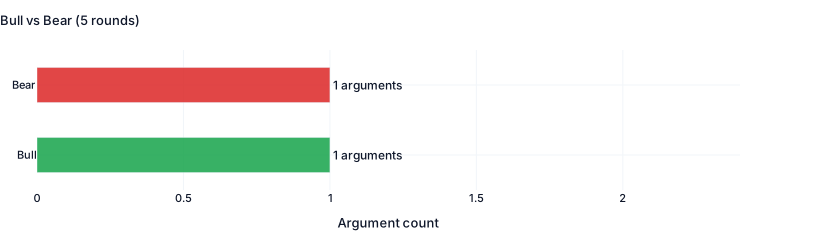
Bull vs Bear Debate (Research Manager)
Recommendation: Underweight
Rationale: Both analysts presented strong arguments, but the bear case carries more weight given current technicals and risk factors. The bull rightly emphasizes the long-term structural AI thesis, CEO sentiment, and the strength of the underlying semiconductor cycle. However, the bear’s evidence is more compelling in the near term: a record-volume breakdown, MACD bearish cross, failed breakout at the 52-week high, RSI collapse from overbought to neutral, and looming macro headwinds (strong jobs data delaying rate cuts, oil price inflation, geopolitical tensions). These factors suggest the parabolic move has ended and a deeper technical correction is likely. The 58% deviation from the 200-day MA and 152% rally from the 52-week low indicate stretched positioning. While the secular bull case remains intact, the risk/reward favors stepping aside until the panic subsides and a clearer base forms. The recommendation is not to abandon the structural theme, but to wait for a better entry after the dust settles.
Strategic Actions: Trader should trim any existing long exposure into bounces toward $555–570. Do not add new positions at current levels. Set alerts for potential support at $462–480 (50-day MA / Bollinger lower band region) and consider re-entering if price stabilizes there with volume contraction and MACD histogram turning higher. Monitor for a decisive reclaim of the VWMA ($553) on declining volume as a sign of renewed strength. Until those conditions are met, remain defensive and preserve capital.
Trader's Execution Plan
Action: Sell
Reasoning: The bear case outlined in the research plan is more compelling in the near term: SOXX has seen a record-volume breakdown, a MACD bearish cross, RSI collapse, and a failed breakout at the 52-week high. With a 152% rally from the 52-week low and a 58% deviation from the 200-day MA, positioning appears stretched. Macro headwinds (strong jobs data delaying rate cuts, oil price inflation, geopolitical risks) add further downside risk. The plan recommends trimming long exposure into bounces toward $555–570 and avoiding new positions until a clearer base forms near the $462–480 support zone. Accordingly, I recommend selling/reducing positions to preserve capital.
Position Sizing: Trim any existing long exposure; do not add new positions. Consider re-entry near $462–480 support zone.
FINAL TRANSACTION PROPOSAL: SELL
Portfolio Manager — Final Verdict
Rating: Underweight
Executive Summary: Trim existing long exposure immediately into any bounce toward $555–570; do not add new positions. The ETF has broken down on record volume with a MACD bearish cross and RSI collapse from overbought, signaling distribution. Re‑entry should be considered only after a deeper correction toward the $462–480 support zone (50‑day MA / Bollinger lower band) with signs of stabilization such as volume contraction and MACD histogram turning higher.
Investment Thesis: The aggressive analyst’s bear case is more compelling for the near term. SOXX has experienced a parabolic advance—152% from the 52‑week low, 58% above the 200‑day MA—that culminated in a record‑volume breakdown, a failed breakout at the 52‑week high, and a close below the VWMA for the first time in the rally. The MACD bearish cross and RSI crash from 80 to 53 confirm momentum has reversed. While the conservative analyst correctly notes the long‑term uptrend and golden cross remain intact, the technical damage is severe and likely to lead to a deeper retracement toward the rising 50‑day MA near $462. Macro headwinds (strong jobs data delaying rate cuts, oil price inflation, geopolitical tensions) and the KOSPI circuit‑breaker crash add further near‑term downside risk. The neutral analyst’s “sell‑half” approach acknowledges the elevated probability of further downside (55‑60% per the research plan) but still leaves half the position exposed to an overnight gap risk. Given the asymmetric risk/reward, the prudent course is to reduce exposure now and wait for a clearer base to form near the $462‑480 support zone before re‑establishing a full position.
Time Horizon: 1-3 months