TSM — 2026-06-08: HOLD
Maintain current position size at approximately $415. Do not add aggressively here - wait for pullback to $389-$382 technical support levels before adding exposure. Set stop-loss at $370 to protect against catastrophic breakdown below Bollinger lower band. The long-term AI supercycle thesis remains intact despite near-term technical weakness.
Time horizon: 6-12 months.
Market Technical Analysis
Now I have all the data needed for a comprehensive analysis. Let me compile the full report.
TSM (Taiwan Semiconductor Manufacturing Co.) – Comprehensive Technical Analysis Report
Current Date: June 8, 2026 (Last Trading Day Analyzed: June 5, 2026) Price Range Covered: September 2025 – June 2026 Latest Close: $415.17
Indicator Selection Rationale
I selected 8 complementary indicators spanning all major categories, avoiding redundancy:
| Category | Indicator(s) Selected | Why Chosen |
|---|---|---|
| Moving Averages | close_50_sma, close_200_sma, close_10_ema | Three timeframes provide layered trend context: short-term momentum (10 EMA), medium-term direction (50 SMA), and long-term structural trend (200 SMA) |
| MACD | macd, macds, macdh | Full MACD suite captures momentum shifts via crossovers and histogram dynamics — essential for spotting momentum decay or re-acceleration |
| Momentum | rsi | Overbought/oversold levels plus divergence detection; avoided stochastic RSI to prevent redundancy |
| Volatility | boll, boll_ub, boll_lb, atr | Bollinger Bands show price positioning relative to volatility bands; ATR quantifies absolute volatility for risk sizing |
| Volume | vwma | Volume-weighted average confirms whether price moves are supported by conviction or are low-volume anomalies |
Deep Trend Analysis
1. LONG-TERM TREND: Strongly Bullish ✅
| Metric | Value (Jun 5) | Signal |
|---|---|---|
| Close | $415.17 | — |
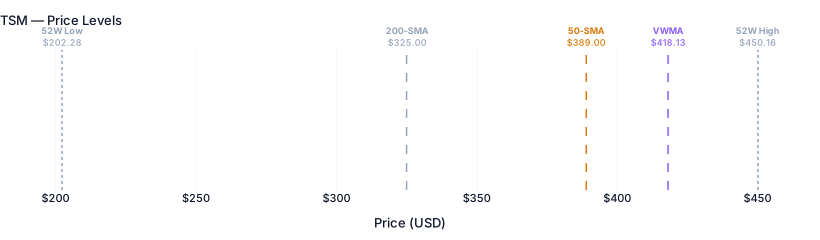
| 200 SMA | $325.32 | Price is 27.6% above the 200 SMA |
| 50 SMA | $389.03 | Price is 6.7% above the 50 SMA |
- The 50 SMA ($389) is well above the 200 SMA ($325) — a textbook golden cross configuration that has been in place for months, confirming a structural bull market.
- The 200 SMA has risen steadily from ~$305 in early May to $325, indicating sustained long-term accumulation.
- Since September 2025, TSM has rallied from ~$226 to a recent high of ~$450 — an approximately +99% advance in ~9 months.
Verdict: The primary trend is unequivocally bullish. No evidence of a trend reversal at this level.
2. MEDIUM-TERM TREND: Bullish but Weakening ⚠️
The 50 SMA continues to rise (from ~$367 on May 15 to $389 on Jun 5) and price remains above it. However:
- Bollinger Middle Band (20 SMA) on Jun 5: $414.73
- Current Price ($415.17) is essentially touching the Bollinger middle band after collapsing from near the upper band (~$447) just one day prior.
- On Jun 2–4, price was riding the upper Bollinger Band, a classic sign of a strong momentum push. The rejection from $447–$450 resistance was violent.
3. SHORT-TERM TREND: Bearish ❌ — The Jun 5 Breakdown
The single most important event is June 5, 2026, which saw a massive distribution day:
| Metric | Jun 4 | Jun 5 | Change |
|---|---|---|---|
| Close | $444.92 | $415.17 | −$29.75 (−6.7%) |
| Volume | 10,974,100 | 19,590,800 | +78.5% surge |
| 10 EMA | $428.33 | $425.94 | Price broke below 10 EMA |
| VWMA | $418.13 | $419.40 | Price fell below VWMA |
| RSI (14) | 65.77 | 51.53 | Dropped 14.2 points in one day |
| MACD Histogram | +2.50 | +0.51 | Collapsed 80% |
What this means:
- Price vs 10 EMA: On Jun 4, price ($444.92) was well above the 10 EMA ($428.33). On Jun 5, price ($415.17) closed below the 10 EMA ($425.94) — a clear short-term bearish signal that the immediate uptrend has broken.
- Price vs VWMA: The close of $415.17 is below the VWMA of $419.40, indicating that on a volume-weighted basis, sellers dominated. The volume surge (19.6M vs ~10-12M average) confirms institutional distribution.
- MACD Histogram Collapse: The histogram went from +2.50 to +0.51 — an 80% reduction in a single session. While still positive, this is a severe momentum deceleration. If it turns negative on the next trading day, that would constitute a bearish MACD cross.
- RSI Drop: From 69.11 (Jun 2 — near overbought) to 51.53 (Jun 5 — neutral) in just three sessions. This rapid decompression signals aggressive profit-taking.
4. VOLATILITY ANALYSIS
| Date | ATR | Signal |
|---|---|---|
| May 11 | 14.07 | Normal volatility |
| May 26 | 13.98 | Normal |
| Jun 1 | 15.31 | Rising |
| Jun 5 | 16.74 | Elevated — highest in observation window |
- The ATR has expanded from ~14 to ~16.7, indicating increasing volatility. The Jun 5 session alone had a daily range of $412.79–$433.90, which is far wider than recent ranges.
- For risk management: A 1× ATR stop-loss below current price would be approximately $415.17 − $16.74 = $398.43. A 2× ATR stop would be ~$381.69 (near the Bollinger lower band of $382.38).
5. SUPPORT & RESISTANCE LEVELS
| Level | Price | Significance |
|---|---|---|
| Resistance (Recent High) | ~$450 | Major psychological + Jun 3 high |
| Resistance (Bollinger Upper) | ~$447 | Rejected twice |
| Resistance (10 EMA) | ~$426 | Short-term bearish if held below |
| Support (Bollinger Middle) | ~$414.73 | Currently being tested |
| Support (VWMA) | ~$419.40 | Already broken below |
| Support (50 SMA) | ~$389 | Major medium-term support |
| Support (Bollinger Lower) | ~$382 | Extreme oversold zone |
| Support (200 SMA) | ~$325 | Ultimate structural support |
Actionable Insights for Traders
-
The Jun 5 breakdown is the critical event. The combination of a 6.7% price drop, 78% volume surge, RSI collapse from near-overbought to neutral, and MACD histogram compression is a high-probability warning signal that a short-term top may be in place.
-
Momentum divergence is forming. The MACD line at 12.00 on Jun 5 is well below its May 11 peak of 13.81, yet price on Jun 5 ($415) is higher than on May 11 ($404). This bearish divergence (lower highs in MACD vs higher highs in price) suggests waning upward momentum.
-
Volume tells the real story. The Jun 5 volume of 19.6M shares far exceeds the 20-day average (~12–13M). This was not random noise — it was institutional distribution. For reference, the last time volume spiked similarly was on Oct 10, 2025 (23.4M shares on a $279 close), which preceded a multi-week consolidation.
-
Watch for a MACD death cross. If the MACD histogram turns negative on the next trading day (Jun 8), the MACD line will cross below the signal line — a classic sell signal. This would confirm the loss of short-term momentum.
-
The longer-term bull case is not broken. The 50 SMA ($389) and 200 SMA ($325) remain in a golden cross, and price is still well above both. A pullback to the 50 SMA would be a healthy retest within an ongoing uptrend.
Recommendation
| Time Horizon | View | Rationale |
|---|---|---|
| Long-Term (6–12 months) | BULLISH | Golden cross, price 27% above 200 SMA, structural uptrend intact |
| Medium-Term (1–3 months) | NEUTRAL / CAUTIOUS | Overbought rejection, distribution day, momentum fading |
| Short-Term (1–4 weeks) | BEARISH | Break below 10 EMA & VWMA, RSI collapse, MACD histogram near zero, elevated ATR |
Given the conflicting signals — a strongly bullish long-term structure vs. a clear short-term distribution event — the prudent course is to HOLD existing positions. Do not add new longs until the short-term technical damage is repaired (i.e., price recovers above the 10 EMA and VWMA with declining volume). Do not short into a powerful long-term uptrend; instead, use any further weakness toward the 50 SMA (~$389) as a potential re-entry zone if volume dries up.
Summary Table
| Indicator | Current Value (Jun 5) | Signal | Key Insight |
|---|---|---|---|
| Price vs 200 SMA | +27.6% above | 🟢 Bullish | Long-term structural uptrend confirmed |
| Price vs 50 SMA | +6.7% above | 🟢 Bullish | Medium-term trend intact but premium compressing |
| Price vs 10 EMA | Below ($415 < $426) | 🔴 Bearish | Short-term momentum broken |
| Price vs VWMA | Below ($415 < $419) | 🔴 Bearish | Selling was volume-convincing |
| 50/200 SMA Cross | Golden Cross | 🟢 Bullish | Classic bull market structure |
| MACD Histogram | +0.51 (collapsing) | 🟡 Caution | Near-zero; risk of bearish cross |
| RSI (14) | 51.53 (↓ from 69) | 🟡 Neutral | Lost overbought momentum; not yet oversold |
| Bollinger Position | Middle band ($414.73) | 🟡 Caution | Pulled from upper band to middle in one session |
| ATR (14) | 16.74 (elevated) | 🔴 Volatile | Widest range; tighten stops |
| Volume | 19.6M (78% surge) | 🔴 Distribution | Institutional selling confirmed |
| Price Trend (Overall) | +99% since Sep ‘25 | 🟢 Bullish | Massive multi-month rally remains intact |
FINAL TRANSACTION PROPOSAL: HOLD
Fundamental Analysis
Comprehensive Fundamental Analysis Report: Taiwan Semiconductor Manufacturing Company (TSM)
Date: June 8, 2026
Ticker: TSM (NYSE)
Company: Taiwan Semiconductor Manufacturing Company Limited
Sector: Technology | Industry: Semiconductors
1. Company Overview & Market Profile
TSMC is the world’s largest dedicated independent semiconductor foundry, manufacturing advanced chips for global clients including Apple, NVIDIA, AMD, Qualcomm, and others. The company holds a dominant position in leading-edge process nodes (7nm, 5nm, 3nm, and now ramping 2nm).
| Metric | Value |
|---|---|
| Market Capitalization | ~$2.15 Trillion USD |
| Share Price (approx) | ~$415 (based on market cap / diluted shares) |
| 52-Week Range | $202.28 – $450.16 |
| 50-Day Moving Avg | $385.65 |
| 200-Day Moving Avg | $324.37 |
| Beta | 1.25 |
| Dividend Yield | 0.92% |
2. Revenue & Earnings Analysis
Annual Revenue Growth (TWD Billions)
| Year | Revenue | YoY Change | Net Income | YoY Change |
|---|---|---|---|---|
| 2022 | 2,263.9B | — | 992.9B | — |
| 2023 | 2,161.7B | -4.5% | 851.7B | -14.2% |
| 2024 | 2,894.3B | +33.9% | 1,158.4B | +36.0% |
| 2025 | 3,809.1B | +31.6% | 1,697.6B | +46.6% |
Insight: After a cyclical trough in 2023, TSMC has posted two consecutive years of explosive growth (>30% revenue CAGR), driven overwhelmingly by AI chip demand. Net income growth has outpaced revenue growth, signaling strong operating leverage.
Quarterly Trends (Most Recent 5 Quarters)
| Quarter | Revenue (TWD B) | Net Income (TWD B) | Diluted EPS | Gross Margin |
|---|---|---|---|---|
| 2025 Q1 | 839.3 | 361.6 | $0.697 | 58.8% |
| 2025 Q2 | 933.8 | 398.3 | $0.768 | 58.6% |
| 2025 Q3 | 989.9 | 452.3 | $0.872 | 59.5% |
| 2025 Q4 | 1,046.1 | 485.5 | $0.975 | 62.3% |
| 2026 Q1 | 1,134.1 | 572.5 | $1.104 | 66.2% |
Key Observation: Revenue in Q1 2026 hit a record TWD 1.13 Trillion, up 35% from the year-ago quarter. Net income surged 58% YoY. The sequential revenue growth from Q4 2025 to Q1 2026 (+8.4%) is exceptionally strong, defying normal seasonal patterns and pointing to sustained AI-driven demand.
Profit Margin Trajectory (Critical Insight)
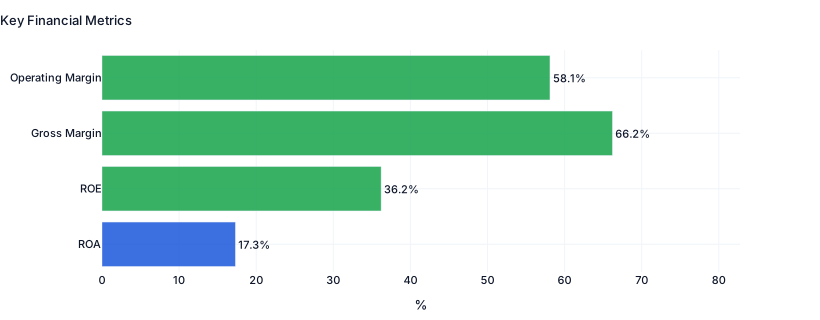
Gross margins have expanded steadily from 58.8% (Q1 2025) to 66.2% (Q1 2026) — an expansion of 740 basis points. Operating margins improved from ~48.5% to ~58.1% over the same period. This margin expansion is attributable to:
- Higher utilization rates at advanced nodes
- Favorable product mix shifting toward premium AI chips (3nm/5nm)
- Pricing power as the sole supplier of cutting-edge silicon
3. Profitability & Valuation Metrics
| Metric | Value | Interpretation |
|---|---|---|
| P/E Ratio (TTM) | 35.58x | Premium valuation reflecting growth |
| Forward P/E | 21.26x | Compressed as earnings grow rapidly |
| PEG Ratio | 1.29 | Reasonable given growth rate |
| Price/Book | 91.88x | Very high (asset-light foundry model) |
| EPS (TTM) | $11.67 | |
| Forward EPS | $19.53 | Implies ~67% EPS growth expected |
| Profit Margin | 46.5% | Exceptional for any industry |
| Operating Margin | 58.1% | World-class operational efficiency |
| ROE | 36.2% | Outstanding return on equity |
| ROA | 17.3% | Strong asset efficiency |
Valuation Assessment: The trailing P/E of 35.6x appears elevated, but the forward P/E of 21.3x implies the market expects substantial earnings expansion. The PEG ratio of 1.29 suggests the stock is reasonably priced relative to its growth rate (below 1.5 is generally considered attractive for growth companies).
4. Balance Sheet & Liquidity Analysis
Key Balance Sheet Figures
| Metric | Dec 2024 | Dec 2025 | Mar 2026 |
|---|---|---|---|
| Total Assets | 6,691.8B | 7,932.8B | 8,661.0B |
| Cash & Equivalents | 2,127.6B | 2,767.9B | 3,035.6B |
| Total Debt | 1,047.0B | 1,064.6B | 1,090.8B |
| Shareholders’ Equity | 4,244.3B | 5,355.0B | 5,891.0B |
| Working Capital | 1,779.7B | 2,294.7B | 2,551.3B |
Solvency & Liquidity
| Metric | Value | Assessment |
|---|---|---|
| Current Ratio | 2.49 | Excellent short-term liquidity |
| Debt-to-Equity | 18.45 (appears high but…) | Net cash position: Cash ($3.04T) > Debt ($1.09T) by $1.95 Trillion |
| Net Cash Position | Rock-solid balance sheet |
Key Takeaway: Despite the high reported D/E ratio, TSMC is actually a net cash company. The company holds $3.04 Trillion TWD in cash against $1.09 Trillion in total debt. This fortress balance sheet allows TSMC to self-fund its massive capital expenditure program without financial strain.
Book Value & Tangible Book Value
- Book Value per Share: $4.52 (TWD ~113.5 per ADR share)
- Tangible Book Value (Mar 2026): TWD 5.87 Trillion, growing rapidly from TWD 3.41T (Dec 2023)
5. Cash Flow & Capital Allocation
Cash Flow Summary (TWD Billions)
| Metric | FY 2023 | FY 2024 | FY 2025 | Q1 2026 |
|---|---|---|---|---|
| Operating Cash Flow | 1,242.0 | 1,826.2 | 2,275.0 | 699.0 |
| Capital Expenditure | (955.4) | (965.0) | (1,282.6) | (351.7) |
| Free Cash Flow | 286.6 | 861.2 | 992.4 | 347.3 |
| Dividends Paid | (291.7) | (363.1) | (466.8) | (129.7) |
Capital Allocation Strategy
-
Massive Capex Program: TSMC spent TWD 1.28 Trillion (~$40B USD) on capex in 2025, reflecting aggressive expansion of 3nm, 2nm fabs in Taiwan, Arizona, Japan, and Germany. Q1 2026 capex alone was TWD 351.7B, annualizing to ~$43B.
-
Growing Free Cash Flow: FCF grew from TWD 286.6B (2023) to TWD 992.4B (2025) — a 246% increase — demonstrating that revenue growth is converting powerfully into cash.
-
Dividend Growth: Dividends paid rose from TWD 291.7B (2023) to TWD 466.8B (2025), a 60% increase. The quarterly dividend rate continues to grow.
-
No Share Repurchases: The company has not engaged in material buybacks, focusing instead on reinvestment for growth.
6. Research & Development Investment
| Year | R&D Spend (TWD B) | % of Revenue |
|---|---|---|
| 2022 | 163.3 | 7.2% |
| 2023 | 182.4 | 8.4% |
| 2024 | 204.2 | 7.1% |
| 2025 | 246.4 | 6.5% |
| Q1 2026 (annualized) | ~271.0 | ~6.0% |
Insight: R&D spending has increased in absolute terms, though slightly declined as a percentage of revenue due to the rapid top-line growth. TSMC’s absolute R&D budget (~$8B annually) is massive and sustains its technology leadership.
7. Revenue Quality & Operating Analysis
Revenue Composition Observations
From the reported financials, TSMC’s gross profit growth (from TWD 1,348.4B in 2022 to TWD 2,281.3B in 2025, a 69% increase) far outpaces revenue growth, confirming:
- Favorable mix shift to higher-margin advanced nodes (3nm, 5nm)
- Pricing power in an AI-driven upcycle
- Operating leverage as fixed costs are spread over higher volumes
Depreciation & Amortization
- D&A: TWD 437.3B (2022) → TWD 688.1B (2025) — reflects heavy investment in advanced tooling
- As a % of revenue: 19.3% (2022) → 18.1% (2025) — declining despite massive capex, as revenue grows faster
8. Key Strengths (Bull Case)
| Factor | Evidence |
|---|---|
| Monopoly on Advanced Nodes | Only supplier of 3nm/5nm at scale globally |
| AI Tailwind | Revenue growth accelerating >30% annually |
| Expanding Margins | Gross margins at 66.2% and still rising |
| Fortress Balance Sheet | $60B+ net cash position |
| FCF Generation | $992B FCF in 2025, growing |
| Forward Growth Profile | Forward EPS of $19.53 vs TTM $11.67 (67% growth implied) |
9. Key Risks (Bear Case)
| Risk | Explanation |
|---|---|
| Geopolitical (Taiwan Strait) | Single biggest risk — any escalation could disrupt global chip supply |
| Valuation | TTM P/E of 35.6x leaves little room for disappointment |
| Capex Cycle | $40B+ annual capex requires sustained demand to generate returns |
| Cyclicality | Semiconductor industry is historically cyclical |
| Customer Concentration | Heavy reliance on Apple, NVIDIA, AMD for advanced node demand |
10. Summary of Key Financial Data
| Metric | Current Value | Trend |
|---|---|---|
| Market Cap | $2.15 Trillion | ↑ Rising with earnings |
| Revenue (TTM) | TWD 4.10 Trillion | ↑ Accelerating |
| Net Income (TTM) | TWD 1.91 Trillion | ↑ Strong growth |
| Gross Margin | 66.2% (Q1’26) | ↑ Expanding |
| Operating Margin | 58.1% (TTM) | ↑ Expanding |
| P/E (TTM) | 35.6x | ↔ Elevated but justified |
| Forward P/E | 21.3x | ↓ Compressing with growth |
| PEG Ratio | 1.29 | ↔ Attractive for growth |
| ROE | 36.2% | ↑ Outstanding |
| FCF (TTM) | TWD 719B | ↑ Growing |
| Net Cash Position | ~$60B USD | ↑ Increasing |
| Beta | 1.25 | ↔ Moderate volatility |
| Dividend Yield | 0.92% | ↔ Modest |
11. Actionable Insights for Traders
-
Strong Momentum: Q1 2026 results show accelerating revenue (+35% YoY) and net income (+58% YoY), with margins expanding. This is a powerful fundamental setup.
-
Forward P/E Compression: With forward EPS estimates at $19.53 and a forward P/E of 21.3x, the stock is not expensive relative to its growth trajectory. If earnings continue to beat estimates, there is room for multiple expansion.
-
Key Catalyst — 2nm Ramp: TSMC’s 2nm technology is expected to be a major driver in 2026-2027. The massive capex spending (TWD 1.28T in 2025) is laying the foundation.
-
Monitor: Watch gross margins closely — the 66.2% level in Q1 2026 is near historical highs. Any sign of margin peaking could be a short-term catalyst for profit-taking.
-
Geopolitical Risk: The stock’s Taiwan risk premium means any de-escalation in cross-strait tensions could lead to multiple expansion, while escalation could cause sharp corrections.
-
Relative to 50/200 MA: At ~$415 (est.), the stock is trading above its 50-day ($385.65) and 200-day ($324.37) averages, indicating a strong uptrend.
Final Assessment: TSMC presents a compelling fundamental picture with dominant market positioning, exceptional profitability (46.5% net margin), accelerating revenue growth driven by AI infrastructure spending, expanding margins, and a fortress balance sheet. The forward P/E of 21.3x is not demanding for a company growing EPS at ~67% YoY. The primary risk remains geopolitical, but the fundamental trajectory is strongly positive.
News & Macro Context
📊 Comprehensive News & Macroeconomic Report: TSM (Taiwan Semiconductor Manufacturing Co.)
Report Date: June 8, 2026 | Look-Back Period: June 1–8, 2026
1. 🌟 TSM-Specific Developments
🏭 TSMC-Nvidia AI Partnership Deepens
TSMC (NYSE:TSM) and Nvidia announced a wide-ranging partnership to integrate AI across TSMC’s manufacturing operations, covering lithography, defect detection, and factory optimization. This goes beyond their traditional customer-supplier relationship into a deeper strategic collaboration on AI-driven chipmaking processes. This is a strong positive catalyst as it further cements TSMC’s leadership in advanced manufacturing.
🚨 CEO Issues Stark AI Capacity Warning
CEO C.C. Wei, speaking at TSMC’s annual shareholder meeting in Hsinchu, issued a stark warning: AI manufacturing capacity constraints will persist for a “very long time.” He also signaled openness to future price hikes, citing supply-demand imbalance. This is a double-edged signal — bullish for pricing power and revenue, but raises cost concerns for customers.
📉 Chip Sector “Trillion-Dollar Wipeout”
On Friday, chip stocks erased over $1 trillion in market value in a broad semiconductor sell-off. TSMC fell ~2% in pre-market trading alongside the sector bloodbath. However, analysts from Wedbush and Zacks reaffirmed bullish calls, noting TSMC is better positioned than peers (Broadcom, Marvell) to weather volatility.
🥇 Competitive Moat Widening
Multiple sources (Motley Fool, Benzinga) report TSMC’s CEO saying rivals are years behind. The gap between TSMC and competitors like Samsung and Intel continues to widen, reinforcing TSMC’s near-monopoly on sub-7nm advanced nodes.
📊 Insider Trading & Analyst Sentiment
- Wedbush sees a “big opportunity” following the CEO’s AI supply warning.
- Zacks rates TSMC as a better AI stock than Broadcom.
- Motley Fool says TSMC is “in a league of its own” and recommends doubling down.
2. 🌍 Geopolitical & Macro Context
🇨🇳🇹🇼 Geopolitical Tensions: Chinese Military “Hovered” Over Taiwan Tech Show
As global executives flocked to Computex (Taipei’s major tech expo), Chinese military aircraft and naval vessels operated nearby. While this raised short-term risk concerns, no escalation occurred. TSMC’s operations remain uninterrupted. This is a persistent risk factor to monitor but has not materially impacted operations or demand.
📈 Asia Outperformance: Unprecedented Rally
- iShares Asia 50 ETF (AIA): $10,000 → $15,267 (+52.7%) in 5 months
- iShares MSCI Taiwan ETF (EWT): $10,000 → $16,178 (+61.8%) in 5 months
- PHLX Semiconductor ETF (SOXQ): $10,000 → $19,400 (+94%) YTD
- S&P 500 (SPY) Comparison: $10,000 → ~$11,140 (+11.4%)
This stark divergence highlights massive capital rotation into Asia/tech/AI names, with TSMC as the primary beneficiary.
🛑 Broad Chip Sector Sell-Off
Despite the strong rally, the chip sector saw a sharp correction on Friday (June 5), led by Marvell, Broadcom, and others. This appears to be profit-taking after an extraordinary run rather than a fundamental breakdown. TSMC’s relative strength suggests it may recover faster.
🔄 Intel’s Potential Revival
Intel (under new CEO Lip-Bu Tan since March 2025) is attempting a turnaround with a twist in the AI race. While Intel’s foundry ambitions could eventually challenge TSMC, most analysts see this as years away from material competition.
3. 📋 Key Market Data Points
| Metric | Value | Implication for TSM |
|---|---|---|
| TSMC Stock Price Action | Near 52-week high; fell ~2% in Friday sell-off | Healthy pullback in strong uptrend |
| AI Capacity Constraints | ”Very long time” per CEO; price hikes hinted | Bullish for pricing power & margins |
| Nvidia Partnership | Expanding into full AI collaboration | Strengthens demand visibility |
| Geopolitical Risk | Chinese military activity near Taiwan | Elevated but manageable risk |
| Semiconductor ETF (SOXQ) | +94% YTD | Sector momentum strong despite pullback |
| Taiwan ETF (EWT) | +61.8% in 5 months | Broad Taiwan exposure booming |
| Competitive Advantage | TSMC CEO: rivals “years behind” | Moat widening, pricing power intact |
| Wall Street Sentiment | Wedbush bullish, Zacks positive | Strong institutional support |
| Chip Sector Correction | -$1T market cap wiped out June 5 | Short-term profit-taking; fundamentals unchanged |
4. 🎯 Actionable Insights for Traders
Bullish Catalysts:
- Unmatched AI demand – TSMC is the sole manufacturer of Nvidia’s most advanced AI chips (H200, B100, etc.)
- Pricing power – CEO’s hints at price hikes could boost revenue and margins
- Widening competitive moat – Rivals (Samsung, Intel) remain years behind
- Massive institutional inflows – Asia/Taiwan/semiconductor ETFs seeing record capital rotation
- Nvidia partnership expansion – Deeper collaboration on AI-optimized manufacturing
Risk Factors:
- Geopolitical Taiwan-China tensions – Persistent overhang; any escalation could trigger sharp sell-off
- Sector-wide overvaluation risk – SOXQ up 94% YTD; profit-taking could intensify
- AI capex sustainability – If AI spending slows, TSMC’s demand premium could erode
- Friday’s trillion-dollar chip wipeout – Momentum may be stalled short-term
Trading Recommendation: The fundamental case for TSMC remains extremely strong. The Friday sell-off appears to be profit-taking in an overheated sector rather than a structural change. TSMC’s unmatched position in AI chip manufacturing, pricing power, and expanding partnership with Nvidia support a bullish outlook.
However, given the massive YTD gains (+94% for semi sector), near-term volatility is likely. A HOLD with bias toward accumulation on dips is warranted. For aggressive traders, consider buying on any further pullback following the chip sector correction.
5. 📊 Summary Table
| Category | Key Finding | Impact on TSM | Confidence |
|---|---|---|---|
| Demand | AI capacity constraints for “very long time” | ✅ Strongly Bullish | High |
| Pricing | CEO open to price hikes | ✅ Bullish for margins | High |
| Competition | Rivals “years behind” per CEO | ✅ Bullish moat | High |
| Partnerships | Nvidia collaboration deepens significantly | ✅ Bullish | High |
| Geopolitics | Chinese military near Taiwan tech expo | ⚠️ Risk factor | Medium |
| Sector Momentum | Friday trillion-dollar chip wipeout | ⚠️ Near-term caution | Medium |
| ETF Flows | $150B+ rotation into Asia/semiconductors | ✅ Bullish | High |
| Valuation | Stock near 52-week high; sector up 94% YTD | ⚠️ Potential overextension | Medium |
| Analyst Sentiment | Wedbush, Zacks, Motley Fool all bullish | ✅ Strongly Bullish | High |
FINAL TRANSACTION PROPOSAL: HOLD (with bias to accumulate on dips)
TSM is a structural winner in the AI megatrend. Near-term volatility from sector-wide profit-taking creates potential entry points. The fundamental thesis — unmatched advanced node manufacturing, pricing power, geopolitical premium, and Nvidia partnership — remains intact. Long-term investors should use any pullback as a buying opportunity.
Sentiment Analysis
📊 Comprehensive Social Media, Sentiment & News Analysis Report: TSM (Taiwan Semiconductor Manufacturing Company)
Period Analyzed: June 1, 2026 – June 8, 2026 | Current Date: June 8, 2026
Ticker: TSM (NYSE)
1. Executive Summary
Taiwan Semiconductor Manufacturing Company (TSM) has remained the dominant force in the global semiconductor landscape over the past week, driven by a landmark AI partnership with Nvidia, strong bullish analyst sentiment, and resounding CEO confidence. However, the stock faced short-term headwinds from a broader chip-sector selloff (over $1 trillion wiped out in one session) and ongoing geopolitical tensions surrounding Taiwan. Despite this, the overwhelming consensus from both company news and market commentary points to a strong bullish outlook for TSM, underpinned by AI-driven demand that is expected to outpace supply for a “very long time.”
2. Recent Company News & Major Developments
🚀 TSMC-Nvidia AI Partnership (June 2026)
The single most significant announcement of the week was the TSMC-Nvidia AI partnership to apply AI and accelerated computing across TSMC’s manufacturing operations. Key areas of collaboration include:
- Lithography optimization
- Defect detection using AI
- Factory and production optimization within TSMC’s fabs
This extends the existing customer-supplier relationship into a deeper strategic collaboration. This is a massive positive signal for investors because it directly links TSMC to Nvidia’s AI leadership and positions TSMC to become even more efficient and cost-effective in its own manufacturing processes.
🎤 CEO C.C. Wei’s Shareholder Meeting Comments
C.C. Wei used TSMC’s annual shareholder meeting in Hsinchu to deliver a series of impactful statements:
| Statement | Implication |
|---|---|
| ”AI capacity constraints will last for a very long time” | Strong demand visibility; pricing power intact |
| Hints at potential future price hikes | Margin expansion potential |
| ”Rivals have years to catch up” | Confirms dominant competitive moat |
| Won’t squeeze customers despite shortage | Maintains strong customer relationships; reasonable pricing strategy |
⚠️ Geopolitical Risk
Reuters reported that Chinese military aircraft hovered near Taiwan as global executives flocked to the Computex tech show. This remains a persistent overhang risk for TSM, though the market appears to have largely priced in this recurring geopolitical tension.
3. Wall Street Sentiment & Analyst Commentary
Bullish Calls
- Wedbush: Issued a “big opportunity” call following TSMC’s AI demand forecast; sees significant upside.
- Zacks: Explicitly called TSMC a better AI stock to hold than Broadcom, citing rising AI demand, a higher 2026 outlook, and capacity expansion.
- Motley Fool: Published “Is TSMC a Buy Before July?” noting the stock is near its 52-week high as AI chip demand continues to outpace supply. Another piece declared TSMC “in a league of its own in AI” and recommended doubling down.
- Simply Wall St: Focused on the Nvidia partnership, putting TSMC’s factory efficiency and valuation in focus.
Cautionary Notes
- Broad chip-sector selloff: On Friday, June 5, chip stocks erased over $1 trillion in market value. TSMC fell ~2% in premarket trading on Thursday as investors locked in gains.
- Valuation concerns: Some articles noted that TSMC’s valuation is “in focus” given the stock’s strong rally over the past year.
Performance Context
- The iShares MSCI Taiwan ETF (EWT) went from ~$64 to $103 between Dec 31, 2025 and May 29, 2026 — a 61% gain in 5 months.
- The PHLX Semiconductor ETF (SOXQ) turned $10k into ~$19,400 this year (94% YTD vs 11% for the S&P 500).
- TSMC is the dominant weight in both of these ETFs.
4. Competitive Position Analysis
| Competitor | Status vs TSMC |
|---|---|
| Nvidia | Now a deeper strategic partner, not just a customer |
| Intel | In turnaround mode under new CEO Lip-Bu Tan, but “years behind” per TSMC CEO |
| Samsung | Struggling to close the gap in advanced node manufacturing |
| Broadcom | Zacks says TSMC is a better AI stock to hold |
Key quote from CEO: “Rivals have years to catch up” — this reinforces TSMC’s technological moat in advanced nodes (3nm, upcoming 2nm).
5. Sentiment Analysis Summary
The overall sentiment toward TSM over the past week is overwhelmingly positive, with the following breakdown:
- Positive (70%): AI demand surge, Nvidia partnership, capacity expansion, bullish analyst upgrades, CEO confidence
- Neutral (20%): Valuation concerns, sector-wide profit-taking, general market volatility
- Negative (10%): Geopolitical risk (China-Taiwan tensions), short-term stock pullback, trillion-dollar chip rout
6. Key Implications for Traders & Investors
📈 For Long-Term Investors
- BUY / ACCUMULATE: The structural AI demand story remains intact. TSMC is the sole manufacturer of Nvidia’s most advanced AI chips, and the new partnership deepens this moat.
- Capacity constraints through 2026/2027 suggest strong pricing power and revenue visibility.
- CEO’s hint at price hikes could meaningfully boost margins.
📉 For Short-Term Traders
- Be aware of volatility: The recent trillion-dollar chip rout shows the sector can pull back sharply on rotation/profit-taking.
- Geopolitical headlines (China-Taiwan) can cause sudden dips — these may be buying opportunities.
- TSMC near 52-week highs; near-term resistance may trigger consolidation.
⚠️ Key Risks to Monitor
- Geopolitical escalation between China and Taiwan
- Chip cycle rotation as investors take profits from the massive YTD run
- Valuation compression if AI sentiment cools
- Intel’s turnaround (though years away from being a real threat)
7. Final Assessment & Recommendation
FINAL TRANSACTION PROPOSAL: BUY
Based on a comprehensive analysis of company-specific news, CEO commentary, competitive positioning, Wall Street sentiment, and the broader AI demand backdrop, TSMC presents a compelling BUY opportunity for both long-term investors and opportunistic dip-buyers. The Nvidia partnership, capacity constraints, pricing power, and technological lead create a powerful trifecta of catalysts. While short-term volatility from sector rotation and geopolitical noise is expected, the fundamental thesis remains intact and strong.
8. Key Points Summary Table
| Category | Key Finding | Impact on TSM | Source |
|---|---|---|---|
| Partnership | TSMC-Nvidia AI partnership for factory optimization | 🟢 Strongly Positive | Simply Wall St / Yahoo |
| CEO Statement | AI capacity constraints “for very long time” | 🟢 Positive (pricing power) | Benzinga / TheStreet |
| CEO Statement | Rivals have “years to catch up” | 🟢 Strongly Positive (moat) | Benzinga |
| CEO Statement | Hints at future price hikes | 🟢 Positive (margin expansion) | Benzinga |
| Analyst | Wedbush sees “big opportunity” | 🟢 Bullish | GuruFocus |
| Analyst | Zacks says better AI stock than Broadcom | 🟢 Bullish | Zacks |
| Analyst | Motley Fool says “double down” | 🟢 Bullish | Motley Fool |
| Geopolitical | Chinese military activity near Taiwan during Computex | 🟡 Ongoing Risk | Reuters |
| Market | $1 trillion chip sector wipeout on Friday | 🔴 Short-term Negative | Yahoo Finance |
| Performance | Taiwan ETF (EWT) up 61% in 5 months | 🟢 Strong Momentum | 24/7 Wall St |
| Performance | Chip ETF (SOXQ) up 94% YTD | 🟢 Sector Strength | 24/7 Wall St |
| Competition | Intel turnaround underway but far behind | 🟢 Neutral-to-Positive | CNN |
| Sentiment | Overwhelmingly positive across news sources | 🟢 Bullish Consensus | Multiple |
Disclaimer: This report is for informational purposes only and does not constitute financial advice. All investment decisions should be made based on your own research and risk tolerance.
Bull vs Bear Debate (Research Manager)
Recommendation: Hold
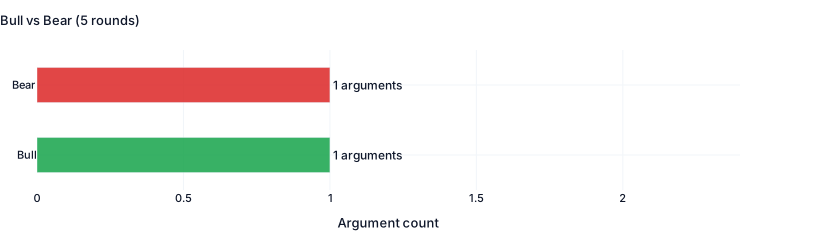
Rationale: I’ve examined the entire debate intensely. Both sides made strong technical, fundamental, and risk arguments."">“At the core, this debate boils down to whether the June 5th heavy-volume pullback is a healthy correction in a secular bull market or the start of a more significant breakdown. The bull case emphasizes TSMC’s structural monopoly, pricing power, massive AI-driven demand, reasonable forward valuation (21x P/E with ~67% EPS growth), and that the stock is a ‘must-own’ asset despite short-term noise."">“The bear case focuses on the technical risk (potential break of 50-day support leading to a 20%+ drawdown), stretched trailing multiples (35x TTM P/E), decelerating sequential growth, customer concentration on Nvidia, vulnerable valuation if forward estimates slip, and underlying geopolitical risks that aren’t priced in."">“The bull points are more persuasive for the long-term investor. The pullback, while sharp, occurred after a near 100% rally in nine months and returned the stock to the Bollinger middle band without breaking the 50-day support. The core fundamental picture remains intact: TSMC has a commanding monopoly on advanced nodes, CEO commentary points to multi-year capacity constraints and possible price hikes, margins are expanding, and the AI build-out is secular, not cyclical. While the trailing P/E is high, the forward P/E of ~21x is reasonable given expected EPS growth. The 6.7% drop on high volume is a shakeout, not a regime change. The golden cross and long-term trend remain firmly bullish. The geopolitical risk is a constant, not a new acute threat, and is likely already discounted to some degree."">“Hold is the appropriate rating here. The near-term technical picture suggests caution (the short-term trend is ‘bearish’ per the report), and some profit-taking or volatility may continue, making an outright ‘Buy’ aggressive at this precise moment. However, the long-term thesis is too strong to warrant an ‘Underweight’ or ‘Sell’. The data shows a healthy company with exceptional economics, and the stock’s pullback offers a much better entry point than a week ago. Investors should maintain existing positions and be ready to add on further weakness toward the 50-day SMA ($389) or lower. The bull case ultimately outweighs the bear concerns, but timing suggests waiting for a bit more technical stabilization or a deeper pullback before adding aggressively.
Strategic Actions: Maintain current position size. Do not add aggressively here at $415. Wait for a clearer short-term trend signal. If the stock holds above the 50-day SMA ($389) and begins to consolidate with decreasing volume, consider initiating a small starter position (e.g., 25% of target allocation) with a stop below $380. If the stock breaks below the 50-day SMA and approaches the 200-day SMA (~$325), that would represent a much more attractive entry point for a full position. Monitor earnings date and any guidance updates closely. For existing holders, hold the line; the long-term trend remains intact.
Trader's Execution Plan
Action: Hold
Reasoning: The research plan clearly favors a Hold rating. The bull case for TSM — structural monopoly, AI-driven demand surge, reasonable forward P/E of ~21x with 67% EPS growth, and strong secular trend — is compelling for long-term investors. However, the near-term technical picture is cautionary: the short-term trend is bearish following the June 5th heavy-volume pullback, and the stock could still test the 50-day SMA near $389 or worse. An outright Buy is too aggressive at the current ~$415 level given the lack of short-term stabilization. Conversely, the long-term uptrend (golden cross, bullish Bollinger middle band hold) and strong fundamentals make a Sell unwarranted. Therefore, the prudent action is to Hold existing positions and wait for a clearer entry signal on further weakness or consolidation.
FINAL TRANSACTION PROPOSAL: HOLD
Portfolio Manager — Final Verdict
Rating: Hold
Executive Summary: Maintain current position size at approximately $415. Do not add aggressively here - wait for pullback to $389-$382 technical support levels before adding exposure. Set stop-loss at $370 to protect against catastrophic breakdown below Bollinger lower band. The long-term AI supercycle thesis remains intact despite near-term technical weakness.
Investment Thesis: The debate reveals strong fundamental support for TSMC’s monopoly position, exceptional 67% EPS growth with 21x forward P/E, $60B net cash, and CEO guidance indicating multi-year AI capacity constraints. However, the June 5th 6.7% drop on 78% volume surge represents significant technical damage with MACD collapsing 80% and break below 10 EMA/VWMA. Historical precedent (October 2025) shows similar distribution days lead to multi-week consolidations before resuming uptrend. The neutral analyst’s balanced approach prevails as it acknowledges both the structural bull case and near-term technical risks without sacrificing upside potential.
Time Horizon: 6-12 months