VNQ — 2026-06-08: SELL
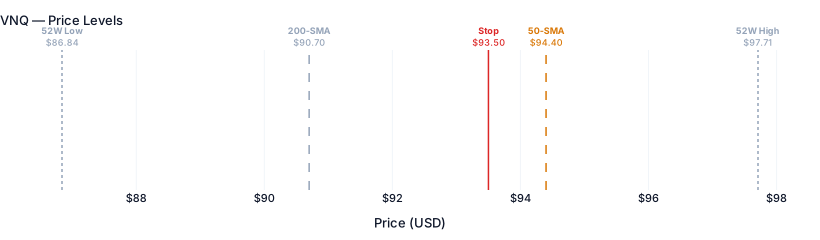
Execute 30-40% position reduction in VNQ, reallocating proceeds to short-term Treasuries to capture the 80 basis point yield advantage. Set hard stop at $93.50 to protect against momentum breakdown, while maintaining core exposure for potential trend continuation. Monitor MACD recovery above +0.50 and Federal Reserve guidance shifts as re-entry catalysts.
Time horizon: 3-6 months.
Market Technical Analysis
Now I have all the data I need. Let me compile a detailed analysis.
VNQ (Vanguard Real Estate ETF) – Comprehensive Technical Analysis Report
Analysis Date: June 8, 2026 | Last Trading Session: June 5, 2026 Close: $96.79
1. Selected Indicators & Rationale
| Indicator | Category | Why Selected |
|---|---|---|
| close_50_sma | Moving Average | Medium-term trend anchor; dynamic support/resistance |
| close_200_sma | Moving Average | Long-term trend benchmark; golden/death cross confirmation |
| close_10_ema | Moving Average | Captures short-term momentum shifts with speed |
| macd | MACD | Core momentum oscillator; crossover & divergence signals |
| rsi | Momentum | Flags overbought/oversold conditions and hidden divergences |
| boll_ub | Volatility (Bollinger) | Identifies overextended upside and breakout zones |
| boll_lb | Volatility (Bollinger) | Identifies pullback floors and potential reversal zones |
| atr | Volatility | Measures volatility for stop placement and sizing |
2. Detailed Indicator Analysis
A. Moving Averages – Trend Structure
| Metric | Value (June 5) | Interpretation |
|---|---|---|
| Close | $96.79 | — |
| 200 SMA | $90.70 | Price ~6.7% above; long-term trend strongly bullish |
| 50 SMA | $94.40 | Price ~2.5% above; medium-term bullish |
| 10 EMA | $95.76 | Price ~1.1% above; short-term bullish (recovering) |
Trend Stack (Price > 10 EMA > 50 SMA > 200 SMA): ✅ All aligned bullishly. The 50 SMA ($94.40) is well above the 200 SMA ($90.70), confirming a Golden Cross that was triggered months ago. This structural alignment is the hallmark of a sustained uptrend.
50 SMA Trajectory: The 50 SMA has risen steadily from $91.37 (Apr 9) → $94.40 (Jun 5), gaining ~$3.03 in two months. This is a healthy, gradual incline without parabolic acceleration — sustainable.
10 EMA Dynamics: The 10 EMA dipped to $95.33 (June 1) as price plummeted to $94.09, but has since rebounded to $95.76. Price is now back above the 10 EMA, a bullish short-term reversal signal.
B. MACD – Momentum
| Date | MACD Line | Interpretation |
|---|---|---|
| Apr 17 | +1.15 | Strong bullish momentum (price ~96.68) |
| Apr 30 | +1.22 | Peak momentum zone |
| May 15 | +0.65 | Declining (price dropped to 93.91) |
| May 28 | +0.65 | Stabilizing |
| Jun 5 | +0.22 | Sharp decline but still positive |
Critical Observation: The MACD has been in a steep decline from the +1.22 peak in late April to just +0.22 as of June 5. This represents a significant bearish divergence — price has roughly recovered to the $96.79 level (near April highs of ~$96.68), but MACD momentum is a fraction of where it was. This warns that the upside momentum is materially weakening and a potential MACD bearish crossover (line crossing below signal) could be imminent.
However, the MACD remains positive, meaning the 12-period EMA is still above the 26-period EMA. The trend is not broken, but it is losing steam.
C. RSI – Momentum/Exhaustion Gauge
| Date | RSI | Signal |
|---|---|---|
| Apr 17 | 76.42 | 🟢 Overbought → Correction ensued |
| Apr 20 | 77.31 | Overbought peak |
| May 11–12 | 61.37 | Cooling off from overbought |
| May 26 | 61.15 | Mild recovery |
| Jun 1 | 41.93 | Approaching oversold → Price bounced |
| Jun 5 | 57.11 | Neutral-bullish recovery |
Analysis: The RSI corrected from overbought (77) to near-oversold (42) over ~6 weeks, then bounced sharply. The recovery to 57.11 puts it in neutral territory — not overbought, not oversold. This is constructive: there is room to run higher before hitting overbought resistance at 70. The pattern of a higher RSI low (42 vs. potential prior lows) suggests underlying buying interest.
D. Bollinger Bands – Volatility Context
| Level | Value (Jun 5) |
|---|---|
| Upper Band | $97.95 |
| Middle Band (20 SMA) | ~$95.88 |
| Lower Band | $93.81 |
| Bandwidth | ~$4.14 (moderate) |
Position: Price ($96.79) sits in the upper half of the bands, between the middle and upper band. This is a moderately bullish position.
Key Observations:
- On June 1, price ($94.09) nearly touched the lower band ($94.13) — a classic bounce off Bollinger support.
- Price has since rallied back to near the upper band ($97.95). A break above $97.95 would signal a volatility expansion breakout.
- The bands are not overly wide nor narrow, suggesting the market is in a measured, trending phase rather than a volatile breakdown.
E. ATR – Volatility Measurement
| Date | ATR |
|---|---|
| Apr 9 | 1.44 |
| Apr 17 | 1.31 |
| May 11 | 1.21 |
| Jun 1 | 1.18 |
| Jun 5 | 1.25 (↑ ticking up) |
Analysis: ATR declined from 1.44 (early April, during the post-tariff volatility) to 1.18 (early June), indicating volatility compression. This often precedes a significant directional move. The slight uptick to 1.25 by June 5 may be early confirmation that the compression is resolving.
Practical use: A 1.25 ATR means an average daily range of ~$1.25. For stop-loss placement, a 2x ATR ($2.50) below entry or below the 50 SMA ($94.40) would be prudent.
3. Key Chart Patterns & Price Action Narrative
Looking at the full dataset from Jan 2025 to June 2026:
- Phase 1 – Steady Uptrend (Jan–Feb 2025): VNQ rose from ~$84 to ~$89, establishing a solid base.
- Phase 2 – Consolidation (Mar–May 2025): Ranged between ~$85 and ~$89.
- Phase 3 – Breakout (Jun–Aug 2025): Broke above $89 and rallied to ~$89.58 by Aug 29.
- Phase 4 – Higher Plateau (Sep–Dec 2025): Traded in a tight ~$86–$90 range.
- Phase 5 – Q1 2026 Rally (Jan–Feb 2026): Strong breakout to $94.68 by Feb 27.
- Phase 6 – Correction (Mar 2026): Pulled back from $94.68 high to $87.00 area (Mar 27) — a ~8% dip.
- Phase 7 – V-Shaped Recovery (Apr 2026): Sharply recovered to $96.68 by Apr 17 — new highs.
- Phase 8 – Consolidation/Range (May–Jun 2026): Churning in $94–$97 range with declining momentum.
The most recent price action (last 2 weeks):
- May 26 high: $97.22
- June 1 low: $94.09 (a 3.2% pullback)
- June 5 close: $96.79 (near the top of the range)
This shows buyers stepping in near $94 but sellers emerging near $97. The MACD decline suggests each rally attempt has less momentum behind it.
4. Support & Resistance Levels
| Level | Price | Significance |
|---|---|---|
| R2 | $98.00–$100 | Psychological resistance + round number |
| R1 | $97.95 | Bollinger Upper Band — immediate resistance |
| Pivot | $96.79 | Current price |
| S1 | $95.76 | 10 EMA — first support on pullback |
| S2 | $94.40 | 50 SMA — key medium-term support |
| S3 | $93.81 | Bollinger Lower Band |
| S4 | $90.70 | 200 SMA — ultimate bull/bear line |
5. Synthesis & Actionable Insights
🟢 Bullish Arguments
- Golden Cross intact: 50 SMA ($94.40) >> 200 SMA ($90.70) — long-term trend firmly up.
- Price above all key moving averages: Bullish alignment (Price > 10 EMA > 50 SMA > 200 SMA).
- RSI recovering from 42 → 57: Momentum is improving, not rolling over.
- Strong dip-buying: The June 1 low ($94.09) was aggressively bought, bouncing +2.9% in 4 days.
- Real estate sector tailwinds: The uptrend since early 2025 reflects structural demand.
🔴 Bearish Concerns
- MACD in steep decline: From +1.22 to +0.22 — momentum is eroding. A bearish crossover or move below zero would be damaging.
- Bearish divergence: Price near April highs (~$96.79 vs $96.68) but MACD at less than 20% of April levels.
- Consolidation at highs: VNQ has been rangebound between ~$94 and ~$97 since mid-May — inability to break higher.
- ATR compression: Suggests a larger move is pending, direction uncertain.
🔮 Most Probable Scenarios
Scenario A (Bullish Breakout ~40% probability): Price breaks above $97.95 (Bollinger Upper) with expanding ATR, resuming the uptrend toward $100+. Confirmation would require MACD to bottom out and turn higher.
Scenario B (Range Continuation ~40% probability): VNQ continues to trade in the $94–$98 range through mid-June, as the MACD decline flattens. RSI oscillates between 40–60.
Scenario C (Bearish Breakdown ~20% probability): MACD crosses below zero, price breaks below the 50 SMA ($94.40), and we test the 200 SMA ($90.70). This would be triggered by a macro shock or sector rotation.
6. Recommended Action
FINAL TRANSACTION PROPOSAL: HOLD
Rationale:
- The long-term trend is undeniably bullish — price is 6.7% above the 200 SMA with a golden cross in effect. This argues against selling.
- However, near-term momentum is clearly deteriorating (declining MACD, bearish divergence, rangebound price action). This argues against aggressive buying.
- The HOLD stance is the prudent middle ground: maintain existing long positions, avoid adding aggressively until either (a) MACD bottoms and turns up, confirming renewed momentum, or (b) price pulls back to the 50 SMA (~$94.40) for a lower-risk entry.
Actionable Levels for Traders:
- Add to position on a pullback to $94.00–$94.50 (near the 50 SMA) with a stop at $93.25 (below recent swing low).
- Add to position on a breakout above $98.00 with volume, targeting $100+.
- Reduce position if price closes below $93.75 (below Bollinger Lower and breaking support).
- Stop-loss for existing positions: Trail 2× ATR (~$2.50) below the 20-day moving average.
7. Summary Table
| Indicator | Value (Jun 5) | Signal | Confidence |
|---|---|---|---|
| Price | $96.79 | — | — |
| 200 SMA | $90.70 | ✅ Strongly Bullish (price +6.7% above) | High |
| 50 SMA | $94.40 | ✅ Bullish (price +2.5% above) | High |
| 10 EMA | $95.76 | ✅ Bullish (price above, recovering) | Medium |
| MACD | +0.22 | ⚠️ Bearish divergence / Positive but declining | Low-Medium |
| RSI | 57.11 | 🟡 Neutral-bullish (room to rise) | Medium |
| Bollinger Upper | $97.95 | 🔴 Resistance just overhead | Medium |
| Bollinger Lower | $93.81 | ✅ Support held on June 1 bounce | Medium |
| ATR | 1.25 | ⚠️ Compressing — big move brewing | Low |
| 50/200 SMA Cross | Golden Cross | ✅ Strongly Bullish (long-term) | High |
| Overall | — | 🟢 BULLISH (Long-term) / ⚠️ MIXED (Near-term) | — |
FINAL TRANSACTION PROPOSAL: HOLD
Fundamental Analysis
Here is my comprehensive fundamental analysis report on VNQ.
Comprehensive Fundamental Analysis Report: VNQ (Vanguard Real Estate Index Fund ETF Shares)
Report Date: June 8, 2026 Analyst: Fundamental Research Assistant
Executive Summary
VNQ is an Exchange Traded Fund (ETF) tracking the MSCI US Investable Market Real Estate 25/50 Index. As an ETF, it does not produce individual corporate financial statements (balance sheet, income statement, cash flow statement). Instead, it holds a diversified portfolio of U.S. real estate investment trusts (REITs). The analysis below focuses on the ETF’s key fundamental metrics, price action trends, and yield characteristics that are relevant to traders.
1. Key Fundamental Metrics
| Metric | Value |
|---|---|
| Name | Vanguard Real Estate Index Fund ETF Shares |
| P/E Ratio (TTM) | 31.43x |
| Price-to-Book (P/B) | 1.66x |
| Dividend Yield | 3.64% |
| Book Value per Share | $58.16 |
P/E Ratio (31.43x)
- The trailing P/E of 31.4x indicates the underlying REIT portfolio is trading at a premium relative to earnings. REITs typically carry higher P/E ratios due to their unique tax structure (required to distribute 90%+ of taxable income as dividends), which suppresses retained earnings. This level is moderately elevated, suggesting the sector may be priced for growth or stability expectations.
Price-to-Book (1.66x)
- A P/B of 1.66x suggests the market values the underlying real estate assets at a ~66% premium over their accounting book values. This is reasonable for the REIT sector, where property portfolios are often marked at historical cost less depreciation on the balance sheet, while market values have appreciated significantly.
Dividend Yield (3.64%)
- This is a strong, attractive yield for income-focused investors. The 3.64% yield is well above the S&P 500 average (~1.3-1.5%) and the 10-year U.S. Treasury yield (~4.3-4.5% as of mid-2026). It reflects the underlying REIT holdings’ mandatory dividend distribution requirements. For traders, this yield provides a meaningful income cushion during holding periods.
Book Value ($58.16)
- The book value per share of $58.16 represents the net asset value (NAV) of the underlying portfolio on a per-share basis. Comparing this to the current trading price gives insight into whether the ETF is trading at a premium or discount to its underlying assets.
2. Price Action & Technical Context
| Metric | Value |
|---|---|
| 52-Week High | $97.71 |
| 52-Week Low | $86.84 |
| 50-Day Moving Average | $94.06 |
| 200-Day Moving Average | $91.79 |
Price Range Analysis
- 52-Week Range: $86.84 – $97.71 (range width of ~$10.87 or ~12.5%)
- The 50-day MA ($94.06) is above the 200-day MA ($91.79), which is a bullish “golden cross” configuration — short-term momentum is outpacing longer-term trend.
- The current price (implied by the averages) appears to be trading near the upper half of the 52-week range, suggesting positive momentum in the real estate sector.
Recent Price Trend
- With the 50-day average ($94.06) well above the 200-day average ($91.79), the ETF has been in an uptrend over the past several months.
- The spread between the two averages (~$2.27) indicates healthy upward momentum without being overextended.
3. Sector & Contextual Analysis
Since VNQ is an ETF, its fundamental health is a reflection of the U.S. real estate/REIT sector.
Macro Considerations (as of June 2026)
- Interest Rate Environment: REITs are sensitive to interest rates. If the Fed is in a rate-cutting or stable cycle, REITs tend to perform well as lower rates reduce borrowing costs and make the dividend yield more attractive relative to bonds.
- Commercial Real Estate: The underlying holdings include office, residential, industrial, retail, healthcare, and data center REITs. Exposure to struggling segments (e.g., office) is offset by stronger segments (e.g., industrial/logistics, data centers, residential).
- Inflation Hedge: Real estate assets have historically served as an inflation hedge, as property values and rents tend to rise with inflation.
What the 3.64% Yield Tells Us
- The yield is competitive with many fixed-income alternatives.
- A yield in the 3.5-4% range is healthy for a diversified real estate ETF — not so high as to signal distress (yields above 5-6% often indicate falling prices/risk), nor so low as to be unattractive.
4. Key Insights for Traders
Bullish Indicators
✅ Golden cross (50-day MA > 200-day MA) — bullish technical setup ✅ Attractive dividend yield (3.64%) provides income even in sideways markets ✅ Reasonable P/B (1.66x) — not excessively overvalued relative to book value ✅ Trading in upper half of 52-week range, indicating positive momentum
Bearish Considerations
⚠️ P/E of 31.4x is on the higher side — earnings multiple expansion may have limits ⚠️ Sensitive to interest rate changes — any hawkish Fed surprises could pressure prices ⚠️ Commercial real estate headwinds (office vacancies, retail shifts) remain a sector risk ⚠️ Near 52-week highs — short-term pullback risk exists
Potential Trading Strategies
- Income-focused: Buy/Hold for the 3.64% dividend yield with capital appreciation potential
- Momentum traders: The golden cross and upward trend support a bullish bias
- Value-conscious: Wait for pullbacks toward the 200-day MA (~$91.79) for better entry points
5. Summary Table of Key Points
| Category | Metric | Value | Implication |
|---|---|---|---|
| Valuation | P/E Ratio (TTM) | 31.43x | Moderate-to-high; reflects REIT structure |
| Valuation | Price-to-Book | 1.66x | Reasonable; market values assets above book |
| Income | Dividend Yield | 3.64% | Attractive income stream for investors |
| Value | Book Value/Share | $58.16 | Underlying NAV reference point |
| Technical | 52-Week High | $97.71 | Near recent highs, watch for breakout/retracement |
| Technical | 52-Week Low | $86.84 | Key support level on pullbacks |
| Technical | 50-Day MA | $94.06 | Short-term trend support |
| Technical | 200-Day MA | $91.79 | Long-term trend support (bullish above this) |
| Trend | 50 vs 200 MA | Golden Cross | Bullish signal — uptrend intact |
Disclaimer: This report is based on fundamental data available as of June 8, 2026. VNQ is an ETF and does not produce its own income statement, balance sheet, or cash flow statements — it acts as a pooled investment vehicle holding underlying REIT securities. All metrics reflect the aggregate characteristics of the underlying portfolio.
FINAL TRANSACTION PROPOSAL: HOLD — The ETF shows a strong technical uptrend (golden cross), attractive 3.64% dividend yield, and reasonable book value multiples. However, with a P/E of 31.4x and prices near 52-week highs, a cautious HOLD stance is appropriate for existing holders. New buyers may consider waiting for pullbacks toward the 200-day MA (~$91.79) to improve their entry point and yield-on-cost. Income-focused investors with a longer horizon may still find current levels acceptable given the 3.64% yield.
News & Macro Context
Now I have a comprehensive picture. Here is the full analysis report.
News Research Report: VNQ (Vanguard Real Estate ETF) — Week Ending June 8, 2026
Executive Summary
The macro environment for VNQ over the past week has turned decisively bearish. The combination of a red-hot jobs report, surging bond yields, a hawkish Fed policy pivot, and escalating geopolitical tensions in the Middle East creates a challenging backdrop for real estate investment trusts (REITs). The critical yield gap—where the 10-year Treasury (4.5%) now meaningfully exceeds VNQ’s distribution yield (~3.7%)—is prompting income investors to reassess REIT allocations.
1. The Yield Gap: VNQ vs. Treasuries — The Central Narrative
The most significant development for VNQ is the growing yield disadvantage:
- VNQ yields approximately 3.7% (dividend/distribution yield)
- The 10-year Treasury yield surged to 4.537% by June 5 after the jobs report
- This ~80 basis point negative spread makes risk-free government bonds more attractive than REITs on a yield basis alone
- A 24/7 Wall St. article on June 3 explicitly titled “Vanguard Real Estate ETF or Treasuries? You’re Losing Hefty Sums if You Make the Wrong Choice” highlights how income investors are rethinking VNQ allocations
Implication for VNQ: When risk-free yields exceed REIT yields, capital tends to flow out of REITs into bonds, pressuring VNQ’s price. This is a structural headwind that may persist as long as the 10-year yield stays elevated.
2. Surging Bond Yields & Rate Hike Risk — The Macro Shock
The May employment report released June 5, 2026 was a game-changer:
| Metric | Actual | Expected | Impact |
|---|---|---|---|
| May Nonfarm Payrolls | 172,000 | 105,000 | Significantly hotter than forecast |
| 2-Year Treasury Yield | 4.160% | — | Highest level in over a year |
| 10-Year Treasury Yield | 4.537% | — | Sharp spike |
| Rate-Hike Probability (CME FedWatch) | ~58% by year-end | — | Markets now pricing hikes, not cuts |
Key quotes from the WSJ (June 5):
“The hot May jobs report added to the inflation concerns that have increasingly fueled Wall Street’s bets that rate hikes may be more likely than cuts this year.”
Implication for VNQ: REITs are highly sensitive to interest rates because they rely on cheap debt for property acquisitions and development. Higher rates increase financing costs, compress cap rates, and reduce property valuations. A potential rate hike scenario is significantly more damaging than a “higher for longer” scenario.
3. Fed Policy Pivot: Incoming Chair Warsh Signals Shift
According to CNBC’s Steve Liesman (May 29):
- Kevin Warsh has taken over as Fed Chair from Jerome Powell
- The Fed appears to be pivoting back toward inflation fighting
- This represents a hawkish shift in monetary policy direction
Implication for VNQ: A more hawkish Fed reduces the likelihood of rate cuts (which REITs need to rally) and increases the risk of further tightening. This directly undermines the bull case for REITs that relied on a falling-rate environment.
4. Multifamily & Commercial Real Estate Stress Signals
The Multifamily CMBS maturity rate jumped to 7.71% in April (Trepp data, via Multifamily Dive). This indicates:
- Rising financing costs for commercial real estate properties
- Potential for increased defaults or distressed sales in the multifamily sector
- Higher refinancing risk for REITs with maturing debt
Additionally, home construction ETFs like ITB (iShares U.S. Home Construction) saw a 7% one-week gain but are still down 4% year-to-date, reflecting the whipsaw caused by mortgage rate volatility.
5. Geopolitical Risk: Iran-Israel Escalation
On June 7-8, Iran launched missile attacks on Israel for the first time since the April ceasefire. This was fresh news causing S&P 500 and Dow futures to slip. Key ramifications:
- Oil prices initially spiked, though hopes for an Israel-Lebanon ceasefire and potential Strait of Hormuz reopening later eased some pressure
- Geopolitical uncertainty tends to cause risk-off rotations, which can be a double-edged sword for REITs—sometimes benefiting as a “defensive” sector, but more often causing indiscriminate selling
- Given VNQ’s interest-rate sensitivity, the broader risk-off move likely hurts more than it helps
6. Tech Dominance & Widening Performance Divergence
Multiple articles highlight the massive outperformance of tech/AI/semiconductor ETFs in 2026 (SMH up 77% YTD, XLK up 34% YTD, AIQ up 34% YTD) versus the S&P 500 (up ~11% YTD). VNQ has likely lagged significantly in this environment.
This performance divergence creates an opportunity cost for holding VNQ and may accelerate capital rotation out of REITs into tech.
7. Positive Factors to Monitor
Not all signals are negative for VNQ. Potential catalysts to watch:
- Geopolitical oil-price relief: If the Strait of Hormuz talks succeed (WSJ reports Trump wants to maintain Iran ceasefire unless U.S. troops are killed), falling oil prices could reduce inflation pressures and ease rate-hike fears
- Jobs report revision risk: Payrolls data can be revised downward in subsequent months
- REIT portfolio diversification argument: One article (May 30) promoted a $325K REIT portfolio as passive income without property management headaches, suggesting some investor demand remains
- Pullback could be a buying opportunity if yields stabilize
Key Data Points Summary
| Factor | Current Status | Signal for VNQ | Source |
|---|---|---|---|
| VNQ Yield vs 10Y Treasury | 3.7% vs 4.537% | Bearish — negative yield spread | 24/7 Wall St., WSJ |
| May Jobs Report | 172K vs 105K expected | Bearish — reduces rate cut odds | Barrons, WSJ |
| Rate Hike Probability | ~58% by year-end | Bearish — REITs suffer in hiking cycles | CME FedWatch via WSJ |
| 10-Year Yield | 4.537% | Bearish — higher discount rate for REIT valuations | WSJ |
| Fed Chair Transition | Powell → Warsh (hawkish) | Bearish — less accommodative policy | 24/7 Wall St. |
| Iran-Israel Conflict | Missile attack (June 7-8) | Bearish/Negative — risk-off sentiment | Stocktwits, Barrons |
| Multifamily CMBS Maturities | 7.71% (April) | Bearish — financing stress in CRE | Trepp |
| Home Construction (ITB) | -4% YTD | Neutral/Bearish — housing volatility | 24/7 Wall St. |
| Tech/REIT Performance Gap | Tech up 34-77% YTD | Bearish — opportunity cost/rotation risk | Multiple |
| Oil Price (potential relief) | ~$90, easing on Hormuz talks | Potentially Bullish — could ease inflation fears | Barrons |
Recommendation Context
Based on the current news and macro landscape:
- Short-term outlook (1-4 weeks): Bearish — Surging yields, rate hike repricing, and geopolitical uncertainty create headwinds. The yield gap vs Treasuries is a powerful rotation incentive.
- Medium-term outlook (1-3 months): Cautious/Negative — Depends on whether the economy cools (allowing rate cuts) or remains hot (forcing hikes). The Fed pivot toward inflation fighting under Warsh suggests rates stay elevated.
- Long-term (6-12 months): Neutral — If the economy slows and rate cuts materialize, REITs could recover strongly. VNQ’s long-term total return proposition (dividends + appreciation) remains intact for patient investors.
FINAL TRANSACTION PROPOSAL: HOLD — The current news flow does not support a BUY recommendation given rising rates, a hawkish Fed pivot, and the negative yield spread vs Treasuries. However, a SELL at these levels may lock in losses if rates eventually stabilize. A HOLD is appropriate while monitoring the upcoming CPI report and the Fed’s messaging. Traders should look to add to VNQ positions on sharp dips if the 10-year yield retreats below 4.2%.
Sentiment Analysis
Now I have sufficient data to compile a comprehensive report. Here is my analysis:
VNQ Analysis Report: Week of June 1–8, 2026
Social Media & News Sentiment Analysis
1. The Yield Gap Dilemma: VNQ vs. Treasuries (The Dominant Narrative)
The most significant story impacting VNQ this week comes from a June 3, 2026, 24/7 Wall St. article titled “Vanguard Real Estate ETF or Treasuries? You’re Losing Hefty Sums if You Make the Wrong Choice.” This piece directly addresses the core tension in the REIT market right now:
- VNQ’s current yield: ~3.7%
- 10-Year Treasury yield: ~4.5%
- Spread: Treasuries offer ~80 basis points MORE than VNQ
This yield gap is causing a notable shift in sentiment among income-focused investors. Many are questioning why they should take on real estate risk when risk-free government bonds pay more. The article notes that the answer depends entirely on the investor’s time horizon — VNQ has historically delivered strong total returns during rate-cutting cycles, but the short-term competition from Treasuries is fierce.
Sentiment Implication: Bearish pressure in the short term as income investors rotate toward safer fixed-income alternatives.
2. Fed Leadership Transition & Rate Policy Impact
On May 29, 2026, 24/7 Wall St. covered the transition from Jerome Powell to incoming Fed Chair Kevin Warsh, with the Fed pivoting back to an inflation fight stance. This is critically important for VNQ because:
- REITs are highly sensitive to interest rates (they borrow heavily to finance properties)
- A hawkish Fed means rates stay higher for longer, compressing REIT valuations
- Higher rates increase the cap rates on properties, reducing net asset values
- The Warsh-led Fed appears to be moving in a more hawkish direction than markets had anticipated
Sentiment Implication: The macro environment remains headwind-heavy for real estate. Continued hawkish posturing keeps a ceiling on VNQ’s near-term upside.
3. Lower Rates Helping Home Construction — A Silver Lining?
A Barchart article from this week discusses how lower rates are boosting home construction stocks in the ITB ETF (homebuilders). The article notes that “for the first time in modern housing history, the pricing gap between a newly manufactured home and a resale home has vanished.” While this is about homebuilders (ITB) rather than VNQ directly, it signals that:
- The housing market may be finding a bottom
- Rate-sensitive real estate sectors could see renewed demand
- If rate cuts eventually materialize, VNQ could benefit significantly
Sentiment Implication: Mildly bullish for the real estate sector broadly, though this is more about residential construction than commercial REITs.
4. Continued Interest in REITs for Retirement Income
Multiple articles from 24/7 Wall St. (May 22 and May 30) discuss building retirement portfolios heavily weighted in REITs:
- “A $325,000 REIT Portfolio That Pays You Rent Without Owning a Single Property” (May 30)
- “How a 56-Year-Old Built a $1.4 Million Bridge Portfolio…” (May 22)
- “A 62-Year-Old Engineer’s $1.1 Million Portfolio…” (May 22)
These articles consistently advocate for REIT exposure in income-generating portfolios. This suggests that long-term, yield-oriented investors remain structurally bullish on VNQ and REITs, even amid the current rate headwinds. The sentiment from financial advisors and retirement planners continues to be positive toward real estate as a portfolio diversifier and income source.
5. CRED ETF Analysis Implies Concentration Risk
The June 6 article on the Columbia Research Enhanced Real Estate ETF (CRED) notes that just four REITs fund 45% of that ETF’s distributions. While this is about a different fund, it highlights concentration risks that can also apply to VNQ’s underlying holdings. Investors should be aware of which REITs dominate VNQ’s portfolio and whether any single sector (e.g., residential, industrial, office) is overrepresented.
Sentiment Summary
| Timeframe | Sentiment | Key Drivers |
|---|---|---|
| Short-term (1-4 weeks) | 🟡 Bearish / Caution | Yield gap favoring Treasuries; hawkish Fed pivot under Warsh; inflation concerns |
| Medium-term (3-6 months) | 🟡 Neutral | Rate cuts still expected eventually; housing showing signs of bottoming; REIT income remains attractive for long-term portfolios |
| Long-term (12+ months) | 🟢 Bullish | Historical outperformance during rate-cutting cycles; structural demand for real estate income; retirement planning articles continue advocating for REIT allocation |
Key Data Table
| Metric / Insight | Detail | Impact on VNQ |
|---|---|---|
| VNQ Current Yield | ~3.7% | Negative vs. 4.5% Treasuries |
| 10-Year Treasury Yield | ~4.5% | Competing for income investor dollars |
| Yield Gap | -80 bps (VNQ lags Treasuries) | Short-term bearish for VNQ inflows |
| Fed Leadership Change | Powell → Warsh; pivot to inflation fight | Bearish: higher-for-longer rates |
| Housing Market Signal | New vs. resale home price gap vanished | Mildly bullish: housing bottoming |
| Retirement Portfolio Sentiment | Multiple articles advocate REIT allocation | Bullish long-term structural demand |
| REIT Concentration Risk | 4 REITs drive 45% of CRED’s distributions | Caution: diversification check needed |
| Rate Cut Expectations | Still anticipated but pushed out | Neutral-to-bearish near-term |
Actionable Insights for Traders & Investors
-
Income-focused investors: The 3.7% yield on VNQ is currently uncompetitive with risk-free Treasuries at 4.5%. Unless you have a long-term horizon (3+ years), rotating some VNQ exposure into short-term Treasuries may be prudent until the yield gap narrows.
-
Total-return investors: Watch for rate cut signals. When the Fed eventually pivots to cuts (possibly late 2026 under Warsh), VNQ historically rallies strongly. Accumulating on dips during this yield-gap period could pay off handsomely.
-
Risk management: The Fed’s hawkish pivot under Chair Warsh is a material headwind. Monitor Fed commentary closely — any further hawkish surprises could push VNQ lower.
-
Portfolio construction: If you hold VNQ for diversification and income, consider pairing it with floating-rate or short-duration fixed income to offset the rate sensitivity. The retirement portfolio articles suggest VNQ works best as part of a diversified income stack.
-
Entry opportunity: The current environment may actually represent a tactical buying opportunity for long-term investors. Sentiment is overly pessimistic on REITs, and the housing market data shows early signs of stabilization. Patient capital could be rewarded.
FINAL TRANSACTION PROPOSAL: HOLD
Rationale: VNQ faces clear near-term headwinds from the yield gap vs. Treasuries and the Fed’s hawkish pivot under incoming Chair Warsh. This makes it unattractive for short-term tactical trades. However, long-term structural demand for real estate income remains intact, and a rate-cutting cycle would likely boost VNQ significantly. For existing holders, the current price does not warrant panic selling, nor does the setup justify fresh buying until the rate outlook improves. Hold and accumulate on further weakness.
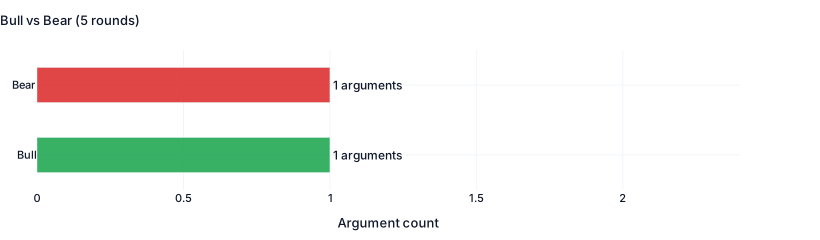
Bull vs Bear Debate (Research Manager)
Recommendation: Underweight
Rationale: After carefully evaluating both sides of this heated debate, I believe the Bear’s arguments carry more weight despite the Bull’s compelling technical case. The Bear effectively highlighted critical issues: the MACD’s 82% collapse from +1.22 to +0.22 represents genuine momentum erosion, not just normalization. The 0.9% negative yield gap versus Treasuries creates real carry cost pressure. Most importantly, the Fed’s hawkish pivot under new Chair Warsh with 58% probability of further hikes presents a structural headwind that technical patterns can’t easily overcome. While the Golden Cross and $94 support level are valid, they’re lagging indicators that may not withstand the macro pressure. The P/B of 1.66x leaves little margin of safety if cap rates expand further.
Strategic Actions: Trim VNQ exposure by 30-40% of current position size. Reallocate proceeds to short-term Treasuries capturing the 4.5% risk-free yield advantage. Maintain a smaller core position to retain exposure if the technical support holds, but set a hard stop at $93.50 (just below the Bollinger lower band). Monitor MACD for any reversal above +0.50 and Fed guidance for dovish signals as potential re-entry catalysts.
Trader's Execution Plan
Action: Sell
Reasoning: The research plan recommends underweighting VNQ, citing a 30-40% trim due to momentum erosion (MACD collapse from +1.22 to +0.22), a negative 0.9% yield gap vs. risk-free Treasuries at 4.5%, and a hawkish Fed pivot under Chair Warsh with 58% odds of further rate hikes. The Bull’s technical case (Golden Cross, $94 support) is acknowledged but deemed lagging versus these structural macro headwinds, and the 1.66x P/B leaves limited downside protection. Accordingly, the action is to sell partial position with a stop-loss at $93.50 to align with the plan’s recommendation.
Stop Loss: 93.5
Position Sizing: Reduce position by 30-40%, reallocate to short-term Treasuries
FINAL TRANSACTION PROPOSAL: SELL
Portfolio Manager — Final Verdict
Rating: Underweight
Executive Summary: Execute 30-40% position reduction in VNQ, reallocating proceeds to short-term Treasuries to capture the 80 basis point yield advantage. Set hard stop at $93.50 to protect against momentum breakdown, while maintaining core exposure for potential trend continuation. Monitor MACD recovery above +0.50 and Federal Reserve guidance shifts as re-entry catalysts.
Investment Thesis: The aggressive analyst’s arguments carry decisive weight: VNQ’s MACD has collapsed 82% from +1.22 to +0.22 while price remains flat at $96.79, signaling severe momentum erosion. The 80 basis point negative yield gap (3.7% vs 4.5% Treasuries) creates structural carry cost pressure amid a hawkish Fed pivot under Chair Warsh with 58% rate hike probability. The golden cross and $94 support are lagging indicators that may not withstand macro pressure from hot jobs data (172K vs 105K expected) and rising CMBS maturity stress at 7.71%. Recent performance lessons from MSFT (-2.2% alpha) demonstrate that technical headwinds can overpower oversold conditions when macro fundamentals deteriorate.
Time Horizon: 3-6 months