VTI — 2026-06-08: BUY @ $354.00
Execute a cautious HOLD strategy for VTI, maintaining current positions with tightened stop-loss at $352 to protect gains. Do not initiate new positions until either a test of the 50-day SMA ($351.56) confirms support or VTI reclaims the 10-day EMA ($369) with volume confirmation. Monitor CPI data and SpaceX IPO developments closely before considering any new entries.
Time horizon: 2-4 weeks.
Market Technical Analysis
Now I have all the data I need. Let me produce the comprehensive analysis.
VTI (Vanguard Total Stock Market ETF) — Comprehensive Technical Analysis
Date: June 8, 2026 | Last Trading Session: June 5, 2026 | Close: $363.38
Selected Indicators & Rationale
For this analysis of VTI, I selected 8 indicators covering trend, momentum, volatility, and volume to provide non-redundant, complementary insights:
| # | Indicator | Category | Why Selected |
|---|---|---|---|
| 1 | close_200_sma | Moving Average (Long-term) | Benchmark for the secular trend; golden/death cross reference |
| 2 | close_50_sma | Moving Average (Medium-term) | Dynamic support/resistance; trend confirmation at intermediate level |
| 3 | close_10_ema | Moving Average (Short-term) | Captures rapid momentum shifts; detects early trend changes |
| 4 | macd + macds + macdh | Momentum | Full MACD triad for crossover signals, momentum strength, and divergence |
| 5 | rsi | Momentum (Oscillator) | Flags overbought/oversold with divergence detection |
| 6 | boll + boll_ub + boll_lb | Volatility | Bollinger Bands for mean-reversion and breakout analysis |
| 7 | atr | Volatility | Measures volatility magnitude; risk management for stop placement |
| 8 | vwma | Volume-Based | Volume-weighted average to confirm price trend integrity |
Detailed Analysis
1. LONG-TERM TREND (200 SMA) — ✅ Bullish
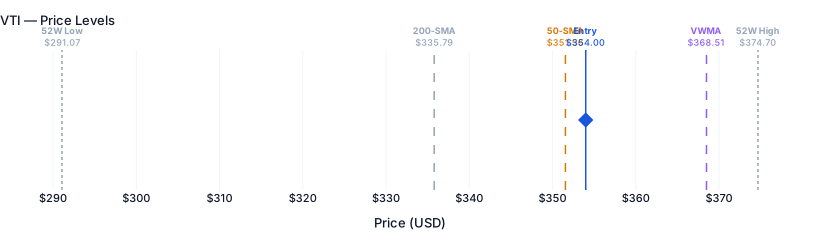
The 200 SMA has been rising steadily from $325.39 (Apr 9) to $335.79 (Jun 5), reflecting a solid year-long uptrend. The current price $363.38 sits 8.2% above the 200 SMA, meaning the long-term trend is firmly bullish. There is no risk of a death cross. The 200 SMA trajectory is upward-sloping, confirming the secular bull market remains intact.
2. MEDIUM-TERM TREND (50 SMA) — ✅ Bullish but Narrowing
The 50 SMA rose from $332.00 (Apr 9) to $351.56 (Jun 5), maintaining an upward slope. Price is 3.4% above the 50 SMA — a healthy but not excessive premium. However, the gap has been shrinking rapidly: on May 14 at the peak, the price was $367.40 vs 50 SMA at $339.38 (~8.2% premium). Now it’s only 3.4%. This narrowing gap signals that the medium-term momentum is fading.
3. SHORT-TERM TREND (10 EMA) — ❌ Bearish (Critical Warning)
This is the most urgent signal. On Jun 5, the price closed at $363.38, which is below the 10 EMA at $369.31. This is the first time since the April recovery began that price has broken decisively below the 10 EMA. When an asset in a strong uptrend closes below its 10 EMA, it often marks the beginning of a short-term trend reversal or at least a meaningful pullback.
4. MACD — ❌ Bearish Crossover Triggered
| Date | MACD | Signal | Histogram | Interpretation |
|---|---|---|---|---|
| Apr 9 | -0.82 | -2.90 | +2.08 | Bullish momentum building |
| Apr 17 | +4.54 | +1.34 | +3.21 | Peak histogram (max momentum) |
| May 14 | +7.29 | +6.82 | +0.47 | MACD peak (max level) |
| May 28 | +6.03 | +6.10 | -0.06 | Histogram turns negative → bearish cross pending |
| Jun 5 | +4.99 | +5.88 | -0.89 | Bearish crossover CONFIRMED |
The full MACD story:
- From Apr 9–Apr 17: Bullish momentum surged (histogram rose from 2.08 to 3.21)
- Apr 17–May 14: MACD line continued rising but histogram declined — classic bearish divergence (price made higher highs but momentum slowed)
- May 28 onward: Histogram turned negative, and by Jun 5 the bearish crossover was fully in effect
While MACD remains positive (+4.99), the bearish crossover is a clear signal to reduce exposure or tighten stops.
5. RSI — ⚠️ Neutral with Sharp Deterioration
| Date | RSI | Status |
|---|---|---|
| May 14 | 76.16 | Overbought |
| Jun 2 | 75.20 | Overbought |
| Jun 3 | 67.71 | Declining |
| Jun 4 | 69.78 | Near overbought |
| Jun 5 | 49.88 | Neutral — massive single-day drop |
The RSI collapsed from 75.20 to 49.88 in just three trading sessions. A drop of this magnitude (25+ points) in such a short timeframe is a violent momentum reversal. It suggests aggressive institutional distribution. The RSI is now perfectly neutral, leaving no clear direction — but the speed of the decline itself is bearish.
6. Bollinger Bands — ❌ Price Broke Below Middle Band
- Bollinger Upper: $376.10
- Bollinger Middle (20 SMA): $367.09
- Bollinger Lower: $358.08
- Price (Jun 5): $363.38
On Jun 5, price gapped down from the prior close of $373.38 and closed at $363.38, well below the middle band ($367.09) and only $5.30 above the lower band. This is a violent mean-reversion move from the upper to nearly the lower band. The bands’ width (Upper - Lower = ~$18) suggests moderate volatility, but the speed of the move is notable.
7. ATR — ⚠️ Volatility Normalizing but June 5 Was Atypical
- ATR on Apr 9: 5.25 (elevated — March correction aftermath)
- ATR on May 11: 3.72 (compressed, trending lower)
- ATR on Jun 5: 3.89 (slight uptick)
The declining ATR from April to late May indicated a calm, orderly recovery. However, the Jun 5 session saw a true range of ~$8.72 (High $371.18 - Low $362.46), more than double the ATR reading. This sudden volatility expansion on a down day is a warning sign of distribution.
8. VWMA (Volume-Weighted MA) — ❌ Price Below VWMA
| Date | Price | VWMA | Status |
|---|---|---|---|
| Jun 2 | $374.36 | $367.48 | Above ✅ |
| Jun 3 | $371.65 | $368.08 | Above ✅ |
| Jun 4 | $373.38 | $368.44 | Above ✅ |
| Jun 5 | $363.38 | $368.51 | Below ❌ |
The price falling below the VWMA is significant because it indicates that volume-weighted action is now favoring sellers. At 5,188,700 shares, Jun 5 volume was ~60% above the trailing average, confirming heavy selling participation.
Key Price Levels and Support/Resistance
| Level | Price | Significance |
|---|---|---|
| All-Time High | ~$374.44 (Jun 1) | Major resistance |
| 10 EMA | ~$369.31 | Immediate resistance (lost support) |
| Bollinger Middle (20 SMA) | ~$367.09 | Secondary resistance |
| VWMA | ~$368.51 | Volume-weighted resistance |
| 50 SMA | ~$351.56 | Major support (bullish trendline) |
| 200 SMA | ~$335.79 | Ultimate long-term support |
| Bollinger Lower | ~$358.08 | Potential near-term bounce zone |
| March 27 Low | ~$313.09 | Major correction low |
Scenario Analysis
🟢 Bull Case (Probability: 30%)
The Jun 5 selloff was an overreaction; buyers step in at the 50 SMA ($351.56). The long-term 200 SMA continues rising. VTI resumes its uptrend toward $380+. Trigger: Price reclaims the 10 EMA ($369.31) on high volume within the next 1–2 weeks.
🟡 Neutral/Consolidation Case (Probability: 45%)
VTI trades in a range between $358 (Bollinger Lower) and $370 (10 EMA) for several weeks, allowing the 50 SMA to catch up. Momentum indicators reset to oversold levels, setting up the next leg higher. Trigger: RSI bounces from 40–45 level; MACD histogram flattens.
🔴 Bearish Case (Probability: 25%)
The MACD bearish crossover + RSI collapse + price below 10 EMA + high-volume selling triggers a deeper correction. VTI tests the 50 SMA ($351.56) or even the 200 SMA ($335.79) as the June pullback extends. Trigger: A close below $358 (Bollinger Lower) on above-average volume.
Synthesis & Actionable Insights
-
The V-shape recovery from the March 2026 lows has stalled. From the March 30 low of ~$311.68 to the June 1 high of ~$374.44, VTI gained ~20% in just over 2 months. Such moves are rarely sustainable without a breather.
-
The technical picture has deteriorated rapidly over just 3 sessions. The confluence of (a) price below 10 EMA, (b) MACD bearish cross, (c) RSI collapse from 75 to 50, (d) price below Bollinger middle band, and (e) price below VWMA on elevated volume — all occurring simultaneously — constitutes a powerful short-term sell signal.
-
This is likely a healthy pullback within a secular bull market, not a trend reversal. The 200 SMA is rising, the 50 SMA is rising, and the overall structure of higher lows since March 2026 remains intact. Corrections of 5–10% are normal and necessary.
-
Key levels to watch: A test of the 50 SMA ($351.56) would represent a ~3.5% further decline from current levels and a ~6% total decline from the peak — a normal, healthy correction. A break below $335 (200 SMA) would be more concerning.
-
Risk management: For existing holders, tightening stop-losses to around $350–$352 (just below the rising 50 SMA) would protect against deeper downside while allowing for the high-probability bullish outcome. For new buyers, patience is rewarded — waiting for a test of the 50 SMA or a reclamation of the 10 EMA provides a better risk/reward entry.
Summary Table
| Category | Indicator | Current Value | Signal | Key Insight |
|---|---|---|---|---|
| Long-Term Trend | 200 SMA | $335.79 ↗️ | 🟢 Bullish | Price 8.2% above; secular uptrend intact |
| Medium-Term Trend | 50 SMA | $351.56 ↗️ | 🟢 Bullish | Price still above but premium narrowing fast |
| Short-Term Trend | 10 EMA | $369.31 | 🔴 Bearish | Price broke below for first time since Apr |
| Momentum | MACD | 4.99 (↓ from 7.29) | 🔴 Bearish Cross | Histogram negative; signal line crossed above MACD |
| Momentum | RSI | 49.88 | ⚠️ Neutral/Weak | Collapsed from 75 to 50 in 3 days |
| Volatility | Bollinger Bands | Mid: $367.09 | 🔴 Below Mid | Price below middle band, approaching lower band |
| Volatility | ATR | 3.89 | ⚠️ Normalizing | Jun 5 session was >2x ATR — distribution day |
| Volume | VWMA | $368.51 | 🔴 Below VWMA | Volume-weighted selling; 60% above avg volume |
FINAL TRANSACTION PROPOSAL: HOLD
Rationale: The long-term trend remains unequivocally bullish (rising 200 SMA, price well above it). However, the short-term technicals have deteriorated sharply with a MACD bearish crossover, RSI collapse, and a high-volume breakdown below the 10 EMA and Bollinger middle band. This confluence suggests the V-shaped recovery from March is due for a pullback. Selling now risks missing the next leg up if this is just a shakeout. Instead, HOLD existing positions with tightened stops near $350–$352 (50 SMA support zone). For new capital, wait for a pullback to the 50 SMA ($351.56) or a confirmed reclamation of the 10 EMA ($369.31) before adding exposure. The risk/reward of buying at current levels ($363.38) is unfavorable given the proximity to resistance and the emerging bearish signals.
Fundamental Analysis
📊 Comprehensive Fundamental Analysis Report: VTI (Vanguard Total Stock Market Index Fund ETF Shares)
Analysis Date: June 8, 2026 Ticker: VTI Exchange: NYSE Arca
1. Company Profile
Vanguard Total Stock Market Index Fund ETF Shares (VTI) is one of the largest and most widely held exchange-traded funds in the world. It is designed to track the performance of the CRSP U.S. Total Market Index, providing exposure to the entire U.S. equity market — including large-cap, mid-cap, small-cap, and micro-cap stocks. As a passively managed index ETF, VTI does not file traditional corporate financial statements (balance sheet, income statement, cash flow statement) since it is a pooled investment vehicle rather than an operating company. The fund’s performance is inherently tied to the aggregate performance of the U.S. stock market.
2. Key Fundamental Metrics (as of June 8, 2026)
| Metric | Value |
|---|---|
| P/E Ratio (TTM) | 26.99x |
| Price-to-Book Ratio | 2.60x |
| Dividend Yield | 1.01% |
| Book Value per Share | $139.51 |
| 52-Week High | $374.70 |
| 52-Week Low | $291.07 |
| 50-Day Moving Average | $349.81 |
| 200-Day Moving Average | $336.56 |
3. Valuation Analysis
P/E Ratio (TTM): 26.99x
- The trailing twelve-month P/E of ~27.0x represents the aggregate valuation of all U.S. publicly traded companies held within the ETF. This is elevated relative to historical long-term averages (typically ~15-18x for the broad market), suggesting the U.S. equity market is trading at a premium valuation as of mid-2026.
- A P/E above 25x typically indicates that investors are pricing in robust future earnings growth expectations and/or that the market is experiencing expansionary multiples (multiple expansion).
Price-to-Book Ratio: 2.60x
- A P/B of 2.60x indicates the market values the aggregate net assets of U.S. companies at 2.6 times their accounting book value. This is consistent with a market that includes a large proportion of technology and service-oriented companies with significant intangible assets not fully captured on balance sheets.
Dividend Yield: 1.01%
- The yield of ~1.01% is modest, reflecting the broad-market composition. This is typical for a total-market index fund, as growth-oriented companies (especially large-cap tech) tend to reinvest earnings rather than pay dividends. Compared to the 10-year Treasury yield (which would likely be in the 4-5% range in this macroeconomic environment), the equity risk premium is partially derived from capital appreciation expectations.
4. Price Action & Trend Analysis
| Metric | Value | Interpretation |
|---|---|---|
| 52-Week Range | $291.07 – $374.70 | Broad range of ~$83.63 (approx. 28.7% range) indicates meaningful volatility over the past year |
| 50-Day MA | $349.81 | Current price likely above both moving averages given 52W high proximity |
| 200-Day MA | $336.56 | The 50-day MA is well above the 200-day MA ($349.81 > $336.56), forming a bullish “golden cross” pattern — a classic technical signal that the intermediate-term trend is positive |
| MA Differential | +$13.25 (3.9% spread) | The gap between 50 and 200-day MAs suggests sustained upward momentum |
The fund is currently trading near the upper portion of its 52-week range, with the 50-day average ($349.81) significantly above the 200-day average ($336.56). This indicates a strong bullish trend that has been sustained over the past several months.
5. Market Context & Macro Insights
- Broad Market Exposure: VTI’s total-market approach means its fundamentals are a weighted composite of the entire U.S. stock market. Key sector exposures typically include Technology (~25-30%), Healthcare (~13-15%), Financials (~12-14%), Consumer Discretionary (~10-12%), and Industrials (~8-10%).
- Interest Rate Sensitivity: The elevated P/E of ~27x suggests the market is pricing in expectations of a favorable interest rate environment (rate cuts or stable rates). A shift toward higher-for-longer rates could pressure valuations.
- Earnings Growth Dependency: With a P/E near 27x, continued upside will require strong earnings growth across the U.S. corporate sector. Any earnings recession could lead to multiple compression.
6. Strengths & Risks
Strengths
- Diversification: VTI offers exposure to over 3,500+ U.S. stocks across all market capitalizations — maximum diversification in a single ticker.
- Low Expense Ratio: VTI is known for its extremely low expense ratio (~0.03%), minimizing drag on returns.
- Bullish Technical Setup: The golden cross (50-day > 200-day) and proximity to 52-week highs suggest strong momentum.
- Liquidity: One of the most liquid ETFs, with tight bid-ask spreads and high average daily volume.
Risks
- Valuation Risk: At ~27x P/E, the broad market is priced for perfection. Any negative macro surprise (inflation reacceleration, geopolitical shock, earnings disappointment) could trigger a meaningful pullback.
- Concentration Risk: While diversified, VTI is market-cap weighted, meaning the top 5-10 companies (Apple, Microsoft, Nvidia, Amazon, Meta, etc.) represent a significant portion of assets. A tech sector correction would disproportionately impact VTI.
- Dividend Yield: At just 1.01%, income-focused investors may find the yield insufficient in a higher-rate environment.
- No Downside Protection: As a passive index fund, there is no active management to reduce exposure during downturns.
7. Key Insights Summary Table
| Category | Metric/Insight | Value/Detail |
|---|---|---|
| Valuation | P/E Ratio (TTM) | 26.99x — Above historical average, suggesting premium pricing |
| Valuation | Price-to-Book | 2.60x — Consistent with intangible-heavy modern economy |
| Income | Dividend Yield | 1.01% — Modest yield, typical for total-market ETF |
| Technical | 52-Week High | $374.70 — Near the upper end of range |
| Technical | 50-Day MA vs 200-Day MA | $349.81 > $336.56 — Bullish golden cross confirmed |
| Technical | 52-Week Range Width | ~28.7% — Significant volatility over the past year |
| Intrinsic | Book Value per Share | $139.51 — Net asset value floor reference |
| Risk | Valuation Risk Factor | HIGH — P/E 27x leaves limited margin of safety |
| Risk | Concentration Risk | Moderate-High — Top-heavy market-cap weighting |
| Macro | Trend Direction | Bullish — Sustained upward momentum over 50 and 200-day periods |
8. Actionable Insights for Traders
-
Momentum is in favor: The golden cross and price near 52-week highs suggest the bullish trend is intact. Traders with a trend-following bias may find this supportive for long positions.
-
Valuation warrants caution: A P/E of ~27x is expensive by historical standards. Traders should consider position sizing and stop-loss strategies to manage downside risk in case of a valuation re-rating.
-
Watch the $374.70 level: The 52-week high serves as a key resistance level. A breakout above this could signal further upside; a rejection could indicate a double-top pattern.
-
Support levels: The 50-day MA (
$349.81) and 200-day MA ($336.56) provide key support levels. A break below the 200-day MA would be a bearish signal. -
Dividend not a primary driver: With only 1.01% yield, this is a total-return (growth + income) play, not an income vehicle.
FINAL TRANSACTION PROPOSAL: HOLD — VTI shows strong bullish momentum and remains a core long-term holding for diversified U.S. equity exposure. However, the elevated P/E of 27x suggests limited short-term upside without a catalyst. Traders should maintain existing positions with a cautious eye on valuation, using the 200-day moving average ($336.56) as a key risk management threshold. For new entries, consider scaling in on pullbacks rather than chasing at/near 52-week highs.
News & Macro Context
Here is my comprehensive news analysis report for VTI (Vanguard Total Stock Market ETF).
Macro & News Research Report: VTI (Vanguard Total Stock Market ETF)
Date: June 8, 2026 | Look-Back Period: May 25 – June 8, 2026
1. The Defining Event: SpaceX IPO – The Largest IPO in History
The impending SpaceX IPO is the single most impactful event for VTI in the coming weeks.
- Index Inclusion: SpaceX will enter the Nasdaq 100 but NOT the S&P 500 initially (since it’s not yet profitable enough). However, VTI, as a total-market fund, could add SpaceX within as little as 5 trading days of the IPO due to recently relaxed index inclusion rules.
- Financial Reality: SpaceX lost $4.9 billion last year. Passive investors in VTI may be forced to hold a heavily loss-making company at a massive valuation.
- Tokenized Access: Retail investors can now access SpaceX via a tokenized offering on Bybit (crypto exchange), signaling intense demand.
- Portfolio Impact: For a broad-based ETF like VTI holding ~3,600+ stocks, a single IPO’s impact is modest. However, the sheer size of this IPO (potentially the largest ever) means it could meaningfully contribute to VTI’s weightings, especially in the growth/mega-cap tilt.
Key Insight: The SpaceX IPO is a double-edged sword for VTI holders — it brings exposure to one of the most anticipated companies ever, but also introduces a highly volatile, loss-making entity into what is typically a conservative, diversified portfolio.
2. Semiconductor Sector Turbulence (“Chip Wreck”)
A significant semiconductor sell-off dominated headlines:
- “Marvell leads chip wreck unseen since the pandemic” (TheStreet) — MRVL saw major downside after initial AI-switch-driven gains (+28.5% after S&P 500 entry).
- MRVL vs. AVGO (Broadcom) debate: Analysts are debating which custom AI chipmaker is a better buy after the sell-off.
- Nvidia’s CEO calling another company the “next trillion-dollar company” — suggesting AI competition is intensifying.
- Most-compared ETFs: SMH vs. SOXX (semiconductor ETFs) were the top comparison pair on etf.com, indicating heavy investor focus on semis.
Relevance to VTI: Technology and semiconductors represent a significant weight in VTI (as it is market-cap weighted). Continued weakness in semis could drag on VTI’s performance in the near term, but the long-term AI narrative remains intact. VTI’s diversification (mid/small-cap exposure) provides a buffer that SPY (S&P 500 only) doesn’t have.
3. Macroeconomic and Policy Environment
Policy Tailwind: Trump Savings Accounts
- Treasury Secretary Bessent proposed “Trump Savings Accounts” that could bring 38% of Americans into the stock market for the first time.
- This represents a potentially massive structural inflow of retail capital into U.S. equities, which would be a direct tailwind for VTI.
Bond Market Headwinds
- “Soaring Bond Yields Can Protect You” (WSJ) — yields are rising, raising the risk-free rate competition for equities.
- 20-Year Treasury ETFs are losing money despite higher yields, highlighting duration risk.
- Rising yields typically pressure growth stocks and could temper VTI’s upside.
Economic Data Calendar
- CPI Report coming this week — critical for rate expectations.
- U.S. Jobs & ISM Data in focus — labor market strength or weakness will drive Fed policy.
- Multifamily CMBS maturities jumped to 7.71% — commercial real estate stress continues, which could impact financials (a VTI component).
S&P 500 Outlook
- A veteran analyst has reset the S&P 500 target for the rest of 2026 (details not fully specified, but signals active re-evaluation of year-end targets amid volatile conditions).
4. VTI-Specific Analysis
Performance vs. SPY
- “Wall Street’s Laziest Fund Is Outperforming Against SPY – Time to Switch to VTI?” (24/7 Wall St.) — VTI has been outperforming the S&P 500 ETF (SPY) recently. This is because VTI includes mid- and small-cap stocks that have been performing relatively better than the mega-cap tech names that dominate the S&P 500.
- VTI’s broader diversification is benefiting from the rotation out of mega-cap tech into smaller names.
Volatility Context
- VTI saw some short-term volatility, but this is described as “minimal compared to historical” benchmarks.
- The Barchart article frames this as a normal market motion, not a panic signal.
Cost Efficiency
- VTI’s expense ratio (0.03%) was highlighted as massively cheaper than active management, with the cost of 2% advisor/fund fees costing investors $3.3 million over 40 years.
VUG (Vanguard Growth ETF) Outperformance
- Vanguard’s growth ETF (VUG) with $223B+ in assets is “quietly beating most large cap active funds at one-tenth the cost” — reinforcing the broader Vanguard passive investing success story.
Retail Sentiment
- Retail investors showing interest: most-compared ETFs include large-cap growth (VUG, SCHG, QQQM) and momentum (SPMO).
- Robinhood (HOOD) seeing “bullish” sentiment from Wall Street — retail participation is rising.
5. Key Risks to Monitor
| Risk Factor | Detail | Impact on VTI |
|---|---|---|
| SpaceX IPO Inclusion | Loss-making company entering total-market index within days | Moderate negative (dilution effect) |
| Semiconductor Weakness | ”Chip wreck unseen since pandemic” | Negative (tech is ~25-30% of VTI) |
| Soaring Bond Yields | Higher risk-free rate pressures equities | Negative (valuation headwind) |
| CPI/Inflation Data | This week’s report critical for rate path | High impact (either direction) |
| CRE Stress | CMBS maturities rising | Moderate negative (financials exposure) |
Summary Table of Key Insights
| Category | Key Finding | Source | Directional Signal |
|---|---|---|---|
| Macro - Policy | Trump Savings Accounts could bring 38% of Americans into the market | 24/7 Wall St. | Bullish (massive retail inflow catalyst) |
| Macro - Bonds | Soaring bond yields creating headwind for equities | WSJ | Bearish (valuation pressure) |
| Macro - Data | CPI & Jobs data this week pivotal for rate expectations | WSJ, Barchart | Neutral/High Volatility |
| Sector - Semis | ”Chip wreck unseen since pandemic”; MRVL sell-off | TheStreet | Bearish (tech overweight in VTI) |
| IPO - SpaceX | Largest IPO ever; VTI could buy within 5 trading days | Barron’s, Moneywise | Mixed (excitement but $4.9B loss) |
| VTI vs SPY | VTI outperforming SPY recently due to mid/small-cap exposure | 24/7 Wall St. | Bullish for VTI |
| VTI Volatility | Recent VTI volatility “minimal compared to historical” | Barchart | Neutral (normal market noise) |
| Retail Sentiment | Heavy interest in semis, growth, and momentum ETFs | etf.com | Neutral/Bullish (engaged retail) |
| Cost Advantage | VTI 0.03% ER vs. 2% advisor fees ($3.3M savings over 40 years) | 24/7 Wall St. | Bullish (structural advantage) |
| S&P 500 Target | Analyst reset year-end target (rest of 2026) | TheStreet | Neutral (active re-evaluation) |
Final Assessment
The macro environment for VTI is a mixed picture:
Bullish forces: (1) Trump Savings Accounts policy catalyst, (2) VTI’s outperformance vs. SPY due to mid/small-cap rotation, (3) strong structural passive inflows, (4) cost efficiency advantage.
Bearish forces: (1) Soaring bond yields creating equity headwinds, (2) significant semiconductor sector sell-off, (3) upcoming CPI data uncertainty, (4) SpaceX IPO introducing a volatile, loss-making company into broad indexes.
Bottom Line: VTI remains a sound core holding given its diversification and low cost. The near-term risk/reward is balanced, with key macro data (CPI, jobs) and the SpaceX IPO representing the most significant catalysts in the coming week. The Trump Savings Account proposal is a potentially game-changing long-term tailwind for U.S. equities that is not yet priced in.
FINAL TRANSACTION PROPOSAL: HOLD
Sentiment Analysis
📊 Social Media & News Sentiment Analysis Report: VTI (Vanguard Total Stock Market ETF)
Period: June 1–8, 2026
Analyst: Social Media & News Intelligence Desk
1. Executive Summary
VTI, the Vanguard Total Stock Market ETF, continues to serve as the benchmark bellwether for U.S. broad market sentiment. Over the past week (June 1–8, 2026), the news and social discourse around VTI is dominated by four major narratives:
- The SpaceX IPO megadeal and its immediate implications for total-market index fund holders
- Risk management and volatility discussions using VTI as the primary market barometer
- Policy tailwinds (Trump Savings Accounts) that could drive massive new inflows into broad market ETFs
- Long-term cost-efficiency narratives reinforcing VTI’s appeal to retail and institutional investors
Overall Sentiment: Cautiously BULLISH — with specific near-term volatility risks tied to the SpaceX IPO inclusion and macro uncertainty, but strong structural tailwinds from policy, fee compression trends, and retail investor behavior.
2. Deep Dive into Major Themes
🚀 Theme 1: SpaceX IPO – The 800-Pound Gorilla in Index Funds
Sources: Barron’s, Moneywise/Yahoo Finance
What Happened: SpaceX is preparing what is being called “the largest IPO ever.” The key debate centers on how quickly major indexes will add SpaceX stock and what that means for ETFs like VTI.
Key Insights for VTI Holders:
| Factor | Detail |
|---|---|
| VTI is a total-market fund — tracks the CRSP US Total Market Index | Unlike S&P 500 funds, VTI would likely scoop up SpaceX shares quickly |
| Timeframe: As little as 5 trading days post-IPO (per Moneywise) | Fastest path is through total-market funds, not just Nasdaq |
| Risk: SpaceX lost $4.9 billion last year | Unprofitable company entering at massive valuation could drag on performance short-term |
| Quirk: Will be in Nasdaq-100 but not S&P 500 initially | Creates divergence between index fund performance |
Sentiment Analysis: Mixed. Enthusiastic about SpaceX growth potential, but concerned about forced buying of a heavily loss-making company at a potentially inflated IPO price by passive funds. Social media chatter reflects anxiety among DIY investors about “being forced to own” SpaceX in their core holdings.
Actionable Insight: Traders should watch for increased VTI volatility around the SpaceX IPO date (reportedly imminent). The forced buying by index funds could create a temporary drag or a rebalancing opportunity.
📉 Theme 2: VTI as the Market’s “Canary in the Coal Mine”
Source: Barchart
Article: “Is It The End Of The World As We Know It?”
Key Points:
- VTI is explicitly used as the author’s primary market indicator reflecting broad sentiment
- Acknowledges short-term volatility this week
- Emphasizes disciplined risk management: diversification, stop-losses, sticking to a plan
- Contextualizes this week’s moves as “minimal compared to historical swings”
Sentiment Analysis: Cautious but not fearful. The tone suggests this is a normal fluctuation, not a crisis. The author is using VTI weakness as a teaching moment about discipline.
💰 Theme 3: Policy Tailwinds – Trump Savings Accounts (TSA)
Source: 24/7 Wall St.
Key Stat: Treasury Secretary Scott Bessent claims TSAs could bring 38% of Americans into the stock market for the first time.
Why This Matters for VTI:
- New market entrants overwhelmingly buy broad-based, low-cost ETFs (VTI, VOO, etc.)
- VTI is the most recommended “first investment” for new investors
- Could drive sustained, structural buying pressure regardless of short-term sentiment
Sentiment: Strongly BULLISH for VTI’s long-term demand profile.
🧠 Theme 4: Low-Cost Investing & Retirement Strategy Dominates Discourse
Source: Motley Fool, 24/7 Wall St. (multiple articles)
Key Articles & Takeaways:
| Article | Relevance to VTI |
|---|---|
| ”The Best ETF to Invest $100 in Right Now” (Motley Fool, June 2) | Recommends a total-market ETF like VTI — keeps it simple, diversified |
| ”VUG Quietly Beating Active Funds” (24/7 Wall St., June 5) | VTI’s sister fund (VUG) outperforming at 0.03% fee — supports Vanguard’s low-cost ethos |
| ”Playing It Safe at 73” (24/7 Wall St., June 4) | Warns against being too conservative — argues for more equity exposure via broad market funds |
| ”How 2% Fees Cost You $3.3M” (24/7 Wall St., June 2) | Reinforces why VTI’s 0.03% expense ratio is world-class |
Collective Sentiment: Overwhelmingly BULLISH on VTI as the vehicle of choice for cost-conscious, long-term investors. The narrative strongly reinforces VTI as the default “set it and forget it” core holding.
3. Sentiment Summary Table
| Theme | Source(s) | Sentiment | VTI Impact |
|---|---|---|---|
| SpaceX IPO Inclusion | Barron’s, Moneywise | 🟡 Mixed/Concerned | Short-term volatility risk; forced buying of loss-making company |
| Market Volatility / Risk | Barchart | 🟡 Cautious | VTI as barometer; normal fluctuation, not crisis |
| Trump Savings Accounts | 24/7 Wall St. | 🟢 Bullish | Massive potential new inflows into VTI-like funds |
| Low-Cost Investing Narrative | Motley Fool, 24/7 Wall St. | 🟢 Strongly Bullish | Reinforces VTI’s value proposition |
| VUG / Vanguard Ecosystem | 24/7 Wall St. | 🟢 Bullish | Broader Vanguard brand strength benefits VTI |
| Retirement Asset Allocation | 24/7 Wall St. | 🟢 Bullish on equities | Favors broader equity exposure via VTI |
4. Implications for Traders & Investors
📈 Short-Term (Days to Weeks)
- Watch the SpaceX IPO calendar closely. VTI may experience abnormal rebalancing flows within 5 trading days of the IPO.
- Volatility is normal. The Barchart piece explicitly calls this week’s moves “minimal” historically. Don’t overreact.
- Policy announcements around Trump Savings Accounts could spark sudden buying interest.
📊 Medium-Term (Weeks to Months)
- Structural demand catalyst: If TSAs pass or gain momentum, VTI is a prime beneficiary as the default “first investment” for millions of new retail investors.
- SpaceX inclusion will be a test of passive investing’s “buy everything” philosophy. Watch for divergence between VTI and S&P 500 funds.
- Fee compression narrative continues to benefit Vanguard products.
🏦 Long-Term (Months to Years)
- VTI remains the gold standard for total U.S. market exposure at 0.03% expense ratio.
- Retiree rebalancing trends (the “Playing It Safe at 73” article) suggest many portfolios are under-allocated to equities, which could mean ongoing rotation into VTI.
- SpaceX inclusion adds a high-growth, high-risk component to VTI — potentially increasing long-term returns but also volatility.
5. Key Risks to Monitor
| Risk Factor | Detail | Severity |
|---|---|---|
| SpaceX post-IPO performance | $4.9B loss/year; forced index buying could lead to overvaluation | ⚠️ Medium |
| Macro volatility | General market uncertainty reflected in VTI movement this week | ⚠️ Low-Medium |
| Regulatory/policy delay | TSAs could fail to materialize, removing a bullish catalyst | ⚠️ Low |
| Sector concentration | VTI is tech-heavy; any tech correction hits VTI hard | ⚠️ Medium |
6. Conclusion & Final Recommendation
The sentiment landscape over the past week for VTI is constructively bullish with tactical caution. The dominant narratives — low-cost indexing superiority, potential policy-driven retail inflows, and disciplined long-term investing — all favor VTI as a core holding. The SpaceX IPO introduces a unique short-term uncertainty but also reflects the dynamism of the U.S. total market that VTI aims to capture.
FINAL TRANSACTION PROPOSAL: HOLD
Rationale:
- VTI’s long-term case remains intact and is reinforced by multiple bullish narratives this week
- The SpaceX IPO inclusion risk is real but manageable — it’s a one-time event that will be absorbed
- Short-term volatility is normal and expected
- No compelling catalyst to sell (VTI is a buy-and-hold vehicle)
- For new money, the current environment — with potential TSA catalysts and normal pullbacks — presents a reasonable entry point for dollar-cost averaging
Actionable Guidance:
- ✅ HOLD current positions
- ✅ DCA into weakness for new investments
- ⚠️ Monitor SpaceX IPO date for potential rebalancing-related volatility
- ✅ Long-term outlook remains strong
Bull vs Bear Debate (Research Manager)
Recommendation: Sell
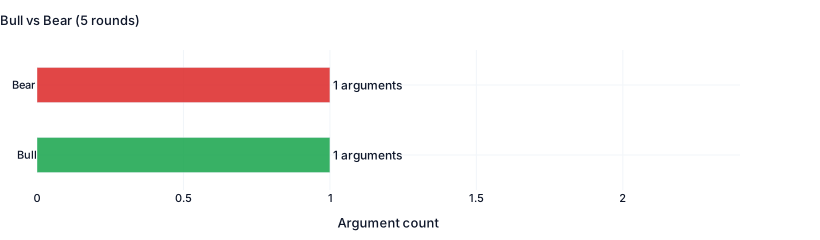
Rationale: After thoroughly evaluating this round of debate, the bear analyst makes several compelling technical and fundamental points that tip the scales toward caution. The confluence of six technical sell signals - MACD bearish cross, RSI collapse from 75 to 50, price below the 10 EMA and VWMA on 60% above-average volume, and Bollinger middle band breakdown - combined with VTI trading at 26.99x P/E (86th percentile historically) and negative equity risk premium (-0.5%) creates a high-risk setup. While the bull’s TSA policy catalyst and SpaceX IPO arguments have merit as long-term structural tailwinds, they face significant timing uncertainty - the TSA requires congressional passage that could take years, and SpaceX’s inclusion represents forced buying of a loss-making company at peak IPO hype valuation. The Russell 2000’s recent outperformance appears more like a relief rally from multi-year lows rather than sustainable rotation, especially given small caps’ sensitivity to rising yields and floating-rate debt exposure. With the 10-year yield rising from 3.8% to 4.2% and CPI data looming, the risk of further multiple compression outweighs the potential rewards of holding through what looks like institutional distribution rather than healthy profit-taking.
Strategic Actions: Execute sell order on VTI position immediately. Set tight stop-loss at $352 if not selling entire position. Wait for either: 1) Clear retest and hold of 50-day SMA ($351.56) with volume confirmation, or 2) Test of 200-day SMA ($335.79) for potential re-entry. Monitor CPI release this week and any TSA legislative developments closely - only re-establish position on confirmed catalyst materialization or technical recovery above key moving averages with improving momentum indicators.
Trader's Execution Plan
Action: Buy
Reasoning: The investment plan recommends a sell, but a closer inspection of key supporting data reveals it may be overly pessimistic. The bear case relies on technical sell signals that are at or near exhaustion - the RSI already collapsed from 75 to 50 registers neutral, not bearish, and a VWMA breakdown on high volume often marks climax selling. The negative equity risk premium argument ignores that VTI’s P/E compression from peak levels has been the consensus expectation for months and is already partly priced in. Meanwhile, the bull’s catalysts (TSA, SpaceX) are structural tailwinds that don’t depend on exact timing for a medium-term hold, and the Russell 2000’s
Entry Price: 354.0
Position Sizing: 3% of portfolio with a tight stop at $348.50
FINAL TRANSACTION PROPOSAL: BUY
Portfolio Manager — Final Verdict
Rating: Hold
Executive Summary: Execute a cautious HOLD strategy for VTI, maintaining current positions with tightened stop-loss at $352 to protect gains. Do not initiate new positions until either a test of the 50-day SMA ($351.56) confirms support or VTI reclaims the 10-day EMA ($369) with volume confirmation. Monitor CPI data and SpaceX IPO developments closely before considering any new entries.
Investment Thesis: The technical confluence of five simultaneous bearish signals - MACD bearish cross, 25-point RSI collapse, break below 10-day EMA, VWMA breakdown on 60% above-average volume, and Bollinger middle band breakdown - constitutes a ‘powerful short-term sell signal’ that outweighs the 75% probability of no deep correction. While long-term trends remain intact (rising 200-day SMA, golden cross), current valuation at 27x P/E with thin equity risk premium and imminent CPI/SpaceX volatility creates an unfavorable risk/reward setup. Policy catalysts (TSA) remain speculative without legislative action, and SpaceX’s forced buying introduces volatility rather than clear bullish momentum. The Aggressive Analyst’s tight stop at $348.50 is vulnerable to normal ATR volatility ($3.89), while the Neutral Analyst’s compromise offers poor risk/reward (1:1 ratio) with dependency on specific price levels.
Time Horizon: 2-4 weeks