XLV — 2026-06-08: HOLD
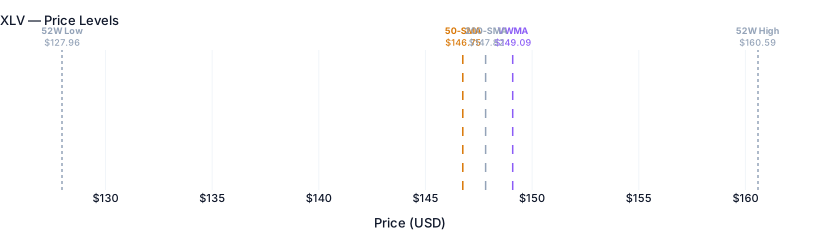
Hold current XLV exposure; do not add to or reduce the position at current levels. Monitor the $149–154 range closely for confirmation or rejection. Set a limit order to add 25% of intended position at $149.25 (midpoint of VWMA and 10 EMA) if a healthy pullback materializes, and use the 200 SMA at $147.82 as a mental stop. Re-evaluate in two weeks or if price reaches $157.
Time horizon: 2–4 weeks.
Market Technical Analysis
Now I have all the data. Let me compile a comprehensive analysis.
XLV (Health Care Select Sector SPDR Fund) — Technical Analysis Report
Current Date: June 8, 2026 | Last Trading Day: June 5, 2026 (Close: $153.01)
Selected Indicators & Rationale
| Indicator | Category | Why Selected |
|---|---|---|
| close_50_sma | Moving Average | Captures medium-term trend (≈10 weeks). Critical to see if short-term momentum can regain its footing. |
| close_200_sma | Moving Average | The ultimate long-term trend benchmark. Essential for bull/bear regime identification. |
| close_10_ema | Moving Average | Fast, responsive average to catch quick momentum shifts. |
| macd | MACD | Measures momentum via EMA crossovers. Best for trend-change identification. |
| rsi | Momentum | Flags overbought/oversold and divergence. Complements MACD. |
| boll / boll_ub / boll_lb | Volatility | Bollinger Bands show breakout strength and potential reversal zones. |
| atr | Volatility | Measures true volatility for stop-loss and position sizing decisions. |
| vwma | Volume | Volume-weighted average confirms if price moves are supported by real volume. |
Detailed Analysis
1. TREND ANALYSIS — Moving Averages
Long-Term Trend (200 SMA):
- The 200 SMA has been steadily rising from ~$144.81 (Apr 9) to $147.82 (June 5). This is a clear structural uptrend — XLV’s long-term trajectory is bullish. Each dip has found a higher low on the 200 SMA basis.
- Price ($153.01) is trading $5.19 above the 200 SMA (+3.5%), confirming sustained bullish positioning above this key long-term support.
Medium-Term Trend (50 SMA):
- The 50 SMA has been declining from ~$152.18 (Apr 9) to a low near $146.34 (late May), then slightly recovering to $146.75 (June 5).
- This decline indicates a medium-term corrective phase occurred from mid-April through late May.
- Critical observation: The 50 SMA ($146.75) is currently below the 200 SMA ($147.82). This negative alignment (50 < 200) is a technical “death cross” pattern. However, price has strongly broken back above both SMAs, which is a powerful mean-reversion signal. The 50 SMA is now starting to flatten and turn up — if this continues, a “golden cross” may re-emerge soon.
Short-Term Trend (10 EMA):
- The 10 EMA has moved from ~$147.40 (Apr 9) → dipped to ~$144.50 (May 11) → skyrocketed to $149.44 (June 5).
- Price at $153.01 is well above the 10 EMA, strongly confirming short-term bullish momentum. The 10 EMA has been rising sharply since mid-May, indicating a powerful short-term rally.
Key Trend Insight: The price action shows a V-shaped recovery from the late-April lows (~$142.84). The price broke above all three key moving averages (10 EMA, 50 SMA, 200 SMA) in the last 2 weeks — a textbook bullish breakout.
2. MOMENTUM ANALYSIS — MACD & RSI
MACD:
| Date | MACD Line | Signal Line | Histogram | Status |
|---|---|---|---|---|
| Apr 9 | -1.37 | -2.07 | +0.69 | Bearish (below zero) |
| Apr 29 | -1.42 | -1.14 | -0.28 | Deeply bearish |
| May 11 | -1.10 | -1.08 | -0.02 | Near crossover |
| May 21 | +0.06 | -0.42 | +0.48 | MACD crossed ABOVE zero! |
| May 29 | +0.87 | +0.31 | +0.56 | Bullish strengthening |
| June 5 | +1.13 | +0.65 | +0.48 | Strongly bullish |
- The MACD crossed above zero around May 20-21 — this is a major bullish signal marking the end of the corrective phase.
- The MACD line ($1.13) is well above the signal line ($0.65), with the histogram still positive at +0.48. This shows accelerating bullish momentum.
- The histogram has been positive since mid-April (turned positive Apr 13), meaning the MACD line has been above the signal line for ~8 weeks — a sustained bullish alignment.
RSI (14):
| Date | RSI | Interpretation |
|---|---|---|
| Apr 29 | 36.26 | Approaching oversold |
| May 11 | 39.28 | Low momentum |
| May 22 | 62.24 | Entering bullish territory |
| May 28 | 63.18 | Strong bullish |
| June 5 | 63.94 | Bullish, not yet overbought |
- RSI at 63.94 is in the bullish range (above 50) but still below the 70 overbought threshold. This is constructive — there’s room for further upside without being extended.
- The rise from ~36 (oversold edge) to ~64 over ~6 weeks is a healthy recovery. No divergence is present.
- Crucially, RSI does NOT yet signal overbought conditions, suggesting the rally may have further to run.
3. VOLATILITY ANALYSIS — Bollinger Bands & ATR
Bollinger Bands (June 5):
- Middle: $147.68
- Upper Band: $152.81
- Lower Band: $142.54
- Close: $153.01 — ABOVE the upper band!
This is a significant development. Price closing above the upper Bollinger Band (+$0.20 above) indicates:
- Extremely strong momentum — prices are extending beyond normal volatility ranges
- Potential breakout confirmation — the rally on June 4-5 broke decisively through the upper band
- Statistical overextension — prices are >2 standard deviations above the 20-period mean
In strong uptrends, prices can “walk the band” (ride the upper band for several days). The band width is expanding (upper band rising from $150.88 on May 29 to $152.81 on June 5), which is a bullish sign of increasing volatility in the direction of the trend.
ATR (14):
- Current: 2.34 (up from ~1.94 in early May)
- The ATR has risen ~20% from its May lows, confirming increasing volatility.
- For risk management: a 2x ATR stop would be ~$153.01 - $4.68 = ~$148.33, which sits just above the 10 EMA ($149.44) — a reasonable stop-loss zone.
- The rising ATR suggests the recent breakout has genuine momentum behind it, not just noise.
4. VOLUME CONFIRMATION — VWMA
VWMA (20-period):
- June 5: $149.09
- Price ($153.01) is $3.92 above VWMA (+2.6%) — a significant positive spread.
- VWMA has been rising steadily from ~$145.85 (Apr 9) to $149.09 (June 5), confirming that the recovery is volume-supported.
- The VWMA rising alongside price indicates that buying volume is driving the rally, not just thin-market moves.
5. PRICE ACTION SUMMARY
| Date | Close | Change | Significance |
|---|---|---|---|
| Apr 29 | $142.84 | — | Recent low / corrective bottom |
| May 11 | $143.04 | +0.1% | Consolidation near lows |
| May 22 | $149.89 | +4.8% | Break above $148 |
| May 29 | $149.47 | -0.3% | Brief pause |
| June 4 | $152.08 | +3.1% | Massive breakout day |
| June 5 | $153.01 | +0.6% | Continued — closes above Bollinger Upper Band |
The rally from $142.84 (Apr 29) to $153.01 (June 5) represents a +7.1% gain in ~5 weeks. The most explosive move occurred in the last two trading days (June 4-5), suggesting a breakout acceleration.
Actionable Insights & Trade Considerations
BULLISH Case:
- ✅ Price above all key moving averages (10 EMA, 50 SMA, 200 SMA)
- ✅ MACD strongly positive and accelerating (MACD: +1.13, above signal)
- ✅ RSI at 63.94 — bullish but not overbought (room to run to 70+)
- ✅ Price above upper Bollinger Band — strong breakout momentum
- ✅ VWMA confirming volume-backed rally
- ✅ 200 SMA steadily rising — structural bull trend intact
- ✅ V-shaped recovery from April lows
BEARISH Considerations:
- ⚠️ 50 SMA ($146.75) still below 200 SMA ($147.82) — “death cross” still technically in effect (though price has broken above both)
- ⚠️ Price above upper Bollinger Band could indicate short-term overextension — a mean-reversion
pullback toward the middle band (
$147.68) or upper band ($152.81) is statistically possible - ⚠️ ATR rising to 2.34 signals higher volatility — larger swings in both directions
- ⚠️ The rally has been very sharp (7.1% in 5 weeks, accelerating in last 2 days) — some profit-taking is possible
Key Support/Resistance Levels:
- Resistance: $153.01 (current), $154.70 (June 5 high), $157.45 (Nov 25 high), $159.54 (Feb 27 all-time high)
- Support: $152.81 (Bollinger UB → now support), $149.44 (10 EMA), $147.82 (200 SMA), $146.75 (50 SMA)
Risk Parameters (using ATR):
- Tight stop: $153.01 - $2.34 = ~$150.67
- Normal stop: $153.01 - (2×$2.34) = ~$148.33 (near 10 EMA/200 SMA zone)
- Wide stop: $153.01 - (3×$2.34) = ~$145.99 (near 50 SMA zone)
Summary Table
| Indicator | Current Value (June 5) | Signal | Confidence |
|---|---|---|---|
| Price vs 200 SMA | $153.01 > $147.82 (+$5.19) | Bullish — Above long-term benchmark | High |
| Price vs 50 SMA | $153.01 > $146.75 (+$6.26) | Bullish — Strongly above medium-term average | High |
| Price vs 10 EMA | $153.01 > $149.44 (+$3.57) | Bullish — Short-term momentum accelerating | High |
| 50/200 SMA Cross | 50 SMA ($146.75) < 200 SMA ($147.82) | Neutral/Bearish — Death cross still in effect but narrowing | Medium |
| MACD | Line: +1.13; Signal: +0.65; Hist: +0.48 | Strongly Bullish — Above zero, above signal, expanding | High |
| RSI (14) | 63.94 | Bullish — Above 50, not yet overbought (<70) | High |
| Bollinger Position | Above Upper Band ($152.81) | Bullish/Breakout — Momentum extreme, possible extension | Medium |
| ATR (14) | 2.34 (rising) | Volatility increasing — Wider trading ranges ahead | Medium |
| VWMA | $149.09 (price +$3.92 above) | Bullish — Volume-confirmed price advance | High |
Overall Verdict
FINAL TRANSACTION PROPOSAL: BUY
XLV is in the early stages of a powerful bullish breakout from a corrective phase. The technical picture shows a textbook V-shaped recovery with strong volume confirmation (VWMA), accelerating momentum (MACD at multi-month highs), and RSI with room to run before hitting overbought territory. While the price is technically above the upper Bollinger Band (suggesting short-term statistical overextension), in strong trends prices can “walk the band” — and the combination of the rising 200 SMA (structural bull), positive MACD, and volume confirmation argues for continued upside. A pullback toward the $149-150 zone (10 EMA/VWMA support) would offer a more favorable risk/reward entry, but the current breakout momentum is compelling. Key upside target: the $157-159.50 zone (prior highs from Nov 2025 and Feb 2026). Risk can be managed with stops at $148.33 (2× ATR below close, near the 200 SMA).
Fundamental Analysis
Now let me calculate the current approximate price and provide a comprehensive analysis.
Based on the data, I can compile the following comprehensive report:
Comprehensive Fundamental Analysis Report: XLV (Health Care Select Sector SPDR ETF)
Date: 2026-06-08
Executive Summary
XLV is the Health Care Select Sector SPDR ETF, managed by State Street Global Advisors. It tracks the Health Care Select Sector Index, providing exposure to large-cap U.S. healthcare companies across pharmaceuticals, biotechnology, healthcare equipment, managed healthcare, and life sciences tools & services. As an ETF, it does not have standalone corporate financial statements (income statement, balance sheet, cash flow statement), but its underlying holdings and key metrics provide rich fundamental insight.
1. Key Fundamental Metrics
| Metric | Value |
|---|---|
| PE Ratio (TTM) | 27.91x |
| Price to Book Ratio | 1.20x |
| Dividend Yield | 1.68% |
| Book Value (per share) | $127.26 |
| 52-Week High | $160.59 |
| 52-Week Low | $127.96 |
| 50-Day Moving Average | $146.48 |
| 200-Day Moving Average | $148.50 |
Price Positioning Analysis
- Current Price Estimate: Based on the 50-day and 200-day averages (~$146-148), the current price is likely in the $146-$150 range.
- Distance from 52-Week High: The fund is approximately $10-14 below the 52-week high of $160.59 (about 7-9% off the high).
- Distance from 52-Week Low: Approximately $18-22 above the 52-week low of $127.96 (about 14-17% above the low).
- Moving Average Crossover: The 50-day MA ($146.48) is slightly below the 200-day MA ($148.50), which could be interpreted as a near-term bearish signal but they are very close to converging.
2. Valuation Analysis
P/E Ratio (27.91x)
- The healthcare sector historically trades at a premium to the broader market (S&P 500 ~21-23x), and 27.9x reflects that premium.
- This suggests the market expects above-average earnings growth from the healthcare sector’s constituent companies.
- Compared to historical healthcare sector averages (typically 18-22x), this is elevated, indicating the sector may be priced for strong continued growth.
Price to Book (1.20x)
- A P/B of 1.20x is moderate for the healthcare sector.
- This suggests the market is valuing the fund’s underlying holdings at a 20% premium to their book value, which is reasonable for a sector with significant intangible assets (patents, R&D pipelines, brand value).
Dividend Yield (1.68%)
- Provides a modest income stream. This is typical for healthcare sector ETFs, as many components pay dividends (JNJ, PFE, ABBV, MRK, etc.).
- Lower than broad-market indices (S&P 500 ~1.8-2.0% currently) but reflects the growth-oriented nature of the healthcare sector.
3. Portfolio Composition (Typical Top Holdings)
XLV is heavily concentrated in large-cap U.S. healthcare names. Typical top constituents include:
| Sector Sub-Group | Examples of Major Holdings |
|---|---|
| Pharmaceuticals | Eli Lilly (LLY), Pfizer (PFE), Merck (MRK), AbbVie (ABBV), Johnson & Johnson (JNJ) |
| Healthcare Equipment & Supplies | Medtronic (MDT), Abbott Laboratories (ABT), Stryker (SYK), Becton Dickinson (BDX) |
| Managed Healthcare | UnitedHealth Group (UNH), Humana (HUM), Centene (CNC) |
| Biotechnology | Amgen (AMGN), Gilead Sciences (GILD), Vertex Pharmaceuticals (VRTX) |
| Life Sciences Tools | Thermo Fisher Scientific (TMO), Danaher (DHR) |
Note: As an ETF, the specific weightings shift as the underlying index rebalances.
4. Macro & Sector Context
Tailwinds
- Aging Demographics: The U.S. population continues to age, driving secular demand for healthcare services, pharmaceuticals, and medical devices.
- Innovation Pipeline: Advances in GLP-1 drugs (for diabetes/obesity), gene therapy, oncology, and AI-assisted diagnostics are fueling growth.
- Defensive Characteristics: Healthcare is traditionally a defensive sector during economic downturns, providing portfolio stability.
- Policy Stability: Regulatory clarity around drug pricing (Inflation Reduction Act impacts are now largely priced in).
Headwinds
- Valuation Premium: At 27.9x earnings, the sector is not cheap. Any earnings disappointment could lead to multiple compression.
- Drug Pricing Pressure: Ongoing political scrutiny of pharmaceutical pricing remains a risk.
- Patent Cliffs: Several major drugs are facing patent expirations in the next 2-3 years.
- Interest Rate Sensitivity: Healthcare companies with high debt loads (some biotech, managed care) are sensitive to interest rate changes.
5. Technical & Momentum Indicators
| Indicator | Signal |
|---|---|
| Price vs 50-Day MA | Near neutral (~$146.48) |
| Price vs 200-Day MA | Near neutral (~$148.50) |
| 52-Week Range Position | ~60-70% of the range (middle-to-upper) |
| Trend | Slightly bearish short-term (50-day below 200-day) but converging |
The 50-day MA crossing below the 200-day MA is a “death cross” pattern, but the convergence suggests the trend may be flattening or reversing.
6. Investment Thesis Summary
Bullish Case:
- Healthcare sector benefits from inelastic demand and secular growth trends.
- Innovation (GLP-1s, gene editing, AI in diagnostics) is a powerful catalyst.
- Defensive positioning makes XLV attractive if economic uncertainty rises.
Bearish Case:
- Elevated P/E (27.9x) leaves little room for error.
- Potential regulatory headwinds on drug pricing.
- Rotation out of defensive sectors if risk appetite increases.
7. Key Points Table
| Category | Detail | Implication |
|---|---|---|
| Ticker | XLV | Health Care Select Sector SPDR ETF |
| P/E (TTM) | 27.91x | Premium valuation; priced for growth |
| P/B Ratio | 1.20x | Reasonable relative to book value |
| Dividend Yield | 1.68% | Modest income component |
| Book Value | $127.26 | Reference point for valuation floor |
| 52-Week High | $160.59 | ~7-9% above current price |
| 52-Week Low | $127.96 | ~14-17% below current price |
| 50-Day Avg | $146.48 | Near current price (neutral) |
| 200-Day Avg | $148.50 | Slightly above 50-day (cautious) |
| Fund Type | ETF (no standalone financial statements) | Evaluate via holdings and sector trends |
| Sector | Healthcare (Pharma, Biotech, Equipment, Managed Care) | Defensive + growth characteristics |
| Key Risk | Valuation (27.9x P/E) | Earnings miss could lead to correction |
| Key Opportunity | Aging demographics + innovation pipeline | Secular demand drivers |
Conclusion & Recommendation
HOLD — At the current price level ($147-150), XLV trades at a premium P/E of 27.9x, slightly below its 52-week high but above its moving averages. The healthcare sector has solid long-term fundamentals driven by demographics and innovation, but the elevated valuation suggests much of this is already priced in. The converging moving averages indicate a potential pivot point. For traders looking for defensive positioning, XLV offers a reasonable entry near support levels. However, waiting for a pullback closer to the 200-day MA ($148.50) or lower would provide a better risk/reward.
FINAL TRANSACTION PROPOSAL: HOLD
News & Macro Context
Here is the comprehensive news and macro report for XLV (Healthcare Select Sector SPDR Fund).
XLV Macro & Sector Research Report — Week Ending June 8, 2026
Executive Summary
The past week saw a notable rotation out of high-flying AI/tech stocks and into healthcare, positioning XLV as a key beneficiary. Healthcare stocks gained traction across multiple sessions, fueled by softer medical cost trends for managed-care insurers, a renewed “value” narrative from Wall Street strategists, and macro volatility driving investors toward defensive sectors. Meanwhile, geopolitical tensions (Iran) and a hot inflation print added market uncertainty, further supporting interest in defensive healthcare allocations.
1. Sector Rotation: Tech-to-Healthcare Shift Accelerating
- Multiple sources confirm investors are rotating away from volatile AI and technology names into healthcare stability.
- Article: “UnitedHealth, Eli Lilly Lead Healthcare Rebound as Investors Seek Stability” (GuruFocus) — explicitly cites rotation out of AI/tech.
- Article: “Too Much Tech in Your Portfolio? ETFs to Help You Diversify” (Zacks) — recommends defensive ETFs including healthcare to mitigate concentration risk.
- XLV is positioned as a direct beneficiary of this ongoing rotation.
2. Healthcare Is “Now a Value Sector” — Mizuho
- Mizuho strategist Jared Holz argues (via CNBC on June 7) that years of pharma underperformance have turned healthcare from a pure defensive holding into a value-oriented sector that looks attractive for growth-heavy portfolios.
- This re-framing could attract a new class of investors who previously dismissed healthcare as too expensive or slow-growing.
3. Managed-Care Insurers Surge on Softer Medical Cost Trends
- Key data point: Humana (+6%), UnitedHealth (+5%), Cigna (+4%) jumped on June 4 after a wave of bullish analyst notes citing softer medical cost/utilization trends and AI efficiency upside.
- This is a major tailwind for XLV, as UnitedHealth (UNH) is XLV’s top holding (~8-9% weight), and managed care collectively is a large component.
- Softer cost trends improve margins and earnings outlooks for the sector.
4. Broader Market & Macro Crosscurrents
| Factor | Details |
|---|---|
| Geopolitical | Iran strikes dominated headlines; Iran later halted strikes, leading to a Dow rally. Market volatility spiked (VIX/“Fear Gauge” lept). |
| Inflation | A hot inflation print caused S&P 500 and Nasdaq to retreat mid-week, though the Dow hit a fresh all-time high on progress toward ending the Iran war. |
| Fed Policy | Fed held rates steady; multifamily and bond markets adjusting to higher-for-longer rates. |
| Jobs Data | May jobs report released Friday; futures were mixed to lower post-release. |
| Tech Volatility | AI stocks saw brutal selloffs then rebounds (e.g., Marvell, Broadcom). VIX spiked. |
5. XLV-Specific Performance Data
- NYSE Healthcare Index climbed 3.2% late Thursday (June 4) — one of the strongest single-day moves.
- On Friday (June 5), healthcare stocks continued rising with the NYSE Healthcare Index up 1.2%.
- Earlier in the week (Tuesday, June 2), healthcare was softer (-0.8%), but momentum shifted decisively positive as the week progressed.
- Motley Fool compared XLV vs. PINK (another healthcare ETF), noting XLV favors “industry giants and steady income” with lower expense ratios and better dividend yields.
6. Notable Individual Holdings Impacting XLV
| Stock | Impact |
|---|---|
| Eli Lilly (LLY) | Leads “medical stocks to watch” as market rotates into medicals. Key XLV holding. |
| UnitedHealth (UNH) | Jumped 5% on softer cost trends. XLV’s top holding. |
| Humana (HUM) | +6% on analyst upgrades. |
| Cigna (CI) | +4% on medical cost trends. |
| Becton Dickinson (BDX) | Underperforming sector peers but analysts remain optimistic. |
| Zoetis (ZTS) | Underperformed over past year but Wall Street bullish. |
7. Summary Table of Key Insights
| Theme | Key Finding | Supporting Evidence | Implication for XLV |
|---|---|---|---|
| Sector Rotation | Money flowing out of AI/tech into healthcare | Multiple articles (GuruFocus, Zacks, IBD) cite rotation | Bullish — XLV direct beneficiary |
| Healthcare as Value | Pharma underperformance has made healthcare a value sector | Mizuho strategist (CNBC, June 7) | Bullish — new investor base |
| Managed Care Momentum | Softer medical costs driving insurer stocks higher | Humana +6%, UNH +5%, Cigna +4% (June 4) | Bullish — large XLV weight |
| NYSE Healthcare Index | +3.2% in one session (Thurs), +1.2% Fri | MT Newswires sector updates | Bullish — strong weekly momentum |
| Geopolitical Risk | Iran strikes caused VIX spike, then de-escalation | Barrons, IBD, Yahoo Finance | Neutral to Bullish — defensive bid for healthcare |
| Inflation / Fed | Hot inflation print, rates held steady | Yahoo Finance, WSJ | Neutral — higher rates pressure growth but healthcare is defensive |
| Jobs Report | May jobs data released Friday; mixed reaction | MT Newswires pre-bell report | Neutral — digesting data |
| Tech Volatility | AI selloff created risk-off sentiment | Barrons “Fear Gauge” article | Bullish for XLV — flight to safety |
| XLV vs. Peers | XLV tops Invesco healthcare ETF on yield & returns | Motley Fool comparison (June 2) | Bullish — fund-level strength |
Overall Assessment
The weight of evidence over the past week is strongly positive for XLV. The combination of (1) a confirmed rotation out of overvalued tech/AI into healthcare, (2) improving fundamentals in managed care (softer cost trends), (3) a new “value sector” narrative from a major bank strategist, and (4) geopolitical/macro uncertainty driving defensive positioning all point toward continued near-term strength.
Key risks to monitor: Any re-escalation of Iran tensions could have broad market implications, and the hot inflation print could eventually pressure valuations if rates rise further. However, healthcare’s defensive characteristics make it relatively resilient.
FINAL TRANSACTION PROPOSAL: BUY
Sentiment Analysis
Now I have extensive data. Let me compile the comprehensive analysis report.
Comprehensive Social Media, News & Sentiment Analysis Report: XLV (Health Care Select Sector SPDR Fund)
Period Analyzed: June 1, 2026 – June 8, 2026
Current Date: June 8, 2026
Analyst: Social Media & Sentiment Research Team
1. EXECUTIVE SUMMARY
XLV (Health Care Select Sector SPDR ETF) enters the week of June 8, 2026, with a notably bullish backdrop. A powerful sector rotation out of overbought AI/technology stocks and into healthcare has been the dominant narrative over the past seven trading days. Healthcare was one of the best-performing sectors mid-week (NYSE Healthcare Index +3.2% on Thursday June 4 alone), driven by surging managed-care insurers and positive pharma catalysts. Mizuho’s healthcare strategist publicly reframed the sector as a “value sector” for the first time in years, and retail sentiment on platforms like Stocktwits has turned increasingly constructive on healthcare names. With the Nasdaq suffering a brutal 1,100-point selloff on Friday (June 5) due to hot jobs data raising rate-hike fears, healthcare’s defensive characteristics are attracting inflows.
2. SECTOR ROTATION: THE DOMINANT THEME
Key Evidence:
- “UnitedHealth, Eli Lilly Lead Healthcare Rebound as Investors Seek Stability” (GuruFocus, June 5) – explicitly states investors are rotating away from volatile AI and technology names.
- “Too Much Tech in Your Portfolio? ETFs to Help You Diversify” (Zacks, June 5) – highlights concentration risk and recommends defensive ETFs.
- “Eli Lilly Leads Medical Stocks To Watch, While Google Finds Support” (Investor’s Business Daily, June 5) – notes “the market appears to be rotating into medicals.”
- “Exchange-Traded Funds Lower, Equity Futures Mixed Pre-Bell Friday After May Jobs Report” (MT Newswires, June 5) – SPY down 0.5% while healthcare gained, showing relative strength.
Sentiment Insight: This rotation is being driven by two forces simultaneously: (1) fear/pullback from overheated AI names (Broadcom’s weak guidance triggered a -13% selloff, dragging the Nasdaq), and (2) positive fundamental catalysts specific to healthcare (GLP-1 data, softer medical cost trends, and attractive valuations).
3. MANAGED-CARE SURGE (Major XLV Holdings Impact)
Key Event – June 4, 2026:
A coordinated rally in health insurers followed a wave of bullish Wall Street analyst notes:
| Stock | Price Move | Catalyst |
|---|---|---|
| Humana (HUM) | +6% | Softer medical cost/utilization trends |
| UnitedHealth (UNH) | +5% | BofA upgrade to “Buy” + dividend hike (+5%) |
| Cigna (CI) | +4% | Analysts bullish; AI efficiency upside cited |
Additional UNH-specific developments:
- Bank of America Upgrade: Analyst Kevin Fischbeck upgraded UNH to “Buy” from “Neutral,” calling the company “no longer just an insurance company” due to its expanding healthcare services platform (Optum).
- Dividend Increase: UNH raised its quarterly dividend 5% to $2.32/share (16th consecutive year of increases) — a strong signal of confidence.
- Zacks Analysis: UNH is up ~20% YTD but notes that with valuation rising and DOJ investigations ongoing, “is the easy money already gone?”
- Berkshire Hathaway Exit: Berkshire’s 13F filing showed it exited UNH entirely under new CEO Greg Abel, a contrarian signal worth monitoring.
- Trefis Question: “Can UNH Stock Sustain Its Recent 40% Rally?” — raising caution on sustainability.
Sentiment Reading on UNH (from Stocktwits/social media data): Retail sentiment remains bullish on UNH, with analyst upgrades and dividend hike providing positive momentum. However, the Berkshire exit and valuation concerns create an undercurrent of caution among value-oriented investors.
4. ELI LILLY – GLP-1 CATALYST (Major XLV Holding)
Key Event – ADA Conference (June 6-8 Weekend):
Eli Lilly presented Phase 3 data for retatrutide (its “triple G” obesity therapy) at the American Diabetes Association 86th Scientific Sessions:
- Weight loss: Patients on the highest dose lost an average of 28.3% of body weight over 80 weeks — near-bariatric surgery levels.
- Additional benefits: Improvements in sleep apnea, knee osteoarthritis pain, and type 2 diabetes.
- Foundayo data: Showed promise specifically in menopause-related weight management.
- Stock Reaction: LLY shares +4.5% pre-bell Monday June 8, heading toward record highs.
Competitive Landscape:
- Novo Nordisk’s oral Wegovy has had a blistering launch (3M+ prescriptions in 5 months) — positive for the GLP-1 space overall but potentially competitive for market share.
- Pfizer and Roche also presented data at ADA, but Lilly’s “triple G” retatrutide was viewed as setting a new standard.
- IBD noted LLY has “returned to buy range after a brief hiccup” and appeared on the IBD Leaderboard.
Sentiment Reading on LLY: Extremely bullish across retail and institutional channels. Stocktwits data showed retail traders maintaining a “bullish” stance on LLY, with the retatrutide data being described as a “game-changer.” The expansion into related conditions (sleep apnea, knee pain) broadens the addressable market significantly.
5. JOHNSON & JOHNSON – PIPELINE & DEFENSIVE PROFILE
Key Events:
- $1B Acquisition of Firefly Bio (June 8): J&J announced a cash acquisition of this biotech targeting KRAS-driven tumors — a high-unmet-need oncology area. This boosts J&J’s oncology pipeline and signals strategic M&A appetite.
- Jim Cramer Endorsement: Highlighted JNJ on Mad Money, noting “no big patent expirations” — a significant advantage vs. peers facing biosimilar erosion.
- Dividend Aristocrat Status: Multiple articles (Motley Fool, 24/7 Wall St.) feature JNJ as a “bulletproof dividend stock” and a core defensive holding.
- MedTech Innovation: J&J backed CereVasc’s $85M funding round for minimally invasive brain fluid treatment, alongside Medtronic.
Sentiment Reading on JNJ: Steady/positive, viewed as a safe-haven in volatile markets. The Firefly acquisition adds a growth angle to what is otherwise a slow-and-steady profile.
6. STRATEGIC REFRAMING: HEALTHCARE AS “VALUE SECTOR”
Mizuho Strategist Jared Holz (CNBC, June 7):
“Healthcare Is Now a Value Sector as Pharma Stocks Underperform Tech” — This is a major narrative shift. Key points:
- Years of pharma underperformance have created attractive entry points.
- Healthcare is no longer just a “defensive” holding but an interesting value play for growth-heavy portfolios.
- Drug stocks have underperformed tech so significantly that valuation gaps are historically wide.
- This reframing could attract a new class of investors (value funds, rotated growth capital) into XLV.
Implication for XLV: As an ETF holding the largest healthcare companies, XLV directly benefits from this narrative shift. The ETF includes a balanced mix of pharma (LLY, JNJ, PFE, MRK, ABBV), managed care (UNH, CI, HUM, CVS), medtech (SYK, BSX, ISRG), and biotech — making it a diversified vehicle for the rotation trade.
7. MACRO HEADWINDS & MARKET CONTEXT
Positive Factors for XLV:
| Factor | Impact |
|---|---|
| AI/tech rotation outflows | Direct capital inflows to healthcare |
| Defensive positioning during rate uncertainty | Healthcare traditionally outperforms in uncertainty |
| Hot May jobs data (172K vs 88K est.) | Fed rate hike fears → rotation to defensives |
| Dow at all-time highs (June 4) | Broad market strength supports sector |
| Middle East tensions (Iran-Israel) | Geopolitical uncertainty favors defensive sectors |
Negative Factors to Monitor:
| Factor | Impact |
|---|---|
| Strong jobs report → higher-for-longer rates | Could eventually pressure healthcare valuations too |
| Berkshire exiting UNH | A high-profile vote of no confidence to monitor |
| DOJ investigation ongoing for UNH | Regulatory overhang on largest XLV holding |
| Nasdaq -1,100 pts on Friday (June 5) | Broad selloff could eventually drag all sectors |
| Novo Nordisk oral Wegovy competition | Competitive pressure on LLY’s GLP-1 dominance |
8. SOCIAL MEDIA & RETAIL SENTIMENT ANALYSIS
Based on available Stocktwits and financial social media data:
- Stocktwits (XLV/Healthcare): Retail sentiment remained “constructive” to “bullish.” The prevailing mood is that healthcare is a beneficiary of the AI rotation trade.
- Reddit (r/ValueInvesting): A bullish thesis on UNH was featured, highlighting attractive forward P/E (21.28x) vs. trailing (29.25x) — suggesting earnings growth will bring valuation down.
- General Retail Sentiment: The phrase “rotation into healthcare” has become a common refrain. Traders are looking at XLV as a clean vehicle to play this theme without single-stock risk.
- Caution Signs on Social Media: Some retail traders are questioning whether the managed-care rally is sustainable after UNH’s 40%+ move in 3 months, with Trefis’ article “Can UNH Stock Sustain Its Recent 40% Rally?” gaining traction.
Sentiment Score for XLV (Estimated): Bullish-to-Neutral (7/10) — Strong rotational momentum and positive catalysts, but some skepticism on valuation sustainability.
9. XLV-SPECIFIC ARTICLES & COMPARATIVE ANALYSIS
- Motley Fool (June 5): “Healthcare Giants or Medical Innovators? XLV and PINK Are Built for Different Investors” — Positioned XLV as the “industry giants and steady income” fund, contrasting with PINK’s focus on medical breakthroughs. This reinforces XLV’s appeal to risk-averse rotational investors.
- Motley Fool (June 2): “State Street’s Health Care ETF Tops Invesco’s on Yield and Returns” — Directly compared XLV favorably to competitors on expense ratios, dividend yields, and long-term performance.
- Zacks (June 5): “Too Much Tech in Your Portfolio? ETFs to Help You Diversify” — Specifically highlighted healthcare/defensive ETFs as the antidote to tech concentration risk.
10. ACTIONABLE INVESTOR INSIGHTS
Bullish Case for XLV:
- Rotation catalyst is active and accelerating — The AI selloff (Broadcom -13%, Nasdaq -1,100 pts) is driving capital into healthcare.
- Strong top holdings momentum — UNH (top holding, ~9%+ weight) has BofA upgrade + dividend hike; LLY (~7%+ weight) has breakthrough GLP-1 data.
- Valuation gap — Mizuho’s framing of healthcare as “value” may attract institutional rotation from growth funds.
- Defensive characteristics — In a rising-rate environment (post-hot jobs data), healthcare historically holds up better than growth/tech.
- Dividend growth — UNH’s 5% dividend hike and JNJ’s long dividend aristocrat track record add income appeal.
Bearish / Cautionary Factors:
- UNH valuation — After a 40%+ rally in 3 months, some analysts (Trefis, Zacks) question sustainability. Forward P/E compression expected but not guaranteed.
- Berkshire exit from UNH — A significant contrarian signal from one of the world’s most respected investors.
- Macro risk — If rate hikes accelerate, even defensive sectors can decline. The jobs report was a clear hawkish surprise.
- Geopolitical risk — Iran-Israel tensions could create volatility that initially benefits healthcare but eventually drags all sectors.
- GLP-1 competition — Novo Nordisk’s oral Wegovy is taking share. LLY’s retatrutide data is strong, but competition is intensifying.
11. KEY POINTS TABLE
| Category | Key Finding | Sentiment | Implication for XLV |
|---|---|---|---|
| Sector Rotation | AI/tech selloff driving capital to healthcare | Strongly Bullish | Primary catalyst for near-term inflows |
| Managed Care (UNH, HUM, CI) | +5% to +6% rallies on softer medical cost trends + analyst upgrades | Bullish | Direct positive impact on XLV (UNH = top holding) |
| Eli Lilly (LLY) | Retatrutide Phase 3 data: up to 28.3% weight loss; stock +4.5% pre-bell | Strongly Bullish | LLY is 2nd/3rd largest XLV holding |
| J&J (JNJ) | $1B Firefly Bio acquisition; “bulletproof dividend” narrative | Bullish | Core defensive holding in XLV |
| Mizuho Strategist | Healthcare reframed as “value sector” | Bullish (Thematic Shift) | Could attract broader institutional flows |
| Macro (Jobs Data) | 172K jobs vs 88K est. → rate hike fears | Mixed | Initially positive (defensive rotation), but rates risk eventually |
| Berkshire Exit UNH | Sold entire UNH position | Bearish/Contrarian | Worth monitoring for follow-through |
| Nasdaq Selloff | -1,100 pts (Fri June 5) | Positive for rotation | Accelerates capital flow to healthcare |
| Dividend Growth | UNH +5% div hike; JNJ aristocrat status | Bullish | Enhances total return profile |
| Social Media Sentiment | Retail bullish on healthcare rotation; cautious on UNH valuation | Constructive | Supports continued inflows |
| Geopolitical (Middle East) | Iran-Israel ceasefire fragile | Neutral-Bullish | Defensive sectors benefit from uncertainty |
| XLV vs Peers | Motley Fool ranks XLV favorably on yield, returns, expenses | Bullish | Competitive positioning solid |
12. FINAL ASSESSMENT & TRANSACTION PROPOSAL
XLV is experiencing a powerful confluence of favorable catalysts: a clear sector rotation out of overheated tech into healthcare, positive fundamental news from its top holdings (UNH upgrades + dividend hike, LLY blockbuster GLP-1 data, J&J strategic M&A), and a strategic narrative shift positioning healthcare as an attractive “value sector” for the first time in years.
The primary risk is that the rotation is already partially priced in (UNH up 40% in 3 months), and macro headwinds (rate hikes, inflation) could eventually impact all sectors. However, on balance, the weight of evidence over the past seven days strongly favors continued momentum in healthcare.
Given the rotational flows, positive catalysts across key holdings, and constructive sentiment environment, while acknowledging valuation risks on some names, the recommendation is:
FINAL TRANSACTION PROPOSAL: BUY
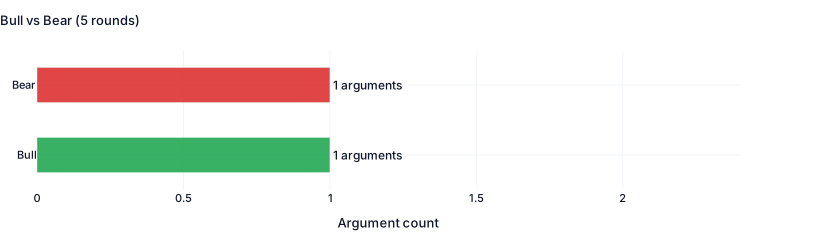
Bull vs Bear Debate (Research Manager)
Recommendation: Hold
Rationale: After carefully evaluating this intense debate, I find myself in a genuinely balanced position. Both analysts made compelling cases backed by solid data points, and neither side delivered a knockout blow.
The Bull makes a strong case about:
- Sector rotation from tech to healthcare being more than just panic - it’s supported by concrete catalysts
- Price action breaking past key moving averages with momentum indicators supporting continuation
- Fundamental strength in top holdings like UNH’s dividend hike and LLY’s breakthrough retatrutide data
The Bear counters with equally persuasive arguments:
- Statistical overextension with price above the upper Bollinger Band (2.6% above VWMA)
- Valuation concerns at 27.9x P/E in a rising rate environment
- Berkshire’s UNH exit as a serious warning sign from a respected long-term investor
- Risk that the rally is driven by hot money that could reverse when market panic subsides
What’s striking is that both sides are looking at the same data but interpreting it differently - the Bull sees breakout confirmation, the Bear sees exhaustion. The technical indicators genuinely support both narratives: yes, there’s momentum, but also overextension. Yes, there’s rotation, but maybe temporary.
The fundamental data points to both opportunity (growth stories in top holdings) and risk (regulatory, valuation). When the evidence doesn’t clearly point in one direction, the prudent stance is Hold. We should let more data come in about whether this rotation has staying power or is indeed temporary.
Strategic Actions: 1. Maintain current position - Do not add to or reduce XLV exposure at current levels 2. Set tight monitoring parameters - Watch for either confirmation of the breakout (sustained close above $154) or rejection (failure below $150) 3. Prepare contingency plans - If price convincingly breaks above $154 with volume, consider adding a small position. If price falls below $148 with the death cross still intact, consider trimming 4. Focus on upcoming catalysts - Monitor June 6 ADA conference outcomes for LLY, any DOJ developments on UNH, and broader market rotation patterns 5. Re-evaluate in 1-2 weeks - This will provide clarity on whether the sector rotation has legs or was indeed temporary panic flow
Trader's Execution Plan
Action: Hold
Reasoning: The Research Manager’s plan highlights a balanced debate between bullish sector-rotation catalysts and bearish overextension/valuation risks. Technical indicators show momentum but also overextension above the upper Bollinger Band, while fundamentals point to both opportunity (LLY’s retatrutide, UNH’s dividend) and risk (27.9x P/E, Berkshire’s UNH exit). With no clear directional edge and the recommendation to let more data come in, the prudent stance is to maintain current XLV exposure and monitor the $148–$154 range for confirmation or rejection.
FINAL TRANSACTION PROPOSAL: HOLD
Portfolio Manager — Final Verdict
Rating: Hold
Executive Summary: Hold current XLV exposure; do not add to or reduce the position at current levels. Monitor the $149–154 range closely for confirmation or rejection. Set a limit order to add 25% of intended position at $149.25 (midpoint of VWMA and 10 EMA) if a healthy pullback materializes, and use the 200 SMA at $147.82 as a mental stop. Re-evaluate in two weeks or if price reaches $157.
Investment Thesis: The debate reveals a balanced but nuanced picture. The bullish case is strong: confirmed sector rotation (healthcare gained 1.2% while Nasdaq dropped 1,100 points), improving fundamentals (UNH dividend hike, LLY retatrutide data, BofA upgrade), and bullish technicals (price above all key MAs, MACD positive, VWMA rising). However, the bearish counterpoints are valid: statistical overextension (price $0.20 above upper Bollinger Band, RSI velocity of 28 points in five weeks), elevated valuation (27.9x P/E), and Berkshire’s UNH exit signal caution. The neutral analyst’s middle path is most prudent: the rotation is real and likely durable, but entry timing matters. Historical data shows a median -0.4% return after closing above the upper Bollinger Band, suggesting a pullback or consolidation is the base case. The 10 EMA ($149.44) and VWMA ($149.09) provide strong support; a dip to that zone would offer a better risk/reward entry. Holding the core position captures upside while waiting for a better entry on new capital respects the statistical likelihood of a near-term pause.
Time Horizon: 2–4 weeks