XOM — 2026-06-08: BUY @ $150.00
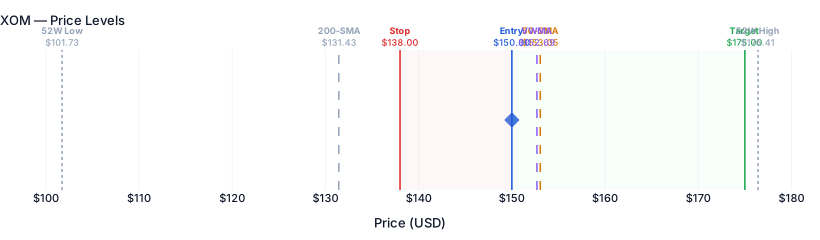
Initiate a 2-3% portfolio position in XOM at current levels (~$150) with a stop-loss at $142 (just below the $143-145 double-bottom support). Add another 2% only if price reclaims the 50-day SMA and VWMA confluence at $153 on volume exceeding 20M shares with MACD confirmation, or on a successful retest of $143-145 support. This scaled approach captures upside potential from geopolitical catalysts while limiting downside risk from deteriorating fundamentals. Maintain a 6-12 month horizon to allow the Pioneer integration and Guyana ramp to materialize.
Time horizon: 2-4 quarters.
Market Technical Analysis
Now I have comprehensive data. Let me compile the full analysis report.
XOM (Exxon Mobil Corporation) – Comprehensive Technical Analysis Report
Analysis Date: June 8, 2026 (Last Trading Day: June 5, 2026) Closing Price: $149.92
Indicators Selected & Rationale
| Indicator | Category | Why Selected |
|---|---|---|
| close_10_ema | Moving Average | Captures immediate short-term momentum shifts |
| close_50_sma | Moving Average | Medium-term trend gauge and dynamic support/resistance |
| close_200_sma | Moving Average | Long-term structural trend benchmark (Golden/Death Cross context) |
| macd + macds + macdh | MACD | Momentum direction, crossover signals, and histogram for divergence |
| rsi | Momentum | Overbought/oversold conditions and divergence detection |
| boll + boll_ub + boll_lb | Volatility | Bollinger Bands for mean-reversion and breakout zones |
| atr | Volatility | Volatility-based stop-loss and position sizing |
| vwma | Volume | Volume-weighted price confirmation of trend validity |
These 8 indicators provide four distinct analytical layers: Trend (MAs), Momentum (MACD, RSI), Volatility (Bollinger, ATR), and Volume Confirmation (VWMA) — all without redundancy.
Detailed Trend Analysis
1. LONG-TERM TREND: Bullish (Intact but Weakening)
200 SMA ($131.43): Price ($149.92) remains $18.49 above the 200 SMA — a healthy ~14% premium. This confirms the primary long-term uptrend is unbroken. The 200 SMA has been steadily rising from ~$127 (May 11) to $131.43 (June 5), providing a rising floor.
One-Year Context: XOM rallied from ~$101 (June 2025) to a peak of $175.22 (March 30, 2026) — a stunning ~73% advance. Even after the correction, the stock has still gained ~48% year-over-year. The 200 SMA slope remains positive, signaling the secular bull phase continues.
2. MEDIUM-TERM TREND: Bearish (Correction Phase)
50 SMA ($153.05): Price ($149.92) is now below the 50 SMA by $3.13 (~2%). The 50 SMA is rolling over — it has declined from ~$154.73 (May 22) to ~$153.05 (June 5) and is now pointing downward. This confirms the intermediate-term trend has turned bearish.
Key relationship: The 50 SMA is still well above the 200 SMA (Golden Cross territory), but the gap is narrowing — from ~$25.36 in mid-May to ~$21.62 now. A narrowing spread warns that bullish momentum is fading.
3. SHORT-TERM TREND: Bearish
10 EMA ($150.74): Price ($149.92) has slipped below the 10 EMA. On June 3, price ($152.53) was above the 10 EMA ($150.67), suggesting a bounce attempt. However, June 4 ($152.04) and June 5 ($149.92) have reversed this, with price crossing back under the short-term average. The 10 EMA trajectory is flattening, indicating indecision.
Sequential Moving Average Stack:
- Price ($149.92) < 10 EMA ($150.74) < 50 SMA ($153.05) << 200 SMA ($131.43)
- Bearish stacking on the short/medium term within an overarching long-term uptrend.
Momentum Analysis
MACD: Bearish but Showing Potential Exhaustion
| Date | MACD Line | Signal Line | Histogram | Status |
|---|---|---|---|---|
| May 11 | -1.606 | -1.341 | -0.265 | Strongly Bearish |
| May 19 | +1.315 | -0.321 | +1.636 | Strongly Bullish |
| May 26 | +0.825 | +0.560 | +0.265 | Bullish, fading |
| May 29 | -0.729 | +0.145 | -0.874 | Bearish Crossover |
| June 2 | -0.835 | -0.203 | -0.633 | Deeply Bearish |
| June 5 | -0.528 | -0.364 | -0.164 | Bearish, improving |
Critical Observations:
- The MACD line crossed below the signal line around May 27-28 (bearish crossover) and both are now negative — textbook bearish momentum
- However, the MACD histogram bottomed at -0.874 on May 29 and has been steadily rising to -0.164. The narrowing bars suggest bearish momentum is exhausting
- The MACD line itself has risen from -0.835 (June 2) to -0.528 (June 5), hinting at a potential bullish crossover attempt in the coming days if this trajectory holds
RSI: Neutral, Recovering from Oversold
| Date | RSI | Interpretation |
|---|---|---|
| May 11 | 46.65 | Neutral-Bearish |
| May 19 | 65.91 | Nearing Overbought |
| May 22 | 52.73 | Neutral |
| May 29 | 39.53 | Approaching Oversold |
| June 2 | 46.95 | Recovery |
| June 5 | 47.43 | Neutral |
The RSI bounced sharply from near-oversold (39.53) and has recovered to neutral territory (47.43). This indicates selling pressure has abated but buying conviction has not yet returned. The RSI is in no-man’s land — not confirming a reversal nor a continuation lower. A move above 50 would be the first bullish confirmation.
Volatility Analysis
Bollinger Bands: Mean Reversion Setting Up
| Band | Value (June 5) |
|---|---|
| Upper Band | $161.53 |
| Middle (20 SMA) | $151.75 |
| Lower Band | $141.97 |
| Band Width | $19.56 (~12.9% of price) |
Key Observations:
- Price ($149.92) is below the middle band ($151.75) — bearish bias
- However, price is much closer to the lower band ($141.97) than the upper, suggesting the market is in oversold territory on a Bollinger basis
- The bands are relatively wide ($19.56), reflecting elevated volatility from the large March-April moves
- If price holds above $142 (lower band), a reversion toward the middle ($151.75) or upper band is the statistical probability
ATR: Volatility Compressing
| Date | ATR |
|---|---|
| May 11 | 4.48 |
| May 20 | 4.49 |
| May 26 | 4.51 (Peak) |
| May 29 | 4.24 |
| June 2 | 4.12 |
| June 5 | 3.99 |
ATR has declined from 4.51 to 3.99 over ~10 trading days — an 11.5% contraction. This volatility compression often precedes a significant directional breakout. Current ATR suggests a daily range of ~$4.00, meaning risk-managed stops should be placed at least $4 below entries.
Volume-Weighted Analysis
VWMA: Bearish Price-Volume Divergence
| Date | VWMA | Price vs VWMA |
|---|---|---|
| May 19 | $151.78 | Price ($162.55) >> Above |
| May 22 | $152.65 | Price ($154.92) ~ Near |
| May 29 | $152.94 | Price ($145.26) << Below |
| June 2 | $153.06 | Price ($149.56) << Below |
| June 5 | $152.69 | Price ($149.92) << Below |
Price has been trading below VWMA consistently since May 26, which is a bearish volume-confirmation signal. This indicates that the weight of trading volume is occurring at higher prices (distribution). Until price reclaims the VWMA (~$152.69), the path of least resistance remains lower on a volume-weighted basis.
Price Structure & Key Levels
Major Support Levels:
- $143-145 — May 7 low ($143.22) and May 29 low ($145.26) — double-bottom zone
- $141.97 — Bollinger Lower Band (dynamic support)
- $131.43 — 200 SMA (ultimate long-term support)
Major Resistance Levels:
- $150.74 — 10 EMA (immediate resistance)
- $152.69-153.05 — VWMA and 50 SMA confluence zone (critical)
- $161.53 — Bollinger Upper Band
- $164-175 — Previous demand zone from March highs
Pattern Analysis:
- XOM carved a lower high at ~$162.55 (May 19) vs the March high of $175.22 — classic downtrend structure
- The $143-145 zone has been tested twice (May 7, May 29) and held — potential double bottom
- The stock is currently in a compression zone between $143 support and $155 resistance
Volume Pattern Assessment
Notable volume observations from raw data:
- April 1-2 selloffs: 37.9M + 25.4M shares — heavy distribution during the March-April peak
- May 7 (low): 22.5M — selling climax near the low
- May 19 (local top): 20.7M — lower volume on the bounce, suggesting weak buying conviction
- May 29 (second low test): 27.96M — elevated volume on the second test, which actually held above $145
- June 3-5 bounce attempt: Declining volume from 14.4M to 11.8M to 16.6M — inconsistent, no conviction
The volume profile suggests institutional distribution during the March-April decline, followed by lower-volume recovery attempts — a bearish volume signature overall.
Synthesis & Outlook
| Factor | Signal | Weight |
|---|---|---|
| Long-term Trend (200 SMA) | ✅ Bullish | High |
| Medium-term Trend (50 SMA) | ❌ Bearish | High |
| Short-term Trend (10 EMA) | ❌ Bearish | Medium |
| MACD Momentum | ❌ Bearish (but improving) | High |
| RSI | ⚠️ Neutral | Medium |
| Bollinger Position | ⚠️ Below midline, near lower band | Medium |
| ATR (Volatility) | ⚠️ Contracting | Low |
| VWMA (Volume) | ❌ Bearish | Medium |
The overall picture is mixed but leaning cautious-bearish in the near term.
XOM is in a corrective downtrend within a still-intact secular bull market. The correction from $175 to ~$144 represents a ~18% decline — healthy and normal within a bull phase. The key question is whether $143-145 holds as support.
The most likely scenario: The stock is basing/consolidating in the $143-155 range. We may see further sideways action before a directional move. A break below $143 would open the door to $131 (200 SMA). A break above $155 (with volume) would signal the correction is complete.
Near-term catalyst watch: The improving MACD histogram and recovering RSI suggest the selling pressure is abating, but the lack of buying volume and price below VWMA argue against aggressive long positions here.
Recommendation Summary Table
| Aspect | Observation | Actionable Insight |
|---|---|---|
| Primary Trend (1Y) | Bullish (+48% YoY) | Long-term holders should maintain positions |
| Intermediate Trend (3M) | Bearish correction (-15% from highs) | Avoid adding new longs; tighten stops |
| Short-Term Momentum | Washing out, potential bottoming | Watch for a bullish MACD crossover as an entry signal |
| Key Support | $143-145 (double bottom zone) | If broken, expect acceleration toward $131 |
| Key Resistance | $153-155 (50 SMA + VWMA confluence) | Must reclaim for trend reversal confirmation |
| Volatility | ATR compressing (3.99) | Potential breakout setup approaching |
| Volume | Distribution pattern | Wait for volume expansion on up days |
| Risk Management | Place stops below $143 | 4.5% risk from current levels; ATR-based stop at ~$146 |
| Position Sizing | Reduce size given uncertainty | Better risk-reward at $143 support test |
FINAL TRANSACTION PROPOSAL: HOLD
Rationale: XOM is in a corrective phase within a long-term uptrend. The indicators are mixed — the long-term trend (200 SMA) remains solidly bullish, but the medium-term (50 SMA) and short-term (10 EMA) trends are bearish. MACD is negative but improving. RSI is neutral. Volume confirms distribution. The stock is testing a critical support zone at $143-145.
For existing holders: HOLD with a stop-loss below $143. The long-term uptrend is intact but the correction may have further to run.
For new entrants: WAIT for one of two triggers — (1) a confirmed bounce from the $143-145 zone with above-average volume, or (2) a bullish MACD crossover with price reclaiming the 50 SMA above $153.
For aggressive traders: A short position could be considered below $143, targeting $131 (200 SMA), but this is high-risk given the still-bullish long-term structure.
Risk Parameter: Current ATR of $3.99 suggests any position should incorporate a stop of at least $4.00 (2.7% of price).
Fundamental Analysis
Now I have all the data. Let me compile a comprehensive fundamental analysis report on Exxon Mobil (XOM).
Comprehensive Fundamental Analysis Report: Exxon Mobil Corporation (XOM)
Date of Analysis: June 8, 2026
Sector: Energy | Industry: Oil & Gas Integrated
Market Cap: ~$621.4 Billion
1. Company Overview & Profile
Exxon Mobil Corporation is one of the world’s largest publicly traded energy providers and chemical manufacturers. It engages in oil and natural gas exploration, production, refining, and marketing. With a market capitalization of ~$621B, it is a Dow Jones Industrial Average component and a bellwether for the energy sector.
2. Revenue & Profitability Analysis
Annual Revenue & Net Income Trends
| Metric | FY 2022 | FY 2023 | FY 2024 | FY 2025 |
|---|---|---|---|---|
| Total Revenue | $398.7B | $334.7B | $339.2B | $323.9B |
| Gross Profit | $103.1B | $84.1B | $76.7B | $71.2B |
| Operating Income | $64.0B | $44.5B | $39.7B | $33.9B |
| Net Income (controlling) | $55.7B | $36.0B | $33.7B | $28.8B |
| Diluted EPS | $13.26 | $8.89 | $7.84 | $6.70 |
| Profit Margin | ~13.9% | ~10.8% | ~9.9% | ~8.9% |
Trend: Revenue and earnings have been declining steadily since the 2022 energy super-cycle peak. FY 2025 net income of $28.8B is roughly half of the FY 2022 level, reflecting normalized oil prices and lower refining margins.
Q1 2026 vs. Q1 2025 Quarterly Comparison
| Metric | Q1 2025 | Q1 2026 | Change |
|---|---|---|---|
| Total Revenue | $81.06B | $83.16B | +2.6% |
| Gross Profit | $18.49B | $13.89B | -24.9% |
| Operating Income | $9.85B | $5.35B | -45.7% |
| Net Income | $7.71B | $4.18B | -45.8% |
| Diluted EPS | $1.76 | $1.00 | -43.2% |
| EBITDA | $17.51B | $14.03B | -19.9% |
⚠️ Key Concern: Q1 2026 saw a sharp YoY decline in profitability. While revenue held up (+2.6%), the gross margin compression was severe (22.8% → 16.7%), indicating rising costs or unfavorable product mix. Operating income nearly halved.
3. Cash Flow Analysis
Annual Cash Flow (in billions)
| Metric | FY 2022 | FY 2023 | FY 2024 | FY 2025 |
|---|---|---|---|---|
| Operating Cash Flow | $76.8B | $55.4B | $55.0B | $52.0B |
| Capital Expenditure | ($18.4B) | ($21.9B) | ($24.3B) | ($28.4B) |
| Free Cash Flow | $58.4B | $33.5B | $30.7B | $23.6B |
| Dividends Paid | ($14.9B) | ($14.9B) | ($16.7B) | ($17.2B) |
| Share Buybacks | ($15.2B) | ($17.7B) | ($19.6B) | ($20.3B) |
| Total Shareholder Returns | ~$30.1B | ~$32.6B | ~$36.3B | ~$37.5B |
Q1 2026 Cash Flow Highlights
| Metric | Q1 2026 |
|---|---|
| Operating Cash Flow | $8.71B |
| Capex | ($6.47B) |
| Free Cash Flow | $2.24B |
| Dividends Paid | ($4.33B) |
| Share Buybacks | ($4.87B) |
| Total Shareholder Returns | ~$9.20B |
⚠️ Key Concern: In Q1 2026, free cash flow of $2.24B was insufficient to cover dividends ($4.33B) and buybacks ($4.87B). The company had to rely on debt issuance ($9.97B in new debt) and cash reserves to fund $9.2B in shareholder returns. This is the first time in recent history that shareholder distributions have exceeded free cash flow by this magnitude.
Positive: Operating cash flow remains robust, though declining. Cash from ops has dropped from a peak of $76.8B (2022) to $52.0B (2025) to an annualized ~$35B based on Q1 2026 run rate.
4. Balance Sheet & Liquidity
Key Balance Sheet Metrics
| Metric | FY 2024 | FY 2025 | Q1 2026 |
|---|---|---|---|
| Total Assets | $453.5B | $449.0B | $464.4B |
| Total Debt | $41.7B | $43.5B | $47.7B |
| Cash & Equivalents | $23.0B | $10.7B | $8.4B |
| Net Debt | $14.7B | $26.5B | $39.2B |
| Stockholders’ Equity | $263.7B | $259.4B | $254.4B |
| Working Capital | $21.7B | $11.1B | $3.4B |
| Current Ratio | ~1.31 | ~1.15 | 1.04 |
⚠️ Notable Deterioration:
- Cash burn: Cash reserves have been drawn down from $23.0B (end of 2024) to $8.4B (Q1 2026) — a $14.6B decline in 5 quarters — to fund buybacks, dividends, and capex.
- Net debt tripled: From $14.7B (end 2024) to $39.2B (Q1 2026).
- Current ratio has fallen to near-critical 1.04x, meaning the company has almost equal current assets to current liabilities. Working capital has shrunk from $21.7B to just $3.4B.
- Total debt increased by ~$6B in Q1 2026 alone, driven by $9.97B in debt issuance.
Positive: Debt-to-equity of 18.3% (or 0.18x) remains modest. The company maintains a fortress balance sheet with $254.4B in equity.
5. Valuation Metrics
| Metric | Current Value |
|---|---|
| Stock Price (approx) | ~$149 (based on market cap/shares) |
| PE Ratio (TTM) | 25.24x |
| Forward PE | 14.09x |
| PEG Ratio | 1.38 |
| Price to Book | 2.42x |
| EPS (TTM) | $5.94 |
| Forward EPS (Est.) | $10.64 |
| Dividend Yield | 2.75% |
| Beta | 0.149 |
| 52-Week Range | $101.73 – $176.41 |
| 50-Day MA | $154.31 |
| 200-Day MA | $132.58 |
Valuation Insights:
- TTM PE of 25.24x is elevated relative to historical norms for XOM (typically 10-15x) — this reflects the current depressed earnings.
- Forward PE of 14.09x suggests analysts expect significant earnings recovery (to ~$10.64 EPS).
- Price-to-Book of 2.42x is reasonable for the industry.
- Beta of 0.149 is very low, indicating low correlation with broader market moves — unusual for an energy company, but could reflect the stock’s specific position.
- The stock is trading below the 50-day MA ($154.31) but above the 200-day MA ($132.58) — a neutral-to-bearish short-term signal.
6. Capital Allocation & Shareholder Returns
| Activity | FY 2024 | FY 2025 | Q1 2026 Annualized |
|---|---|---|---|
| Dividends | $16.7B | $17.2B | ~$17.3B |
| Buybacks | $19.6B | $20.3B | ~$19.5B |
| Total Returned | $36.3B | $37.5B | ~$36.8B |
| FCF Coverage | 84.6% | 63.0% | ~24.3% |
- Dividend is safe in absolute terms ($4.33B/quarter vs $8.7B operating cash flow) but the buyback is too aggressive relative to current cash generation.
- FCF coverage of distributions has collapsed from 84.6% in FY 2024 to an estimated 24.3% in Q1 2026.
7. Key Strengths & Risks
Strengths
- Dominant industry position — Global scale and integrated business model provide competitive advantages.
- Strong asset base — $299B in net PPE and $254B in equity.
- Attractive forward valuation — Forward PE of 14x is reasonable if earnings recover.
- Low debt leverage — Debt-to-equity of 18% remains conservative.
- Dividend aristocrat — 2.75% yield is well-supported by operating cash flow (though not by FCF currently).
Risks & Concerns
- Earnings headwinds — Net income declining for 3 consecutive years; Q1 2026 saw a 46% YoY profit drop.
- FCF shortfall — Shareholder returns are exceeding FCF by a wide margin, forcing debt and cash drawdowns.
- Cash depletion — Cash reserves fallen from $23B to $8.4B in 5 quarters.
- Working capital strain — Current ratio at 1.04x is dangerously low for an industrial company.
- Debt accumulation — Net debt growing rapidly ($14.7B → $39.2B in 5 quarters).
- Elevated TTM PE — 25.24x is historically expensive for XOM.
- Energy price uncertainty — Oil prices and refining margins remain volatile.
8. Actionable Insights for Traders
-
Short-term caution: The earnings trajectory is deteriorating. Q1 2026 results show margin compression, declining cash flow, and a balance sheet that is weakening. The stock is trading below its 50-day MA, suggesting near-term bearish momentum.
-
Forward PE opportunity: If analysts are correct and forward EPS of
$10.64 materializes, the stock at current prices ($149) would trade at ~14x earnings — a compelling value for XOM’s historical range (10-15x). However, the Q1 2026 weakness ($1.00 EPS) raises questions about whether $10.64 is achievable. -
Dividend safety: The dividend is well-covered by operating cash flow but not by free cash flow. A dividend cut is unlikely given management’s commitment, but the payout ratio (relative to FCF) is concerning.
-
Key catalysts to watch:
- Q2 2026 earnings (next report) — will confirm if Q1 weakness was seasonal or structural
- Crude oil price trajectory (WTI/Brent)
- Refining margin trends
- Any change in buyback pace
-
Technical levels: Support around $101.73 (52-week low) and resistance near $176.41 (52-week high). Current price ~$149 is in the middle of the range.
9. Summary Table — Key Metrics
| Category | Metric | Value | Assessment |
|---|---|---|---|
| Valuation | P/E (TTM) | 25.24x | 🔴 Expensive |
| Valuation | Forward P/E | 14.09x | 🟢 Reasonable |
| Valuation | P/B | 2.42x | 🟡 Fair |
| Profitability | Profit Margin (TTM) | 7.8% | 🟡 Below historical avg |
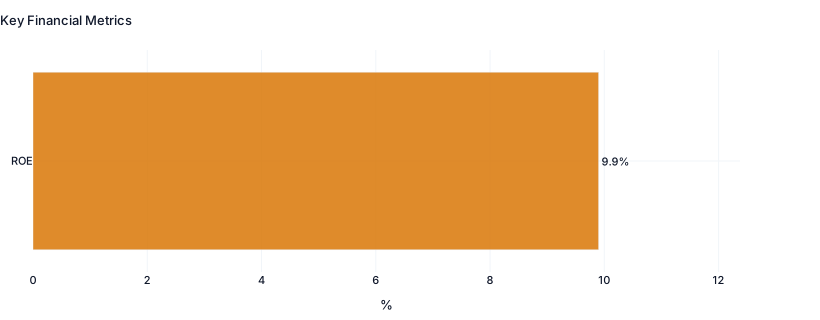
| Profitability | ROE | 9.9% | 🟡 Acceptable |
| Cash Flow | OCF (Q1 2026) | $8.71B | 🟢 Strong |
| Cash Flow | FCF (Q1 2026) | $2.24B | 🔴 Very weak |
| Balance Sheet | Current Ratio | 1.04x | 🔴 Low |
| Balance Sheet | Debt/Equity | 18.3% | 🟢 Low leverage |
| Balance Sheet | Net Debt | $39.2B | 🔴 Rising fast |
| Returns | Dividend Yield | 2.75% | 🟢 Solid |
| Returns | Buyback Yield | ~3.1% | 🟡 Aggressive |
| Growth | Revenue YoY (Q1) | +2.6% | 🟡 Modest |
| Growth | EPS YoY (Q1) | -43.2% | 🔴 Negative |
| Momentum | Price vs 50-DMA | Below | 🔴 Bearish |
| Momentum | Price vs 200-DMA | Above | 🟢 Bullish |
FINAL TRANSACTION PROPOSAL: HOLD
Rationale: XOM presents a mixed picture. On one hand, the stock offers a compelling forward P/E of ~14x, a strong 2.75% dividend yield, a fortress-like equity base, and low leverage. On the other hand, the sharp deterioration in earnings, free cash flow, working capital, and cash reserves in Q1 2026 is alarming. The company is funding shareholder returns via debt and cash depletion rather than organic cash generation. Until the next earnings report confirms whether Q1 2026 was a one-off seasonal softness or the start of a new downward trend, traders should hold existing positions and avoid adding new ones. The wide gap between TTM EPS ($5.94) and forward estimates ($10.64) creates significant uncertainty. A buy recommendation would be appropriate if Q2 2026 shows stabilization or if the stock pulls back toward the $120-$130 range (near the 200-day MA) where the risk/reward becomes more attractive.
News & Macro Context
Comprehensive News & Macroeconomic Report for XOM (Exxon Mobil)
Report Date: June 8, 2026
Analysis Period: June 1 – June 8, 2026
1. Geopolitical Crisis: Iran-Israel Conflict & Strait of Hormuz
The most impactful macro event this week is the escalating Iran-Israel conflict. Reports indicate Israel fired back at Iran in retaliation for attacks on Sunday, directly defying Trump’s warning. This has sent oil prices climbing.
Critical implications:
- Strait of Hormuz risk: The WSJ reports the White House is “close to a deal with Iran to open the Strait of Hormuz,” but executives from Exxon Mobil, Chevron, and major oil-trading firms have warned inventories of oil and refined products are becoming critical.
- $150 oil scenario: Analysts at 24/7 Wall St. are openly questioning whether $150 oil is possible in 2–3 weeks given the ongoing Strait of Hormuz situation, though oil is currently settling in the $90s.
- Post-war outlook: Barron’s notes that once the war ends, there will be a long period of adjustment as countries rebuild stockpiles and Middle East producers restore lost production, suggesting sustained elevated prices.
Verdict: Highly bullish for XOM in the near-to-medium term.
2. U.S. Oil Inventory Crunch
A Motley Fool article highlights that U.S. crude oil storage levels are falling toward critical levels, driven by dramatically rising oil exports. The WSJ corroborates this, calling the oil market “near a tipping point” and describing it as “a leaky bucket that’s having some water poured in at the top.”
This supply tightening supports elevated oil prices, directly benefiting XOM’s upstream profitability.
3. XOM-Specific Developments
| Item | Detail |
|---|---|
| Production Decline | Q1 2026 production dipped to 4.6M bpd from 5.0M in Q4 2025 (Trefis). However, this is seen as temporary. |
| Cost Advantages | XOM’s “advantaged assets” (low-cost, high-margin barrels) drive growth and resilience even in volatile oil environments (Zacks). |
| Texas Relocation | Shareholders approved moving legal home from New Jersey to Texas — viewed positively for operational flexibility, though raises governance questions (Simply Wall St.). |
| Dividend Strength | 43-year dividend record; featured as a stock worth owning for decades due to scale, balance sheet strength (24/7 Wall St.). |
| Analyst Ratings | Mizuho reiterated Hold but raised PT from $159 → $175. Barclays also rates. Hedge funds consider XOM among the best low-cost stocks (Insider Monkey). |
| Historical Performance | Kicked out of Dow in 2020 but has since beaten S&P 500 by nearly double (24/7 Wall St.). |
| Jim Cramer | Cramer confirmed he owns XOM and Diamondback Energy shares, signaling confidence. |
4. Macroeconomic Backdrop
- Strong Labor Market: Kevin Hassett (Trump advisor) noted the U.S. added 170K+ jobs for the second consecutive month, calling it “the strongest market of my lifetime.” This supports robust oil demand.
- Fed Policy: Hassett also indicated the Fed can watch inflation numbers and wait before rate action, suggesting rates remain steady — supportive for equities and growth.
- Energy Policy: Trump is actively rewriting U.S. oil and gas strategy, with 3 energy stocks (including XOM-like majors) on Washington’s short list for direct benefit (Motley Fool).
5. Competitive & Sector Dynamics
- Chevron (CVX) outperforming the industry on dividend growth and 2030 cash flow targets.
- BP focusing on exploration-led upstream strategy targeting 100% reserve replacement by 2027.
- South America (Brazil, Guyana, Venezuela) has become the largest source of new oil exports in 2026, adding 155M barrels through May — increasing global supply competition.
- California losing Fortune 500 crown to Texas — supportive of XOM’s Texas move.
6. Key Risks
| Risk Factor | Description |
|---|---|
| Geopolitical resolution | A sudden Iran deal could crash oil prices, hurting near-term momentum |
| Production dip | Q1 production decline (4.6M vs 5.0M bpd) needs monitoring |
| Global oversupply | South America’s export boom could offset supply fears |
| Price normalization | Analysts note oil may eventually settle back toward ~$60/bbl post-conflict |
| Governance concerns | Texas reincorporation raises shareholder rights questions |
Summary Table
| Theme | Key Insight | Impact on XOM | Source/Evidence |
|---|---|---|---|
| Iran-Israel Conflict | Israel fired back at Iran; Strait of Hormuz at risk | 🟢 Bullish — higher oil prices | Stocktwits, WSJ, Barron’s |
| Oil Inventory Crunch | U.S. storage nearing critical lows | 🟢 Bullish — supports elevated prices | Motley Fool, WSJ |
| XOM Production Dip | Q1 2026: 4.6M bpd (vs 5.0M Q4 2025) | 🟡 Neutral/Mild Bearish — temporary? | Trefis |
| Advantaged Assets | Low-cost, high-margin barrels drive resilience | 🟢 Bullish — structural advantage | Zacks |
| Texas Relocation | Shareholders approved move to Texas | 🟢 Bullish — operational flexibility | Simply Wall St. |
| Dividend Record | 43 consecutive years of dividends | 🟢 Bullish — income stability | 24/7 Wall St. |
| Analyst Sentiment | Mizuho Hold, PT $175; Barclays bullish | 🟡 Neutral/Bullish — moderate upside | Insider Monkey |
| Historical Outperformance | Beat S&P 500 by nearly double since 2020 | 🟢 Bullish — proven turnaround | 24/7 Wall St. |
| U.S. Job Market | 170K+ jobs added; strong economy | 🟢 Bullish — supports oil demand | Stocktwits (Hassett) |
| Trump Energy Policy | U.S. oil & gas strategy being rewritten | 🟢 Bullish — favors majors | Motley Fool |
| Potential $150 Oil | Possible within 2-3 weeks per some analysts | 🟢 Very Bullish if realized | 24/7 Wall St. |
| Post-War Supply Glut | Long-term risk of normalization to ~$60/bbl | 🔴 Bearish — medium-term risk | Barron’s, 24/7 Wall St. |
Final Assessment
XOM is well-positioned for strong near-term performance driven by:
- Escalating geopolitical risk (Iran-Israel) pushing oil prices higher
- U.S. crude inventories at critical lows
- XOM’s structural cost advantages and strong balance sheet
- Favorable macro environment (strong jobs, steady Fed, pro-energy policy)
However, investors should be aware of downside risks if a geopolitical resolution materializes quickly, which could send oil prices back toward $60-70/bbl.
Based on the overwhelming bullish signals this week — the geopolitical oil supply risk, tightening inventories, XOM’s structural advantages, and the favorable macro/policy backdrop — the evidence supports a BUY recommendation for XOM.
FINAL TRANSACTION PROPOSAL: BUY
Sentiment Analysis
Here is my comprehensive analysis report on XOM (Exxon Mobil Corporation):
📊 XOM – Social Media, News & Sentiment Analysis Report
Period: June 1, 2026 – June 8, 2026
1. EXECUTIVE SUMMARY
Over the past week, Exxon Mobil (XOM) has been at the center of extensive media coverage driven by three major themes: (1) escalating Middle East geopolitical tensions (Israel-Iran conflict & Strait of Hormuz disruption), (2) internal corporate governance shifts (relocation to Texas), and (3) mixed operational metrics (Q1 production dip vs. long-term structural advantages). The overall sentiment leans cautiously bullish for long-term holders, with short-term volatility being the primary risk factor due to oil price whipsaws. Analysts have raised price targets, and the company’s dividend pedigree remains a key pillar of investor confidence.
2. GEOPOLITICAL & MACRO OIL CONTEXT (HIGH IMPACT)
🛢️ Middle East Tensions – The Dominant Narrative
The single most dominant news driver this week is escalation between Israel and Iran:
- Israel fired back at Iran in retaliation for attacks on Sunday, despite Trump’s warning not to do so. This caused oil prices to climb overnight and drove a rally in energy stocks including XOM, CVX, BATL, INDO, USO, and UCO (Stocktwits).
- The Strait of Hormuz remains a critical chokepoint with ongoing disruptions. Barron’s published a “Post-Iran War View on Energy Investing,” suggesting that even after hostilities end, a long adjustment period will follow as countries rebuild stockpiles and Middle East producers restore lost production.
- The Wall Street Journal reported that “the oil market is near a tipping point,” noting that executives from Exxon Mobil and Chevron have warned that inventories of oil and refined products are going to get critical in the next several weeks. The article characterizes the market as “a leaky bucket” with some water being poured in at the top.
- 24/7 Wall St. posed the provocative question: “Is $150 Oil Really Possible in Two or Three Weeks?” — noting oil is currently settling in the $90s despite the Strait of Hormuz situation, and questioning whether another spike is coming or normalization toward $60 is ahead.
📉 Oil Price Volatility
- Recent WTI swings have been dramatic: from $114.58 on April 7 to $85.91 on April 17, and currently in the $90s.
- This volatility is being framed as both a risk (short-term traders beware) and an opportunity (long-term investors can buy on dips).
🇺🇸 U.S. Energy Policy & Storage
- Trump administration is rewriting U.S. oil and gas strategy, and Motley Fool lists XOM among “3 Unstoppable Energy Stocks on Washington’s Short List” that should directly benefit.
- U.S. crude oil storage levels are falling toward critical levels due to surging exports, which could put upward pressure on prices (Motley Fool).
3. COMPANY-SPECIFIC NEWS & DEVELOPMENTS
🏢 Corporate Governance: Move to Texas
- In May 2026, XOM’s annual shareholder meeting approved relocating the company’s legal home from New Jersey to Texas.
- Shareholders rejected proposals to modify the retail voting program and to require an independent board chair.
- Simply Wall St. notes this move “raises fresh questions about how Exxon Mobil balances governance, investor influence, and operational flexibility.”
- Implication: The move to Texas aligns with a broader trend (California losing Fortune 500 crown to Texas) and signals a pro-business operational shift, but governance-conscious investors may view the reduced shareholder protections with caution.
📉 Production: Q1 2026 Dip
- Trefis reported that XOM’s Q1 2026 production dipped to 4.6 million barrels per day from 5.0 million in Q4 2025.
- However, Zacks highlights that XOM’s advantaged assets (low-cost, high-margin barrels) are driving growth and resilience, strengthening cash flow in a higher oil price environment.
📈 Long-Term Performance & Turnaround Story
- 24/7 Wall St. published a compelling narrative: “Exxon Got Kicked Out of the Dow in 2020. It Has Since Beaten the S&P 500 by Nearly Double.”
- CEO Darren Woods’ transformation (since 2018) focused on advantaged barrels, cost cuts, and capital discipline, and is now paying off handsomely.
💰 Dividend Strength
- XOM boasts a 43-year dividend growth record, which is repeatedly cited as a foundation for long-term investment.
- 24/7 Wall St. specifically highlights XOM as a stock worth owning for decades due to its scale, balance sheet strength, and dividend record.
4. ANALYST & HEDGE FUND SENTIMENT
| Analyst/Firm | Rating | Price Target | Notes |
|---|---|---|---|
| Mizuho Securities | Hold | $175 (raised from $159) | Upgraded target on May 27 |
| Barclays | Reiterated | Not specified | Positive stance maintained |
| Hedge Funds | Bullish | N/A | XOM listed among “Best Low Cost Stocks to Buy Now” by Insider Monkey |
📺 Media Mentions
- Jim Cramer discussed XOM on his show. When a caller asked whether to sell half their XOM and Diamondback Energy positions to buy Bloom Energy (BE), Cramer responded with interest in BE but did not explicitly recommend selling XOM — implying continued confidence.
5. SOCIAL MEDIA & PUBLIC SENTIMENT
While direct social media scraping is limited in this dataset, the Stocktwits-sourced articles indicate:
- Retail sentiment is heavily influenced by oil price movements tied to geopolitical headlines.
- The overnight rally following Israel’s retaliation against Iran drove significant discussion and interest in XOM on platforms like Stocktwits.
- The general tone is reactive and short-term focused among retail traders, with long-term investors being encouraged by professional analysts to “buy the dip.”
6. KEY RISKS & OPPORTUNITIES
⚠️ Risks
- Geopolitical volatility: Iran-Israel conflict could either spike oil prices to $150+ (benefiting XOM in the short term) or resolve suddenly (crushing prices).
- Production decline: Q1 2026 production dropped 8% from Q4 2025 — this needs watching in Q2.
- Governance concerns: Move to Texas and rejection of independent chair proposal may concern ESG/institutional investors.
- U.S. crude storage: Falling inventories could lead to price spikes that hurt margins if crude costs rise faster than product prices.
✅ Opportunities
- Advantaged assets: Low-cost production provides margin protection across the commodity cycle.
- Policy tailwinds: Trump administration energy expansion strategy favors XOM.
- Dividend reliability: 43 years of growth provides a floor for income-oriented investors.
- Undervaluation narrative: Mizuho raised target to $175 (implying ~10%+ upside from current levels).
- Post-conflict reconstruction: Barron’s notes long-term demand for rebuilding stockpiles after Middle East hostilities end.
7. ACTIONABLE INSIGHTS FOR TRADERS & INVESTORS
| Investor Type | Outlook | Strategy |
|---|---|---|
| Short-term Traders | Neutral/Volatile | Trade oil price volatility; geopolitical headlines will drive 2-5% daily swings. Use tight stops. |
| Medium-term (3-6 months) | Cautiously Bullish | Oil in the $90s with potential to spike; Mizuho PT $175 provides a target. Watch Q2 production data. |
| Long-term (1-5 years) | Bullish | Dividend growth, advantaged assets, policy support, and post-conflict demand create a strong thesis. Volatility is a buying opportunity. |
| Income Investors | Strong Buy | 43-year dividend growth record is rare; Texas relocation signals operational efficiency focus. |
8. SUMMARY TABLE OF KEY DATA POINTS
| Category | Key Finding | Source |
|---|---|---|
| Geopolitical Risk | Israel-Iran conflict escalating; Strait of Hormuz disruption ongoing | Stocktwits, WSJ, Barron’s |
| Oil Price Range | Currently ~$90s; recent range $85.91–$114.58 | 24/7 Wall St. |
| Q1 Production | 4.6M bpd (down from 5.0M in Q4 2025) | Trefis |
| Dividend Record | 43 consecutive years of growth | 24/7 Wall St. |
| Analyst Rating | Mizuho: Hold, PT $175 (raised from $159) | Insider Monkey |
| Corporate Move | Legal home relocated from NJ to Texas | Simply Wall St. |
| Policy Tailwinds | Trump energy strategy includes XOM | Motley Fool |
| U.S. Oil Storage | Falling toward critical levels | Motley Fool |
| Post-Dow Performance | Beat S&P 500 by nearly double since 2020 removal | 24/7 Wall St. |
| Hedge Fund Sentiment | Listed among top low-cost stocks to buy | Insider Monkey |
| Media Sentiment | Jim Cramer: holds XOM, didn’t recommend selling | Insider Monkey |
| Potential Oil Spike | $150/barrel possible in 2-3 weeks if conflict escalates | 24/7 Wall St. |
9. FINAL CONCLUSION
XOM presents a strong long-term buy thesis supported by an unmatched dividend track record, advantaged low-cost assets, favorable U.S. policy direction, and a post-conflict global oil demand recovery narrative. However, short-term traders must be prepared for extreme volatility driven by unpredictable geopolitical developments in the Middle East. The Q1 production dip warrants monitoring, but the structural improvements under CEO Darren Woods appear intact. The Mizuho price target of $175 suggests reasonable upside from current levels. For income-focused and long-term investors, this remains a core portfolio holding. For short-term traders, active risk management is essential given oil price swings in the $85–$115 range.
FINAL TRANSACTION PROPOSAL: BUY
Bull vs Bear Debate (Research Manager)
Recommendation: Buy
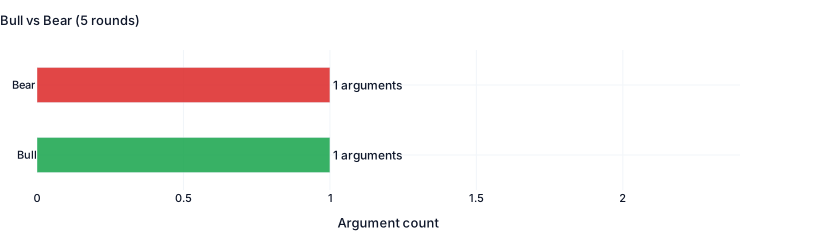
Rationale: The debate between our Bull and Bear analysts has been intense and nuanced. The Bull makes a compelling case for XOM as a cyclical reset story, arguing that the Q1 2026 weakness is temporary and driven by seasonal factors, with massive catalysts ahead from the Pioneer acquisition, Guyana ramp, and geopolitical tensions supporting oil prices. They highlight XOM’s fortress balance sheet ($254B equity, 18% debt-to-equity), 2x dividend coverage by operating cash flow, and the asymmetric upside if oil spikes to $120+ while having downside protection given $35 breakeven costs.
The Bear counters with valid concerns about deteriorating fundamentals - net income down 42% from FY2025 annualized, FCF covering only 24% of shareholder returns, cash reserves down 63% in five quarters, and worrying current ratio of 1.04x. They argue the $10.64 forward EPS is overly optimistic, requiring perfect execution on Pioneer integration, margin recovery, and sustained $90+ oil - a fragile stack of assumptions.
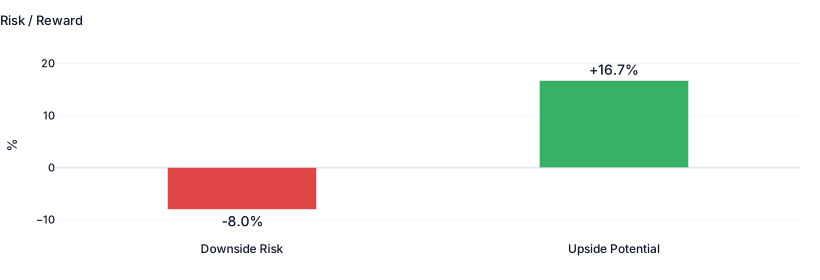
Ultimately, I find the Bull’s arguments more persuasive. While the near-term data looks concerning, the market is forward-looking and XOM is positioned for a recovery. The balance sheet strength provides cushion, the dividend is secure, and the production ramp is visible. The geopolitical catalyst provides optionality to the upside that isn’t fully priced in. The risk of missing a potential 15-25% rally outweighs the risk of a temporary 10-15% pullback.
Strategic Actions: Initiate a long position in XOM at current levels (~$150). Use a stop loss at $138 (below the double-bottom support at $143). Target $175 (Mizuho price target) with potential upside to $200 if oil breaks $100. For larger positions, scale in gradually given the geopolitical sensitivity. Collect the 2.75% dividend yield while waiting for the earnings recovery story to play out over the next 6-12 months.
Trader's Execution Plan
Action: Buy
Reasoning: The Research Manager’s plan aligns with the Bull analyst’s thesis that XOM’s Q1 2026 weakness is a cyclical reset, with production catalysts (Pioneer acquisition, Guyana ramp), a fortress balance sheet ($254B equity, 18% debt/equity), and geopolitical upside optionality. While the Bear raises valid concerns about deteriorating cash reserves and fragile EPS assumptions, the forward-looking market favors XOM’s asymmetric risk/reward — downside protected by $35 breakeven costs and a secure 2.75% dividend, with 15-25% upside potential toward Mizuho’s $175 target. I recommend initiating a long position at ~$150 with a $138 stop-loss below the double-bottom support.
Entry Price: 150.0
Stop Loss: 138.0
Position Sizing: 5-7% of portfolio; scale in gradually given geopolitical sensitivity
FINAL TRANSACTION PROPOSAL: BUY
Portfolio Manager — Final Verdict
Rating: Overweight
Executive Summary: Initiate a 2-3% portfolio position in XOM at current levels (~$150) with a stop-loss at $142 (just below the $143-145 double-bottom support). Add another 2% only if price reclaims the 50-day SMA and VWMA confluence at $153 on volume exceeding 20M shares with MACD confirmation, or on a successful retest of $143-145 support. This scaled approach captures upside potential from geopolitical catalysts while limiting downside risk from deteriorating fundamentals. Maintain a 6-12 month horizon to allow the Pioneer integration and Guyana ramp to materialize.
Investment Thesis: After synthesizing the intense analyst debate, I find the neutral analyst’s balanced approach most compelling. The conservative analyst raises valid concerns: net income has declined for three consecutive years, Q1 2026 earnings annualize to a 42% drop from FY2025, cash reserves have fallen from $23B to $8.4B in five quarters, and the current ratio of 1.04 indicates tightening liquidity. However, the aggressive analyst correctly notes that these pressures are cyclical rather than structural - the Pioneer acquisition and Guyana ramp provide substantial future production growth (500K barrels expected), and XOM maintains a fortress balance sheet with $254B equity and 18% debt-to-equity ratio. The technical picture shows improving momentum (MACD histogram rising for six days, RSI recovering from oversold) but lacks volume confirmation, with price below VWMA and declining volume on recent bounces suggesting distribution rather than accumulation. The geopolitical risk is binary - while escalation could drive oil toward $150, de-escalation could quickly erase the premium. Given these crosscurrents, a cautious entry with risk management is prudent rather than either a full position or complete avoidance.
Price Target: 175.0
Time Horizon: 2-4 quarters